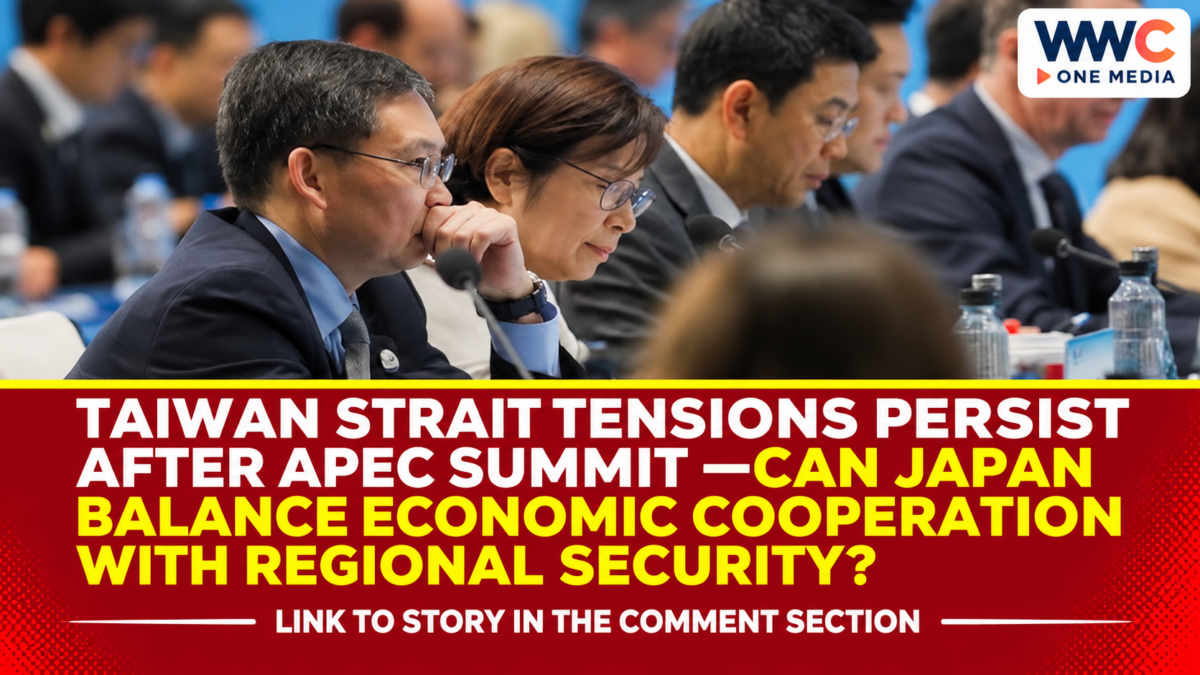
TAIWAN — Taiwan Strait tensions remain an unresolved diplomatic challenge following the Asia-Pacific Economic Cooperation (APEC) leaders’ meeting in Shenzhen, China, where Japanese Prime Minister Sanae Takaichi promoted stronger regional economic cooperation on Nov. 19, 2026.
A day later, Beijing renewed its criticism of Japan’s position on Taiwan, demanding that Tokyo address statements and actions that the Chinese government considers inconsistent with the political agreements underpinning bilateral relations.
The developments highlight a difficult balancing act for Japan: maintaining economic engagement with China while protecting its security interests and supporting regional stability.
For the Philippines, the issue extends beyond diplomatic disagreements. Economic resilience, maritime access and regional security are interconnected concerns that could shape Manila’s relationships with its major international partners.
Taiwan Strait Tensions Remain Despite Economic Cooperation
During the APEC leaders’ meeting in Shenzhen, Takaichi emphasised the importance of maintaining an international trading system based on established rules, strengthening supply chains and protecting cross-border investment.
Japan also expressed support for reforming the World Trade Organization and advancing regional economic integration.
These priorities reflected Tokyo’s continuing interest in economic cooperation with Asia-Pacific economies, including China.
Chinese President Xi Jinping, meanwhile, announced that China would provide US$20 million to support APEC cooperation. Beijing also outlined plans for new institutions focusing on digital technology, cross-border data flows, clean energy and small and medium-sized enterprises.
The summit produced the 2026 APEC Leaders’ Shenzhen Outlook, establishing a collective agenda for regional economic development.
However, cooperation on trade and investment does not necessarily resolve disagreements over national security.
On Nov. 20, Chinese Foreign Ministry spokesperson Guo Jiakun reiterated Beijing’s position that Japan must comply with the four political documents governing China-Japan relations and address its disputed statements concerning Taiwan.
The exchange illustrates how economic diplomacy and political disagreements can continue simultaneously.
WWC previously examined Japan’s economic priorities ahead of the Shenzhen summit, including Tokyo’s efforts to strengthen energy security and regional economic resilience.
Why a Diplomatic Agreement From 1972 Still Matters
At the centre of the disagreement is the joint communiqué signed by Japan and the People’s Republic of China on Sept. 29, 1972.
The document established formal diplomatic relations between Tokyo and Beijing.
Under its provisions, Japan recognised the government of the People’s Republic of China as China’s sole legal government. Beijing asserted its sovereignty claim over Taiwan, while Japan stated that it understood and respected Beijing’s position and maintained its position under the Potsdam Proclamation.
The distinction between these provisions remains important when examining Japan’s current diplomatic policy.
Japan’s 2026 Diplomatic Bluebook identifies Taiwan as an important partner with substantial economic and people-to-people connections. Tokyo maintains these relationships through unofficial, working-level arrangements.
At the East Asia Summit in Manila on Nov. 17, Takaichi reaffirmed that Japan’s basic position on Taiwan remained unchanged while emphasising the international importance of stability across the Taiwan Strait.
Japan therefore continues to pursue economic and practical engagement with Taiwan without establishing formal diplomatic relations.
Beijing, however, maintains that Taiwan is part of China and considers foreign involvement in the issue a matter affecting Chinese sovereignty.
These differing policy considerations remain a significant obstacle to resolving diplomatic tensions.
Major-Power Diplomacy Does Not Guarantee Regional Stability
The Shenzhen meetings also included a separate summit involving Xi, US President Donald Trump and Russian President Vladimir Putin on Nov. 19.
Their published declaration addressed international security, energy supply, United Nations reform and efforts to reduce nuclear risks.
The three governments expressed support for further dialogue concerning nuclear non-proliferation.
Although these commitments could contribute to international stability, they should not be interpreted as a comprehensive settlement of regional security disputes.
The published agreements do not, by themselves, establish new security guarantees for Taiwan or resolve Japan’s diplomatic disagreements with Beijing.
For regional governments, the practical question is whether major-power engagement will produce mechanisms that reduce the likelihood of confrontation.
Diplomatic declarations may provide a foundation for cooperation, but their effectiveness ultimately depends on subsequent negotiations and implementation.
Why the Philippines Has an Interest in Taiwan Strait Stability
For Manila, developments involving Taiwan and Japan have implications for maritime security, investment decisions and economic continuity.
A serious regional disruption could affect shipping schedules, transportation costs, business confidence and access to essential imports.
These are potential consequences rather than confirmed outcomes of the Shenzhen meetings.
The Philippines also has an interest in ensuring that economic cooperation with international partners can continue without creating unnecessary regional confrontation.
Japan’s expanding regional security relationships provide additional context. WWC’s coverage of Japan’s growing defence cooperation across the Indo-Pacific examines how maritime security and practical defence partnerships are becoming increasingly important to Manila.
The Quad leaders’ summit in Manila also provides a separate example of regional cooperation involving economic resilience, technology and maritime security.
The Philippines would benefit from evaluating each diplomatic arrangement according to its own national interests, legal obligations and economic priorities.
Taiwan’s Participation Raises Questions About Regional Inclusion
Before the Shenzhen summit, Taiwan’s Ministry of Foreign Affairs issued a statement on Nov. 4 calling on China to uphold equal participation among APEC member economies.
Taiwan’s foreign ministry noted that it became a full APEC member in 1991 and maintained that its accession arrangements established equal participation in the organisation’s activities.
This introduces a wider institutional question for the Asia-Pacific: how can regional economic cooperation remain inclusive when members have unresolved political disagreements?
Maintaining functional economic institutions could provide opportunities for continued dialogue even when broader diplomatic negotiations encounter difficulties.
However, economic participation alone cannot settle competing political claims.
What Happens Next?
The immediate developments to watch include further diplomatic exchanges between Japan and China, implementation of the Shenzhen economic commitments and any new official statements concerning Taiwan Strait security.
Businesses should distinguish between diplomatic disagreements and confirmed changes to trade regulations, investment restrictions or transportation arrangements.
For the Philippines, the priority is to maintain constructive international relationships while strengthening preparedness for possible economic disruptions.
Japan’s participation in APEC demonstrates that economic cooperation remains possible despite significant political differences.
Whether Tokyo and Beijing can turn that engagement into a more stable relationship will depend on their willingness to manage disagreements through sustained diplomatic communication.
The wider Asia-Pacific has a substantial interest in ensuring that political disputes do not undermine the economic cooperation on which regional prosperity depends.
Frequently Asked Questions
Why are Japan and China experiencing tensions over Taiwan?
Beijing objects to Japanese statements and actions concerning Taiwan, while Tokyo maintains that stability across the Taiwan Strait is important to international security.
Does Japan officially recognise Taiwan as an independent country?
Japan maintains unofficial working-level relations with Taiwan under its diplomatic framework established with China in 1972.
Did the Shenzhen APEC summit resolve Taiwan Strait tensions?
The summit produced regional economic agreements, but the official records reviewed do not establish a settlement of the Taiwan dispute.
Why does Taiwan Strait stability matter to the Philippines?
Regional instability could affect maritime transportation, international trade, investment confidence and Philippine security planning.
Can Japan continue economic cooperation with China despite political disagreements?
Yes. Japan’s participation in the Shenzhen APEC summit demonstrates continuing economic engagement, although future cooperation depends on diplomatic relations and policy implementation.