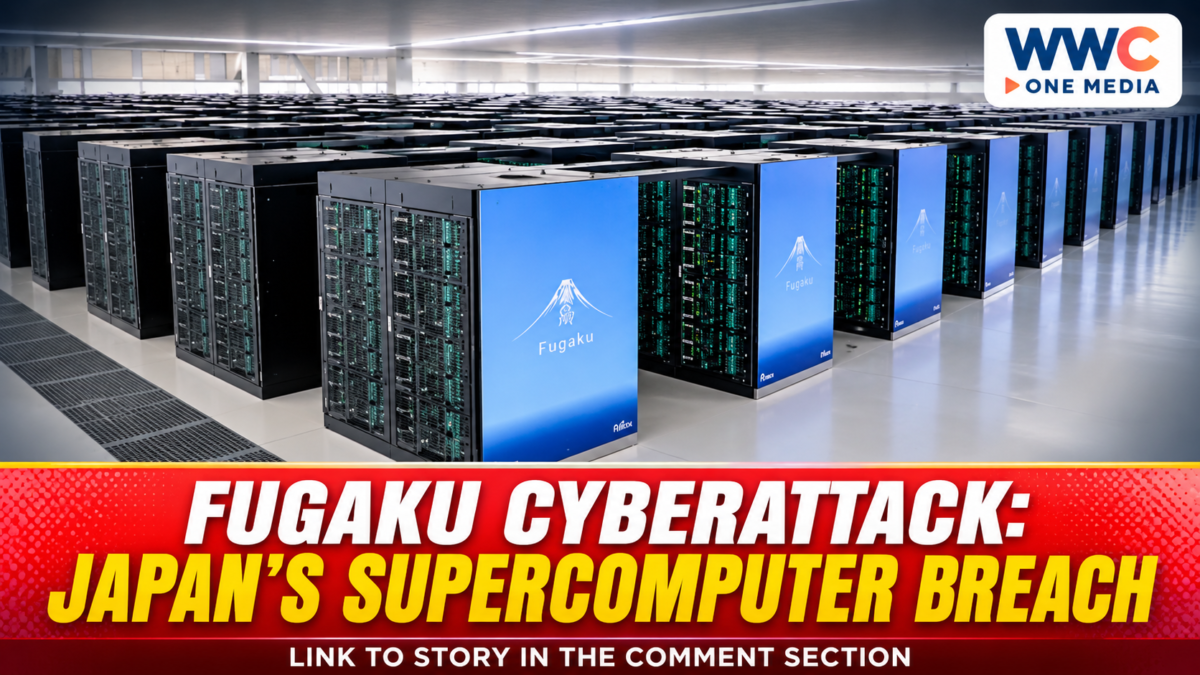
Japan’s supercomputer Fugaku was taken offline after an external party gained unauthorised access to its internal operational network, prompting concerns about the possible exposure of information belonging to thousands of researchers and system users.
The incident, confirmed by the RIKEN research institute on Nov. 13 and detailed in a public notice on Nov. 17, involved more than a compromised computer system. Information that may have been accessed included user names, email addresses, account IDs, research files and authentication credentials used to connect to other services.
The most concerning development is that the intruder attempted to use some of the obtained credentials to connect to other systems. Investigators are still determining whether those attempts caused further damage. RIKEN+1
How the Fugaku Cyberattack Reached an Internal Network
Fugaku is operated by the RIKEN Center for Computational Science and serves as a major part of Japan’s high-performance computing infrastructure. It supports scientific work that requires computing capacity far beyond what ordinary computers can provide.
The security incident began with unauthorised access between Nov. 10 and 13, 2026. RIKEN said the external party used a publicly accessible webpage displaying Fugaku’s operational status, known as its dashboard, as a way into the internal operational network.
The maintenance and management of the affected system had been outsourced to an external service provider. After suspicious network traffic was detected on Nov. 12, RIKEN and the provider began investigating.
The institute confirmed the unauthorised access at 4:33 p.m. on Nov. 13. It has not yet disclosed the precise technical method used to enter the network, saying that part of the investigation remains ongoing. RIKEN
This distinction matters. The public record identifies the dashboard as the route used to gain access, but it does not establish exactly which software weakness or configuration failure enabled the intrusion.
Thousands of User Records May Have Been Affected
RIKEN’s notice identifies several categories of information that were either taken or may have been taken.
These include names, email addresses and user IDs registered in the authentication system. The detailed breakdown lists up to 4,224 Fugaku users and up to 375 users of RIKYU, RIKEN’s AI-for-Science supercomputer.
The notice’s overview gives a slightly different maximum figure for Fugaku users: 4,222. Its detailed breakdown lists 4,224. The discrepancy should be clarified in any subsequent update rather than treated as a settled count.
Files stored in users’ home directories were also potentially exposed. These included research data and credentials used to access external systems, such as SSH private keys and access keys. RIKEN+1
The distinction between information that may have been accessed and information confirmed to have been stolen is important. RIKEN has not established that every listed file or account record was taken.
The institute also said there was no evidence at the time of its notice that research data or files had been exfiltrated. However, it is still examining whether files containing personal information belonging to third parties were involved.
The Bigger Concern: Credentials Used to Reach Other Systems
The incident has a potentially wider impact because some of the credentials obtained during the intrusion were used in attempted connections to other systems.
RIKEN confirmed that the unauthorised party tried to connect elsewhere using some of the credentials. The institute is working with relevant organisations to determine whether those attempts resulted in damage or further unauthorised access. RIKEN
This is a serious concern for research institutions because users may rely on the same computing environment to access multiple services, research platforms and external systems.
A compromised credential can create risks beyond the original network if it remains valid elsewhere. That does not mean every connected institution was breached, but it does explain why the investigation cannot end with securing Fugaku itself.
The issue also reflects a broader cybersecurity challenge involving external service providers. WWC previously examined the risks created when Japanese companies depend on outside contractors and technology suppliers in its report on cyberattacks affecting Japanese businesses and their suppliers.
Similar concerns have appeared in other sectors. A separate report on cybersecurity incidents affecting Singapore healthcare organisations highlighted how digital systems and third-party service arrangements can create additional points of exposure.
Why Fugaku Was Shut Down
RIKEN suspended Fugaku’s operations at 4:30 a.m. on Nov. 14 and blocked external access. It also stopped all running and queued computing jobs, while notifying users on Nov. 15.
The response included isolating the system used in the intrusion and replacing administrative keys. RIKEN also invalidated the public keys used by all users to log in and asked users to revoke credentials stored on Fugaku through the external services where those credentials were authorised. RIKEN
These steps are intended to limit the possibility that information obtained during the intrusion can be reused.
For affected users, the instructions are particularly important for SSH credentials. RIKEN advised users to remove or revoke the corresponding public keys from external services, generate new key pairs and replace other authentication credentials that may have been stored on the system.
The institute also warned users to be cautious of suspicious emails pretending to come from Fugaku or RIKEN. It stated that it would never request passwords or other personal information through email. RIKEN
The response resembles a wider principle in data protection: stopping the original intrusion is only one part of recovery. Organisations must also determine whether exposed credentials can be used elsewhere and whether affected users need to take additional protective steps.
That issue is relevant beyond Japan. In the Philippines, investigations into alleged government system intrusions have also highlighted the need to distinguish confirmed breaches from unverified claims. WWC examined that distinction in its report on the CICC investigation into alleged cyberattacks targeting government agencies.
What the Incident Means for Scientific Research
Fugaku’s importance goes beyond its computing power. RIKEN describes it as a key part of Japan’s high-performance computing infrastructure, supporting scientific and technological research.
The system began shared operations in March 2021 after being developed by RIKEN and Fujitsu. Its role is to provide computing resources for research projects and work addressing scientific and social challenges. RIKEN
The shutdown therefore affects an important research resource, although the public notice does not quantify the number of projects delayed or the economic value of interrupted computing work.
The incident also comes as RIKEN expands its AI research infrastructure. Its RIKYU supercomputer entered production operation on Oct. 14, 2026, supporting selected AI-for-Science research programmes and RIKEN projects. 理化学研究所 計算科学研究センター(R-CCS)
RIKEN’s notice includes RIKYU users in the possible exposure of authentication-system information. However, it does not say that RIKYU itself was shut down, so the status of that separate system should not be confused with Fugaku’s suspension.
The broader lesson is that advanced research infrastructure needs protection not only for the data it stores but also for the accounts and connections that allow researchers to work across multiple systems.
What Happens Next?
RIKEN said Fugaku will resume operations only after it implements measures intended to prevent another intrusion.
These include addressing vulnerabilities in the exploited software, rebuilding compromised servers, reviewing network configurations and introducing additional security measures that use artificial intelligence.
The institute also plans to review how operational and maintenance responsibilities are divided so that emergencies can be handled more quickly. It has committed to disclosing further findings as the investigation progresses. RIKEN
The most important unanswered questions concern the full extent of the information taken, whether third-party personal information was included, and whether the attempted use of credentials resulted in access to other systems.
Until those findings are published, it would be premature to describe the incident as a confirmed theft of research results or a breach of every connected institution.
For now, the Fugaku case demonstrates how a weakness in an operational system can create risks that extend beyond one supercomputer. The next phase of the investigation will determine how far those risks reached.
Frequently Asked Questions
1. What happened to Japan’s Fugaku supercomputer?
An external party gained unauthorised access to Fugaku’s internal operational network between Nov. 10 and 13, 2026. RIKEN confirmed the incident on Nov. 13 and suspended Fugaku’s operations the following morning.
2. How many people may have been affected?
RIKEN’s detailed breakdown lists up to 4,224 Fugaku users and up to 375 RIKYU users whose authentication information may have been affected. The notice’s overview gives a slightly different Fugaku figure of 4,222, which requires clarification.
3. Was research data stolen?
RIKEN said it had no evidence at the time of its notice that research data or files had been exfiltrated. However, it confirmed that files in user home directories may have been taken and that the investigation was continuing.
4. Were other systems targeted using the exposed credentials?
Yes. RIKEN confirmed that the unauthorised party attempted to connect to other systems using some of the obtained credentials. Whether those attempts caused further damage remains under investigation.
5. When will Fugaku resume operations?
RIKEN has not announced a specific reopening date. It said operations would resume after security measures are implemented, compromised servers are rebuilt and network configurations are reviewed.