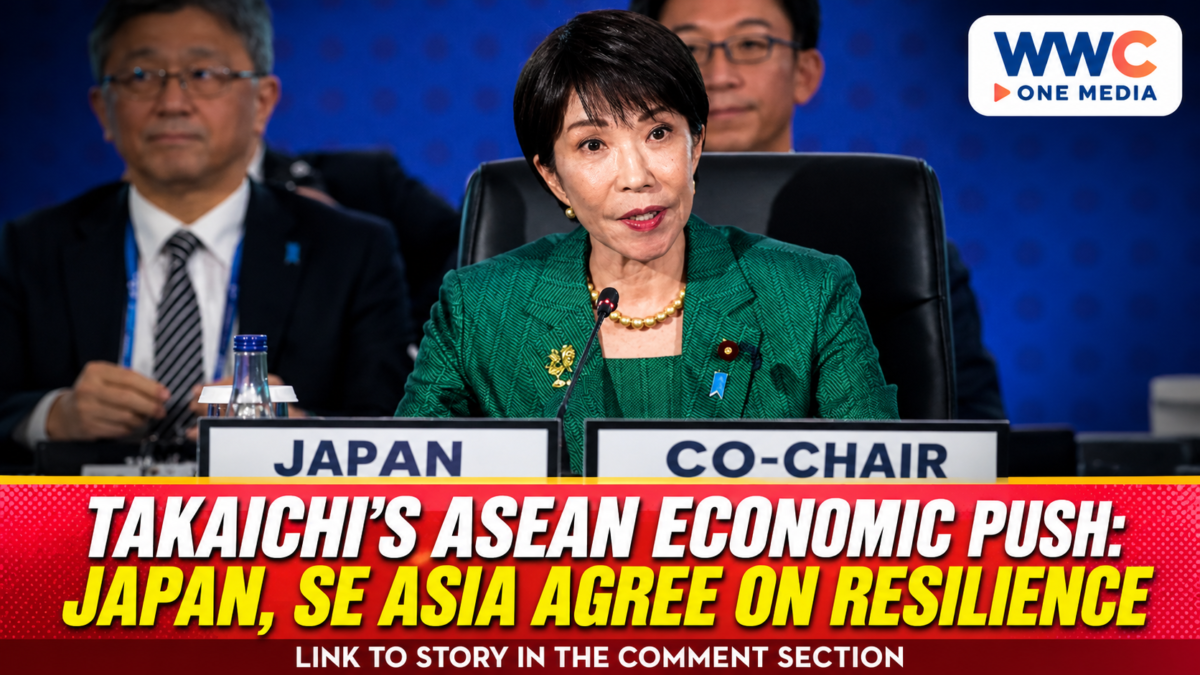
Japanese Prime Minister Sanae Takaichi used the ASEAN-related summit meetings in Manila on Nov. 17, 2026, to advance a broader economic agenda focused on energy security, critical minerals, supply chains and artificial intelligence. The meetings produced a new ASEAN-Japan joint statement on economic resilience, giving the partnership a more concrete policy direction.
The agreement matters because Japan and Southeast Asian economies depend on regional trade, energy supplies and interconnected manufacturing networks. However, the challenge now is turning shared commitments into projects, investment and arrangements that businesses can actually use.
ASEAN-Japan agreement puts economic resilience at the centre
The 29th ASEAN-Japan Summit, chaired by Philippine President Ferdinand Marcos Jr., adopted the Joint Statement on Realising Economic Resilience on Nov. 17.
The document reaffirmed the commitment of ASEAN member states and Japan to strengthen regional economic resilience and cooperation. Takaichi identified the Partnership on Wide Energy and Resources Resilience Asia, or POWERR Asia, as one of the frameworks through which Japan intends to support this objective.
She also highlighted the importance of stronger regional supply chains, particularly for critical minerals, amid concerns about export restrictions and vulnerabilities in international trade.
For Southeast Asian economies, the issue extends beyond access to raw materials. Critical minerals are important inputs for advanced manufacturing, electronics, batteries and other industries that depend on reliable supplies.
The agreement establishes a shared direction, but it does not automatically guarantee new mineral supplies or investment. Those outcomes will depend on future agreements, commercial participation and implementation. Ministry of Foreign Affairs of Japan+1
Japan adds AI safety to its regional economic agenda
Another development was the launch of the Japan-ASEAN AI Safety and Security Partnership.
The initiative addresses risks associated with the rapid development and use of artificial intelligence. Japan said it would work with ASEAN countries to explore solutions to emerging challenges linked to AI.
The partnership is significant because AI is increasingly connected to economic competitiveness, digital services and industrial productivity. Governments must consider not only how to encourage adoption but also how to manage security risks and protect the reliability of digital systems.
The summit also recognised wider cooperation in science and technology, education and youth exchanges. These programmes could help strengthen the region’s ability to develop skills and participate in emerging technology industries.
However, the practical value of the AI partnership will depend on how governments translate its objectives into technical cooperation, standards and programmes that can be implemented across different national systems. Ministry of Foreign Affairs of Japan+1
Energy security remains a major concern for Japan and ASEAN
Energy cooperation was another central part of Takaichi’s Manila agenda.
Japan intends to use POWERR Asia and the Asia Zero Emission Community, or AZEC, to strengthen energy resilience and support more stable regional supplies. Takaichi also discussed developing AZEC into AZEC 2.0, with greater emphasis on economic and energy resilience.
The Philippines has a direct interest in this cooperation because it remains exposed to changes in international petroleum markets and disruptions to imported fuel supplies.
The two countries already have a framework for petroleum stockpiling cooperation, covering the Philippines’ strategic national petroleum reserve programme and possible wider cooperation across ASEAN.
Their Nov. 16 summit meeting reinforced the political commitment to economic and energy resilience. Marcos expressed support for Japan’s initiatives.
As previously discussed in WWC’s report on Japan-Philippines petroleum stockpiling cooperation, regional reserves and access arrangements could help countries prepare for supply disruptions. They should not, however, be confused with guaranteed reductions in fuel prices or an immediately available shared oil reserve. Ministry of Foreign Affairs of Japan+1
The Mekong region gets a separate cooperation framework
Takaichi also co-chaired the 13th Mekong-Japan Summit with Vietnamese Prime Minister Le Minh Hung on Nov. 17.
The meeting was held in Manila under the theme “Innovating Together and Building Resilience.” It was the first Mekong-Japan summit in six years.
The resulting cooperation agenda included connectivity, digitalisation, water resource management, energy supply and efforts to strengthen regional responses to organised fraud, natural disasters and cybersecurity threats.
Japan also committed to promoting safe, secure and trustworthy AI and using digital technologies to support sustainable growth in the Mekong region.
The meeting’s co-chair role passed from Vietnam to Cambodia, marking a change in the leadership arrangement for the next phase of Mekong-Japan cooperation. Ministry of Foreign Affairs of Japan+1
Why the Manila agreements matter to the Philippines
The Philippines occupies an important position in these developments because it hosted the summit and is already working with Japan on energy, infrastructure and economic cooperation.
The broader partnership also includes discussions on the Luzon Economic Corridor and the Japan-Philippines Economic Partnership Agreement. These areas connect regional diplomacy with investment, transport infrastructure and the movement of goods.
Japan’s updated regional approach could create opportunities for Philippine industries if commitments lead to practical cooperation in energy infrastructure, critical-mineral supply chains, digital technology and workforce development.
But announcements should not be mistaken for completed projects. The joint statement provides political direction; the next stage requires financing, government coordination, private-sector participation and measurable progress.
The same distinction applies to energy security. A policy framework can encourage cooperation, but it cannot by itself guarantee fuel availability during a crisis.
What happens next?
Japan’s diplomatic agenda continues in Shenzhen, China, where Takaichi is scheduled to attend the APEC Economic Leaders’ Meeting on Nov. 18–19.
Her stated priorities include trade and investment, regional economic integration, energy resilience, the digital economy and artificial intelligence.
The Manila agreements give Japan and ASEAN a clearer framework for cooperation. Their real test, however, will come after the summit: whether governments can turn commitments on energy, critical minerals and AI into functioning programmes that strengthen the region’s economy.
For the Philippines, the opportunity is substantial. The challenge is ensuring that regional cooperation produces practical benefits for local businesses, industries and households rather than remaining a series of diplomatic declarations.