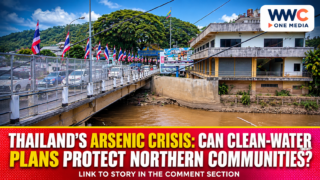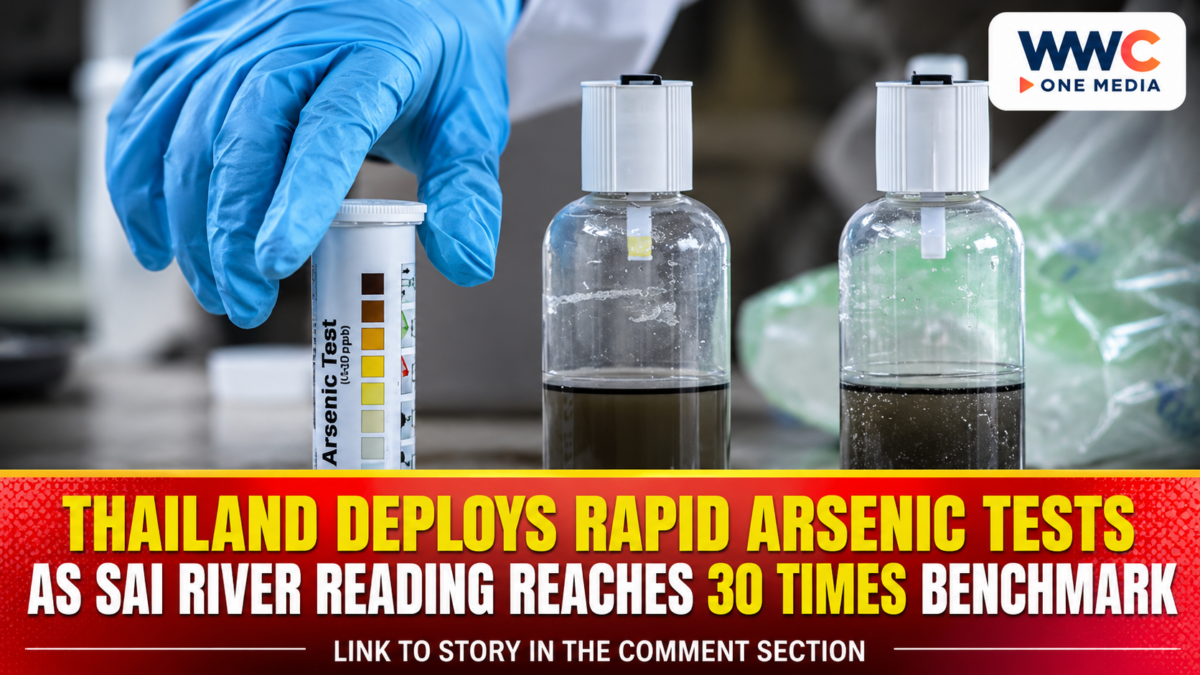
Thailand has expanded its response to arsenic contamination in the Sai River, deploying portable water-testing technology in Chiang Rai after an official update reported arsenic levels reaching 0.30 milligrams per litre during November 5–6 monitoring.
The new equipment is intended to help local authorities screen water more quickly, while government agencies continue investigating contamination sources and strengthening safeguards for communities dependent on the affected waterways. National Nanotechnology Center+1
The development adds a new operational dimension to the continuing environmental problem along Thailand’s northern border. The immediate challenge is not only detecting contamination, but also ensuring that raw water is properly assessed before it enters public supply systems.
Sai River arsenic reading puts monitoring under pressure
The National Nanotechnology Center’s November 16 update reported that water turbidity in the Sai River exceeded 10,000 nephelometric turbidity units on November 5–6. It also reported an arsenic concentration of 0.30 mg/L.
The Mekong River Commission’s April 2026 assessment identifies 0.01 mg/L as the relevant water-quality threshold. Compared with that benchmark, the reported Sai River reading was 30 times higher. National Nanotechnology Center+1
That comparison needs careful interpretation. The 0.30 mg/L figure refers to a reported river-water measurement at a particular time; it is not a measurement of every stretch of the river, every household’s tap water or all drinking water distributed in Chiang Rai.
The distinction between raw river water and treated water is essential. A contaminated source can create serious treatment challenges, but a river reading alone does not establish that treated household water contains the same concentration.
Portable M-Sense kit brings faster screening to Mae Sai
During a November 15 visit to Mae Sai, Deputy Prime Minister and Minister of Higher Education, Science, Research and Innovation Yodchanan Wongsawat reviewed local water-quality measures and the use of the M-Sense portable heavy-metal detection kit.
The National Nanotechnology Center, which operates under Thailand’s National Science and Technology Development Agency, developed the device. It can screen for arsenic, lead, cadmium and mercury, providing readings in approximately three to five minutes.
The equipment was handed over to the Chiang Rai Provincial Public Health Office to support field monitoring. National Nanotechnology Center+1
The technology could help local officers identify locations that require closer examination without waiting for every initial sample to be processed at a central laboratory.
However, the research agency describes M-Sense as a preliminary screening tool. Results that require confirmation should still be checked through standard laboratory methods. That distinction matters: faster field screening can improve the speed of response, but it should not be confused with a complete laboratory assessment.
The initiative forms part of a wider effort to connect monitoring, water treatment and local technical capacity. A community water-supply prototype developed through the A-QUALITY programme is designed to reduce arsenic in the Kok River Basin and serve more than 1,180 households. National Nanotechnology Center
Waterworks authority says production safeguards remain in place
Thailand’s Provincial Waterworks Authority has separately described how its Mae Sai branch is managing changes in raw-water quality.
In a November 11 update, the authority said it would temporarily stop water production if turbidity or arsenic contamination exceeded the treatment system’s capacity. During a production suspension, it increased monitoring frequency to every 30 minutes and arranged water deliveries, including supplies for Mae Sai Hospital and residents in higher-altitude areas.
The authority reported that, as of November 10, raw-water quality had returned to a condition suitable for normal production and that water in the production system met its standards. pwa.co.th
The date matters. That statement describes the authority’s assessment as of November 10; it should not be presented as confirmation of conditions on November 18.
For residents, the key issue is whether the water reaching households meets the applicable drinking-water requirements. The authority’s published procedures show that it may suspend production when raw-water conditions exceed treatment capacity rather than allow unsuitable water to proceed through the system.
The agency is also pursuing a longer-term infrastructure response. Its November 11 statement said a project to expand water services across Mae Sai, Huai Khrai, Mae Chan and Chiang Saen was 50% complete. The planned system is intended to use raw water from the Mekong River. pwa.co.th
Thailand is still investigating where the contamination began
The Thai government’s November 16 statement also outlined efforts to establish the source of the arsenic.
The Ministry of Higher Education, Science, Research and Innovation is working with Naresuan University on isotope analysis to examine whether the arsenic found in the river is consistent with particular sources. The government also said it was promoting comparison and rechecking of results with laboratories on the Chinese side.
The same statement described plans to assess water-management measures, including studying the possible construction of small weirs to slow water and capture sediment. The rationale is that arsenic can accumulate in sediment, making the movement and disturbance of riverbed material an important part of the investigation. thaigov.go.th
These are investigative and planning measures, not proof that a specific mine, company or operator caused the contamination. Establishing responsibility requires reliable sampling, source tracing and evidence linking a particular activity to the pollution.
The wider river system also requires regional coordination. The Mekong River Commission has reported arsenic concerns in parts of the Kok, Sai, Ruak and Mekong rivers, while noting that contamination is localised and that results vary between water and sediment samples. It has also described cooperation with Myanmar on joint monitoring and assessment. Mekong River Commission
Why the latest response matters beyond Chiang Rai
The crisis illustrates why water security depends on more than the availability of rivers and reservoirs. A source may be physically accessible but still require intensive testing and treatment before it can be used safely.
The issue also has a regional dimension. The Mekong basin supports communities and economic activity across several countries, making reliable monitoring and cross-border information-sharing important. WWC’s coverage of Mekong-region cooperation and water-resource management provides wider context for the region’s shared environmental and development concerns.
For Philippine readers, the distinction between pollution types is also relevant. WWC has previously examined efforts to prevent waste from entering rivers and waterways and the scale of nationwide coastal and waterway cleanup operations. Removing solid waste, however, is not the same as removing dissolved heavy metals or contaminated sediment. Each problem requires its own testing and treatment approach.
What happens next?
Thailand’s immediate priorities are to keep monitoring the Sai River, protect public water supplies and determine whether the new field-screening equipment can strengthen local surveillance.
The next important evidence will include confirmed laboratory results, updated raw-water and treated-water measurements, and findings from the government’s source-tracing work.
The longer-term test will be whether the infrastructure and regional cooperation plans lead to sustained improvements rather than temporary responses to individual contamination episodes.
For now, the official records establish that the Sai River has experienced a serious arsenic reading, that Mae Sai’s waterworks authority has procedures for suspending production when raw-water conditions exceed treatment capacity, and that Thailand is adding faster screening tools while investigating the source.
They do not yet establish the precise origin of the contamination or prove that every household water supply is affected.