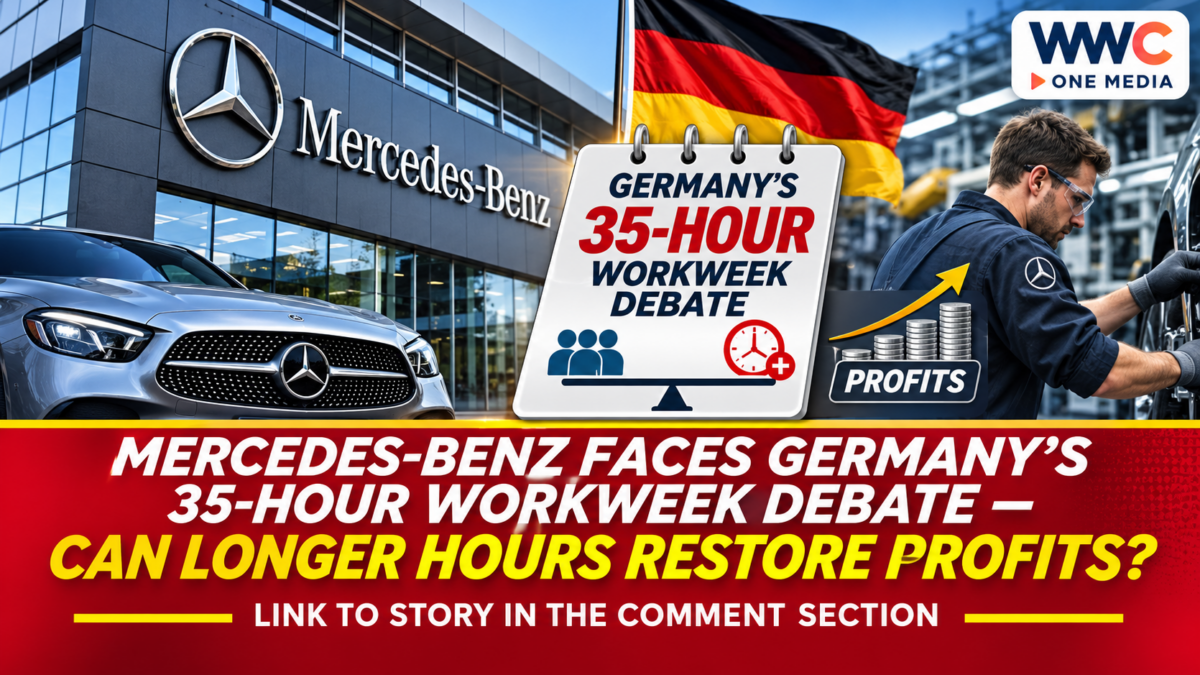
STUTTGART, Germany — Nov. 18, 2026. Mercedes-Benz is tightening costs and warning of weaker passenger-car profitability as German employers and metalworkers debate whether established working-time arrangements need more flexibility. The company’s latest financial statement confirms deteriorating adjusted car margins, but it does not show that a 35-hour workweek caused the problem or that Mercedes-Benz has adopted a universal 40-hour schedule.
The debate matters because working time affects labour costs and factory capacity, while automotive earnings also depend on prices, demand, technology spending and global competition. Treating hours as the sole answer would ignore much of what the company’s published accounts actually reveal.
Germany’s 35-Hour Workweek Is a Bargained Standard
The 35-hour week is an important collective-agreement standard in Germany’s metal and electrical industries. It is not a legal ceiling applied to everyone working in the country. IG Metall’s explanation of working-time rules distinguishes the standard negotiated week from the separate statutory framework, and notes that collective agreements already allow flexibility in how hours are distributed.
Regional terms can differ. The union’s published materials describe a 35-hour standard in western bargaining regions and a 38-hour standard in eastern ones. That distinction matters when discussing multinational companies with employees in different locations and roles.
In the 2026 metal and electrical industry bargaining round, IG Metall says employers want greater scope for extending working time from 35 to 40 hours through company-level arrangements. It opposes moving such decisions outside the collective-bargaining process. This is the union’s account of the employers’ position, not proof that every employer has implemented such an extension.
Mercedes-Benz Results Show a More Complicated Problem
On Oct. 28, Mercedes-Benz reported third-quarter group revenue of €30.7 billion, compared with €32.1 billion a year earlier. Reported group earnings before interest and taxes rose to €1.77 billion from €0.75 billion, but adjusted group EBIT declined 15% to €1.78 billion.
The adjusted figures are particularly relevant because the company says the increase in reported EBIT principally reflected smaller adjustments than in the previous-year quarter. It would be misleading to present the headline earnings increase as evidence that all operating pressures had disappeared.
Within Mercedes-Benz Cars, adjusted return on sales fell to 2.5% from 4.8% in the corresponding quarter of 2025. The passenger-car business sold 407,232 vehicles in the quarter, down 8% year on year, with management identifying intense competition and difficult conditions in China.
The wider squeeze resembles the challenges described in WWC’s analysis of pressures across global car manufacturing. For Mercedes, however, its own filings provide the proper basis for evaluating its results.
Why Longer Hours Would Not Automatically Fix Margins
Additional scheduled hours might raise available production time where there is sufficient demand, equipment capacity and an agreement with workers. But longer schedules do not guarantee that a factory can sell more vehicles profitably.
The company’s reporting identifies currency headwinds, reduced earnings contributions from China and costs associated with introducing new models. None of these automatically vanishes when employees work extra hours. More output without sufficient orders could instead add inventory and working-capital costs.
Mercedes-Benz disclosed industrial free cash flow of €172 million in the third quarter, compared with €1.37 billion in the prior-year period, partly reflecting higher inventories of new vehicles awaiting delivery. For the first nine months, industrial free cash flow was €3.1 billion, including about €1.1 billion of restructuring-related cash outflows, mainly tied to a voluntary severance programme in Germany.
What this could mean: Working-time flexibility could be one possible productivity tool, but the business case depends on demand, staffing, shift design and the actual terms agreed. Published results do not support a claim that changing the standard week alone will restore earnings.
The Company Is Already Pursuing Other Changes
Mercedes-Benz says it has intensified global productivity measures since June 2026, particularly at German sites, building on a roughly 25% reduction in fixed costs since 2019. Its Oct. 28 update also said the company would again offer a voluntary severance programme for indirect functions in Germany from December 2026.
At the same time, the group continues to invest in vehicle technology. Its report described strong electric-vehicle momentum, with quarterly battery-electric passenger-car sales up 61% year on year, even as the overall passenger-car unit total declined. That contrast shows why changing demand across products matters alongside factory efficiency.
The competitive context is explored further in WWC’s coverage of global electric-vehicle sales and shifting markets. A manufacturer can face simultaneous growth in one category and weakness in another.
Why Labour and Competitiveness Are Different Questions
Employers can reasonably seek flexible scheduling to match production with orders. Workers can reasonably seek predictable hours, adequate pay and protection against uncompensated changes. Both positions are relevant to the economics of an industrial agreement.
Neither side’s negotiating position, by itself, demonstrates the optimal schedule for every factory. The question is whether any proposed arrangement improves productivity after accounting for wages, overtime, equipment utilisation, worker retention and product demand.
Mercedes-Benz also faces a changing international market. WWC has examined China’s automotive export expansion and the pressure it places on established manufacturers. Competitive pricing abroad cannot be reduced to the length of a German working week.
What Happens Next
The 2026 bargaining process will determine whether unions and employers agree on any revised working-time provisions. A proposal, a negotiation and an implemented company-specific arrangement are different events; none should be treated as interchangeable.
Mercedes-Benz’s next disclosures will provide a better test of its efficiency programme: adjusted passenger-car margins, unit sales by market, inventory movement and cash generation. Its Oct. 28 outlook reduced the expected full-year adjusted return on sales at Mercedes-Benz Cars to 2%–3%, from an earlier 3%–5% range.
The economic question is not whether 35 hours is inherently affordable or unaffordable. It is whether Mercedes-Benz can deliver cars customers want, at prices and costs that support sustainable profitability, while negotiating workable terms with its employees.
Frequently Asked Questions
Does everyone in Germany work a 35-hour week?
No. Thirty-five hours is a common collective-agreement standard in parts of the metal and electrical industries, not a nationwide maximum for all employees. Different bargaining regions and sectors have different arrangements.
Has Mercedes-Benz increased its workweek to 40 hours?
The company records reviewed do not establish a company-wide change to 40 hours. The broader 2026 industry negotiations include a dispute about making longer schedules more flexible.
Did Mercedes-Benz lose money in the third quarter of 2026?
No. It reported positive group EBIT and net profit. However, adjusted passenger-car profitability weakened compared with the year-earlier quarter.
Could longer working hours improve Mercedes-Benz’s profits?
Possibly in particular production settings, but it is not guaranteed. Vehicle demand, selling prices, factory utilisation, staffing costs and competition also determine profitability.