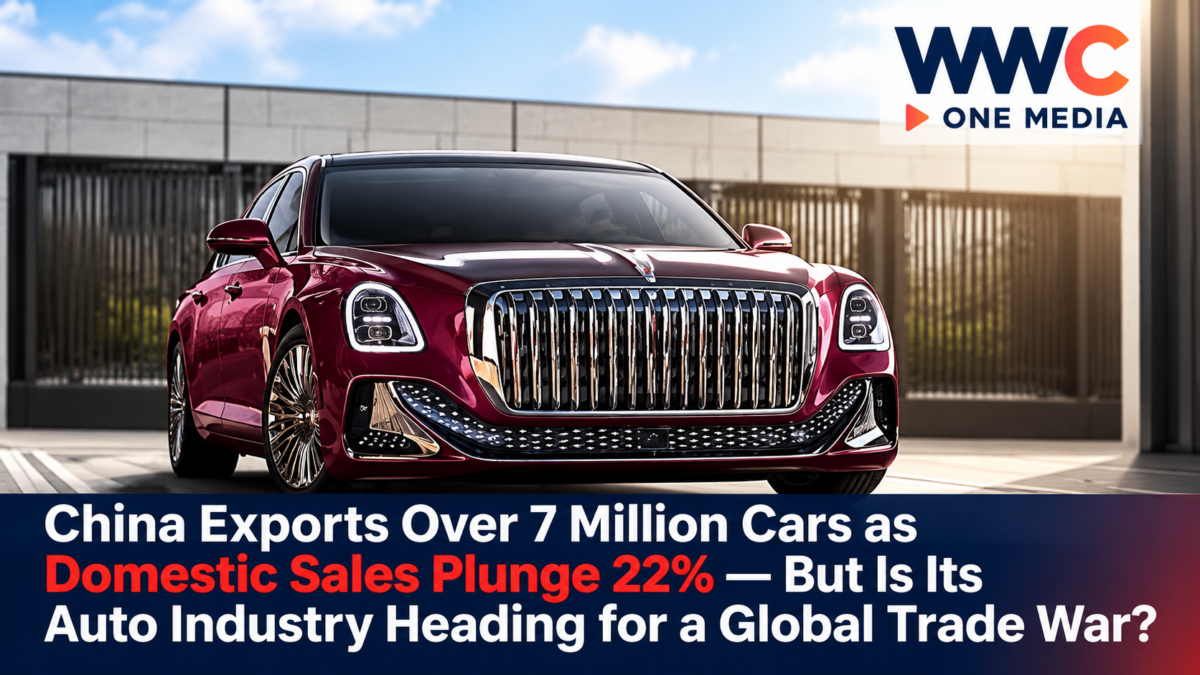
BEIJING, China — October 30, 2026. China’s automotive industry is racing toward another historic export milestone, but its global expansion is being driven by an increasingly troubling reality: Chinese consumers are buying substantially fewer cars while domestic manufacturers face fierce price competition, shrinking profits and mounting pressure to find customers overseas.
More than 7.1 million Chinese-made passenger vehicles were exported between January and September 2026, an increase of over 70% from the comparable period last year, according to industry data reported by the Associated Press.
The surge comes as passenger-car retail sales within China fell 21.7% to approximately 13.33 million units during the same period, based on figures cited by CNBC.
The contrast reveals one of the biggest challenges facing the world’s largest automotive market.
China has developed enormous production capabilities, particularly in electric vehicles, batteries and automotive technology. But domestic demand is no longer absorbing that capacity at the pace manufacturers need.
As a result, companies are increasingly targeting Europe, Southeast Asia, Latin America, Australia and other international markets.
The bigger question: Can Chinese carmakers turn their export boom into sustainable global success—or will aggressive overseas expansion trigger a new wave of trade barriers and threaten the profitability of the entire industry?
China’s domestic car market suffers a sharp downturn
For years, China’s automotive industry benefited from rising household incomes, strong government support and rapid growth in electric vehicle adoption.
But the situation has changed dramatically in 2026.
According to figures from the China Passenger Car Association cited in CNBC’s October 28 report, domestic passenger-car retail sales reached approximately 13.33 million units through September.
That represented a decline of 21.7% compared with the previous year.
The association projected full-year domestic retail sales of approximately 18.5 million passenger vehicles, a decrease of around 22%.
The downturn is particularly striking because China remains one of the world’s most important automobile production and consumption centers.
The weakness reflects several pressures occurring simultaneously.
Consumer confidence has been affected by economic uncertainty, a difficult employment environment and continued weakness in the property market.
Households have also become more cautious about major purchases.
Meanwhile, reductions in vehicle trade-in incentives and electric vehicle tax benefits have made some purchases less attractive.
In Beijing, one dealership salesman told CNBC that the traditional September–October peak buying season had become one of the weakest periods of his long career, apart from the pandemic.
The broader problem is that vehicle manufacturers have built enormous production capacity during years of rapid growth, leaving many businesses under pressure when domestic demand slows.
Car exports surge as manufacturers search for overseas buyers
While domestic sales have weakened, China’s vehicle exports have accelerated.
Industry figures show that passenger-vehicle exports surpassed 7.1 million units during the first nine months of 2026.
September alone recorded approximately 919,000 exported passenger vehicles, representing a 64% increase from the same month a year earlier.
The growth reflects expanding international demand for Chinese-built cars, including gasoline-powered vehicles, battery-electric vehicles and hybrids.
Chinese manufacturers have developed competitive advantages in manufacturing scale, battery technology, supply chains and vehicle pricing.
These strengths allow brands to enter foreign markets with products that may cost less than comparable vehicles from established competitors.
But export growth also reflects increasing pressure inside China.
When manufacturers cannot sell enough vehicles domestically, overseas markets provide another outlet for production.
The strategy can help maintain factory utilization and support revenue.
However, exporting more vehicles does not automatically produce stronger profits.
International sales involve shipping expenses, distribution networks, warranties, regulatory compliance and additional marketing costs.
If companies rely heavily on discounts to gain market share, profitability may remain under pressure even as export volumes rise.
Auto industry profits drop 22.8% despite stronger exports
One of the clearest warning signs involves the financial performance of China’s automobile manufacturers.
According to figures cited by CNBC, profits in China’s automobile manufacturing industry declined 22.8% during the first nine months of 2026.
That contrasts sharply with the growth in the country’s overseas vehicle shipments.
The development illustrates a fundamental business challenge.
A company can produce and sell more vehicles while earning less profit if competitive pressure forces selling prices down or operating costs remain elevated.
China’s automotive market has experienced intense price competition among domestic manufacturers.
Brands have introduced discounts, financing incentives, upgraded features and new models to attract buyers.
These measures may benefit customers, but they can also squeeze manufacturers’ margins.
Automakers with strong balance sheets and efficient production systems may be better positioned to withstand the competition.
Smaller manufacturers could face greater difficulty maintaining operations.
This raises the possibility of industry consolidation as financially weaker businesses struggle to compete.
Is China’s automobile industry suffering from overcapacity?
The controversy surrounding China’s export boom centers on industrial overcapacity.
Overcapacity occurs when an industry’s production capabilities exceed the level of demand needed to sustain commercially viable operations at prevailing prices.
China has invested heavily in vehicle factories, battery production and automotive supply chains.
The country’s enormous manufacturing system has allowed businesses to achieve economies of scale and produce competitively priced vehicles.
But critics argue that years of rapid investment, government support and local industrial incentives have encouraged more production capacity than the domestic market can comfortably absorb.
The Wall Street Journal reported that China’s factories have the capacity to manufacture approximately 63 million light vehicles annually, far above its projected domestic sales.
That figure represents estimated production capacity, not actual annual output.
WWC ONE MEDIA previously examined the issue in China Is Producing More Cars, Batteries and Goods Than Ever — But the Numbers Reveal Why the West’s ‘Overcapacity’ Case Isn’t So Simple.
The report explored competing arguments about China’s industrial policies.
Western governments contend that excess capacity and state support can distort competition and threaten domestic manufacturers.
Beijing rejects the idea that high production volumes automatically prove unfair trade practices, arguing that Chinese companies have achieved genuine advantages through innovation, scale and supply-chain efficiency.
Both production capacity and actual consumer demand matter when assessing the industry’s financial sustainability.
BYD’s international growth shows the opportunity—and the risk
Chinese electric vehicle giant BYD is among the manufacturers expanding aggressively beyond China.
The company has become a major global competitor in battery-electric and plug-in hybrid vehicles.
In its latest financial reporting, BYD recorded third-quarter revenue of approximately 221.5 billion yuan and net profit of around 10 billion yuan.
Its quarterly net profit increased approximately 28% year on year, even as results fell short of analyst expectations.
Overseas operations have become increasingly important.
BYD exported more than 1.3 million vehicles during the first nine months of 2026, nearly twice the comparable volume from the previous year, according to Financial Times reporting.
The company is expanding its distribution networks and manufacturing capabilities in international markets.
But international growth does not remove the pressure from China’s weakening domestic market.
BYD still faces intense competition, pricing challenges and the costs associated with establishing operations overseas.
For investors, the central issue is whether export growth will translate into sustainable earnings rather than simply larger shipment volumes.
The Philippines is becoming an important market for Chinese cars
The implications of China’s automotive expansion are increasingly visible in the Philippines.
Chinese brands have gained recognition among Filipino motorists through competitively priced vehicles, hybrid technology, electric drivetrains and growing dealer networks.
BYD is one prominent example.
WWC ONE MEDIA reported in BYD Philippines Nearly Doubles Sales to 28,399 Units — But One Type of Vehicle Is Driving Almost 80% of the Boom that the company’s Philippine distributor sold 28,399 vehicles during the first eight months of 2026, an increase of approximately 99%.
Plug-in hybrid vehicles accounted for much of the growth.
The figures suggest that electrified vehicles are becoming more appealing to Philippine motorists.
However, BYD’s local distributor sales should not be treated as identical to China’s export statistics.
Export data record shipments, while retail sales data generally measure transactions involving end customers.
Differences in reporting periods, inventories and vehicle classifications can produce different totals.
Subic Port becomes a gateway for imported Chinese vehicles
China’s automotive expansion is also creating opportunities for Philippine ports and logistics operators.
WWC ONE MEDIA recently covered the arrival of a shipment of electrified vehicles at Subic Port in BYD Cars Land at Subic Port for Philippine Buyers — What This Could Mean for the Country’s EV Market.
The shipment included 80 hybrid vehicles and 20 fully electric vehicles, according to port reporting.
The development highlights the importance of logistics infrastructure as automotive imports increase.
Additional vehicle shipments could support port handling, distribution, dealerships and after-sales services.
But the longer-term economic impact will depend on consumer demand, infrastructure readiness and whether the country develops more local participation in the electric vehicle supply chain.
XPENG expands as competition intensifies in the Philippines
BYD is not the only Chinese automaker targeting Filipino consumers.
XPENG entered the Philippine market with plans to establish eight showrooms across Metro Manila, Cebu and Davao by the end of 2026.
The company is promoting electric mobility, software and advanced driver-assistance technologies.
WWC ONE MEDIA covered its expansion in XPENG Plans Eight Philippine Showrooms as Chinese EV Brand Expands Local Presence.
The development reflects a broader shift in the country’s automobile industry.
More manufacturers are competing through vehicle technology, battery performance and digital features rather than relying exclusively on conventional engine specifications.
However, expanding dealership networks requires ongoing investment.
Automakers must establish reliable service centers, parts availability and customer support.
A competitive initial vehicle price will not be enough if owners encounter problems obtaining maintenance or replacement components.
The sustainability of Chinese brands’ Philippine expansion will therefore depend on long-term customer satisfaction as well as initial sales.
Europe raises trade barriers as Chinese vehicle imports surge
China’s overseas expansion is creating growing tension with European policymakers.
The European Union has imposed additional duties on certain Chinese battery-electric vehicles following an anti-subsidy investigation.
European officials argue that unfair competitive advantages can threaten the bloc’s domestic automotive industry.
Chinese manufacturers have increasingly emphasized hybrid and plug-in hybrid vehicles, which are affected differently by the EU’s trade measures.
In October, China and European representatives discussed arrangements to restrict hybrid vehicle exports.
Subsequent reporting indicated an understanding involving a proposed annual ceiling of approximately 350,000 Chinese-made hybrid vehicles entering the EU.
The arrangement and its implementation remain subject to the relevant policy and regulatory processes.
WWC ONE MEDIA previously examined the earlier stage of the negotiations in China Rejects EU Demand to Cap Hybrid Car Exports — Is a New Trade War About to Explode?.
That earlier report described Beijing’s initial rejection of proposed voluntary restrictions.
Developments after October 8 should not be confused with the position that prevailed when the earlier report was published.
The evolving negotiations illustrate how rapidly international trade conditions can change.
For Chinese manufacturers, the challenge is maintaining access to overseas customers without provoking escalating restrictions.
The United States remains a difficult market for Chinese automakers
China’s automotive exporters face even greater barriers in the United States.
Washington maintains steep tariffs and restrictions affecting Chinese-made electric vehicles and certain connected-vehicle technologies.
American policymakers have cited national security concerns, domestic manufacturing interests and the treatment of Chinese industrial subsidies.
As a result, Chinese brands have concentrated much of their overseas expansion in other markets.
These include Europe, Latin America, Africa, Australia and Southeast Asia.
However, the absence of easy access to the American market increases the importance of maintaining relationships with other countries.
New tariffs or import restrictions in those destinations could create substantial problems for Chinese manufacturers that have become increasingly dependent on exports.
The ongoing trade dispute also shows why global expansion is not simply about producing the cheapest vehicle.
Manufacturers must navigate political risk, regulatory requirements and local industrial policies.
Chinese companies are turning to overseas manufacturing
One response to rising trade barriers is to build vehicles closer to overseas customers.
Chinese automakers are pursuing factories, assembly arrangements and supplier networks outside China.
Local production can potentially reduce transportation expenses, improve access to particular markets and strengthen relationships with governments.
It can also help manufacturers satisfy applicable local-content rules.
However, overseas factories require substantial investment and time.
Companies must secure land, infrastructure, workers, suppliers and regulatory approvals.
Manufacturing operations abroad may also face different labor costs, energy prices and operating conditions.
The strategy therefore introduces financial risks even as it offers opportunities to reduce dependence on vehicle exports from China.
For countries receiving the investments, the benefits can include jobs, manufacturing activity and new technology.
But the extent of local economic value depends on domestic sourcing, workforce development and the scale of actual production.
Can China’s export strategy continue working?
China’s automotive industry has achieved remarkable international expansion.
Its manufacturers benefit from strong battery supply chains, large-scale production and technological development.
Consumers in multiple countries have responded to competitively priced Chinese vehicles.
But exports are becoming increasingly important at precisely the moment when domestic demand and profitability are weakening.
This creates a potential vulnerability.
If overseas markets impose additional restrictions, Chinese manufacturers could face difficulty finding enough buyers to maintain existing production levels.
At the same time, continued price competition could erode profits.
The industry may eventually need to reduce capacity, consolidate weaker manufacturers or adjust production plans.
The outcome is not predetermined.
Strong global demand and continued technological improvements could support further growth.
Yet the industry’s long-term health will depend on whether international expansion generates sustainable financial returns.
The bigger question: Is China exporting cars—or exporting the consequences of weak demand?
China’s automotive export boom reflects both genuine industrial strength and the growing pressure created by its domestic market slowdown.
Its manufacturers have developed internationally competitive products while expanding production far beyond the level of sales currently taking place at home.
That gives consumers around the world more vehicle choices.
It also places significant pressure on established automakers and governments seeking to protect domestic industries.
For the Philippines, the developments may provide access to more electrified vehicles and create opportunities in logistics, retail distribution and possibly future manufacturing.
For Europe and the United States, they raise complex questions about trade policy, competition and economic security.
For Chinese manufacturers, the critical issue is profitability.
Record exports are impressive, but they cannot compensate indefinitely for weak pricing, shrinking margins and underused factories.
China has become a global automotive export powerhouse. But unless domestic demand stabilizes and international sales remain profitable, the very export boom supporting its factories could become the next flashpoint in a much larger global trade confrontation.