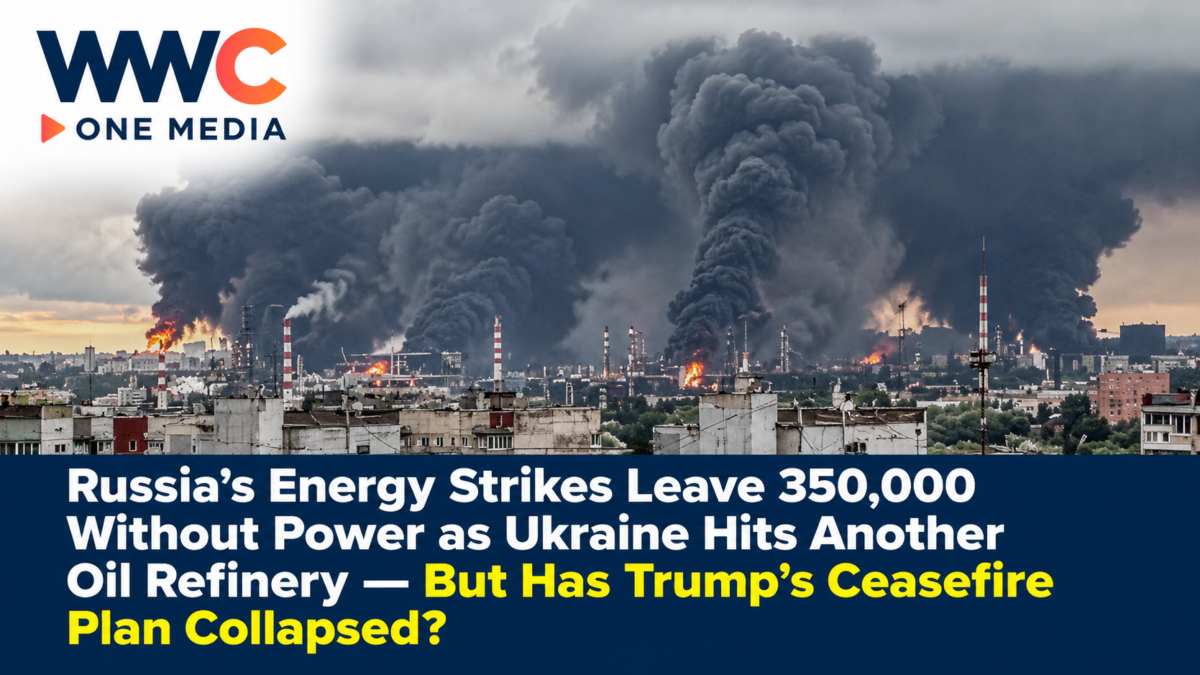
KYIV, Ukraine — October 31, 2026
Russia and Ukraine have intensified their attacks on energy infrastructure as winter approaches, exposing the fragility of US President Donald Trump’s attempts to negotiate a pause in strikes on power plants and oil refineries.
On October 30, Russian attacks on electricity infrastructure in the Ukrainian city of Dnipro caused widespread outages affecting more than 350,000 people, according to reporting referenced by the Council on Foreign Relations.
Meanwhile, Ukraine reportedly struck the Novokuibyshevsk oil refinery in Russia’s Samara region, ending a pause in attacks on Russian refining facilities that had been linked to pressure from Washington.
The exchange represents a major setback for efforts to prevent the conflict from further disrupting fuel supplies, electricity networks and civilian life.
The escalation also comes after a deadly Russian attack on a railway platform in Dnipro on October 29, which killed at least 14 people according to contemporaneous reports.
Ukrainian President Volodymyr Zelenskyy has argued that his country’s strikes on Russian energy facilities are a response to Moscow’s continuing attacks on Ukraine’s electricity system.
But Washington has urged Kyiv to reduce strikes on Russian oil refineries, citing the effects of supply disruptions on global fuel prices.
As both countries target infrastructure crucial to their economies, a dangerous question is emerging: Can diplomatic pressure stop the escalating energy war—or will the approaching winter bring even more devastating consequences for civilians and global markets?
Russia’s Latest Attacks Leave Dnipro Facing Widespread Power Outages
Russian attacks on Ukrainian energy facilities have caused another major disruption to the country’s electricity supply.
On October 30, strikes affecting power infrastructure in Dnipro left more than 350,000 people without electricity, according to the Council on Foreign Relations’ conflict tracker, citing CNBC.
The disruption followed weeks of attacks targeting power networks, substations and other critical facilities.
For residents, the consequences extend beyond household lighting.
Electricity is essential for water distribution, heating, communications, healthcare and transportation.
Damage to power infrastructure can also interrupt businesses and complicate emergency operations.
Restoration depends on the condition of the equipment, availability of replacement components and the ability of repair crews to work safely.
The latest reporting establishes a major outage, but it does not provide a final verified restoration timeline for every affected household.
Dnipro’s Deadly Railway Attack Raises the Human Cost
The energy strikes came amid another devastating episode in the war.
On October 29, a Russian drone struck a crowded railway platform in Dnipro, killing at least 14 people and injuring others, according to initial accounts reported by the Guardian and international news agencies.
The attack drew condemnation from European leaders.
Ukraine’s president characterized it as a particularly horrific assault on civilians.
The railway strike and the later energy outage are separate events, although both reflect the worsening security situation in the region.
Civilian deaths and injuries should not be added to electricity outage figures or treated as consequences of a single strike unless supported by specific evidence.
The attacks also illustrate why public infrastructure remains central to the humanitarian crisis.
Railways, electricity systems and other facilities support millions of people who continue living and working in areas exposed to missile and drone attacks.
Ukraine Reportedly Strikes a Russian Oil Refinery
As Russian attacks continued, Ukraine reportedly resumed strikes on Russian refining infrastructure.
The Wall Street Journal reported that a Ukrainian operation targeted the Novokuibyshevsk oil refinery in Russia’s Samara region on October 30.
The refinery is associated with Rosneft and produces petroleum products including gasoline and diesel.
A Ukrainian defense-industry representative claimed that the facility had been hit.
Russian regional authorities confirmed a drone attack involving infrastructure but did not provide a full public assessment of the refinery’s condition.
The extent of damage therefore remains uncertain.
Reports of a successful attack should not automatically be interpreted as evidence that the entire refinery was destroyed or that all its production capacity was permanently lost.
Even temporary interruptions, however, can affect refinery operations and complicate fuel distribution.
A Reported Two-Week Pause Ends in Renewed Strikes
The latest refinery attack follows conflicting reports about a pause in Ukraine’s long-range strikes.
On October 30, Reuters reported that Ukraine had temporarily stopped certain refinery operations following pressure from the Trump administration.
The information originated from Wall Street Journal reporting based on sources familiar with military operations.
Reuters said it could not independently verify the reported pause.
According to the Journal, Ukrainian strike units had been directed in mid-October to complete ongoing missions while temporarily withholding new refinery attacks.
However, the arrangement was informal, and its precise scope and timing remain disputed.
The October 30 attack in Samara suggests that the restraint did not develop into a lasting prohibition on Ukrainian strikes.
For Kyiv, the underlying argument remains that Russia’s energy facilities are connected to the economic resources supporting its invasion.
For Washington, the immediate concern includes the effect of disrupted refinery operations on already elevated fuel prices.
Trump’s Energy Ceasefire Plan Faces a Serious Credibility Test
On October 11, President Trump announced that Russia and Ukraine had agreed to an immediate halt to attacks on energy infrastructure.
But the announcement was followed by confusion.
Ukraine expressed willingness to support a reciprocal arrangement while reporting that Russian attacks on its electricity facilities were continuing.
There was no clearly established, mutually observed nationwide energy ceasefire in the public record reviewed.
Russian strikes against Ukrainian power infrastructure continued during October.
Ukraine also resumed some of its operations against Russian oil facilities.
Consequently, describing the energy ceasefire as a fully implemented agreement would be misleading.
The central issue is that diplomatic declarations have not produced a sustained reduction in attacks on the infrastructure involved.
Zelenskyy Demands Reciprocal Action From Russia
Zelenskyy has repeatedly argued that Ukraine should not be expected to stop attacking Russian refineries while Moscow continues striking Ukrainian power facilities.
During an interview reported by Ukrainian outlet Hromadske on October 26, Zelenskyy outlined alternatives he said could make a halt to refinery operations acceptable.
These included a reciprocal end to energy attacks, additional Patriot air-defense missiles or expanded satellite communications access supporting Ukraine’s military operations.
The proposals reflect Kyiv’s concern that unilateral restraint could weaken its defenses without delivering meaningful protection for civilians.
Ukraine views strikes on Russian refining infrastructure as one way to increase the economic cost of Moscow’s military campaign.
But the strategy also exposes Kyiv to diplomatic pressure from countries concerned about global fuel supplies.
Any agreement would need clear terms, monitoring and reciprocal implementation to become a reliable ceasefire.
Why Russian Oil Refineries Have Become Strategic Targets
Oil refining is important to Russia’s economy.
Refineries transform crude oil into products such as diesel, gasoline and aviation fuel.
These products serve civilian consumers, industry, agriculture and transportation.
They can also support military logistics.
Ukraine’s long-range drone campaign has targeted refining and related infrastructure in an effort to disrupt fuel production and increase pressure on Russia’s economy.
The Council on Foreign Relations reported in its October 27 conflict assessment that Ukrainian attacks had affected a substantial portion of Russia’s refining capacity.
However, estimates of affected capacity are not equivalent to permanently destroyed production.
Some facilities may resume operations after repairs.
Others may operate below normal levels or face repeated disruptions.
A full assessment would require reliable data on refinery throughput, repair schedules and supply inventories.
Russia’s Attacks on Ukraine’s Grid Create a Different Kind of Pressure
Russia’s campaign targets the infrastructure Ukraine needs to maintain essential services.
Power plants, electrical substations and transmission systems are critical to the country’s ability to function during wartime.
Damage to these facilities can cause widespread consequences even when the initial strike affects a relatively small area.
A damaged substation may interrupt power distribution across several communities.
Loss of electricity can also affect water pumping, telecommunications and heating networks.
Ukraine has been repairing damaged energy facilities throughout the conflict.
But repeated strikes create additional costs and may delay restoration.
With winter approaching, the risks become more severe.
Reliable electricity and heating are essential for vulnerable populations, hospitals and emergency shelters.
Starlink Disruptions Complicate Ukraine’s Military Operations
Another major issue involves access to satellite communications.
During October, Ukrainian officials reported restrictions affecting Starlink and related military communications services.
These systems have been important for battlefield coordination and some unmanned operations.
The Wall Street Journal reported that temporary restrictions disrupted certain Ukrainian drone missions before service was restored.
The circumstances surrounding those limitations and the decisions that produced them remain contested.
The incident highlights the risks of relying on communications technology controlled or managed outside a country’s military command structure.
WWC ONE MEDIA previously examined related security concerns in Germany Detains Four in Polish Starlink Sabotage Investigation as Tusk Blames Russia — But Europe’s Next Hybrid War Threat Could Be Even Bigger.
That investigation concerns a separate alleged attack on Starlink infrastructure in Poland.
It does not establish the cause of October’s reported satellite service restrictions.
Together, the developments demonstrate the strategic importance of resilient communications.
Ukraine’s Expanding Use of Drones Changes the Battlefield
The war has accelerated the development of unmanned military systems.
Ukraine uses drones for reconnaissance, logistics and attacks on military and infrastructure targets.
Ground robots are also being deployed for dangerous assignments, including transporting supplies and evacuating wounded personnel.
WWC ONE MEDIA explored these developments in Ukraine Wants Robots to Replace a Third of Frontline Troops — But the Next Step Could Transform Warfare Forever.
The report examined how unmanned ground vehicles are changing frontline operations.
Long-range drones and ground robots are different technologies, but both illustrate Ukraine’s reliance on innovation to compensate for military disadvantages.
For Russia, defending energy facilities against long-range attacks adds another security requirement.
For Ukraine, protecting communications and maintaining access to components remain critical challenges.
Trump’s Russian Diesel Deal Adds Another Complication
The energy confrontation has become intertwined with Washington’s efforts to lower fuel costs.
On October 9, Trump announced arrangements intended to facilitate Russian diesel reaching international markets.
The administration subsequently eased certain sanctions restrictions for a limited period.
The move drew criticism from opponents who argued that allowing additional Russian fuel sales could provide Moscow with revenue during its war against Ukraine.
Supporters of increasing fuel supplies have emphasized the economic consequences of elevated diesel prices.
The disagreement reflects competing priorities.
Governments want to reduce energy costs for consumers and businesses.
But restrictions on Russian energy exports are also part of the international response to Moscow’s invasion.
Measures designed to achieve one objective can complicate the other.
Higher Diesel Prices Are Already Affecting Global Markets
Diesel is essential for transportation, freight, agriculture and industrial activity.
Elevated diesel costs can increase expenses across supply chains.
The Wall Street Journal reported that US diesel prices remained high despite the Trump administration’s Russian fuel arrangements.
At the same time, geopolitical risks involving the Middle East and the Strait of Hormuz continued putting pressure on energy markets.
These developments cannot all be attributed to the Russia–Ukraine war.
Global fuel prices reflect several factors, including crude oil supply, refining capacity, transport costs, regional conflicts and market expectations.
Nevertheless, attacks on Russian refining facilities add another source of uncertainty.
That uncertainty can influence commodity traders and businesses preparing for future fuel purchases.
Why the Philippines Should Pay Attention
The Philippines relies heavily on imported petroleum products and is therefore exposed to changes in international energy prices.
Higher global fuel costs can affect transportation, electricity generation, food distribution and household expenses.
WWC ONE MEDIA recently examined the broader problem in Philippines Faces Broader, Stickier Inflation Wave as Food, Fuel and Labor Costs Rise.
That report discussed how fuel prices interact with food, wages and transportation costs.
The conflict in Ukraine is one of several international developments influencing energy markets.
A refinery attack in Russia does not automatically produce a specific increase in Philippine pump prices.
Actual domestic adjustments depend on international benchmarks, exchange rates, inventories and other pricing factors.
But continued instability can make future costs harder for businesses and households to predict.
The Peso and Transport Costs Add to the Risk
Energy-related uncertainty can also affect currencies.
When imported fuel becomes more expensive, countries may require additional foreign currency to pay for petroleum imports.
The Philippine peso is influenced by many economic and financial factors, but oil prices can be one source of pressure.
WWC ONE MEDIA previously explored this relationship in Peso Slips as US-Iran Tensions, Wage Hike and Higher Fares Fuel Inflation Concerns.
The report examined the interaction between energy prices, transportation fares and inflation expectations.
For Filipino consumers, the practical issue is affordability.
Fuel-price increases can raise transportation costs and place additional pressure on household budgets.
But it would be inaccurate to attribute every peso movement or fare increase directly to the latest strikes in Ukraine.
Philippine Emergency Financing Highlights Wider Energy Vulnerabilities
The risks associated with international energy shocks have also influenced government financing decisions.
WWC ONE MEDIA recently covered the country’s $1.5-Billion Asian Development Bank Emergency Financing Agreement.
The package is intended to support government programs addressing economic disruptions, including higher energy costs.
It was developed in response to wider international pressures, particularly the Middle East conflict.
It should not be described as a direct response to the October 30 Russia–Ukraine strikes.
Nevertheless, it demonstrates how governments are attempting to prepare for economic shocks originating beyond their borders.
For the Philippines, energy security remains important to inflation management and economic resilience.
A Localized Humanitarian Truce Shows Cooperation Is Still Possible
Amid the broader escalation, a separate humanitarian development offers a limited sign of cooperation.
Russia and Ukraine agreed to a localized ceasefire supporting humanitarian access and evacuations in Russian-occupied Oleshky.
Reuters and the Financial Times reported that residents received supplies and that evacuation operations took place on October 30.
The arrangement helped some civilians leave an area that has experienced severe shortages, damaged infrastructure and dangerous conditions.
However, the truce applies to a limited geographic area.
It does not amount to a nationwide ceasefire or a broader settlement of the war.
Russian attacks elsewhere continued.
The operation nevertheless illustrates that carefully negotiated humanitarian arrangements can sometimes proceed despite ongoing hostilities.
What Happens Next?
Several developments will determine whether the energy conflict intensifies further.
One is the extent of damage to the Novokuibyshevsk refinery.
Another is Ukraine’s ability to restore damaged power infrastructure before temperatures fall.
Diplomatic discussions may also influence whether the two sides attempt another reciprocal pause in energy attacks.
Washington’s approach will be important because of its influence over military assistance, intelligence cooperation and certain energy-related sanctions.
European governments are also concerned about the humanitarian and economic effects of continued attacks.
But the immediate evidence does not establish that a durable agreement is imminent.
Both countries continue to pursue military objectives while discussing limited forms of cooperation.
The Bottom Line
Russian strikes on October 30 disrupted electricity supplies in the Dnipro area, reportedly affecting more than 350,000 people.
Ukraine separately struck a Russian oil refinery in the Samara region, according to international reporting, although the final damage assessment remains uncertain.
The attack followed reports that Kyiv had temporarily restrained some refinery operations under US pressure.
Trump’s earlier announcement of an energy ceasefire has not produced a sustained, mutually observed halt to strikes.
Meanwhile, high diesel prices and wider geopolitical tensions are keeping global energy markets under pressure.
As Russia targets Ukraine’s power grid and Kyiv resumes attacks on Russian refining infrastructure, the central question is becoming increasingly urgent: Can Washington negotiate a genuine reciprocal energy ceasefire before winter deepens the humanitarian crisis—or will the conflict continue threatening civilians, fuel supplies and economic stability far beyond Europe’s borders?