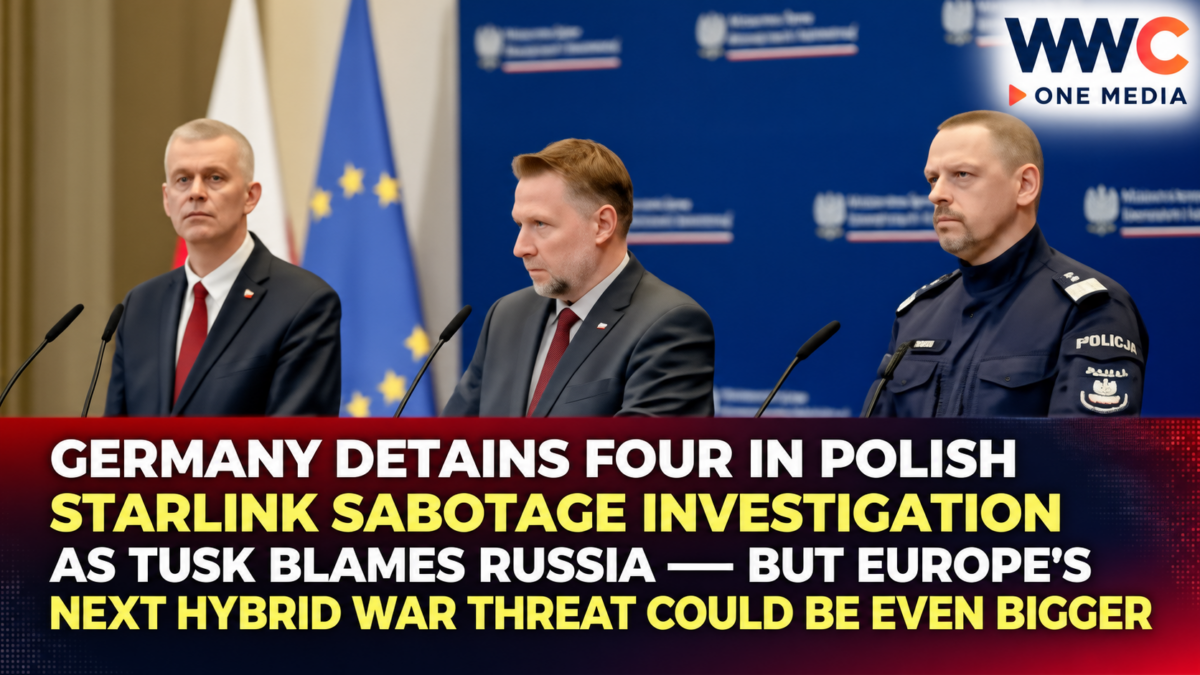
WARSAW, Poland — October 14, 2026 — A suspected arson attack on a critical Starlink satellite communications facility in Poland has triggered an international security investigation, with four people reportedly detained in Germany as Polish authorities accuse Russian intelligence services of orchestrating an operation targeting communications infrastructure used by Ukraine.
The latest developments follow Polish Prime Minister Donald Tusk’s October 12 announcement that German police had arrested two Turkish nationals suspected of setting fire to a Starlink ground station in Wola Krobowska, south of Warsaw, on September 23.
The fire damaged the facility’s electrical distribution equipment and backup generator, raising concerns about the security of satellite internet infrastructure supporting communications across parts of Central and Eastern Europe.
Poland’s intelligence authorities believe the attack was part of a wider Russian-directed sabotage campaign designed to undermine European support for Ukraine.
Tusk characterized the incident as another example of hybrid warfare.
The investigation widened on October 13 when Reuters, citing Polish private broadcaster RMF FM, reported that German authorities had detained two additional people, bringing the reported total to four.
One of the additional suspects, a woman arrested in Berlin, is believed by investigators to have played a possible transportation role.
But while the arrests represent an important breakthrough for European investigators, the bigger question is whether the Starlink attack signals a new phase of covert warfare in which vital communications networks become targets far beyond Ukraine’s front lines.
German Police Arrest Suspects Over September Starlink Fire
The investigation concerns a fire at a Starlink ground station in Wola Krobowska in Poland’s Mazovia region.
The incident occurred on September 23, 2026.
Polish authorities subsequently opened a criminal investigation into suspected deliberate arson and possible sabotage carried out on behalf of a foreign intelligence service.
On October 12, Prime Minister Tusk announced that German police had detained two Turkish citizens at the request of Polish authorities.
German reporting subsequently identified Nürtingen, in the state of Baden-Württemberg, as the location of the initial arrests.
According to Deutsche Welle and German broadcaster ARD’s Tagesschau, the two men are suspected of involvement in setting fire to the communications facility.
The suspects have not been publicly identified in the reporting reviewed.
The arrests are not equivalent to criminal convictions, and the allegations remain subject to investigation and judicial proceedings.
Reported Arrest Total Rises to Four
The case developed further on October 13.
Reuters reported that German authorities had detained two more people in connection with the suspected sabotage, according to information obtained by RMF FM.
The Polish broadcaster initially reported the arrest of a woman in Berlin who may have acted as a driver.
It subsequently reported the detention of a fourth person without providing detailed information about that individual’s identity or suspected role.
German authorities confirmed cooperation with Polish investigators, although public official details about the additional arrests remained limited.
The distinction is important.
The two Turkish nationals were the subject of the original October 12 announcement by Tusk.
The higher total of four comes from subsequent media reporting and should be described as a reported development rather than as four convictions or four independently established participants in the arson.
Investigators must still determine whether each detained individual had a criminal role.
Fire Destroys Power Equipment at Starlink Ground Station
The September 23 fire struck infrastructure serving a Starlink ground-based satellite communications site.
According to Reuters, the blaze engulfed the facility’s power system and backup generator.
Polish prosecutors subsequently said the evidence indicated deliberate arson.
The damaged equipment is important because satellite communications facilities need reliable power to support ground-based network operations.
Backup generators help maintain operations when ordinary electricity supplies are interrupted.
Disabling both the primary electrical equipment and emergency power can therefore threaten a site’s availability.
However, the reported destruction of this equipment does not establish that Starlink internet service throughout Poland or Ukraine was completely disabled.
The publicly available reporting does not provide a verified total outage duration, number of users disconnected or precise military impact.
The significance of the attack lies both in the physical damage and in the vulnerability it exposed.
Why a Starlink Ground Station in Poland Matters to Ukraine
Starlink is a satellite internet system operated by SpaceX, the company founded by Elon Musk.
The service has become an important part of Ukraine’s communications infrastructure since Russia launched its full-scale invasion in February 2022.
Ukrainian military units use satellite connectivity for communications, coordination and other operational needs.
Starlink also supports civilian and institutional connectivity in locations where conventional infrastructure is damaged or unavailable.
Poland has played an important role in helping Ukraine maintain access to the system.
Polish authorities have previously said the country pays for Starlink subscriptions used by Ukraine.
Ground stations connect satellite networks to terrestrial infrastructure and therefore form one element of a broader communications system.
The alleged targeting of a facility in Poland raises concerns that attackers may seek to disrupt Ukraine-related communications by striking infrastructure located in neighboring countries.
However, a single ground station should not be confused with the entirety of the Starlink satellite network.
The system includes satellites, user terminals, ground infrastructure and interconnected network resources.
Poland Accuses Russian Intelligence Services
Polish officials have publicly accused Moscow of directing the suspected sabotage.
Tomasz Siemoniak, Poland’s minister coordinating intelligence services, said authorities believe Russian intelligence was responsible for the incident.
He also warned that Russian services increasingly recruit people associated with criminal networks to carry out covert operations.
Polish prosecutors stated that investigators had reasonable grounds to suspect the involvement of foreign intelligence.
These are serious official allegations.
However, the precise chain of command and the responsibility of each suspect remain matters for investigators and courts.
Moscow denies allegations of conducting sabotage operations in Europe and has dismissed Western accusations as politically motivated.
The article therefore distinguishes Poland’s intelligence assessment from an independently established judicial finding.
What Is Hybrid Warfare?
Hybrid warfare describes efforts to weaken an opponent through a combination of military and nonmilitary methods.
These can include sabotage, cyberattacks, disinformation, economic disruption and covert operations.
Such activities may be designed to create uncertainty about responsibility while imposing costs on a target country.
Attacks on communications infrastructure are particularly concerning because modern economies depend on reliable internet connectivity.
The same networks may support civilian businesses, emergency services, transportation systems and military activities.
When an attack targets infrastructure outside an active battlefield, it can also create political and diplomatic tensions.
For Poland, the Starlink case raises questions about how to secure facilities that are geographically inside NATO territory but provide services connected to the war in Ukraine.
For European governments, it illustrates the difficulty of preventing comparatively small physical attacks from threatening important technological systems.
European Investigators Warn of a Wider Sabotage Campaign
The Starlink case is unfolding amid broader warnings about suspected Russian covert operations across Europe.
The Associated Press reported that Western authorities have identified more than 210 incidents involving sabotage or other malign activity linked to Russia since the full-scale invasion of Ukraine.
These incidents vary in nature, evidence and legal status.
Some have resulted in criminal convictions, while others remain allegations or ongoing investigations.
European security officials say the alleged operations are designed to weaken support for Ukraine, intimidate communities and stretch the resources of domestic security agencies.
At a security conference in Warsaw, Siemoniak warned that intelligence services were confronting repeated attempts at subversion.
Security agencies have also raised concerns about recruitment through online platforms, including messaging applications.
However, the existence of wider allegations does not prove that every suspicious fire, cyber incident or infrastructure outage in Europe was directed by Russia.
Each case requires its own evidence.
Similar Starlink-Related Arson Case Emerged in Britain
The Polish investigation follows a separate case in the United Kingdom.
In a British criminal proceeding involving a March 2024 arson plot, three men were convicted in connection with an attack targeting a London warehouse containing Starlink equipment intended for Ukraine.
British prosecutors linked that operation to Russian intelligence interests.
The case is relevant because it involved equipment associated with the same satellite communications system.
Both incidents highlight concerns about the protection of technology used to support Ukraine.
Nevertheless, they are separate investigations involving different suspects, locations and legal proceedings.
The outcome of the British case cannot be treated as proof of the allegations in Poland.
Germany Warns of an Expanding Shadow War
Germany has also raised the alarm about threats to national security.
On October 12, German Interior Minister Alexander Dobrindt warned that the country faced an increasingly serious campaign of covert activity.
He described threats involving sabotage, espionage, cyber operations and disinformation.
German authorities are pursuing proposals intended to strengthen domestic intelligence capabilities.
The government argues that intelligence agencies need more effective tools to identify and prevent emerging threats.
At the same time, any expansion of surveillance powers raises questions about privacy, democratic accountability and appropriate legal oversight.
The wider debate reflects the challenge facing European democracies: improving security while maintaining constitutional protections.
The Starlink investigation adds urgency to that discussion because it involves alleged cooperation between operatives across national borders.
Why Poland and Germany Are Working Together
The cross-border nature of the investigation makes cooperation essential.
The suspected attack occurred in Poland, while the initial arrests took place in Germany.
Investigators must coordinate information, evidence and legal procedures across jurisdictions.
Polish authorities have indicated that suspects may face proceedings in Poland.
The European Arrest Warrant system provides a mechanism through which participating European countries can request the surrender of suspects for prosecution or the enforcement of sentences.
However, transfer is not instantaneous.
Courts must review relevant requirements, and suspects retain applicable procedural rights.
German authorities have been assisting with investigative cooperation.
The process may also involve the examination of communications, travel records and potential financial links.
No final judicial outcome had been established in the reporting reviewed as of October 14.
Could Similar Attacks Threaten Other European Infrastructure?
The incident illustrates a broader security risk to infrastructure that supports digital services.
Facilities involving communications, electricity and transportation can be vulnerable when attackers identify physical points of failure.
The issue is not limited to the technology used by Starlink.
Other operators may also depend on ground equipment, power supplies and telecommunications connections.
Governments and businesses therefore have strong reasons to review site security, resilience and emergency recovery arrangements.
However, the investigation does not establish that other European Starlink stations are currently under attack or that a continent-wide communications shutdown is imminent.
Those would be speculative conclusions unsupported by the available evidence.
The practical security challenge is to improve protection without overstating the immediate threat.
Could the Attack Affect NATO–Russia Relations?
Poland is a member of the North Atlantic Treaty Organization.
That makes allegations of a foreign-directed sabotage operation on Polish territory particularly sensitive.
Warsaw has been among Ukraine’s most important European supporters.
The Polish government has also repeatedly warned of security threats linked to Russia’s war.
If evidence establishes that foreign intelligence directed sabotage on NATO territory, the incident could deepen diplomatic tensions and strengthen calls for additional security measures.
However, a suspected covert attack does not automatically trigger NATO’s collective-defense provisions.
Any alliance response depends on the facts, the nature of the incident and decisions by member governments.
There has been no verified announcement that NATO has invoked Article 5 over the Starlink fire.
What the Incident Means for Asian Security and Technology Networks
The Polish case carries lessons for countries outside Europe.
Modern communications infrastructure often serves customers across national borders.
Digital systems may support government services, maritime operations, commercial transactions and emergency communications.
A physical attack against one important facility can therefore raise wider questions about resilience.
For governments and businesses in Asia, the incident underscores the value of redundancy, secure power supplies and well-coordinated incident response.
However, there is no confirmed direct connection between the Polish Starlink investigation and any specific communications outage or security threat in the Philippines.
Its relevance to Asian audiences is primarily through the broader issue of critical infrastructure protection.
What Happens Next in the Investigation?
The immediate focus is on establishing the suspects’ involvement and determining whether the attack was directed by a foreign intelligence service.
Polish and German authorities may examine forensic evidence, communications and the movements of individuals connected with the case.
Investigators must also determine the responsibilities, if any, of the additional people reportedly detained on October 13.
Possible extradition or surrender proceedings could follow, subject to applicable legal requirements.
A court would ultimately need to assess the evidence supporting criminal charges.
The investigation may also prompt additional reviews of communications infrastructure serving Ukraine.
Important unanswered questions include the exact operational effect of the fire, how the attack was organized and whether a wider network participated.
Until those questions are resolved, conclusions about the full scope of the operation remain provisional.
The Bigger Question: Is Europe’s Infrastructure Becoming a New Battlefield?
The Starlink fire in Poland has developed from a local arson investigation into a significant international security case.
The detention of two Turkish nationals in Germany, followed by reports of two more arrests, suggests that investigators are examining a potentially broader operation.
Polish authorities believe the attack was directed by Russian intelligence.
Russia denies responsibility.
The damaged facility was part of the communications infrastructure associated with Starlink, a network that has become important to Ukraine since the beginning of the full-scale invasion.
For European governments, the incident raises urgent questions about the protection of technology systems supporting critical civilian and military functions.
For investigators, the priority remains establishing what happened and who was responsible through evidence capable of withstanding legal scrutiny.
Germany has reportedly detained four people in the investigation of a burned Starlink station in Poland. But the bigger concern now extends beyond the suspects: If covert attackers can target the communications infrastructure supporting Ukraine from inside neighboring countries, Europe may face a growing security challenge far beyond the conventional battlefield.