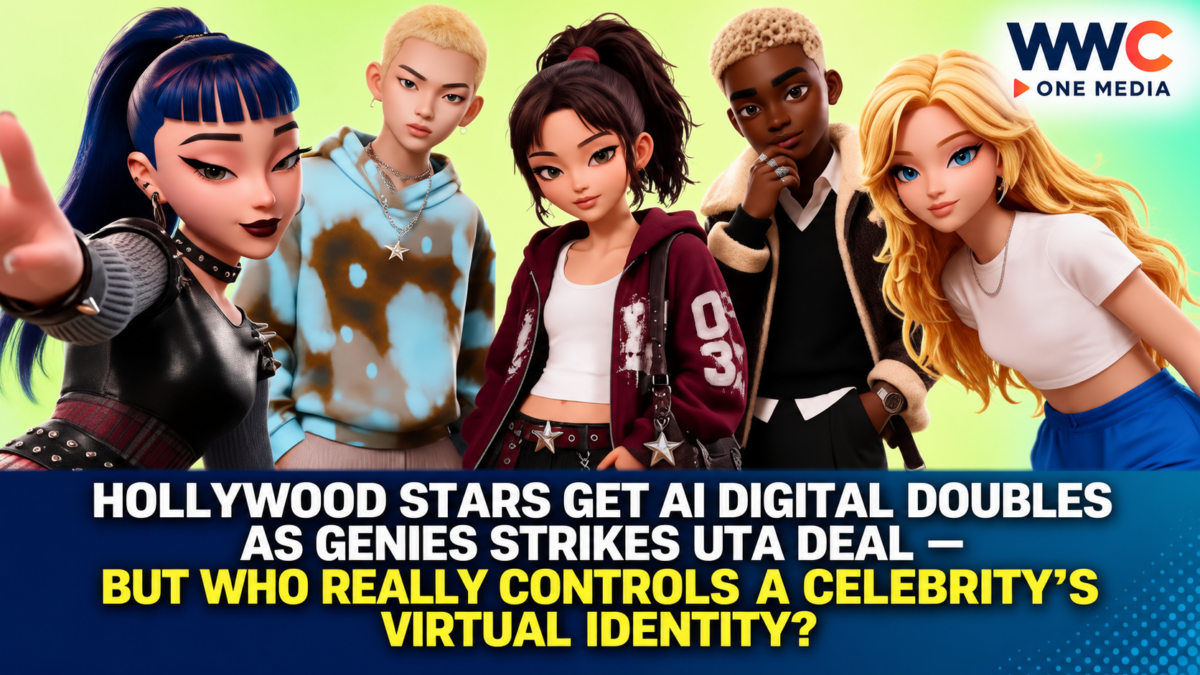
LOS ANGELES, United States — October 14, 2026 — Hollywood’s artificial intelligence revolution is entering a new phase as one of the entertainment industry’s most influential talent agencies partners with a technology company to create interactive digital versions of actors, musicians and other celebrities.
Los Angeles-based Genies has reached an agreement with United Talent Agency (UTA) that will allow participating clients to develop AI-powered avatars modeled on their physical appearance, personality and personal experiences.
Unlike traditional celebrity avatars that simply resemble famous individuals, these AI characters are intended to hold conversations and interact with fans through digital platforms.
The partnership, first reported by Bloomberg on October 12, could create new opportunities for celebrities to expand their online presence, connect with audiences and eventually develop additional sources of revenue.
But the move also arrives during an increasingly contentious debate about whether artificial intelligence will protect performers’ rights or undermine their control over their own identities.
Genies founder and chief executive Akash Nigam says the arrangement is designed to give entertainers ownership and control over their digital representations.
The avatars can be moderated by the artists and their teams, allowing them to influence what their virtual counterparts say and how they behave.
Among the first identified participants is rapper and actor Chris Bridges, better known as Ludacris, who is developing AI-generated characters for his KidNation educational platform.
The financial terms of the Genies–UTA agreement have not been disclosed.
The partnership could give Hollywood stars the ability to interact with millions of fans through virtual versions of themselves. But the bigger question is whether celebrities can truly control what their AI doubles say, do and represent — especially as synthetic identities become increasingly difficult to distinguish from real people.
Genies Signs Major AI Partnership With United Talent Agency
The new agreement brings together a technology company specializing in interactive digital characters and one of the world’s leading entertainment agencies.
UTA represents actors, musicians, comedians, filmmakers and other creative professionals.
Its clients include internationally recognized entertainers such as Will Ferrell, Kylie Minogue and Bad Bunny.
Under the new arrangement, eligible clients can explore creating AI personas through Genies’ technology.
These characters may incorporate elements of the artist’s appearance, public personality and experiences.
The goal is to create digital companions that communicate with fans in a personalized way.
However, participation is not automatic.
The fact that an entertainer is represented by UTA does not mean that the person has agreed to create an AI replica.
No comprehensive public list of artists participating in the Genies partnership has been released.
The agreement establishes a framework for opportunities rather than confirming that every UTA client now has a virtual double.
How Celebrity AI Avatars Actually Work
Genies develops technology for creating digital characters capable of interacting with users.
Traditional celebrity avatars often function as animated representations in games, videos or social media content.
AI-powered avatars add another layer.
They can use language models and other software to respond dynamically to conversations.
Instead of watching a prerecorded celebrity message, a fan could interact with a character designed to reflect that entertainer’s public persona.
Potential applications include answering questions, discussing creative projects, guiding users through digital experiences or participating in interactive entertainment.
But an AI persona is not the actual celebrity.
Its responses are generated by software.
Even when the character is designed to reflect an artist’s personality, it should not be treated as an authenticated statement made personally by the entertainer.
That distinction is essential for preventing misleading interactions.
Genies Promises Celebrities Control Over Their Digital Identity
Control is central to the company’s pitch.
Nigam told Bloomberg that participating UTA clients would retain authority over their AI-generated characters.
They would also be able to moderate online behavior.
In its own published materials, Genies says its technology is intended to help entertainers create digital personalities while maintaining control over likeness and identity.
That matters because celebrities increasingly face unauthorized AI-generated content.
Deepfake technology can imitate faces, voices and mannerisms.
Such material can be used for entertainment, but it can also facilitate deceptive advertising, misinformation and impersonation.
An authorized avatar provides a different model.
Instead of a third party creating a celebrity likeness without permission, the entertainer participates in developing and supervising the digital representation.
However, the effectiveness of those controls will depend on the contracts, technical safeguards and moderation procedures used in practice.
Ludacris Becomes an Early Participant
One of the first UTA clients identified in the Genies initiative is Chris Bridges, known professionally as Ludacris.
The Grammy-winning rapper and actor is developing AI-generated characters connected to KidNation, his online education platform.
KidNation aims to offer educational and entertainment experiences for young audiences.
AI characters could potentially make those experiences more interactive.
For example, children might engage with a digital guide rather than passively watch prerecorded material.
However, the specific functionality, commercial terms and full rollout schedule of the KidNation characters have not been publicly detailed.
The project also raises important questions about child safety.
AI products designed for younger audiences require particular care with data protection, age-appropriate responses and the management of potentially misleading interactions.
Participation by Ludacris does not establish that other high-profile UTA clients have launched similar services.
Will Ferrell, Kylie Minogue and Bad Bunny Are Among UTA’s Clients
Bloomberg identified several well-known names associated with UTA’s roster.
These include actor Will Ferrell and musicians Kylie Minogue and Bad Bunny.
Their inclusion demonstrates the range of talent represented by the agency.
But the reporting does not confirm that these individuals have agreed to license their likenesses for AI avatars.
This distinction is especially important in entertainment reporting.
A talent agency signing a technology partnership does not automatically authorize the use of every client’s voice, image or personality.
Individual consent and licensing arrangements may still be required.
As of October 14, there is no independently verified announcement that Ferrell, Minogue or Bad Bunny has launched an official Genies AI character under this agreement.
Claims suggesting otherwise would be premature.
Genies Has Raised $200 Million From Major Investors
Genies is not a newly established startup.
The Los Angeles company has raised approximately $200 million in funding.
Its investors have included former Disney chief executive Bob Iger and investment firm Silver Lake Management.
The company has spent years developing avatar and digital identity technology.
Its original products focused heavily on personalized animated characters and digital experiences.
More recently, it has expanded toward AI-powered conversational personas.
This reflects a shift in the broader technology market.
Consumers increasingly interact with generative AI tools that can answer questions and perform tasks.
Genies believes those systems will become more engaging when presented through interactive characters.
However, its $200 million in historical fundraising should not be confused with the value of the UTA agreement.
No financial amount was disclosed for the new partnership.
Sports Stars Have Already Entered Genies’ Digital Universe
The UTA agreement builds on earlier partnerships.
Genies has worked with organizations associated with Major League Baseball players and other sports personalities.
In February 2026, the company announced an initiative to create AI characters associated with professional baseball players.
Its broader partnership history also includes basketball-related talent and digital entertainment brands.
These relationships suggest that Genies sees opportunities beyond Hollywood.
Professional athletes have recognizable identities and international fan bases.
Interactive digital characters could support fan engagement, sports education, gaming and licensed experiences.
The same underlying questions about consent, accuracy and commercial rights apply.
For athletes and entertainers alike, their names and likenesses are valuable forms of intellectual property.
How those rights are managed will influence the commercial success of the technology.
Justin Bieber and Webtoon Are Also Part of Genies’ Partnership History
Genies has previously collaborated with music superstar Justin Bieber and digital entertainment company Webtoon Entertainment.
Those projects reflect the company’s efforts to expand avatar technology across music, comics and interactive entertainment.
Digital characters can potentially appear in games, virtual events and branded experiences.
But the nature of each partnership can differ.
An earlier agreement to develop animated avatars should not automatically be described as an agreement to build autonomous conversational AI replicas.
The newer UTA initiative is significant because it emphasizes AI personalities capable of interacting with individual fans.
That functionality introduces opportunities and risks that are different from ordinary digital artwork or prerecorded animation.
Hollywood’s AI Battle Has Shifted Toward Consent and Compensation
Artificial intelligence has been a major source of tension in Hollywood.
Actors, writers and other entertainment professionals have questioned whether studios might use AI systems to reproduce their work without adequate permission or payment.
The controversy has included digital replicas of performers and completely synthetic characters.
Entertainment unions have pushed for stronger contractual protections.
SAG-AFTRA’s 2026 television and theatrical agreement includes expanded rules covering digital replicas and synthetic performers.
The union has emphasized consent, performer rights and restrictions on inappropriate uses.
These developments are relevant to the Genies partnership because they reflect the industry’s growing focus on ownership of personal identity.
However, the agreement between Genies and UTA is not the same as a union contract governing film and television production.
The specific protections applicable to an avatar will depend on the relevant arrangements.
SAG-AFTRA Strengthens AI Protections in 2026
Under its 2026 agreement, SAG-AFTRA secured additional protections for actors whose likenesses may be reproduced digitally.
The provisions address circumstances involving digital replicas, biometric information and synthetic performers.
The agreement also includes protections against certain unauthorized uses during labor strikes and restrictions involving minors.
For some synthetic performances, producers must satisfy negotiated requirements and demonstrate additional value.
These protections underscore the industry’s preference for human performers and meaningful consent.
But they do not mean all AI-generated avatars are prohibited.
Authorized digital replicas may be used under appropriate conditions.
The legal and contractual distinction is between permitted, controlled uses and unauthorized exploitation.
That difference is central to evaluating Genies’ business model.
UTA Previously Joined an Industry Statement Against Unauthorized AI
The October partnership is especially notable because UTA has publicly supported measures protecting performers from unauthorized AI impersonation.
On August 26, SAG-AFTRA, UTA, Creative Artists Agency, WME, Cameo and other organizations issued a joint statement concerning performer rights.
The participants emphasized the importance of safeguarding names, images, voices and creative work.
The statement addressed the need for ethical use and proper authorization.
UTA’s agreement with Genies can be understood within that wider debate.
Rather than rejecting all AI-generated celebrity content, the agency is exploring a structure intended to let its clients authorize and control particular uses.
Whether that structure delivers effective protection will be an important test.
The Tilly Norwood Controversy Shows Hollywood’s Deep Divisions
The industry debate intensified in 2025 after the introduction of Tilly Norwood, a fully AI-generated performer.
The character was presented as a synthetic actress.
SAG-AFTRA criticized the development and argued that human performers should not be displaced by creations derived from real artists’ work without consent.
Supporters of synthetic entertainment have argued that AI characters represent another form of creative expression.
The controversy illustrates an important distinction.
A completely fictional AI performer is different from a digital replica authorized by an identifiable human entertainer.
Genies’ UTA partnership focuses on the second category: digital personas associated with existing talent.
However, both forms of technology raise questions about authenticity, audience expectations and the future of creative employment.
Could AI Avatars Become a New Source of Celebrity Revenue?
One of the main commercial opportunities involves fan engagement.
Celebrities already earn revenue through music, film, sponsorships, live appearances, merchandise and digital content.
AI personas could create additional ways to interact with fans.
Potential models include licensed branded experiences, digital events, gaming integrations and subscription-based services.
For example, a musician could offer an interactive character connected to an album launch.
An actor could participate in a licensed digital entertainment experience.
An athlete could provide authorized interactive content.
However, these are potential applications.
The Genies–UTA agreement does not establish that particular subscription fees, revenue splits or guaranteed celebrity earnings have been agreed.
The financial terms remain undisclosed.
Successful monetization will depend on the quality of the experience and consumers’ willingness to pay.
What Happens When a Celebrity’s AI Avatar Says Something Controversial?
One of the biggest challenges is managing AI-generated responses.
A conversational avatar may produce statements that the real celebrity never intended.
It could provide inaccurate information or respond inappropriately to sensitive subjects.
If the character is strongly associated with a famous person, audiences may incorrectly assume that its statements represent the entertainer’s personal views.
That creates reputational risk.
Genies says it offers creator controls and moderation capabilities.
But all generative AI systems can make mistakes.
A responsible deployment would need clear disclosure that users are interacting with AI rather than the person themselves.
It would also require safeguards around impersonation, inappropriate content and unauthorized endorsements.
The effectiveness of those safeguards has not yet been established through independent evaluation of the new UTA experiences.
The Privacy Question Could Be Just as Important
Building a convincing AI persona may involve personal information, voice samples, photographs, interviews or other material associated with an entertainer.
The system may also collect information during conversations with fans.
That raises questions about consent and privacy.
Who can access the underlying materials?
How long are they retained?
Can the artist revoke authorization?
Can data be used to develop other models?
What happens if the technology provider is acquired or shuts down?
These questions are relevant to celebrities and ordinary users.
The terms of the Genies–UTA partnership have not been publicly disclosed in sufficient detail to answer all of them.
Accordingly, claims that the agreement offers unlimited revocation rights or guarantees complete control over every interaction would go beyond the verified information.
The Industry Is Moving Toward Licensed AI Identities
Genies is not the only company developing this market.
In June, the Los Angeles Times reported that Hollywood’s AI debate was increasingly focused on consent and licensing.
Creative Artists Agency has developed technology allowing clients to manage authorized digital representations of their identities.
Other companies are experimenting with synthetic dubbing, digital performances and AI-assisted production.
The emergence of these tools suggests that an industry for licensed digital likenesses is developing.
However, the market is still evolving.
Regulation, union agreements and public expectations may influence which business models succeed.
The companies that gain trust may be those able to demonstrate reliable consent, security and compensation arrangements.
What the Deal Means for Fans
For audiences, the most visible change could be more personalized entertainment.
Fans might eventually interact with digital versions of favorite musicians, actors and athletes through applications and games.
These experiences could offer educational content, entertainment and information about an artist’s projects.
But transparency will be essential.
A simulated conversation with a celebrity should not be presented as an actual private conversation with that person.
Fan relationships can be emotionally significant, especially for younger audiences.
Companies should avoid creating confusion about whether the interaction is real, automated or commercially sponsored.
The value of these products will depend on delivering engaging experiences without misleading users.
Why Asia and the Philippines Should Pay Attention
The Genies–UTA agreement is part of a broader global shift toward digital characters and AI-driven entertainment.
Asia already has strong markets for virtual performers, gaming avatars, anime characters and interactive fan experiences.
Genies has worked with Japan’s King Records on AI-character initiatives.
This suggests potential applications across music, animation and digital entertainment.
For the Philippines, the trend could eventually affect celebrity marketing, digital agencies, gaming businesses and content production.
Filipino artists may find new opportunities to license authorized digital identities.
Creative professionals may also need skills in AI supervision, animation, user experience and intellectual-property management.
However, the UTA agreement does not establish that Genies has signed any particular Filipino celebrity or announced a Philippine rollout.
Those developments would require separate confirmation.
What Happens Next?
Several developments will determine whether the partnership becomes commercially significant.
Artist participation: Genies and UTA may announce additional clients who choose to create AI personas.
Ludacris’ KidNation project: The development and rollout of educational AI characters may provide an early example of the technology.
Licensing terms: The extent of celebrity control and financial participation may become clearer.
Moderation safeguards: Fans and artists will want assurance that avatars behave appropriately.
Platform distribution: Genies could expand these characters into additional applications and interactive experiences.
Industry response: Other talent agencies may pursue similar partnerships.
Audience acceptance: Users will ultimately determine whether interactive celebrity avatars provide lasting entertainment value.
The agreement is an important commercial step, but the scale of adoption remains uncertain.
The Bigger Question: Will AI Expand Celebrity Careers or Redefine What Being Famous Means?
Genies’ agreement with United Talent Agency marks another step toward a future in which celebrity identities can exist in interactive digital form.
For entertainers, the technology may provide new ways to reach global audiences.
It could also allow them to create experiences that would be impossible to deliver through personal appearances alone.
For talent agencies, the partnership provides another tool for managing and licensing valuable intellectual property.
But the technology also creates difficult questions.
A celebrity’s likeness is more than an image.
It carries reputation, public trust and commercial value.
When an AI system speaks or acts through that identity, the consequences can extend beyond a single digital interaction.
Hollywood’s future may therefore depend not simply on making convincing virtual performers, but on creating rules that preserve human control and accountability.
Genies and UTA are opening the door to a world where Hollywood stars can have AI versions interacting with fans around the clock. But the bigger test is still ahead: Will these digital doubles become a powerful new source of celebrity influence and income — or will the race to commercialize virtual identities create a crisis over who truly owns a person’s face, voice and personality?