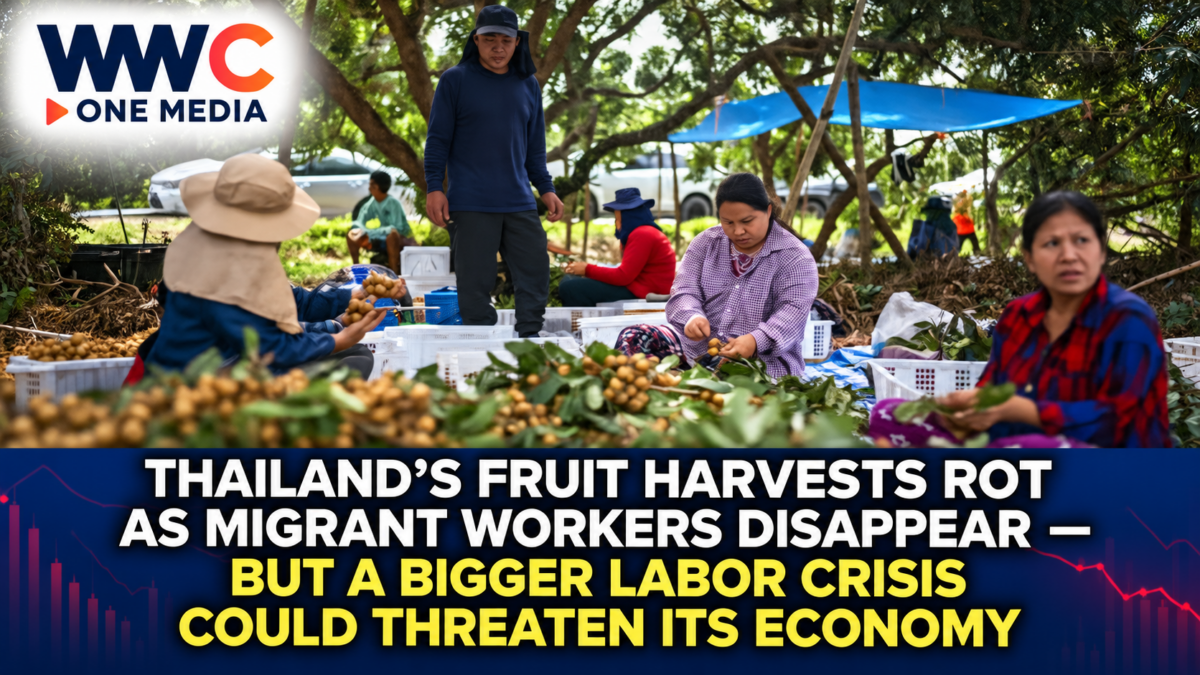
BANGKOK / CHANTHABURI, Thailand — October 14, 2026 — Thailand is facing a worsening labor crisis as a shortage of migrant workers forces fruit growers to leave ripe crops rotting on trees, construction companies to scramble for employees and businesses to confront rising operating costs.
The shortage has become particularly severe in eastern Thailand, where farmers harvesting mangosteen, rambutan and durian depend heavily on workers from neighboring Cambodia and Myanmar.
According to Bloomberg’s October 13 report, the labor shortage has become so acute that some farm wages have more than doubled, making it financially impractical to harvest lower-value fruit.
The crisis has intensified following border tensions between Thailand and Cambodia, which caused large numbers of Cambodian migrants to return home.
At the same time, political instability and recruitment restrictions in Myanmar have complicated efforts to find replacement workers.
Thailand’s rapidly aging population is making the problem more difficult.
Migrants already account for approximately one-tenth of the country’s workforce, supporting agriculture, construction, manufacturing, tourism and service businesses.
The government is now preparing to recruit workers from countries farther away, including Sri Lanka, Nepal and Bangladesh, in an effort to reduce its dependence on traditional labor sources.
But new recruitment agreements may take months to produce significant numbers of workers.
Thailand is running out of time to solve its labor shortage before more crops are lost and construction projects are delayed. The bigger question is whether the government’s new recruitment strategy can stabilize the economy—or whether an aging workforce and regional political tensions will turn today’s shortage into a permanent economic problem.
Farmers Are Leaving Fruit to Rot Because Workers Are Too Expensive
In Thailand’s eastern Chanthaburi province, farmers are confronting a difficult choice.
Harvest fruit at sharply higher labor costs—or leave part of the crop unpicked.
For grower Jomsak Putirattana, the departure of five Cambodian workers following Thailand’s border dispute has transformed the economics of his farm.
Jomsak grows durian alongside other tropical fruits.
He told Bloomberg that daily wages, previously around 350 to 400 baht, have risen to as much as 800 to 1,000 baht in some cases.
That represents more than double the earlier rate at the top of the reported range.
For valuable crops such as premium durian, the higher labor cost may still be manageable.
But for lower-priced mangosteens and rambutans, picking, packing and transporting fruit can become more expensive than the additional revenue the harvest would generate.
The result is food waste and lost income.
The problem is especially serious because fruit harvesting is seasonal.
Once fruit reaches maturity, farmers have a limited period to collect and sell it.
Labor that arrives after the harvest window cannot recover produce that has already spoiled.
Thailand’s Farm Labor Costs Surge
| Indicator | Reported figure |
|---|---|
| Earlier daily wages in affected orchards | 350–400 baht |
| Higher reported daily wages | 800–1,000 baht |
| Cambodian workers lost by one Chanthaburi grower | 5 |
| Eastern Thai fruit production value, grower’s estimate | 200 billion baht annually |
| Primary eastern fruit harvest season | Approximately 4–5 months, beginning in late April |
The wage figures are examples from the affected agricultural area, not official nationwide minimum-wage statistics.
Likewise, the 200-billion-baht production estimate is attributed to a local grower and should not be treated as an independently audited government total.
The figures nevertheless illustrate how quickly labor scarcity can affect agricultural economics.
Cambodia Border Conflict Is a Major Cause
Thailand’s labor problems worsened after its long-running border dispute with Cambodia erupted into deadly fighting in 2025.
The conflict damaged relations between the neighboring countries and created serious concerns among Cambodian workers living in Thailand.
Many decided to return home.
According to Reuters’ August 2025 reporting, approximately 400,000 Cambodian workers had returned to Cambodia following the initial escalation, although estimates differed significantly among Thai authorities, Cambodian authorities and migrant-rights organizations.
Channel News Asia subsequently reported that Cambodian government figures and civil-society estimates pointed to an even larger return migration.
The figures should not be treated as a single universally accepted count.
But the economic consequences are clear.
Agriculture, construction, manufacturing and other businesses have lost access to workers who previously formed a critical part of their labor supply.
For employers, restoring that workforce has proved difficult.
For Cambodian families, returning home has also meant losing jobs and income.
The crisis is therefore affecting both countries.
Myanmar Can No Longer Fill the Labor Gap Quickly
Myanmar has historically been one of Thailand’s most important sources of migrant labor.
Millions of Myanmar nationals have worked in Thailand across agriculture, construction, factories and service businesses.
But recruitment has become increasingly complicated.
Political instability following Myanmar’s 2021 military takeover has affected migration rules, transport and cross-border employment.
Bloomberg cited recruitment agency executive Myat Thu as saying that hiring workers from Myanmar can now take six to eight months.
That is a significant delay for employers needing workers immediately.
A farmer facing a harvest deadline cannot wait half a year for a recruitment process to finish.
Construction contractors also face problems when workers are unavailable during critical project stages.
Complaints over wages, subcontracting arrangements and labor protections have further reduced the attractiveness of certain Thai jobs to prospective migrants.
Construction Faces an Even Bigger Workforce Problem
Thailand’s construction industry is particularly dependent on foreign workers.
According to Liza Ngamtrakulpanit, president of the Thai Contractors Association, migrants account for approximately 60% to 70% of the sector’s workforce.
The industry employs an estimated 4.2 million to 4.5 million workers.
That means a very large share of Thailand’s infrastructure and property-development labor force depends on cross-border migration.
When workers disappear, the impact extends beyond the construction site.
Projects can fall behind schedule.
Contractors may face higher wages and additional recruitment costs.
Equipment and financing expenses can continue even while work slows.
Delays can create cash-flow problems, especially for smaller subcontractors.
For an economy trying to attract investment in infrastructure, manufacturing and technology, an unreliable construction workforce can become a serious competitiveness issue.
Thailand Looks to Sri Lanka for 10,000 Workers
The government has begun diversifying its recruitment strategy.
On September 14, Thailand and Sri Lanka signed formal labor-cooperation agreements in Bangkok.
The agreements create a legal framework for recruiting up to 10,000 Sri Lankan workers in the initial phase.
The arrangements cover recruitment procedures, employment conditions, worker protections and coordination between the two governments.
Thailand’s Ministry of Labour said the workers would be entitled to legally mandated rights, wages, benefits and healthcare protections.
The Thai government had already approved the cooperation framework on September 8.
Bloomberg reported that the first Sri Lankan workers are expected to arrive in January 2027, with construction among the initial areas of employment.
However, the 10,000 figure represents planned opportunities, not workers already deployed.
Actual recruitment will depend on employer demand, documentation, labor screening and the implementation of the bilateral agreements.
Nepal and Bangladesh Could Be Next
Thailand is also exploring labor agreements with Nepal and Bangladesh.
Labor Minister Julapun Amornvivat told Bloomberg that discussions are intended to broaden the country’s recruitment options.
Agreements with those countries are expected to be pursued in 2027.
The strategy would reduce reliance on a small group of neighboring countries.
But recruitment farther from Thailand introduces additional challenges.
Employers may need to provide language training and orientation.
Workers may face higher transportation costs and unfamiliar conditions.
Recruitment agencies must establish legal and transparent procedures.
Thailand will also be competing with other destinations.
Singapore, Malaysia and several Middle Eastern economies already recruit significant numbers of workers from South Asia.
That competition could make labor more expensive and require Thailand to offer stronger employment protections and more attractive working conditions.
Thailand’s Aging Population Is Making the Crisis Permanent
The migrant shortage is not simply the result of regional conflict.
Thailand also faces a long-term demographic problem.
Its population is aging, while the number of younger people entering the domestic workforce is under pressure.
As more workers retire, employers have fewer people available to fill vacancies.
This is particularly challenging in physically demanding jobs such as farming, construction and industrial production.
The International Labour Organization has long identified Thailand as a major destination for migrant workers in Southeast Asia.
In a 2026 assessment, the ILO estimated that approximately 3.8 million documented migrant workers from Myanmar, Cambodia and Laos were living and working in Thailand.
More than one million were employed in agriculture.
Those figures demonstrate that migrant labor is not a minor supplement to the Thai economy.
It is already an essential component of its productive capacity.
Migrant Workers Support Thailand’s Export Economy
Thailand’s agriculture sector is an important source of domestic employment and export earnings.
According to the ILO, agriculture contributes up to 8.6% of Thai GDP and generates approximately US$51 billion in exports.
The sector relies on migrant workers in farming, harvesting, processing and related activities.
Fresh fruit is particularly labor-intensive.
Crops must be harvested at suitable stages of maturity, sorted, packed and moved into distribution networks.
Disruptions during any of these stages can affect quality and commercial value.
A shortage of workers may therefore reduce farmers’ income even when international demand remains strong.
Exporters could also face uncertainty over shipment schedules and available volumes.
However, the reporting does not establish that Thailand’s entire fruit-export sector has collapsed.
The documented impact is concentrated in affected farms and labor-dependent industries, with broader risks if shortages persist.
Why Higher Wages Alone May Not Solve the Problem
One possible response is to offer better pay.
That may attract some workers and improve retention.
However, higher wages cannot always compensate for a severe shortage of available labor.
Seasonal farms may compete for the same limited workforce at the same time.
Construction companies may offer longer contracts or more predictable earnings.
Urban service-sector jobs may appeal to workers who prefer less physically demanding work.
Farmers must also consider the price they can receive for their produce.
If labor becomes too expensive, harvesting low-value crops may be uneconomic regardless of demand.
This is why an effective response requires more than wage increases.
It also requires faster recruitment, legal employment opportunities, labor protections and productivity improvements.
Legal Employment for Myanmar Refugees Offers Another Solution
Thailand has already experimented with alternative approaches.
In 2025, the government expanded legal employment opportunities for Myanmar refugees living in camps along the border.
Reuters reported in June 2026 that more than 5,500 refugees had obtained legal employment following the policy change.
The initiative could potentially benefit tens of thousands of refugees.
It has been welcomed by the United Nations as an example of how host countries can support both labor-market needs and refugee self-reliance.
The arrangement includes legal protections and access to employment under the applicable conditions.
But the number already employed remains much smaller than Thailand’s overall migrant workforce.
The initiative could help relieve shortages, yet it is not an immediate replacement for all Cambodian workers who have departed.
Workers’ Rights Must Be Part of the Solution
Migrant labor shortages cannot be addressed sustainably through recruitment numbers alone.
The ILO has identified serious concerns about wages, occupational safety, working hours and access to social protection among migrant agricultural workers in Thailand.
Some workers operate in informal employment arrangements.
Others face high recruitment fees or restrictions linked to their employers.
These conditions can increase vulnerability to exploitation.
They can also discourage workers from returning or remaining in particular industries.
Thailand’s new agreements with Sri Lanka explicitly include provisions intended to prevent abusive recruitment practices, deception and human trafficking.
Stronger worker protection may help the country become a more attractive destination.
A reliable workforce depends not only on legal entry but also on fair treatment after arrival.
Could Automation Reduce Thailand’s Dependence on Migrants?
Businesses may increasingly consider machinery and technology to reduce their dependence on labor-intensive processes.
Agricultural mechanization can help with transportation, irrigation, sorting and packaging.
Construction companies can also improve productivity through prefabrication and better project management.
But some activities remain difficult to automate.
Delicate fruit harvesting, for example, often requires workers to assess maturity and handle produce carefully.
Advanced machinery can also be expensive for smaller farms.
Technology may gradually reduce labor requirements, but it cannot be assumed to replace hundreds of thousands of workers in the near term.
The more realistic strategy combines appropriate mechanization with improved recruitment and worker retention.
What the Crisis Means for ASEAN
Thailand’s labor shortage exposes the economic interdependence of Southeast Asian countries.
Cambodian and Myanmar workers depend on employment opportunities in Thailand.
Thai employers depend on those workers to maintain production.
When political tensions interrupt migration, the economic damage can spread across borders.
For Cambodia, large-scale returns create pressure on domestic employment and household income.
For Thailand, the departures create shortages and rising costs.
Other ASEAN countries may also face stronger competition to recruit workers from South Asia.
The situation demonstrates why regional labor mobility, border stability and worker protections matter to economic integration.
Trade agreements and investment policies can encourage business growth.
But those benefits become harder to realize when employers cannot recruit enough people.
What the Philippines Should Watch
The Philippines is both a labor-sending economy and a participant in regional competition for investment.
Thailand’s efforts to recruit workers from more countries could eventually influence employment opportunities for skilled and semi-skilled workers across Asia.
Reuters reported in 2025 that the Philippines was among the countries Thailand had considered as an additional potential source of labor.
However, the October 13 Bloomberg report did not announce a new Philippines–Thailand recruitment agreement or a specific number of Filipino workers to be hired.
Such claims would require separate confirmation.
For Philippine businesses, the case highlights how labor availability can influence agriculture, tourism, construction and infrastructure delivery.
The broader lesson is that workforce planning requires attention to wages, skills, mobility and long-term demographics.
Thailand’s Economic Growth Ambitions Face Another Obstacle
The workforce shortage comes as Thailand seeks to revive its economy.
Reuters reported on October 9 that Finance Minister Ekniti Nitithanprapas wants to support growth through investment in semiconductors, data centers, electric vehicles and renewable energy.
The government aims to raise annual economic growth toward 3% within three years.
But attracting investment is only part of the challenge.
Factories, roads, utilities and industrial facilities still require workers to build and maintain them.
If labor shortages delay construction, investment projects may take longer to generate economic benefits.
Thailand therefore faces the task of improving both capital investment and workforce availability.
Its labor strategy could become an important part of its broader effort to restore competitiveness.
What Happens Next?
Several developments will determine whether the shortage eases.
January 2027: Thailand expects the first Sri Lankan recruits under the new arrangements, subject to implementation.
Additional labor agreements: Negotiations with Nepal and Bangladesh could expand recruitment channels during 2027.
Work-permit reform: The government is preparing measures to simplify renewals and regularize eligible undocumented migrants already in Thailand.
Border relations: Improved stability with Cambodia could create conditions for some workers to return, although there is no guarantee they will.
Myanmar recruitment: Changes to political and administrative restrictions could affect how quickly new workers are hired.
Fruit harvests: Growers will watch whether sufficient labor becomes available before the next peak season.
Construction projects: Developers and contractors will assess whether the shortage is affecting schedules and costs.
The challenge is ensuring that temporary measures develop into reliable, long-term labor policies.
The Bigger Question: Can Thailand Grow Without Enough Workers?
Thailand’s migrant labor shortage has exposed a vulnerability at the heart of its economy.
The country depends on workers from neighboring states to harvest fruit, build infrastructure, operate factories and support service businesses.
But geopolitical conflict has disrupted those relationships.
An aging population is reducing the availability of domestic workers.
And recruitment from Myanmar has become slower and more complicated.
The government’s decision to look toward Sri Lanka, Nepal and Bangladesh marks a significant change in strategy.
New agreements could help diversify the workforce.
But the initial recruitment numbers are small compared with the scale of Thailand’s labor needs.
Without efficient hiring systems, stronger worker protections and improvements in productivity, employers may continue to face shortages even after new programs begin.
Thailand’s fruit growers are already watching valuable crops go to waste while construction businesses struggle to fill essential jobs. But the deeper test is still ahead: Can the country rebuild its migrant workforce before the next major harvest and infrastructure push—or will demographic decline and regional tensions leave one of Southeast Asia’s largest economies permanently short of the workers it needs?