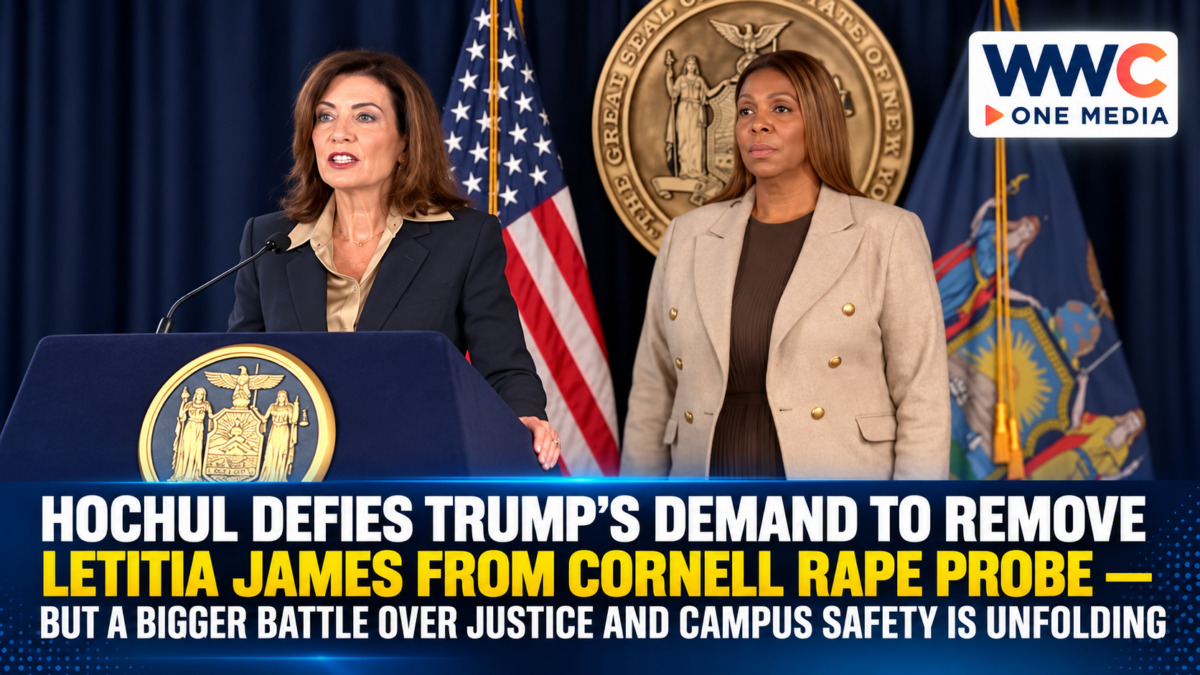
NEW YORK, UNITED STATES — October 14, 2026 — New York Governor Kathy Hochul is defending her decision to appoint Attorney General Letitia James to lead a renewed investigation into sexual-assault allegations at Cornell University, escalating a political confrontation with President Donald Trump as the case dominates debate in the state’s gubernatorial election.
The controversy intensified during a televised debate on October 13 between Hochul and Republican challenger Bruce Blakeman.
Blakeman accused the Democratic governor of failing to act sooner over allegations involving a former Cornell student who says she was sexually assaulted by multiple men at a fraternity house in October 2024.
Hochul defended her response and her decision to remove the local district attorney from the criminal investigation.
The dispute took on a national political dimension when Trump demanded James’ removal, questioning her credibility and impartiality.
The president has a long history of legal and political confrontations with James, whose office brought a civil fraud case against him.
But the Cornell case raises questions extending well beyond the political rivalry.
A former student alleges she was sexually assaulted after being given drugs at a fraternity gathering. The local prosecutor initially declined to pursue criminal charges, and the university’s handling of the allegations has faced intense scrutiny.
Cornell has since suspended fraternity parties for the remainder of the academic year and commissioned an independent review of its procedures.
Hochul says reopening the case under new leadership is necessary to restore public confidence. But the bigger question is whether political interference allegations and institutional failures will complicate the pursuit of an independent, credible investigation.
Hochul Faces Blakeman in Heated New York Governor Debate
The Cornell controversy became one of the most contentious exchanges during the October 13 gubernatorial debate in New York City.
Hochul, the Democratic incumbent, faced Republican challenger Bruce Blakeman in their only scheduled debate.
Blakeman questioned her leadership and accused her of failing to protect students at Cornell.
He pointed to Hochul’s position as an ex-officio member of Cornell’s board of trustees and argued that she should have acted sooner when concerns about the investigation emerged.
He also raised questions about the university’s receipt of state funding.
The Republican candidate portrayed the delay as a failure of accountability.
Hochul rejected the attempt to make her personally responsible for the alleged conduct at a fraternity.
She defended the steps taken by her administration after new information raised concerns about the original investigation.
The debate underscored the competing arguments surrounding the case.
Blakeman focused on the timing and adequacy of Hochul’s response.
Hochul emphasized the need for a fresh investigation capable of restoring confidence in the justice process.
Trump Demands Letitia James Be Removed
President Trump entered the controversy by publicly attacking James’ appointment.
In an October 13 social media statement, he argued that the attorney general lacked credibility and should not lead the Cornell investigation.
Trump demanded that Hochul remove James and replace her with another prosecutor.
The president’s criticism follows years of conflict with the New York attorney general.
James previously pursued legal action against Trump’s business interests, and the two have repeatedly accused one another of political motivations.
Those disputes provide context for Trump’s intervention.
However, past political disagreements do not independently establish that James is legally disqualified from overseeing the Cornell case.
Whether there is a valid conflict or other basis for removing her must be assessed according to applicable legal standards.
Trump’s demand is not itself a court order and does not automatically change the appointment.
Why Hochul Appointed Letitia James
Hochul appointed James as special prosecutor on October 1.
The decision followed new scrutiny of the original Cornell police investigation and the Tompkins County District Attorney’s decision not to prosecute.
The local prosecutor, Matthew Van Houten, had initially declined to bring criminal charges.
As new details emerged from the woman’s civil lawsuit and public reporting, questions grew over what information investigators had considered.
Hochul said those developments undermined her confidence in the district attorney’s ability to handle the case.
She issued an executive order giving James authority to investigate the allegations and pursue criminal proceedings if the evidence warrants them.
The appointment also allows the attorney general’s office to present evidence to a grand jury when appropriate.
The objective, according to Hochul, is to ensure the case receives an independent and thorough examination.
However, the decision does not mean James has reached a conclusion about anyone’s guilt.
The renewed investigation must evaluate the evidence and applicable law.
What Is the Cornell Sexual-Assault Case About?
The allegations involve an incident at Cornell University’s Chi Phi fraternity house in October 2024.
A former female student, publicly identified by the pseudonym Jane Doe, alleges she was drugged and sexually assaulted by multiple men during a gathering.
She filed a civil lawsuit in September 2026 naming Cornell University, the fraternity and several individuals.
The lawsuit contains allegations about what happened during the evening and how the university subsequently responded.
The individuals accused dispute aspects of the allegations.
No criminal charges had been filed in connection with the alleged assault as of October 14.
The distinction is essential.
The existence of a civil lawsuit does not establish that the alleged offenses occurred exactly as described.
Likewise, the absence of criminal charges does not, by itself, resolve the underlying factual questions.
The investigation must determine whether the available evidence supports criminal proceedings.
Why the Original Investigation Is Under Scrutiny
Cornell’s campus police received a report concerning the alleged incident in 2024.
The matter was subsequently reviewed by local prosecutors.
Van Houten’s office initially decided not to pursue criminal charges.
After the former student filed her civil lawsuit in September 2026, new questions arose about information supplied to prosecutors and the basis for the original decision.
The woman’s lawyer argued that important details had not been adequately reflected in the investigative materials.
Van Houten later announced that the case would be reopened.
But Hochul subsequently reassigned the criminal investigation to James.
The central issue is whether the original process adequately examined the complainant’s account, gathered relevant evidence and applied New York law.
A reopened investigation allows those questions to be considered again.
It does not mean prosecutors are required to file charges regardless of the evidence.
New York’s Sexual-Assault Laws Face Renewed Debate
The case has also prompted discussion about how New York law addresses sexual activity involving intoxication or incapacitation.
Consent and the legal meaning of incapacity can become central questions in criminal investigations.
However, each case depends on its particular facts and the laws applicable at the time.
Public discussion has focused on whether existing legal provisions adequately protect people who are unable to give meaningful consent.
Hochul has expressed support for examining possible legislative changes.
But changes in law would generally need to proceed through the legislative process.
They would not automatically determine the outcome of the current investigation.
A fair criminal process requires both a thorough examination of the complainant’s allegations and respect for the legal rights of those accused.
Cornell Suspends Fraternity Parties Through the Academic Year
Cornell University announced major changes on October 13.
President Michael Kotlikoff ordered an immediate suspension of parties and social events at houses belonging to the university’s Interfraternity Council.
The restriction will remain in place for the rest of the 2026–27 academic year.
Fraternities that violate the directive face emergency suspension.
The university said it would review whether and how fraternity social activities can safely continue.
Cornell is also seeking to develop alternative social activities for students.
The decision followed student protests and growing concern about campus culture and the handling of sexual misconduct complaints.
However, the suspension applies to fraternity-house social events; it is not a closure of Cornell University or a blanket prohibition on all student gatherings.
Cornell Calls in Former Deputy Attorney General Sally Yates
Cornell has also commissioned an independent institutional review.
Former US Deputy Attorney General Sally Yates and a team at law firm King & Spalding have been retained to examine the university’s policies and practices concerning sexual harassment and assault.
The review includes reporting procedures, student support, campus policing and fraternity oversight.
It is separate from the criminal investigation being led by James.
That distinction is important.
James’ role involves determining whether criminal proceedings are appropriate.
Yates’ team is examining institutional systems and potential reforms.
The two efforts may consider related facts but have different responsibilities.
Cornell has pledged cooperation and transparency.
However, Reuters reported that questions remain over how much of the independent review’s eventual findings will be made public.
Legal confidentiality and privacy considerations could affect disclosure.
Cornell Brings New York State Police Into Campus Safety Efforts
The university is also seeking greater involvement from the New York State Police in handling sexual-assault investigations.
The move is intended to improve independence and strengthen the response to serious allegations.
Cornell has announced additional survivor-support measures and changes to its campus services.
These steps may help address concerns about whether students trust existing reporting systems.
But the success of the reforms will depend on their implementation.
Announcing new procedures does not automatically resolve longstanding cultural or institutional problems.
Independent oversight, effective complaint handling and accessible support services will remain important.
A University Survey Raises Wider Concerns
The controversy has drawn attention to sexual misconduct beyond the individual case.
Reuters reported that a 2025 Cornell survey found 35% of undergraduate women reported experiencing non-consensual sexual contact involving force or incapacitation.
This is a campus survey result, not a statistic describing the number of reported crimes or criminal convictions.
It also should not be interpreted as evidence about the specific allegations involving Chi Phi.
Nevertheless, the findings underscore why students and faculty have called for stronger protections.
Sexual misconduct can affect students’ safety, educational experiences and confidence in university institutions.
Campus policies must address prevention, reporting and support, not solely the handling of high-profile cases after allegations become public.
Lawyers Challenge James’ Appointment
The controversy has also entered the courts.
Attorneys representing one of the accused men have challenged the appointment of James as special prosecutor.
They argue that comments she made before being appointed raise questions about impartiality.
The challenge asks a New York court to examine Hochul’s decision and James’ role.
Those arguments remain allegations within a legal proceeding.
They are not a judicial finding that James has acted improperly.
The attorney general’s office has defended the appointment.
Any decision to disqualify her would depend on the relevant legal standards and a court’s assessment.
This development reinforces the need to keep political criticism separate from established legal conclusions.
Why the Case Has Become a Political Flashpoint
The timing has made the Cornell controversy especially sensitive.
New York voters are approaching the November 2026 gubernatorial election.
Hochul is seeking another term, while Blakeman is attempting to persuade voters that the state needs new leadership.
Public safety, government accountability and institutional trust are important campaign issues.
Trump’s intervention has added a national political dimension.
Hochul has used her opposition to Trump’s policies as part of her broader political positioning.
Blakeman, meanwhile, has criticized her performance on crime, affordability and government management.
The Cornell case provides both campaigns with a highly visible example through which to make their arguments.
But the interests of the complainant and the accused should not be reduced to election strategy.
The investigation’s legitimacy depends on its independence from electoral considerations.
Could the Controversy Affect the Governor’s Race?
The debate exchange may influence how voters assess Hochul’s leadership.
Blakeman has emphasized her role as governor and Cornell trustee.
Hochul has focused on her decision to appoint a new prosecutor after confidence in the original investigation weakened.
Those arguments may appeal to different voters.
However, there is no verified evidence that the Cornell debate exchange alone has significantly changed the election outcome or polling.
Any such claim would require reliable polling or other electoral data.
For now, the case has become part of a wider political contest involving affordability, immigration, crime and the candidates’ relationships with Trump.
The Bigger Question: Who Should Investigate Campus Allegations?
The Cornell controversy highlights a broader challenge confronting universities across the United States.
Campus police, university administrators and local prosecutors may have overlapping responsibilities.
Universities also maintain disciplinary systems that operate separately from criminal courts.
Those processes have different standards and objectives.
Disciplinary action against a student does not automatically establish criminal guilt.
Likewise, a prosecutor’s decision not to file charges does not necessarily mean an institution has no obligation to address misconduct or improve safety.
Effective systems require clear responsibilities, trained investigators and appropriate independent oversight.
They must also protect the confidentiality, dignity and legal rights of everyone involved.
The Cornell investigation could influence future debate over how those responsibilities should be divided.
What International Universities Can Learn
The case is relevant to universities beyond the United States, including higher-education institutions in Asia.
Universities need clear procedures for reporting sexual misconduct and supporting complainants.
They also need fair investigative processes and effective coordination with law-enforcement authorities.
Students should understand how complaints are handled and what protections are available.
Institutional independence matters because universities may face reputational or financial pressures when allegations involve prominent organizations or individuals.
However, the Cornell case does not establish misconduct by universities in other countries.
Its broader relevance lies in the importance of trustworthy procedures, transparent accountability and survivor support.
What Happens Next?
Several developments will determine the future of the case.
Special prosecutor’s investigation: James’ office will continue reviewing evidence relating to the 2024 allegations.
Legal challenge: The courts may address the attempt to remove James from the investigation.
Cornell’s independent review: Yates’ team will examine the university’s procedures and institutional response.
Fraternity restrictions: Cornell’s suspension of Interfraternity Council house parties will remain in effect for the rest of the academic year unless the university changes its directive.
Campus reforms: University leaders will face pressure to demonstrate that new protections are working.
New York election: Hochul and Blakeman will continue campaigning ahead of the November vote.
None of these developments should be assumed to establish criminal guilt before the relevant legal processes have concluded.
The Bigger Question: Can Cornell’s Investigation Restore Public Trust?
The Cornell case has exposed tensions involving university accountability, criminal investigations and political leadership.
The former student’s allegations are serious and deserve a thorough investigation.
The individuals accused are entitled to due process and the presumption of innocence.
The university faces difficult questions about its internal systems.
The original prosecutor’s decisions are under scrutiny.
And New York’s governor is now defending her appointment of a new investigator against criticism from both her election opponent and the president.
Cornell has responded with a sweeping fraternity-party suspension and an independent institutional review.
But those steps will be judged by their results, not their announcements.
Hochul has rejected the political pressure surrounding her decision to put Letitia James in charge of the Cornell investigation. But the bigger test is still ahead: Can the renewed inquiry establish the facts and restore confidence in campus justice—or will legal challenges, institutional failures and political rivalries leave the case mired in another controversy?