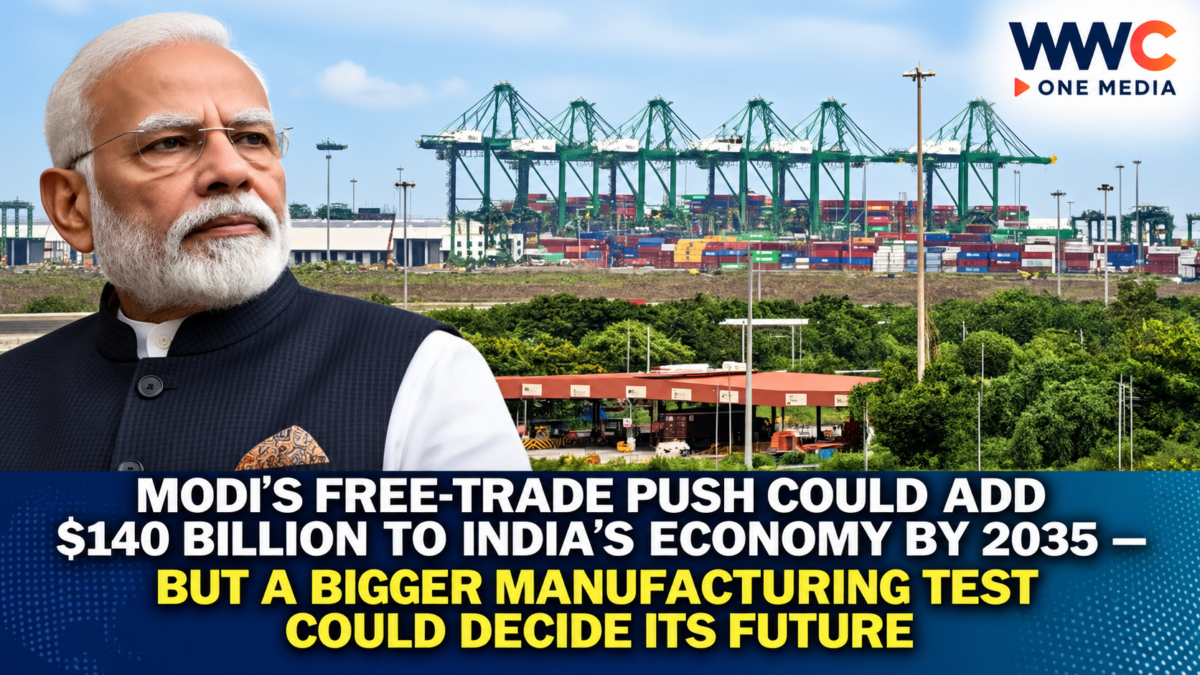
NEW DELHI, India — October 14, 2026 — Prime Minister Narendra Modi’s ambitious drive to negotiate free-trade agreements across the world could add approximately $140 billion to India’s annual economic output by 2035, giving Asia’s third-largest economy an opportunity to strengthen its position as global supply chains shift away from traditional trading relationships.
A new Bloomberg Economics study estimates that India’s expanding trade agreements could lift gross domestic product by 1.7% above the level otherwise expected in 2035.
The gains could rise to approximately $170 billion if India successfully concludes additional negotiations with major economic partners.
The analysis arrives at a pivotal moment for global trade.
US President Donald Trump’s tariff policies have encouraged companies and governments to reconsider their reliance on established export markets.
India is responding by pursuing greater access to Europe, the United Kingdom, New Zealand, the Middle East and other regions.
The country hopes lower trade barriers will encourage exports, attract foreign investment and accelerate the growth of its manufacturing sector.
But the Bloomberg Economics projections come with an important warning.
The trade agreements alone will not guarantee the estimated gains. India must improve its productivity, upgrade infrastructure and help millions of workers move into higher-value employment if it wants to turn international agreements into lasting prosperity.
Bloomberg Economics Sees a $140-Billion Opportunity
The October 12 study by Bloomberg economists Eleonora Mavroeidi, Abhishek Gupta and Maeva Cousin used a global economic model developed by the World Trade Organization.
The researchers analyzed the possible impact of India’s existing and planned trade agreements.
Their central scenario estimates that India’s GDP could be $140 billion higher in 2035 than it would have been without the relevant agreements.
The calculation is expressed in constant 2025 US dollars.
That means it is adjusted to avoid confusing inflation with real economic growth.
The forecast is not a claim that India will suddenly receive $140 billion in cash.
It also does not describe an additional $140 billion in government tax revenue.
Instead, it measures the projected increase in economic output during 2035 relative to a baseline scenario.
The distinction matters because India’s economy would be expected to grow over the coming decade even without these trade agreements.
The study attempts to calculate the additional benefit attributable to trade liberalization.
How Much Could India’s Trade Agreements Add to GDP?
| Trade-policy scenario | Estimated increase in 2035 GDP |
|---|---|
| Agreements already in force | +1.2% |
| Existing agreements plus EU and New Zealand | +1.7%, about $140 billion |
| Above scenario plus interim US agreement | +1.9% |
| Additional agreements with EAEU, GCC and Israel | +2.1%, about $170 billion |
The study also estimates that exports could grow substantially faster than GDP.
Under the central $140-billion scenario, export volumes could be approximately 6.2% higher than the baseline.
Under the wider trade-agreement scenario, exports could rise by almost 10%.
These are cumulative effects on the projected level of exports in 2035, not guaranteed annual export-growth rates.
The numbers depend on assumptions about tariff reductions, regulatory barriers, investment and economic responses.
Modi Is Redrawing India’s Global Trade Strategy
For years, India maintained a cautious approach to many free-trade negotiations.
Its government was concerned about protecting domestic manufacturing, agriculture and employment.
Those concerns have not disappeared.
However, the international trading environment has changed.
Countries increasingly want multiple trading partners to reduce their exposure to geopolitical disruption.
Companies are also seeking additional manufacturing locations and more resilient supply chains.
India has responded by accelerating negotiations and implementing new agreements.
The country has expanded ties with the United Arab Emirates, Australia, the United Kingdom, Oman, European Free Trade Association members and New Zealand.
It has also concluded negotiations with the European Union and is pursuing further arrangements with other partners.
For Modi, the objective is to position India as a major manufacturing, investment and services center.
But the strategy must compete with established export economies, including China and several Southeast Asian countries.
Trump’s Tariffs Could Create an Unexpected Opening
One of the study’s most significant findings concerns US trade policy.
The researchers estimate that the average American tariff rate increased from 2.3% in 2024 to approximately 10.7% by August 2026.
For Indian goods exported to the United States, the estimated average tariff increased from 2.4% to 11.6%.
These higher barriers could reduce India’s goods exports to the US by about one-fifth relative to the previous tariff regime by 2035.
That would represent a substantial loss of potential trade.
However, the study suggests the overall GDP impact could remain limited if India successfully expands exports elsewhere.
The researchers estimate that less than 2% of Indian economic output directly depends on US markets.
That does not mean the US is unimportant.
It remains a major destination for Indian exports and an important source of investment and technology.
The conclusion is that diversification could reduce the economy’s vulnerability to tariffs imposed by any single trading partner.
India–EU Trade Deal Could Be a Game Changer
The European Union is among India’s most important potential trade partners.
In January 2026, India and the EU concluded negotiations on a major free-trade agreement after years of discussions.
The arrangement could improve access to markets for manufactured goods, services and other products.
India’s government has described the agreement as an opportunity for exporters, small businesses and technology companies.
European manufacturers could also benefit from improved access to India’s large consumer market.
The agreement covers a trading relationship involving approximately two billion people.
However, completion of negotiations is not the same as full legal implementation.
The agreement must go through the applicable signing, approval and implementation procedures.
Bloomberg Economics assumes the deal takes effect from 2027 for its central model.
If implementation is delayed or provisions change materially, the actual economic benefits could differ from the projections.
The UK Agreement Is Already in Force
India has also strengthened its trading relationship with Britain.
The UK–India free-trade agreement was signed in 2025 and entered into force on July 15, 2026.
The British government’s long-term impact assessment estimates that the deal could raise India’s GDP by approximately 0.06% compared with a world without the agreement.
That corresponds to around £5.1 billion in additional annual output under the assessment’s assumptions.
For Britain, the government estimates a long-run GDP gain of approximately 0.13%, equivalent to £4.8 billion annually.
The UK analysis also projects higher bilateral trade.
These estimates are separate from the broader Bloomberg Economics calculation and use their own models and reference periods.
They should not be added directly to the $140-billion figure as though they represent an unrelated gain.
Both studies attempt to estimate economic effects arising from international trade agreements.
India–New Zealand Agreement Begins October 20
Another important milestone is approaching.
India and New Zealand signed their free-trade agreement on April 27, 2026.
Both countries have completed their domestic ratification procedures.
The agreement is scheduled to enter into force on October 20, 2026 — six days after this article’s publication date.
According to the Indian government, the agreement provides zero-duty access for all qualifying Indian exports to New Zealand from the beginning of implementation.
Potential beneficiaries include textile producers, footwear manufacturers, engineering businesses and agricultural processors.
The agreement also includes provisions relating to services, investment and professional mobility.
India’s government has cited an investment commitment of $20 billion over 15 years.
However, that represents a commitment or investment objective under the arrangement, not money already invested.
The precise economic impact will depend on how extensively businesses use the new market-access opportunities.
New Zealand Deal Protects Sensitive Indian Agriculture
Free-trade agreements often create domestic political concerns.
Lower import barriers can benefit consumers and manufacturers but may increase competition for local producers.
India has historically been cautious about opening sensitive agricultural markets.
Dairy is particularly important because millions of households depend on livestock and small-scale farming.
The India–New Zealand agreement preserves protections for selected sensitive agricultural sectors.
That reflects the government’s attempt to balance market access with domestic economic concerns.
The design is significant because New Zealand is a major agricultural exporter.
The agreement shows that India is willing to expand international trade while negotiating exclusions and safeguards for politically sensitive industries.
However, protective measures can also reduce the total economic benefits that might otherwise arise from broader liberalization.
Why the Gulf and Eurasian Markets Matter
India is seeking additional agreements with the Gulf Cooperation Council, Eurasian Economic Union and Israel.
These markets offer different economic opportunities.
Gulf countries are important partners in energy, investment, logistics and services.
Eurasian markets provide potential opportunities for manufacturing exports and regional supply-chain development.
Israel has established industries in technology, agricultural innovation and other advanced sectors.
Bloomberg Economics estimates that concluding these additional agreements could raise India’s projected GDP gain from 1.9% to approximately 2.1% when combined with the modeled US deal.
That would increase the potential benefit to roughly $170 billion by 2035.
However, these agreements have not all been finalized.
The expanded forecast is therefore more conditional than the central scenario.
A Potential US Deal Could Add Another Economic Boost
India and the United States have continued negotiating a trade arrangement.
The relationship has experienced significant volatility over tariffs and geopolitical disagreements.
But the two countries have also expressed interest in improving commercial cooperation.
Bloomberg Economics estimates that a modeled interim US agreement could add approximately 0.2 percentage point to India’s 2035 GDP gain.
The modeled arrangement assumes some easing of trade barriers and non-tariff restrictions.
However, it does not assume that all US tariffs disappear.
The researchers retain substantial duties on metals and certain other products.
That is important because the potential benefits depend on the specific terms negotiated.
A deal that looks substantially different from the modeled agreement could produce a different economic outcome.
The Bigger Challenge Is Manufacturing Productivity
Signing trade agreements is only the beginning.
Businesses must be capable of producing goods competitively and delivering them reliably.
India has invested heavily in roads, ports, manufacturing incentives and infrastructure.
It has also pursued tax reforms and measures designed to encourage investment.
But production costs, logistics efficiency and regulatory complexity remain challenges.
Bloomberg Economics modeled an additional scenario in which manufacturing efficiency improves sufficiently to reduce production costs by approximately 2%.
That could add around 0.5 percentage point to the GDP benefit in 2035, alongside an additional boost to exports.
The finding suggests that domestic reforms could be as important as diplomatic trade agreements.
Lower tariffs help companies access markets.
But efficient production determines whether they can win customers once those markets open.
India Must Move More Workers Into Higher-Value Jobs
One of the study’s most important findings concerns employment.
More than 40% of India’s workforce remains in agriculture, according to the Bloomberg Economics analysis.
Many agricultural workers are underemployed or work in relatively low-productivity activities.
The researchers compare India with Vietnam, where agriculture’s share of employment has declined substantially during industrialization.
Vietnam has also achieved strong improvements in agricultural productivity.
Bloomberg Economics modeled a scenario in which India achieves similar productivity gains and enables more workers to move into manufacturing and services.
That change could provide an additional GDP boost beyond the trade-agreement benefits.
But such a shift cannot happen automatically.
Workers need education, practical training, transport, housing and access to new employment opportunities.
Manufacturers must also generate enough jobs to absorb people moving out of low-productivity sectors.
Without these conditions, the benefits of trade expansion may be unevenly distributed.
What the Study Means for Indian Exporters
Businesses producing textiles, clothing, footwear, machinery, chemicals and other goods could benefit from lower tariffs and better market access.
But opportunities will vary by product and destination.
Some agreements may introduce tariff reductions gradually rather than immediately.
Others contain rules of origin requiring a minimum level of local production before goods qualify for preferential treatment.
Exporters must understand those requirements.
They must also comply with safety, quality, environmental and labeling regulations in importing countries.
Smaller businesses may face higher relative compliance costs.
For India’s trade strategy to succeed, government agencies and industry groups may need to help smaller exporters understand and use the agreements.
The strongest gains will likely come when improved market access is combined with investment, technology and competitive manufacturing.
Imports Will Also Increase
Free-trade agreements are often discussed primarily in terms of exports.
But their economic effects also include greater imports.
Lower tariffs can make foreign machinery, intermediate products and consumer goods more affordable.
Indian manufacturers may benefit from less expensive equipment and components.
Consumers may gain access to a greater variety of products.
However, domestic businesses could face stronger competition.
Some firms may need to modernize operations or adjust their product offerings.
This is why the distribution of benefits matters.
An economy can gain overall even while some sectors experience short-term pressure.
Effective training and transition support can help reduce the economic costs faced by affected workers and communities.
IMF Says Trade Reform Could Strengthen India’s Growth
The International Monetary Fund has also emphasized the potential benefits of trade liberalization.
In its India Article IV consultation, the IMF argued that lowering external trade barriers and negotiating high-quality agreements could help attract foreign investment.
It also identified the importance of integrating Indian companies more deeply into international production networks.
This supports the broad economic logic behind Modi’s strategy.
However, the IMF has also stressed the importance of domestic structural reforms.
Trade agreements can encourage growth, but they cannot substitute for productivity improvements, infrastructure development or labor-market reform.
The IMF’s analysis is therefore consistent with the central lesson of the Bloomberg Economics study: policy implementation matters as much as signing agreements.
WTO Warns Against a Fragmented Global Trade System
The World Trade Organization’s 2026 World Trade Report provides another important perspective.
It warns that a global economy divided into rival trading blocs could suffer major economic losses.
The WTO estimates that severe geopolitical fragmentation could reduce world GDP by approximately 5.1% under one modeled scenario.
It also estimates significant losses in a world where the multilateral trading system disappears and is replaced entirely by separate free-trade agreements.
This creates a broader policy lesson.
Bilateral and regional agreements can help individual countries find new opportunities.
But they are not a perfect substitute for a stable, rules-based international trading system.
India may benefit from expanding its trade partnerships while continuing to support predictable global commerce.
What This Means for China and Southeast Asia
India’s trade expansion could influence competition for manufacturing investment across Asia.
Companies seeking to diversify production may compare India with Vietnam, Thailand, Indonesia, Malaysia and the Philippines.
Potential investors consider labor availability, trade preferences, electricity costs, logistics and regulatory certainty.
India has advantages in market size, workforce availability and domestic demand.
Southeast Asian economies have established strengths in electronics, automotive components and export manufacturing.
Greater competition could encourage investment reforms across the region.
However, India gaining trade benefits does not automatically mean every Southeast Asian country will lose investment or exports.
Regional production networks can be complementary.
Some manufacturers may expand operations in several countries rather than choosing one exclusive location.
What the Philippines Should Watch
India’s trade push is relevant to the Philippines because both countries compete for international investment while participating in global services and manufacturing networks.
India is a major competitor in information technology and business-process services.
It is also expanding manufacturing ambitions.
Philippine businesses may face stronger competition in certain export markets.
But India’s growing economy could also generate opportunities for Philippine suppliers, technology companies and service providers.
The most important lesson concerns implementation.
Trade agreements can support growth, but businesses also need reliable energy, efficient ports, skilled workers and clear regulations.
The Philippines has its own trade arrangements, including ASEAN agreements and partnerships with major economic markets.
Strengthening business competitiveness will determine how much value local companies extract from those agreements.
However, the Bloomberg study does not provide a specific forecast of how India’s trade strategy will affect Philippine GDP.
Any numerical claim about local gains or losses would require separate research.
Why Investors Are Paying Attention
The study could influence investment expectations for Indian companies exposed to exports, manufacturing, logistics and infrastructure.
Potential beneficiaries may include businesses that gain access to new markets or attract foreign investment.
But the benefits will not arrive equally or immediately.
Tariff reductions are often phased in.
Companies may face upfront costs for expanding production capacity.
Currency movements, interest rates and commodity prices can also affect earnings.
Stock-market investors should therefore distinguish between long-term economic potential and near-term corporate profitability.
A $140-billion projected GDP gain for the entire Indian economy is not equivalent to $140 billion in additional profits for publicly traded companies.
Individual investment decisions require company-specific analysis.
What Happens Next?
Several milestones will determine whether the projection becomes reality.
October 20, 2026: The India–New Zealand free-trade agreement is scheduled to enter into force.
EU implementation: India and the European Union must complete the necessary procedures to bring their agreement into operation.
US negotiations: A potential interim agreement could reduce commercial uncertainty and provide additional market access.
Gulf and Eurasian negotiations: Further agreements could expand the geographic reach of India’s export strategy.
Manufacturing reforms: Infrastructure, logistics and technology investment will affect competitiveness.
Employment transitions: Policies that help workers move into higher-productivity sectors could substantially increase economic gains.
Export performance: Actual trade flows will reveal how successfully businesses use new agreements.
These developments will determine whether India’s trade strategy achieves the gains modeled by Bloomberg Economics.
The Bigger Question: Can India Turn Trade Deals Into a Manufacturing Breakthrough?
India’s latest trade push represents a significant shift in economic strategy.
Instead of relying primarily on its large domestic market, the government is seeking deeper commercial relationships across Europe, Asia and the Middle East.
The potential rewards are substantial.
Bloomberg Economics estimates that existing and planned trade agreements could add approximately $140 billion to the country’s 2035 GDP.
Additional agreements could lift the figure to around $170 billion.
But these numbers are conditional.
The analysis assumes that agreements are implemented, trade barriers decline and businesses respond by investing and expanding production.
India must also address the challenges that have limited manufacturing productivity and the movement of workers into higher-value employment.
Global trade opportunities are becoming more competitive as countries attempt to secure investment and diversify supply chains.
The winners may be those that combine market access with efficient infrastructure, skilled labor and regulatory certainty.
Modi’s free-trade strategy could add $140 billion to India’s economy by 2035 and help protect it from rising US tariffs. But the bigger test lies beyond signing agreements: Can India transform market access into millions of productive jobs and globally competitive factories — or will infrastructure bottlenecks and unfinished reforms prevent the country from fully capturing its opportunity?