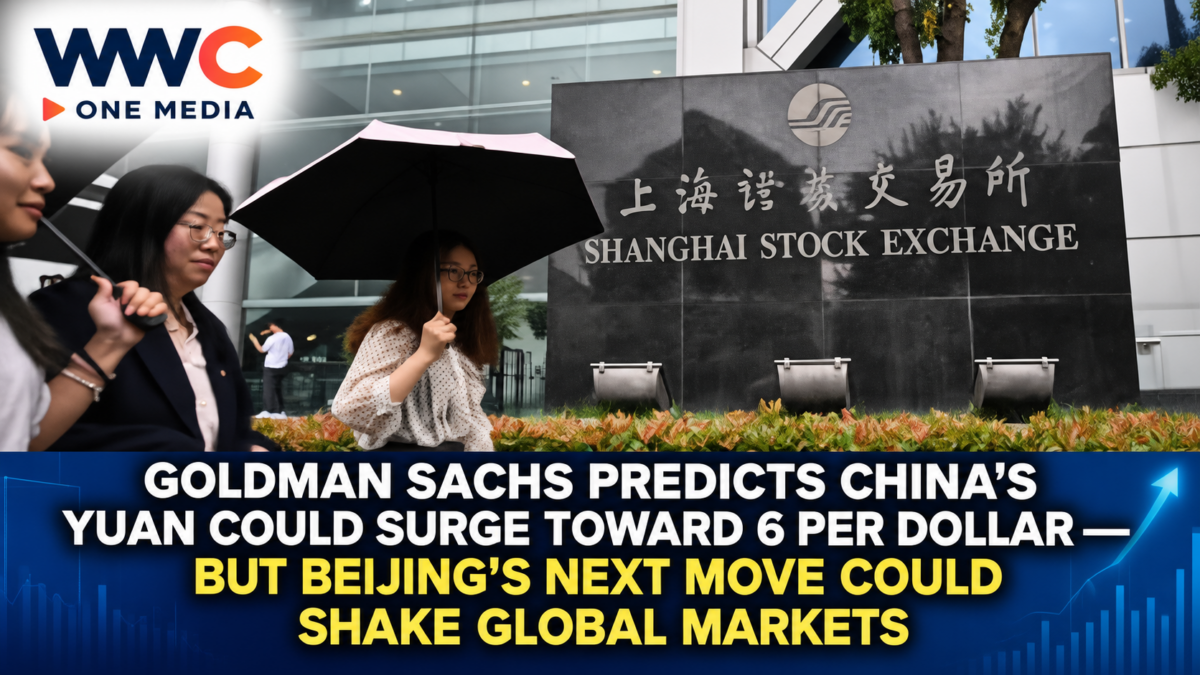
HONG KONG / BEIJING — October 14, 2026 — Goldman Sachs is making a bold call on China’s currency, warning that global investors may be seriously underestimating how much further the yuan could rise against the US dollar.
The Wall Street investment bank expects the Chinese currency to strengthen to 6.40 yuan per dollar within the next 12 months, compared with approximately 6.69 when the forecast was reported.
Its currency valuation models suggest that the yuan could eventually approach 6 per dollar, a level last seen in early 2014.
The forecast, reported by Bloomberg on October 12, challenges the view that China’s weak domestic demand, low interest rates and managed exchange-rate system will prevent substantial appreciation.
Goldman Sachs’ global head of foreign exchange, rates and emerging markets strategy research, Kamakshya Trivedi, argues that China’s huge trade surplus points to a currency trading well below its fundamental value.
His team estimates that the yuan is undervalued by approximately 20% to 25% — and he considers that assessment conservative.
But the bank’s bullish outlook is far from universally accepted.
Other investment houses expect Beijing to limit currency appreciation to protect exporters and maintain economic stability.
The result is an increasingly important debate over the future of one of the world’s most influential currencies.
China’s yuan has already strengthened considerably, yet Goldman Sachs believes the market is missing an even bigger opportunity. But whether that rally materializes may depend less on Wall Street’s forecasts than on how far Beijing is willing to let its currency rise.
Goldman Sachs Sees Yuan at 6.40 Within a Year
Goldman’s latest forecast represents a further upward revision to its expectations for the Chinese currency.
In May, the bank raised its 12-month yuan forecast to 6.50 per dollar.
Its October analysis goes further, projecting 6.40 within a year.
That would represent approximately 4.5% appreciation against the dollar from the 6.69 reference level.
In currency markets, the yuan strengthens when the USD/CNY exchange rate declines.
For example, at 6.69, one US dollar purchases 6.69 yuan.
At 6.40, it purchases only 6.40 yuan.
This means the Chinese currency has become more valuable relative to the dollar.
Goldman’s assessment is particularly notable because it goes against more conservative market expectations.
Trivedi believes investors have been slow to recognize the implications of China’s external financial position.
However, the bank’s official 12-month forecast is 6.40, not 6.00.
The lower exchange-rate level is a potential longer-term outcome suggested by its valuation models, rather than a guaranteed target for October 2027.
Is China’s Currency Really Undervalued by 25%?
Goldman Sachs’ estimates suggest that the yuan is trading substantially below its theoretical fair value.
Currency valuation models consider factors such as purchasing power, international trade balances, prices and other economic variables.
A currency with a persistent trade surplus may face appreciation pressure because exporters earn foreign currency and can convert those earnings into domestic money.
But foreign-exchange markets do not operate solely on trade flows.
Interest rates, capital movements, economic confidence and government policies also influence exchange rates.
Goldman’s 20%–25% undervaluation estimate therefore does not mean the yuan will automatically gain that amount.
It is an assessment of the difference between market prices and the bank’s estimated equilibrium value.
A currency can remain undervalued for years if other economic forces offset pressure for appreciation.
China’s Massive Trade Surplus Strengthens the Argument
One of the main reasons behind Goldman’s optimism is the scale of China’s trade surplus.
Official figures show that the country’s surplus reached approximately $805.5 billion during the first eight months of 2026.
China also recorded a record merchandise trade surplus of nearly $1.2 trillion in 2025, according to Reuters.
These figures reflect its continuing strength in manufacturing and exports.
Chinese companies sell products across international markets, generating substantial foreign-currency revenues.
The growing importance of advanced manufacturing, electric vehicles, industrial machinery and technology products has strengthened the export base.
Goldman argues that these developments support a stronger yuan.
However, a large trade surplus does not guarantee currency appreciation.
Chinese exporters may hold dollar earnings offshore, while domestic investors may seek overseas assets.
Those capital flows can counterbalance trade-related demand for yuan.
Europe Wants China to Allow a Stronger Currency
China’s currency policy has become a major international trade issue.
European policymakers argue that the yuan’s valuation contributes to an uneven competitive environment for manufacturers.
The European Union recorded a merchandise trade deficit with China of approximately €360.6 billion in 2025, according to EU figures cited by Reuters.
That was about 15% larger than the previous year’s deficit.
German Chancellor Friedrich Merz has suggested that the yuan could be undervalued by 25% to 30%.
European officials worry that a weak Chinese currency makes exported goods relatively inexpensive in international markets.
A stronger yuan could raise the foreign-currency cost of some Chinese products and help reduce certain competitive pressures.
But the relationship is complicated.
Export prices also depend on productivity, profit margins, sourcing and supply-chain efficiency.
Currency appreciation alone would not necessarily eliminate the trade imbalance.
Beijing Rejects Claims of Currency Manipulation
China’s central bank has pushed back strongly against accusations that it deliberately keeps the yuan weak.
In an October 8 statement, the People’s Bank of China said it does not pursue competitive currency depreciation to gain an advantage in trade.
The central bank argued that China’s export performance reflects industrial competitiveness rather than a policy of currency manipulation.
It also rejected the idea that exchange rates alone explain structural trade imbalances.
Beijing maintains that market forces play an important role in determining the yuan’s value, while acknowledging its managed exchange-rate framework.
The central bank has emphasized the importance of flexibility and movements in both directions.
These statements are significant because Goldman Sachs believes Chinese policymakers may be growing more comfortable with currency appreciation.
That interpretation remains the bank’s assessment.
It is not an official Chinese commitment to let the yuan reach Goldman’s target.
China’s Yuan Has Already Strengthened Substantially
The yuan’s recent performance helps explain why investors are debating its next move.
Reuters reported that the currency had risen nearly 9% against the US dollar over approximately 20 months by late August.
It also reported that the yuan had gained about 4% against the dollar during 2026 as of October 8.
The strengthening has occurred despite China’s relatively low domestic interest rates.
That suggests external trade flows and other factors have supported the currency.
Goldman believes the appreciation could continue.
But the pace is important.
Beijing may prefer a gradual increase that gives exporters and financial markets time to adjust.
A sudden appreciation could disrupt business planning and create volatility.
Other Banks Are Much Less Bullish
Not everyone agrees with Goldman’s forecast.
Reuters reported in August that the median year-end forecast among 12 global investment banks was around 6.68 yuan per dollar.
That was far less aggressive than Goldman’s 12-month projection of 6.40.
HSBC expected the currency to remain close to 6.72 by the end of 2026.
Macquarie also forecast approximately 6.72.
Morgan Stanley’s economists argued that domestic economic weakness and the central bank’s preference for stability could limit further gains.
These forecasts have different horizons and were issued at different times, so they should not be compared as though they refer to the same future date.
Nevertheless, they demonstrate substantial disagreement about how quickly the yuan can appreciate.
The difference largely reflects contrasting expectations for Chinese policy, capital flows and the US dollar.
The People’s Bank of China Could Slow the Rally
Unlike currencies that float freely, China’s onshore yuan trades within a managed exchange-rate system.
The People’s Bank of China announces a daily reference rate, around which the currency can trade within a prescribed band.
Authorities can also influence market expectations through communication and financial-market operations.
Reuters reported in August that Chinese policymakers appeared to be restraining the yuan’s rise.
The central bank had been setting reference rates weaker than market models implied.
State-owned banks were also reported to have purchased dollars, according to people familiar with the transactions.
These developments suggested that Beijing wanted to prevent rapid appreciation.
The central bank has not confirmed that its objective is to defend a specific exchange-rate level.
But investors know that policy decisions can affect both the speed and extent of currency movements.
This is one of the biggest risks to Goldman’s forecast.
Weak Chinese Consumer Demand Remains a Major Obstacle
China’s export strength contrasts with persistent weaknesses in parts of its domestic economy.
Consumers remain cautious, and confidence has been affected by problems in the property sector.
Low domestic interest rates have also reduced the income investors can earn from yuan-denominated deposits and bonds.
When overseas assets offer higher returns, some investors may prefer to move capital abroad.
That creates potential downward pressure on the currency.
A stronger yuan could also reduce the value of exporters’ dollar earnings when converted into domestic currency.
For businesses operating on thin margins, the impact can be significant.
Chinese policymakers therefore face competing priorities.
They want to preserve trade competitiveness and support economic growth.
But they also want a credible currency and more balanced international economic relationships.
A Stronger Yuan Could Help Chinese Consumers
Currency appreciation has potential benefits for China’s domestic economy.
A stronger yuan can reduce the local-currency cost of imported goods priced in dollars, assuming other factors remain unchanged.
That can benefit companies purchasing foreign machinery, energy products and raw materials.
Consumers may also face lower costs for imported products and overseas travel.
Currency strength can improve the foreign-currency purchasing power of households and businesses.
However, those benefits must be balanced against potential pressure on exporters.
For a major manufacturing economy, the net effect depends on how domestic spending, trade volumes and investment respond.
This is why a gradual appreciation path could be more attractive to Beijing than a sudden currency surge.
Could a Stronger Yuan Attract More Foreign Investment?
Goldman Sachs believes an appreciating currency could improve returns for investors holding Chinese assets.
Consider an international investor who purchases a Chinese stock.
The investment’s final return depends on both the stock’s performance and the exchange rate when proceeds are converted into the investor’s home currency.
If the stock price remains unchanged in yuan but the yuan appreciates, a US-dollar investor could still benefit from the currency movement.
The opposite is also true.
A falling yuan can reduce dollar returns even when a Chinese asset performs well locally.
An expectation of sustained appreciation could therefore make Chinese bonds and equities more attractive to some international investors.
However, foreign investment also depends on economic fundamentals, market access, regulation and geopolitical confidence.
Currency expectations alone are insufficient.
Yuan Internationalization Becomes a Bigger Priority
China has long sought to increase the yuan’s role in global trade and finance.
Its objective is to reduce dependence on the US dollar for certain international transactions.
Goldman Sachs believes gradual currency appreciation could support that ambition.
A currency viewed as stable and capable of preserving value may become more attractive for international settlement, borrowing and investment.
China has expanded cross-border yuan settlement arrangements and promoted the currency’s use in trade.
However, becoming a major global reserve currency involves more than exchange-rate performance.
Investors also consider financial-market openness, capital mobility, legal protections and liquidity.
The US dollar remains the dominant global reserve currency.
A stronger yuan might support China’s internationalization goals without displacing the dollar in the foreseeable future.
What a 6.00 Yuan Could Mean
Goldman’s valuation models point toward a possible exchange rate around 6 yuan per dollar over a longer horizon.
From 6.69, reaching 6.00 would imply approximately 11.5% appreciation in the yuan’s dollar value.
That would represent a considerable currency move.
The yuan last traded near that level in early 2014, during a period of substantial investment inflows.
But the economic environment today is different.
China is dealing with weaker domestic demand, changing international trade relationships and interest-rate differences with the United States.
A model suggesting an eventual 6.00 exchange rate does not provide a reliable date for reaching it.
Investors should distinguish a fair-value scenario from a near-term trading forecast.
US Dollar Strength Could Delay the Forecast
The yuan’s future also depends on the American economy.
Higher US interest rates can attract money into dollar-denominated assets.
Geopolitical uncertainty can also increase demand for the dollar as a widely used reserve and settlement currency.
Reuters and other outlets reported renewed dollar strength in October as investors responded to Middle East tensions and inflation concerns.
If the Federal Reserve keeps interest rates higher than expected, the dollar could remain strong.
That would complicate the yuan’s appreciation even if China’s trade surplus remains large.
Goldman’s forecast therefore depends on more than China’s domestic policies.
Global interest rates and investor sentiment also matter.
What a Stronger Yuan Means for Asia
China is a major trading partner for many Asian economies.
Currency appreciation can change relative prices for exports, imports and investment.
A stronger yuan may make some Chinese products more expensive in foreign-currency terms.
It can also make imported goods cheaper for Chinese buyers, potentially benefiting foreign suppliers.
The overall effects are not uniform.
Companies competing directly with Chinese exporters could gain some pricing flexibility.
Businesses importing Chinese components might face higher costs if suppliers adjust prices.
The impact depends on contracts, invoicing currencies and exchange-rate hedging.
Asian financial markets may also respond if a stronger yuan affects broader investor expectations for regional currencies.
What the Philippines Should Watch
The Philippines has significant trade links with China and depends on imported goods, equipment and industrial materials.
A sustained yuan appreciation could affect the pricing of Chinese imports, although the effect would depend on how contracts are denominated and whether suppliers change their prices.
For businesses purchasing goods priced directly in yuan, exchange-rate movements may influence costs.
For companies paying in US dollars, the outcome may depend more on exporters’ pricing decisions and the peso-dollar exchange rate.
Filipino travelers and businesses making yuan-denominated payments could also see changes in purchasing costs.
However, Goldman’s forecast does not establish a specific future USD/PHP or PHP/CNY exchange rate.
The peso follows its own market dynamics.
Any precise prediction of the impact on Philippine inflation or retail prices would require additional economic modeling.
What Could Push the Yuan Higher?
Several developments could support Goldman’s outlook.
China’s export surplus could remain large.
Trade partners might continue pressing for more balanced exchange rates.
Beijing could become more comfortable with a gradual currency rise.
Foreign investors could increase purchases of Chinese financial assets.
And a softer US dollar could make appreciation easier.
These factors could reinforce one another.
However, a strong trade surplus is not sufficient on its own to ensure the forecast is realized.
What Could Stop the Yuan Rally?
The largest risks include persistent weakness in Chinese consumer demand, continued capital outflows and policy intervention to limit appreciation.
A stronger-than-expected US dollar could also reduce the yuan’s gains.
Additional trade disputes might damage investor confidence.
A sharp slowdown in China’s economy could make policymakers more reluctant to tolerate an appreciating currency.
These developments would not necessarily invalidate Goldman’s estimates of long-term undervaluation.
But they could delay the adjustment or prevent the exchange rate from reaching the bank’s 12-month target.
The Bigger Question: Is the World Underestimating China’s Currency Power?
Goldman Sachs has made a striking argument about the future of the yuan.
Despite substantial appreciation, the bank believes the currency remains undervalued by 20% to 25%.
Its 12-month forecast calls for 6.40 yuan per dollar, with valuation models suggesting the possibility of a move toward 6 over a longer period.
China’s large trade surplus and growing strength in advanced manufacturing support that view.
But the outlook is complicated by domestic economic weakness, capital flows and Beijing’s preference for stability.
Other major banks remain significantly more cautious.
The result is an important dividing line in international finance.
Goldman sees an underappreciated currency opportunity.
Skeptics see an economy whose policymakers may not be prepared to permit a rapid currency adjustment.
Goldman Sachs believes China’s yuan could strengthen far more than investors expect, potentially reshaping returns on Chinese assets and international trade flows. But the biggest question may not be whether the currency is undervalued — it is whether Beijing will allow the yuan to rise far enough to prove Wall Street’s most bullish forecast right.