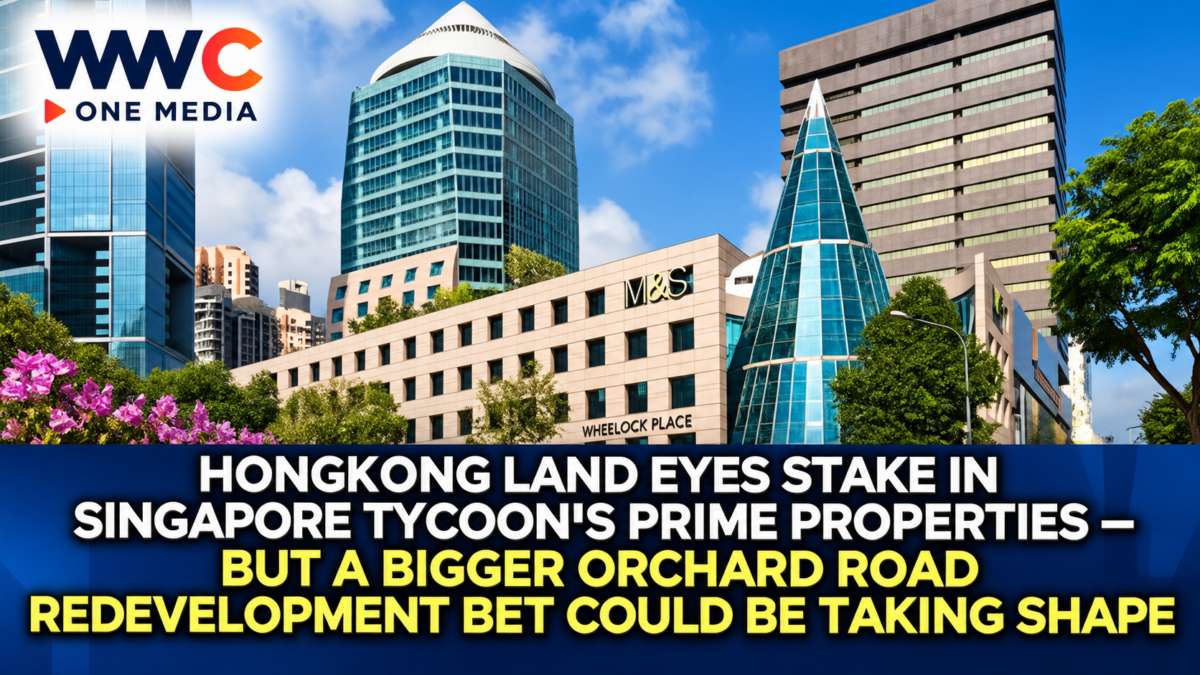
SINGAPORE — October 14, 2026 — Hongkong Land is reportedly exploring another major investment opportunity in Singapore’s premium property market, extending a multibillion-dollar expansion strategy that has already brought some of the city-state’s most valuable commercial buildings into its portfolio.
The potential transaction, reported by Bloomberg on October 14, comes as the Jardine Matheson-backed property group seeks to increase its exposure to high-quality commercial real estate and expand its investment-management business.
One significant opportunity in the market involves assets linked to Singapore property and hospitality tycoon Ong Beng Seng, whose Hotel Properties Limited (HPL) has been seeking partners for a major redevelopment along Orchard Road.
The proposed development involves Forum The Shopping Mall, voco Orchard Singapore and HPL House—three properties that could be transformed into a mixed-use complex featuring hotel, retail, office and residential space.
Earlier property-market reporting identified Hongkong Land as a potential strategic partner for HPL’s redevelopment ambitions.
However, Bloomberg’s October 14 article was not fully accessible for independent verification. Consequently, the identity of the tycoon and the precise target assets in that specific report cannot be established conclusively here.
No completed acquisition, agreed equity percentage or purchase price has been independently verified for the newly reported negotiations.
Nevertheless, Hongkong Land’s confirmed investments show why Singapore remains central to its strategy.
The company launched an S$8.2-billion private property fund in February, acquired a 10.8% stake in Suntec REIT in March and announced a S$1.1-billion acquisition of Wheelock Place in July.
Hongkong Land is building an increasingly powerful position in Singapore’s premium commercial-property market. But its next challenge may be more ambitious than purchasing established buildings: convincing investors that a major redevelopment can generate attractive returns without tying up too much capital.
Hongkong Land Pursues Another Singapore Property Opportunity
Hongkong Land’s latest reported interest in Singapore assets is consistent with its broader shift toward investment properties and fund management.
The company has been restructuring its business to focus on premium commercial developments in major Asian cities.
Instead of concentrating on building residential properties for sale, it increasingly favors owning, managing and investing alongside institutional partners in income-producing assets.
Singapore is a key market for this approach.
The city-state offers a large financial-services industry, a well-established legal framework and a concentration of multinational businesses.
Premium offices and centrally located retail developments can generate recurring rental income.
But such assets are expensive.
Competition among institutional investors can also make attractive acquisitions difficult to secure.
Hongkong Land’s strategy depends on identifying investments that deliver reasonable returns while supporting its wider fund-management business.
Ong Beng Seng’s Orchard Road Properties Offer a Major Redevelopment Opportunity
One of Singapore’s prominent redevelopment opportunities involves Hotel Properties Limited.
The company, associated with tycoon Ong Beng Seng, has explored plans involving three neighboring properties:
- Forum The Shopping Mall
- voco Orchard Singapore
- HPL House
The properties occupy a strategically important stretch of Orchard Road.
Earlier reporting in The Business Times identified Hongkong Land as a possible partner that could bring development expertise and institutional capital to the project.
Property-industry publication Mingtiandi also reported that HPL was in discussions with potential joint-venture partners concerning an equity stake in the proposed development.
However, those earlier reports do not, by themselves, confirm that Hongkong Land is the winning bidder or that a binding agreement has been reached.
The possibility of a partnership remains commercially significant because of the project’s location and scale.
Redevelopment Could Create a 1.23-Million-Square-Foot Complex
HPL previously received provisional permission from Singapore’s Urban Redevelopment Authority for a mixed-use project with approximately 1.23 million square feet of gross floor area.
The contemplated development could include hotel rooms, retail space, offices and residences.
Such a project would represent a major transformation of the existing properties.
Its commercial appeal lies in combining several income sources within one development.
Hotel operations could benefit from Singapore’s tourism and business-travel markets.
Retail tenants could benefit from foot traffic in Orchard Road.
Offices could serve companies seeking centrally located premises.
Residential units could provide another potential source of value.
But the project would also involve substantial capital commitments.
Its feasibility would depend on construction costs, final planning approvals, market conditions and the returns available to investors.
Provisional permission is not equivalent to a completed development or a guaranteed financial return.
Why Orchard Road Matters
Orchard Road is one of Singapore’s best-known shopping and hospitality districts.
The area contains major shopping malls, luxury hotels and mixed-use developments.
Its established transport connections and international profile make prime sites attractive to developers.
However, some older properties along Orchard Road face growing competition from newer buildings.
Redevelopment offers an opportunity to modernize those assets.
Developers may seek to create larger, better-connected complexes with updated amenities and more flexible commercial layouts.
That opportunity helps explain why institutional investors are interested in the district.
But major redevelopment also carries execution risk.
Construction delays, cost inflation and uncertain leasing demand can affect profitability.
A valuable address does not guarantee that every project will be financially successful.
Hongkong Land’s S$8.2-Billion Property Fund Changes Its Strategy
In February 2026, Hongkong Land established the Singapore Central Private Real Estate Fund, or SCPREF.
The fund began with approximately S$8.2 billion in assets under management.
Its portfolio included interests in several important Singapore commercial properties.
These included Marina Bay Financial Centre Towers 1 and 2, One Raffles Quay, One Raffles Link and Asia Square Tower 1.
Hongkong Land serves as the fund’s manager and general partner.
It also retained a majority ownership interest at inception.
Institutional investors include Qatar Investment Authority and APG Asset Management.
The fund structure allows Hongkong Land to manage a larger portfolio with capital contributed by outside partners.
The company can potentially earn management fees in addition to returns from its own investment.
This is central to its long-term transformation.
Fund Targets S$15 Billion in Assets
Hongkong Land wants SCPREF to grow substantially.
The original target was approximately S$15 billion in gross asset value within five years.
That would make the platform significantly larger than at launch.
The strategy involves acquiring high-quality commercial assets in Singapore’s central business district and Orchard Road area.
Such acquisitions could provide stable rental income while increasing the amount of property managed by the group.
However, growing assets under management is not the same as generating profit.
Returns depend on acquisition prices, occupancy, rental income, operating expenses and financing costs.
Fund investors will also expect appropriate distributions and long-term capital appreciation.
Hongkong Land therefore needs to balance expansion with investment discipline.
Wheelock Place Becomes a Major Acquisition
The fund’s expansion gathered momentum in July.
Hongkong Land announced that SCPREF would acquire Wheelock Place, an established commercial property on Orchard Road, for approximately S$1.1 billion.
The acquisition was agreed with Wharf Real Estate Investment Company.
Wheelock Place combines office and retail space in a prominent location.
The building’s position within Orchard Road makes it strategically relevant to Hongkong Land’s growing Singapore portfolio.
The company said the acquisition would support its investment-management strategy and increase its exposure to income-producing properties.
It also indicated that it would contribute additional equity to maintain its majority stake in the fund.
The acquisition illustrates how Hongkong Land can use its investment platform to pursue individual commercial properties.
But the announced Wheelock Place deal is separate from the newly reported potential stake involving a tycoon’s assets.
They should not be treated as the same transaction.
Hongkong Land Also Buys Into Suntec REIT
Another important step came in March 2026.
Hongkong Land acquired a 10.8% interest in Suntec REIT from ESR Group.
The acquisition cost approximately S$541 million.
Suntec REIT owns interests in offices and commercial properties in Singapore, Australia and the United Kingdom.
Its Singapore assets include interests in Marina Bay Financial Centre Towers 1 and 2 and One Raffles Quay.
Hongkong Land’s private fund also holds interests in those buildings.
The transaction increased Hongkong Land’s indirect exposure to high-quality commercial real estate.
It also demonstrated the company’s willingness to invest through listed property vehicles.
However, a 10.8% holding does not automatically provide control over Suntec REIT or its manager.
Those questions depend on shareholder rights and the trust’s governance arrangements.
Singapore Portfolio Expands Toward S$9.4 Billion
The announced Wheelock Place transaction was expected to raise SCPREF’s assets under management from S$8.2 billion to approximately S$9.4 billion, based on June 30, 2026 valuations.
That growth represents a significant early step toward the S$15-billion ambition.
It also shows why Hongkong Land may continue evaluating new investment opportunities.
The company is seeking scale.
A larger portfolio may allow it to spread management costs and strengthen relationships with institutional investors.
But each potential acquisition must still meet the fund’s investment criteria.
The company has not established that every major Singapore property being marketed will ultimately enter its portfolio.
Marina One Remains Another Major Deal to Watch
Hongkong Land has also been linked to Singapore’s Marina One commercial complex.
The Business Times reported on October 7 that market participants had been awaiting a possible acquisition of Marina One’s commercial component by the Hongkong Land-managed fund.
The reported asking price was approximately S$5.7 billion.
The asset comprises roughly 1.88 million square feet of premium office space and approximately 140,000 square feet of retail space.
Marina One was developed by M+S, a joint venture between Malaysia’s Khazanah Nasional and Singapore’s Temasek.
A transaction of that size could substantially increase SCPREF’s portfolio.
However, the reported asking price is not a completed sale price.
Nor has a definitive acquisition been independently confirmed in the reporting reviewed.
Potential investors must also consider how much additional equity or borrowing would be required to finance a deal of this scale.
Hongkong Land’s Bigger Goal: US$100 Billion in Managed Assets
The Singapore expansion is part of Hongkong Land’s Strategic Vision 2035.
The group aims to substantially increase investment-property assets under management, with a long-term target of US$100 billion.
It also intends to increase recurring earnings, recycle capital and improve shareholder returns.
The strategy reflects a broader transformation in Asian real estate.
Large property groups are increasingly seeking models in which they manage assets for institutional investors rather than finance every acquisition entirely from their own balance sheets.
This can potentially free capital for other investments.
It can also create recurring fee income.
However, the model depends on maintaining investor confidence and delivering competitive returns.
A large assets-under-management figure does not eliminate investment or operational risk.
What a Property Stake Could Mean for Ong Beng Seng
If a partnership involving HPL’s Orchard Road properties were confirmed, it could provide several possible benefits to the existing owners.
An outside investor might contribute development capital.
A specialist property manager could help plan commercial spaces and attract tenants.
A joint venture could also distribute the financial risks of a major project.
For an existing shareholder, such arrangements can potentially unlock the value of property holdings without requiring a complete sale.
However, ownership structures matter.
A minority stake provides different rights from a controlling interest.
A direct investment in particular buildings is different from buying shares in Hotel Properties Limited.
Until transaction documents are announced, those structures should not be treated as interchangeable.
Singapore’s Premium Property Market Faces a Valuation Test
Strong institutional interest in Singapore commercial buildings reflects the appeal of prime locations.
But property investment remains sensitive to interest rates and financing costs.
Higher borrowing expenses can reduce returns.
Developers must also assess expected rental growth and occupancy.
For a redevelopment, the financial challenge is even greater.
Existing rental income may be interrupted while buildings are demolished or reconstructed.
Construction costs can rise.
Project completion may take several years.
Investors must therefore estimate future income well in advance.
This is why the valuation and financing of any proposed Hongkong Land transaction will be especially important.
Could Institutional Investors Fund the Next Acquisition?
SCPREF’s structure gives Hongkong Land access to external institutional capital.
Its founding investors include major sovereign and pension-backed investment organizations.
The fund may raise additional capital to finance new acquisitions.
That could help Hongkong Land pursue larger transactions without using only its own cash.
However, raising capital is not automatic.
Institutional investors evaluate expected returns, liquidity, risks and the terms of each investment.
Large property acquisitions may also require debt financing.
Management must ensure that financing arrangements remain sustainable.
The company has not disclosed a finalized funding package for the newly reported potential transaction.
What the Expansion Means for Singapore
Hongkong Land’s investment activity contributes to a wider reshaping of Singapore’s commercial-property market.
Large assets are changing hands as established owners recycle capital and new investors seek exposure to premium locations.
Some buyers intend to operate buildings for long-term income.
Others see opportunities for refurbishment or redevelopment.
The transactions can influence competition among property owners, demand for construction services and the future appearance of major commercial districts.
However, announced acquisitions do not guarantee wider economic benefits.
The impact depends on the scale of investment, project delivery and actual tenant demand.
For Singapore, the most significant consequence may be the continued modernization of centrally located commercial properties.
What Philippine Property Investors Can Learn
Singapore’s institutional real estate market offers several lessons for property groups elsewhere in Southeast Asia.
Large commercial buildings can be held through private funds, listed property trusts or direct ownership structures.
Each model has different capital requirements and investor expectations.
In the Philippines, real estate investment trusts have also become an established financing and investment vehicle.
The Singapore experience illustrates how property companies may recycle capital while retaining asset-management responsibilities.
However, there is no verified direct connection between the newly reported Hongkong Land talks and a specific Philippine property transaction.
The broader relevance is the growing importance of capital-efficient ownership and recurring-income strategies.
What Happens Next?
Investors will be watching for confirmation of the potential Singapore stake acquisition.
Key questions include the identity of the target assets, the percentage interest being sought and the proposed valuation.
The investment vehicle also matters.
Hongkong Land could potentially invest directly or through one of its managed platforms, depending on the final structure.
Other issues include funding arrangements, planning requirements and the commercial objectives of the current asset owners.
Meanwhile, SCPREF is pursuing its existing growth strategy.
The progress of Wheelock Place and any Marina One transaction will remain important indicators of the company’s capacity to deploy capital.
Until a binding agreement is disclosed, the new deal should be described as a reported possibility rather than a completed investment.
The Bigger Question: Is Hongkong Land Building Singapore’s Next Property Powerhouse?
Hongkong Land has already made significant moves in Singapore in 2026.
Its new private fund began with S$8.2 billion in assets.
It acquired a major stake in Suntec REIT and announced a substantial investment in Wheelock Place.
The group has also been associated with interest in larger commercial properties.
Those developments demonstrate a clear shift toward building a scalable institutional real estate platform.
But expanding a portfolio is only the first part of the challenge.
The company must ensure that acquisitions generate attractive returns.
It must secure sufficient capital without increasing financial risks unnecessarily.
And if it pursues major redevelopment projects, it must demonstrate that future rental and development income can justify the costs.
Hongkong Land’s reported pursuit of another Singapore property stake could mark the next step in its transformation into a major institutional real estate manager. But the bigger question is whether the company can turn Singapore’s most prestigious addresses into sustained earnings growth—or whether expensive acquisitions and complex redevelopment projects will test the limits of its ambitious strategy.