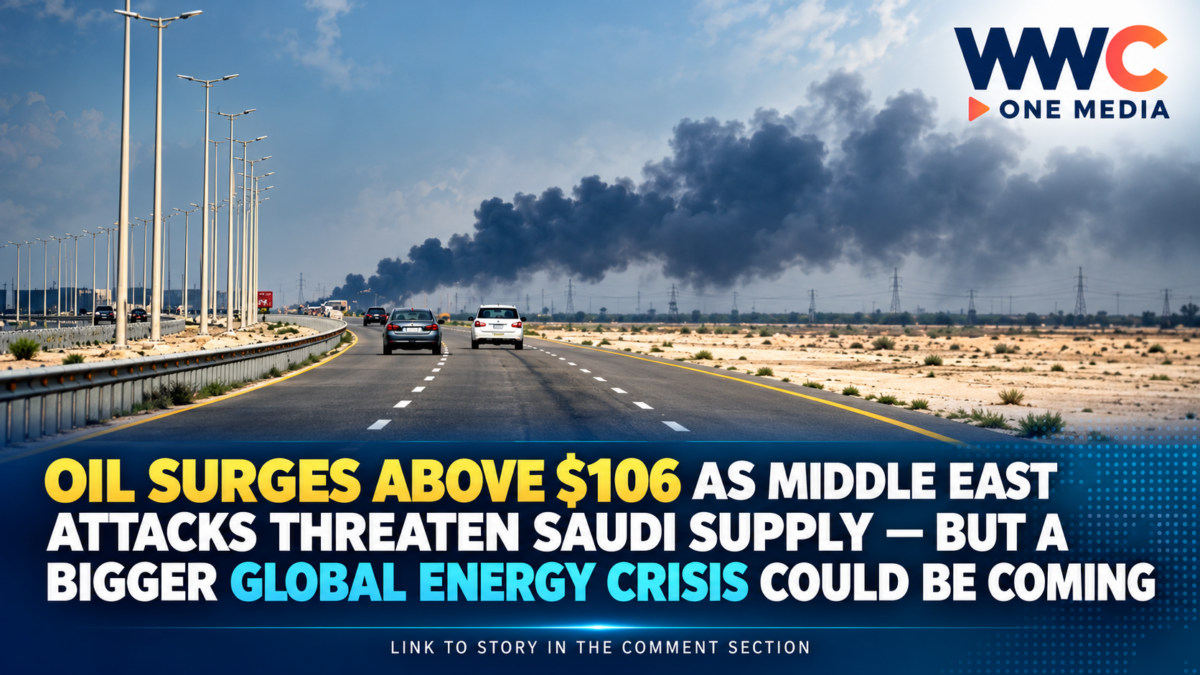
SINGAPORE / LONDON — October 14, 2026 — Global oil prices climbed above $106 a barrel on Wednesday as a fresh wave of attacks involving Saudi Arabia and Yemen’s Houthi movement reignited fears that escalating Middle East hostilities could disrupt critical energy supplies.
The renewed rally came despite expectations that additional Russian diesel exports could help ease tightness in global fuel markets, leaving traders caught between two competing developments: worsening security risks in the Persian Gulf and the possibility of additional petroleum supplies entering international markets.
Brent crude, the global oil benchmark, rose 89 cents to $106.58 a barrel in Wednesday’s trading, while US West Texas Intermediate (WTI) gained 80 cents to $94.94, according to Reuters.
The increase followed a period of volatility in which traders repeatedly reassessed threats to oil infrastructure, tanker movements and the stability of energy shipments from the Middle East.
With crude prices already elevated, any significant disruption to Saudi Arabian exports or shipping through the Strait of Hormuz could create additional pressure on fuel prices, inflation and economic growth worldwide.
The biggest concern is no longer simply whether oil prices will rise further — but whether regional military escalation could interrupt the fragile recovery in global energy flows.
Oil Prices Rebound as Supply Fears Intensify
Oil markets have experienced sharp price movements as investors respond to competing developments in the Middle East and Russia.
On Tuesday, October 13, Brent futures settled at $105.69 a barrel, down 0.9%, while WTI closed at $94.14, up 0.4%.
The mixed performance reflected investors taking profits after a powerful rally while continuing to monitor potential supply disruptions.
By Wednesday, prices had moved higher again.
The renewed increase suggested that geopolitical risks were regaining influence over market sentiment.
Oil traders are particularly sensitive to developments affecting Saudi Arabia because of the kingdom’s central position in global petroleum production and exports.
Although a military attack does not automatically translate into lost barrels, sustained threats can raise shipping, insurance and operating costs.
That uncertainty can encourage buyers to pay a premium for reliable near-term supply.
Saudi Arabia Faces Renewed Houthi Missile and Drone Attacks
The latest increase in oil prices followed reports of renewed missile and drone strikes launched by Yemen’s Iran-backed Houthi movement.
According to Bloomberg and Reuters, Saudi Arabia intercepted additional projectiles on Tuesday as the conflict showed little indication of easing.
Recent attacks have targeted transportation facilities and other locations in the kingdom.
Reuters also reported a limited fire at a Saudi Aramco administrative building in Dhahran following an attack.
The incident heightened concern about the potential exposure of the country’s energy sector to a widening conflict.
However, damage to an administrative building should not be confused with a confirmed shutdown of a major oil production facility.
The critical issue for international energy markets is whether future attacks could affect refineries, export terminals, pipelines or other infrastructure essential to maintaining crude shipments.
Saudi Arabia remains one of the world’s most important petroleum exporters, meaning disruptions to its energy operations can have consequences far beyond the Middle East.
Strait of Hormuz Becomes a Major Market Flashpoint
The security of oil shipments through the Strait of Hormuz is another central concern.
The narrow waterway connects the Persian Gulf with the Gulf of Oman and the wider international shipping network.
It is one of the world’s most strategically important energy transport routes, carrying crude oil, petroleum products and liquefied natural gas from major Middle Eastern producers.
Reports of attacks on commercial vessels have increased fears that maritime traffic could face further interruptions.
Even when tankers continue operating, security threats can create uncertainty over voyage schedules, insurance premiums and the availability of vessels.
A serious or prolonged interruption could force energy buyers to seek replacement cargoes, adding pressure to international prices.
Nevertheless, shipping risks should be distinguished from an actual halt in exports.
Bloomberg has reported that Persian Gulf oil shipments have continued despite previous attacks, suggesting that regional producers and shipping operators have maintained some ability to manage the security threats.
The market will be watching whether that resilience continues.
Russia’s Diesel Export Deal Could Help Ease Fuel Supply Pressure
While attacks in the Middle East have supported crude prices, developments involving Russia have provided a potential counterweight.
Reuters reported that a US-Russia arrangement could allow additional Russian diesel to enter global markets.
The prospect of increased Russian fuel exports has raised expectations that some supply shortages could ease.
Diesel is particularly important because it powers commercial transportation, shipping, industrial machinery and agricultural equipment.
Higher diesel prices can increase operating costs across multiple industries and contribute to consumer inflation.
Additional exports could therefore offer some relief to fuel buyers.
However, the impact will depend on how much diesel is actually delivered, when shipments arrive and which markets receive the supply.
Promises of additional exports do not immediately resolve physical shortages.
Moreover, diesel supply and crude oil supply are related but distinct markets.
An increase in available diesel can ease refined-fuel tightness without fully eliminating concerns about disruptions to crude production or transportation.
Russia-Ukraine Energy Tensions Complicate the Outlook
Oil traders are also monitoring developments involving Russia and Ukraine.
Recent reports have highlighted disagreement over a proposed energy ceasefire between the two countries.
Ukrainian President Volodymyr Zelenskyy has indicated that Ukrainian attacks on Russian energy infrastructure would continue while Russia continued striking Ukraine’s own energy facilities.
The dispute raises questions about whether any temporary agreement can meaningfully reduce risks to energy production, refining and fuel exports.
Russian refineries have faced repeated disruptions during the conflict, adding another layer of uncertainty to international petroleum markets.
For traders, this means developments in Eastern Europe and the Middle East must be assessed together.
Supply improvements in one region could be offset by new disruptions elsewhere.
Oil Above $100 Revives Global Inflation Concerns
The latest rise in crude prices has implications extending well beyond energy markets.
Higher petroleum prices can increase the cost of transportation, industrial production, food distribution and international trade.
They can also complicate efforts by central banks to bring inflation under control.
In the United States, investors are closely monitoring consumer price data to determine whether higher fuel costs are feeding into broader inflation.
Persistent price pressures could encourage the Federal Reserve to maintain elevated borrowing costs or consider additional monetary tightening.
That would potentially increase financing expenses for households and companies.
Higher energy prices can also weaken economic growth by reducing consumer purchasing power.
The result is a difficult policy environment in which inflation risks increase even as expensive energy threatens demand.
Philippines and Asia Face Renewed Fuel Price Risks
For the Philippines and other major Asian energy importers, sustained oil prices above $100 represent a significant economic concern.
The Philippines depends heavily on imported petroleum, making local fuel prices sensitive to international crude markets and foreign-exchange movements.
If elevated oil prices persist, domestic gasoline and diesel costs could face additional upward pressure.
That can affect public transportation, freight services, food distribution, manufacturing and electricity generation.
Higher transport costs can eventually spread into consumer prices, particularly when companies pass increased expenses to customers.
The Philippine peso is another important factor.
Because international oil transactions are generally denominated in US dollars, a weaker peso can increase the local-currency cost of imported petroleum.
However, a rise in international crude prices does not automatically produce an identical increase at Philippine fuel stations.
Domestic pump prices also depend on refined-product prices, taxes, inventory costs, exchange rates and individual oil companies’ pricing schedules.
For Filipino households, transport operators and businesses, the persistence of the oil rally may matter more than a single day’s market movement.
Global Economy Shows Resilience, but Risks Are Building
Despite geopolitical instability, the international economy has demonstrated some resilience.
The International Monetary Fund’s October 2026 outlook projects global economic growth of approximately 3.1% this year and 3.4% in 2027.
However, the IMF’s forecasts come amid considerable uncertainty about geopolitical conflict, inflation and government finances.
The Financial Times has highlighted the possibility that repeated geopolitical shocks could eventually undermine the global economy’s ability to absorb higher costs.
Energy markets are especially important because oil is closely connected to transportation, industrial activity and consumer spending.
An extended period of elevated crude prices could deepen inflation concerns and make monetary policy decisions more difficult.
Five Factors That Could Decide Oil’s Next Move
1. Saudi Arabian energy security: Whether attacks remain limited or begin affecting major petroleum production and export infrastructure.
2. Strait of Hormuz shipping: Whether commercial tankers can continue operating and whether maritime insurance and transportation costs remain manageable.
3. Russian diesel exports: Whether additional fuel shipments arrive in sufficient volumes to ease shortages.
4. Russia-Ukraine energy conflict: Whether attacks on refineries and other infrastructure continue disrupting petroleum supply.
5. Global demand and inflation: Whether higher prices reduce oil consumption or force central banks to keep monetary policy restrictive.
These developments could produce sharp market movements in either direction.
A reduction in security threats and stronger-than-expected supplies could push crude lower.
But a major infrastructure outage or prolonged maritime disruption could result in another upward price shock.
The Bigger Picture: Is the World Heading Toward Another Energy Crisis?
The October oil rally highlights the fragile balance between global energy supply and geopolitical stability.
Saudi Arabia and other major producers have continued working to maintain petroleum flows, while additional Russian diesel exports could provide some relief in refined-fuel markets.
Yet the growing number of security threats facing oil infrastructure, pipelines, refineries and shipping routes has left traders increasingly sensitive to military developments.
For countries dependent on imported energy, the risks include more expensive fuel, stronger inflation pressures and weaker economic growth.
For oil-producing economies, higher prices may boost export revenue but can also raise the costs of operating in an increasingly dangerous environment.
The path ahead will depend on whether producers and shipping companies can preserve energy flows despite the expanding conflict.
Oil has returned above $106 a barrel, but the real danger may emerge if the next wave of attacks begins shutting down the infrastructure and shipping routes that have so far kept the global energy market functioning.