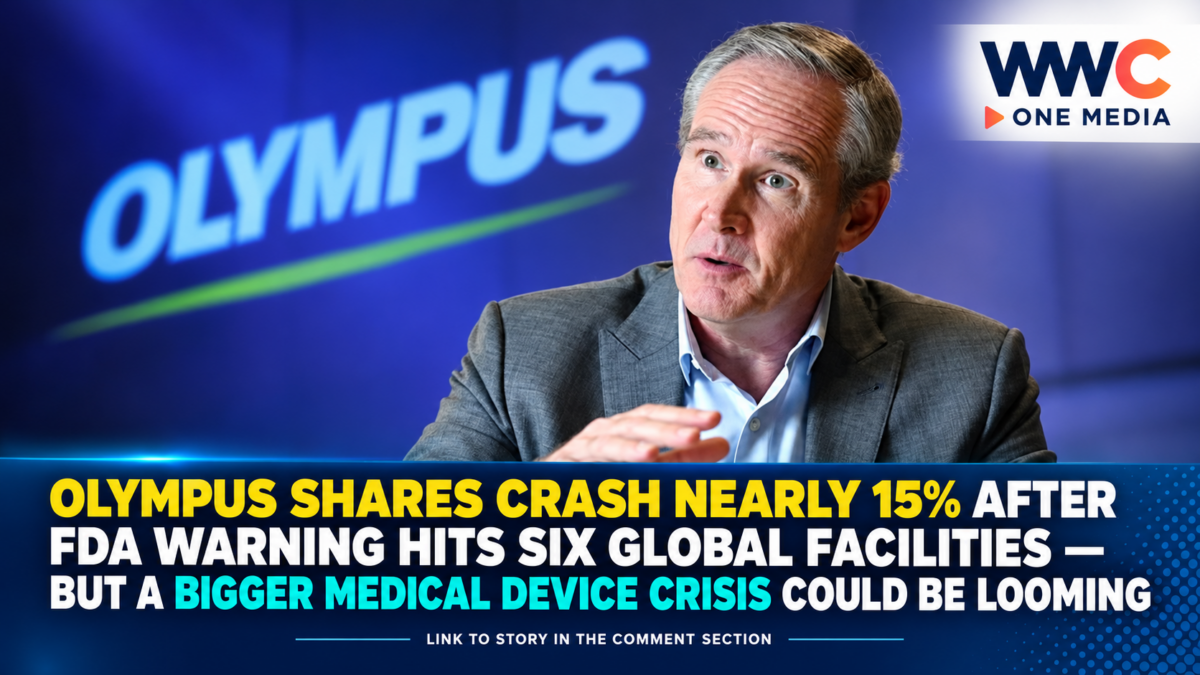
TOKYO, JAPAN — October 14, 2026 — Shares of Japanese medical technology giant Olympus Corporation plunged nearly 15% in Wednesday morning trading after the company disclosed a warning letter from the US Food and Drug Administration (FDA) concerning quality-management problems at six facilities across Japan, Germany and the United States.
The sharp selloff has placed renewed attention on Olympus’ manufacturing standards, regulatory compliance and efforts to rebuild confidence in its global medical device business.
The FDA warning, dated October 7 and publicly disclosed by Olympus on October 13, followed inspections conducted during the second half of 2025.
According to the company, regulators raised concerns primarily involving quality-management systems and related operational processes.
Although Olympus insists that the warning does not restrict manufacturing or sales, require new product recalls, or prevent applications for US medical device clearances, investors reacted sharply to the prospect of continuing regulatory scrutiny.
At approximately 9:35 a.m. Tokyo time, Olympus shares were trading at ¥1,733, down 14.73%, according to Japanese financial publication Minkabu.
The selloff highlights a central concern: whether Olympus can resolve its regulatory deficiencies quickly enough to restore investor confidence while maintaining trust among hospitals and medical professionals.
Olympus Loses Nearly 15% as Investors React to FDA Warning
Olympus shares came under heavy selling pressure during the October 14 trading session following the company’s announcement.
The stock’s decline contrasted with Olympus’ October 13 closing price of ¥2,032.50, before the market had fully reacted to the regulatory development.
The sudden drop underscores the importance investors place on regulatory compliance in the medical technology industry.
Unlike many consumer electronics businesses, medical device manufacturers face extensive oversight because their products are used in diagnostic and therapeutic procedures involving patient safety.
Any suggestion that quality-management systems may not meet regulatory expectations can therefore trigger investor concerns about future costs, operational disruptions and reputational damage.
However, the size of the stock decline should not be confused with a confirmed financial penalty or operating loss.
The market reaction reflects investors reassessing potential risks.
FDA Warning Covers Six Facilities Across Three Countries
The FDA’s warning concerns six Olympus facilities involved in the company’s global medical device operations.
According to Olympus’ official disclosure, the affected locations are:
Japan
- Olympus Medical Systems Corporation — Hachioji
- Olympus Medical Systems Corporation — Hinode
- Aomori Olympus Co., Ltd.
- Shirakawa Olympus Co., Ltd.
Germany
- Olympus Winter & IBE GmbH — Hamburg
United States
- Gyrus ACMI, Inc. — Brooklyn Park, Minnesota
The geographical spread of the facilities has raised questions about the consistency of quality-control practices across the company’s international operations.
The warning involves the adequacy of Olympus’ responses to observations made during FDA inspections in late 2025.
The inspections had produced regulatory observations concerning quality-management systems and processes, which the company subsequently sought to address.
The latest warning indicates that the FDA still requires further corrective action or evidence that those concerns have been adequately resolved.
What Exactly Is the FDA Warning About?
The US Food and Drug Administration regulates medical devices sold in the American market.
Manufacturers must maintain quality systems designed to ensure that products are consistently produced, controlled and monitored according to applicable regulatory requirements.
These systems cover areas such as manufacturing procedures, documentation, complaint handling, corrective actions and product traceability.
An FDA warning letter is a formal regulatory communication identifying concerns that require corrective action.
It is a serious compliance matter, but it does not automatically mean that every product manufactured at a facility is defective.
Nor does the issuance of a warning letter automatically establish that patients have been harmed.
In Olympus’ case, the company says the latest concerns primarily relate to its quality-management framework and responses to earlier inspection findings.
The specific deficiencies and their resolution will be important in determining whether further regulatory action becomes necessary.
Olympus Says Products Can Still Be Sold and Used
Despite the regulatory development, Olympus has emphasized that the warning does not impose new restrictions on its business operations.
According to the company’s October 13 statement, the letter does not:
- Prohibit Olympus from manufacturing, marketing or distributing its products.
- Require any new product recall.
- Prevent the company from seeking FDA 510(k) clearance for new medical devices.
- Require customers to take additional action solely because of the October 2026 warning.
Olympus also maintains that its products remain safe and effective when used in accordance with their instructions.
These assurances are important for hospitals, healthcare providers and other customers relying on Olympus equipment.
However, the company’s statements should be understood in the context of the latest warning.
They do not cancel previously issued FDA import alerts or product-specific safety notices.
Hospitals should continue following all applicable FDA communications, product labeling and manufacturer instructions.
Olympus CEO Promises Urgent Corrective Action
Olympus President and Chief Executive Officer Bob White has pledged to address the FDA’s concerns.
The company says it began implementing corrective and preventive measures after the inspections concluded in late 2025.
Olympus also announced that it would submit a comprehensive response to the FDA within 15 business days of receiving the warning letter.
Additional progress updates will follow until the regulator determines that the corrective actions are adequate.
Chief Quality Officer Brian Barry also reaffirmed the company’s commitment to patient safety, product quality and clinical performance.
The company has been carrying out a multiyear quality-system transformation program intended to strengthen oversight across its global operations.
The next major test will be whether those efforts satisfy the FDA’s requirements.
The Bigger Concern: Olympus Has Faced FDA Problems Before
The latest warning comes against the backdrop of earlier regulatory scrutiny involving Olympus medical devices.
In June 2025, the FDA alerted US healthcare providers to import restrictions affecting certain Olympus devices manufactured in Japan.
The agency cited unresolved quality-system violations and concerns about compliance with manufacturing requirements.
The affected product categories included certain:
- Ureterorenoscopes used in urinary-tract procedures.
- Bronchoscopes used to examine the respiratory system.
- Laparoscopes used in abdominal and pelvic procedures.
- Automated endoscope reprocessors used to clean and disinfect medical equipment.
The FDA’s 2025 communication explained that certain products would be refused entry into the United States under applicable import alerts.
The agency also provided guidance to healthcare professionals about using equipment already in service.
Importantly, the June 2025 restrictions are separate from the October 2026 warning letter.
They illustrate a longer-running regulatory challenge rather than proving that the latest warning has resulted in new import prohibitions.
Earlier Medical Device Recalls Add to Regulatory Scrutiny
Separate FDA records also document product-specific corrective actions involving Olympus equipment.
In July 2026, the agency published a Class II recall record involving the Olympus Toomey Evacuator, a device used in urological procedures.
The recall involved concerns that certain sterilization instructions might not consistently ensure adequate sterilization.
Other FDA records from 2026 include corrective actions involving Olympus surgical instruments and endoscopic accessories.
These earlier actions demonstrate why regulators continue to scrutinize the company’s quality-control practices.
However, each recall or corrective notice has its own technical cause, affected products and regulatory status.
It would be inaccurate to assume that every earlier recall is directly connected to the six-facility warning issued in October.
The larger question is whether Olympus’ quality transformation program can prevent recurring deficiencies and satisfy regulatory expectations across its international manufacturing network.
Why the FDA Warning Matters to Olympus’ Global Business
Olympus has transformed significantly over the past several years.
Once widely recognized as a major camera manufacturer, the company has increasingly concentrated its business on medical technology.
Its core activities include endoscopy, minimally invasive treatment and devices used by healthcare professionals in diagnostic and surgical procedures.
This makes medical device quality and regulatory compliance central to its business strategy.
The United States is an important market for advanced medical technologies.
Failure to resolve regulatory deficiencies could potentially create additional compliance expenses, slow certain business processes or increase the risk of future enforcement measures.
However, those outcomes are possibilities rather than confirmed consequences of the October 2026 warning.
Olympus has said it does not currently anticipate a material impact on consolidated financial results based on the information available.
Investors will therefore be monitoring whether the company’s financial expectations change as regulatory discussions progress.
What This Means for Hospitals in the Philippines and Asia
The development is relevant to healthcare providers throughout Asia, including the Philippines, where Japanese medical technology is used in diagnostic and therapeutic settings.
Endoscopy systems and related medical devices play an important role in modern healthcare.
Regulatory findings involving a global supplier can prompt hospitals and procurement teams to review documentation, maintenance arrangements and applicable safety notices.
However, the FDA’s latest warning does not establish that Olympus equipment currently used by Philippine hospitals is unsafe.
Nor does it automatically require healthcare providers to stop using existing devices.
Hospitals should rely on official product-specific advisories, applicable Philippine FDA guidance and manufacturer instructions when making safety decisions.
For patients, the most important distinction is between a manufacturer’s quality-system deficiencies and a confirmed safety problem involving a particular medical device.
Those are not necessarily the same thing.
Five Developments Investors Should Watch
1. Olympus’ FDA response: Whether its submission within 15 business days adequately addresses the regulator’s concerns.
2. Additional regulatory action: Whether the FDA requests further evidence, conducts follow-up inspections or takes additional measures.
3. Quality-system improvements: Whether Olympus can demonstrate lasting corrective actions across all six facilities.
4. Financial guidance: Whether management maintains its expectation that the warning will not materially affect consolidated results.
5. Customer and investor confidence: Whether hospitals, medical professionals and shareholders remain satisfied with the company’s remediation efforts.
The Bigger Picture: Olympus Faces a Test Beyond Its Stock Price
Olympus’ nearly 15% share-price decline reflects growing concern about regulatory risks in one of Japan’s most internationally recognized medical technology companies.
The immediate warning does not require new recalls or impose new sales restrictions.
But the FDA’s concerns involving six facilities, combined with earlier compliance problems, raise important questions about the company’s ability to maintain consistent quality standards across its global operations.
Olympus has promised urgent corrective action and says substantial improvements are already underway.
Whether those measures satisfy regulators will ultimately determine the significance of the latest warning.
For investors, the financial implications remain uncertain.
For healthcare providers and patients, the priority is ensuring that medical devices meet appropriate quality and safety requirements.
Olympus has assured customers that operations can continue, but the bigger question is whether its quality-control reforms can finally resolve years of regulatory scrutiny — or whether another setback could put its global medical technology ambitions under even greater pressure.