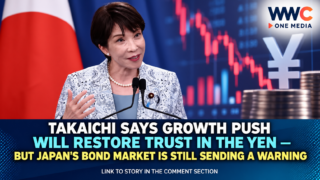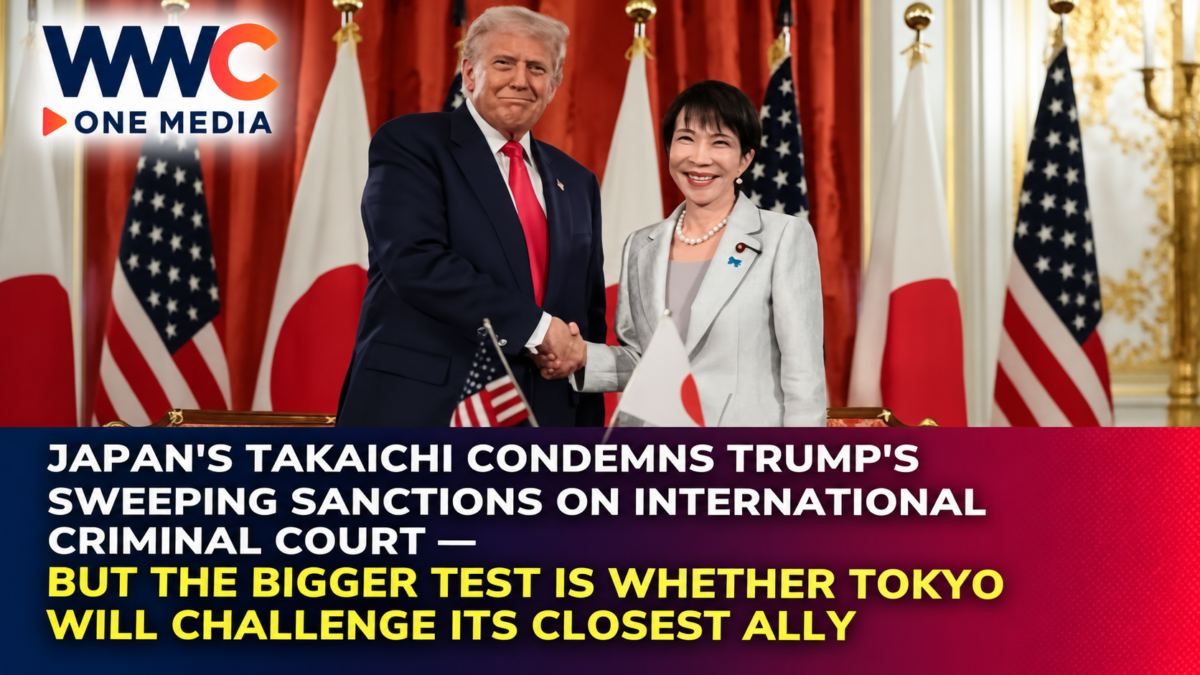
TOKYO, Japan — October 10, 2026 — Japanese Prime Minister Sanae Takaichi has voiced deep concern over the Trump administration’s sweeping sanctions against the International Criminal Court (ICC), exposing a growing diplomatic disagreement between two close allies over international justice, national sovereignty and the rule of law.
The public criticism followed Washington’s October 9 decision to impose sanctions on the court itself, significantly expanding an earlier campaign against individual ICC judges and prosecutors.
Takaichi said the American measures were incompatible with Japan’s longstanding position supporting international law and the independence of the court.
She pledged to maintain communication with Washington while providing necessary support to ensure that the Hague-based tribunal can continue performing its responsibilities.
But the controversy carries an especially sensitive dimension for Japan.
The court’s president, Tomoko Akane, is Japanese and was already targeted by American sanctions in August.
The bigger question is whether Tokyo can defend an international institution led by one of its own citizens without damaging its security relationship with the United States.
Japan Breaks With Washington Over ICC Sanctions
Takaichi publicly expressed deep concern after the United States announced its latest measures against the International Criminal Court.
In a statement posted on social media, the Japanese prime minister reaffirmed her country’s commitment to the rule of law and the ICC’s role in international criminal justice.
She said Japan would continue urging the United States to reconsider its position and support the court’s ability to carry out its mandate.
The announcement represented a notable public disagreement between Tokyo and Washington.
Japan depends heavily on its alliance with the United States for national and regional security.
At the same time, it has long supported international institutions and legal mechanisms intended to address serious crimes.
For Takaichi, the dispute creates a difficult diplomatic balance.
She must defend Japan’s stated principles while maintaining cooperation with President Trump on issues involving trade, defense and regional stability.
Trump Expands Sanctions From ICC Officials to the Entire Court
The latest American action marks a major escalation in Washington’s campaign against the ICC.
On October 9, the Trump administration announced sanctions targeting the institution itself.
Earlier measures had focused on individual officials, including prosecutors and judges.
The new sanctions broaden the pressure to the court’s financial and commercial operations.
According to Reuters and the Financial Times, businesses providing services to the ICC have been given a six-month wind-down period.
The restrictions could affect access to American financial services, dollar transactions and technology providers.
For an international court relying on banking, communications and specialized digital systems, losing access to important service providers could create substantial operational difficulties.
The practical impact will depend on the regulations, available exemptions and how financial institutions and technology companies respond.
But the scope of the measures has raised concern that the court could face serious obstacles in carrying out investigations and trials.
Why the United States Is Targeting the ICC
The Trump administration argues that the International Criminal Court has exceeded its authority by pursuing investigations involving Americans and nationals of countries that are not parties to the Rome Statute.
The United States has not joined the ICC.
Washington has maintained that the court should not exercise jurisdiction over American personnel without US consent.
Secretary of State Marco Rubio has emphasized the administration’s determination to protect US sovereignty and reject what Washington considers inappropriate prosecutions of its citizens.
The dispute also involves Israel, another country that is not a member of the court.
In November 2024, the ICC issued arrest warrants for Israeli Prime Minister Benjamin Netanyahu and former Defense Minister Yoav Gallant in connection with alleged crimes during the Gaza war.
Israeli officials have rejected the court’s allegations and jurisdiction.
The warrants are judicial actions concerning allegations; they are not criminal convictions.
Supporters of the ICC maintain that the court’s jurisdiction can extend to alleged crimes committed on the territory of member states, including when suspects are nationals of non-member countries.
That legal disagreement is central to the confrontation.
The United States frames its sanctions as a defense of sovereignty.
The court and its supporters view them as an attempt to obstruct independent judicial proceedings.
ICC Warns the Sanctions Threaten International Justice
The International Criminal Court strongly condemned the US decision.
Court officials described the sanctions as an attack on judicial independence and the international legal system.
The institution has urged its member states to protect its ability to function.
Deputy Prosecutor Nazhat Shameem Khan told Reuters that the court would continue its investigations and prosecutions despite the pressure.
The ICC was established in 2002 under the Rome Statute to prosecute individuals accused of genocide, crimes against humanity, war crimes and the crime of aggression, within its jurisdiction.
It operates on the principle of complementarity, meaning it generally acts when national authorities are unwilling or unable genuinely to investigate or prosecute relevant crimes.
Unlike the International Court of Justice, which handles legal disputes between states, the ICC prosecutes individuals.
Its effectiveness depends partly on cooperation from member governments because the court does not maintain its own police force.
Sanctions that interfere with financial services, communications or international cooperation could therefore create problems extending beyond the officials specifically targeted.
Japan’s Own Judge Is at the Center of the Crisis
The dispute is particularly important to Japan because Tomoko Akane serves as president of the ICC.
Akane, a Japanese judge, became president of the court in March 2024.
Her leadership placed Japan in a highly visible position within international criminal justice.
In August 2026, the Trump administration imposed sanctions against Akane and another senior ICC official.
Japan protested the designation, with officials describing the move as incompatible with the country’s position.
The controversy sparked criticism of Takaichi at home, including claims that Tokyo’s initial response was too restrained.
The prime minister subsequently defended her administration’s diplomatic efforts, saying Japan had pressed Washington at several levels before the sanctions were imposed.
Akane herself has urged the Japanese government to help reduce tensions with the United States.
The latest sanctions against the entire ICC have made the disagreement more consequential.
Japan is now defending not only a Japanese national serving in an international judicial role but also the institution she leads.
Russia Adds Another Challenge for Japan’s ICC President
The ICC is also facing pressure from Russia.
In 2023, the court issued an arrest warrant for Russian President Vladimir Putin over allegations involving the unlawful deportation and transfer of Ukrainian children.
Moscow rejects the court’s jurisdiction and the allegations.
Russia later pursued legal action against ICC personnel involved in the court’s work.
On October 10, Associated Press reported that Japan had protested Russian extradition requests concerning Akane and eight other ICC staff members.
Tokyo described the targeting of the personnel as unjust and unacceptable.
The development places Japan in an unusual diplomatic position.
Its government is objecting to pressure on the ICC from both Russia and the United States, even though its relationships with those countries differ dramatically.
The contrast strengthens the argument made by Japanese officials that their position concerns the independence of international legal institutions rather than alignment with a particular geopolitical bloc.
Japan and Seven Other Countries Issue Joint Statement
Japan has also joined several other US allies in criticizing Washington’s sanctions.
According to Bloomberg’s report, Japan, Canada, Denmark, France, Germany, Italy, the Netherlands and the United Kingdom expressed opposition to the latest measures.
The governments reaffirmed their support for the court’s independence, impartiality and integrity.
Their response highlights the diplomatic risks created by the sanctions.
The United States maintains close military and economic relationships with many of the countries involved.
However, those alliances do not eliminate disagreements over international legal institutions.
European governments have particularly strong reasons to protect the ICC because the court is headquartered in The Hague, Netherlands.
The European Union has also considered legal measures intended to shield businesses from the effects of US sanctions.
Whether those responses can preserve the court’s operations will depend on their implementation.
Takaichi Raised ICC Concerns With Trump Before the Latest Sanctions
The dispute was already on Japan’s diplomatic agenda before the October 9 announcement.
Takaichi discussed the issue during a meeting with President Trump in September.
The two leaders agreed that the matter would be handled through discussions involving Japanese Foreign Minister Toshimitsu Motegi and US Secretary of State Marco Rubio.
That arrangement remains important following Washington’s latest decision.
Takaichi has indicated that the two foreign ministers will continue communicating closely.
The discussions could provide a way to manage disagreement without allowing it to escalate into a broader diplomatic crisis.
However, dialogue does not guarantee that the United States will reverse the sanctions.
The administration has repeatedly emphasized its opposition to ICC investigations involving American citizens and officials from non-member countries.
Japan will therefore need to decide what additional diplomatic measures, if any, are appropriate if Washington maintains its position.
Why the US–Japan Alliance Makes This Dispute So Sensitive
The United States and Japan maintain one of the most important security alliances in the Indo-Pacific.
American military forces are stationed in Japan, and the two governments cooperate extensively on defense, regional security and technology.
Tokyo relies on that cooperation as it responds to challenges involving China, North Korea and Russia.
This gives the ICC dispute significance beyond international law.
Takaichi faces the possibility of challenging Washington on an issue that the Trump administration considers central to American sovereignty.
At the same time, accepting measures that undermine the ICC could damage Japan’s credibility as a supporter of international law.
Japan’s response reflects an effort to preserve both interests.
Rather than threatening immediate retaliation, Takaichi has emphasized diplomatic engagement and continued support for the court.
The approach allows Tokyo to express disagreement while leaving room for negotiations.
The Nobel Peace Prize Adds Symbolic Pressure
The US sanctions announcement came only hours after former ICC judge Navi Pillay was awarded the 2026 Nobel Peace Prize.
Pillay, a South African jurist and former United Nations human rights chief, has been associated with international efforts to address serious violations of human rights and international law.
The timing drew additional attention to the Trump administration’s decision.
Supporters of the court interpreted the Nobel announcement as a symbolic affirmation of international justice.
Washington, however, maintained its criticism of the ICC.
The contrast highlighted the widening disagreement over the role and authority of international judicial institutions.
It also ensured that the new sanctions would attract international attention beyond the immediate diplomatic exchanges.
Could the Sanctions Disrupt War Crimes Investigations?
The operational consequences of the sanctions may be among the most serious aspects of the dispute.
International investigations require secure communications, evidence storage, financial services, specialist technology and cooperation with governments.
Restrictions affecting those functions could create delays or additional costs.
The ICC has reportedly been preparing alternative arrangements to reduce its dependence on vulnerable systems and service providers.
But replacing established infrastructure can be difficult.
Financial institutions and suppliers may also act cautiously because of concerns about violating US regulations.
That could produce effects beyond the strict legal scope of the sanctions.
Even companies not explicitly prohibited from assisting the ICC might reassess their relationships with the institution.
These risks explain why the court and supporting governments are treating the measures as an institutional challenge rather than merely a dispute involving individual judges.
However, the precise extent of disruption remains uncertain.
The sanctions’ announcement does not establish that every ICC investigation or trial has stopped.
What the Dispute Means for the Philippines and Asia
The controversy is relevant to Asian countries because it raises questions about the strength of international legal institutions.
Japan is a member of the ICC, while the Philippines has a more complicated relationship with the court.
The Philippines withdrew from the Rome Statute in 2019.
However, the ICC has maintained that its jurisdiction can extend to alleged crimes committed during the period when the Philippines was a member, subject to the applicable legal requirements.
The dispute over US sanctions therefore has broader significance for international accountability.
If the court encounters severe financial or operational restrictions, proceedings involving different countries could face additional challenges.
For Asian governments, the controversy also illustrates how legal principles can create disagreements even among longstanding allies.
Japan’s response demonstrates that alignment with Washington on defense issues does not necessarily mean agreement with every American policy affecting international institutions.
The Bigger Picture: Can International Courts Remain Independent of Major Powers?
The confrontation highlights a longstanding challenge facing international criminal justice.
Courts depend on legal authority, professional independence and cooperation from governments.
But powerful states can refuse to join treaties, reject jurisdiction or impose political and economic pressure.
The ICC’s supporters argue that its independence is necessary to investigate serious crimes regardless of the status of the accused.
Critics, including the Trump administration, question the court’s authority over nationals of countries that have not joined the Rome Statute.
These competing positions raise difficult questions about sovereignty, treaty obligations and the enforcement of international law.
Japan’s position is particularly consequential because it combines strong support for the ICC with a close strategic alliance with the United States.
The outcome could influence how other governments respond when international judicial institutions come under pressure from powerful countries.
THE BOTTOM LINE
Japanese Prime Minister Sanae Takaichi has expressed deep concern over the Trump administration’s October 9, 2026, sanctions against the International Criminal Court.
The latest US action targets the institution itself, expanding earlier measures against individual judges and prosecutors, including Japanese ICC President Tomoko Akane.
Japan has reaffirmed its support for the court and pledged continued diplomatic engagement with Washington.
Several other US allies have also opposed the sanctions, warning about the potential consequences for international justice.
The United States maintains that the ICC has overreached by pursuing investigations involving nationals of non-member countries.
The court and its supporters argue that the measures threaten judicial independence and the rule of law.
The biggest question is whether Japan can persuade the Trump administration to ease its pressure on the ICC while preserving the strategic alliance that remains central to Tokyo’s national security.
For Prime Minister Takaichi, defending international justice has become a diplomatic test: can Japan stand firmly behind the court’s independence even when its closest ally is the government challenging it?