PARIS / BRUSSELS — October 10, 2026 — Europe’s embattled automotive giants have been handed a potential lifeline after China agreed to curb the growth of hybrid vehicle exports to the European Union, easing fears of a deepening trade confrontation just days before the Paris Motor Show opens.
The breakthrough follows high-level negotiations in Beijing between EU Trade Commissioner Maroš Šefčovič and Chinese officials.
Under the preliminary understanding announced October 9, China has agreed to moderate exports of hybrid and plug-in hybrid vehicles to the European market over the next four years.
European officials say the arrangement could reduce Chinese hybrid exports by more than half compared with projected levels, potentially preventing millions of additional vehicles from entering the region.
The announcement provided an immediate lift to European automotive shares, with Renault and other companies benefiting from investor optimism that competition from lower-cost Chinese imports could ease.
However, the relief comes with a major warning.
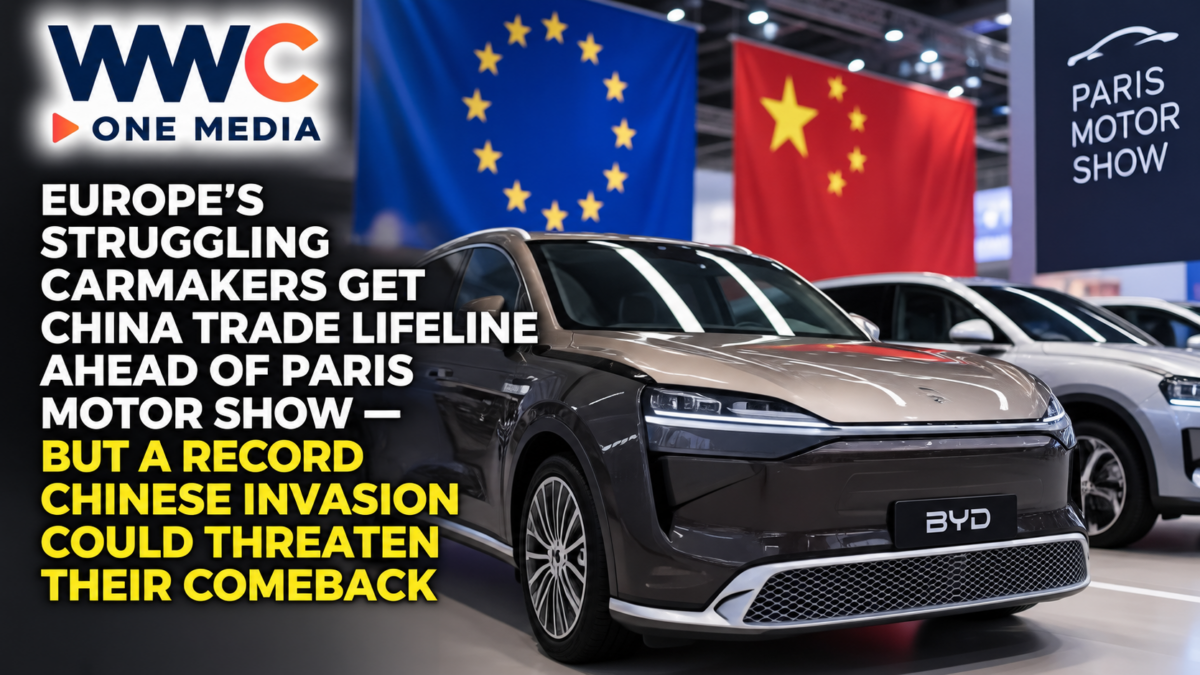
A record 20 Chinese car brands will participate in the Paris Motor Show, twice the number that attended in 2024.
China’s manufacturers are accelerating their international expansion even as European competitors struggle with weak demand, rising production costs and the expensive transition to electric vehicles.
The bigger question is whether Europe’s new trade understanding with China will give its struggling automakers enough time to recover — or whether Chinese brands have already gained too much ground in the race for the next generation of cars.
China Offers Europe a Breakthrough on Hybrid Vehicle Exports
The announcement on October 9 represents a significant development in economic relations between Brussels and Beijing.
Following negotiations in China, the European Commission announced a shared understanding aimed at reducing the flow of Chinese hybrid and plug-in hybrid vehicles into the European Union.
The proposed arrangement would moderate exports over a four-year period.
European officials said the measures could cut Chinese shipments by more than half relative to projected export levels.
That qualification matters.
The agreement does not necessarily mean that the number of Chinese hybrids sold in Europe will immediately fall by 50% compared with today’s sales.
Instead, it is intended to constrain future exports compared with a scenario in which they continued growing without the new arrangements.
The exact effect will depend on implementation details, market conditions and subsequent negotiations.
Nevertheless, the understanding suggests China is prepared to make concessions to address European concerns about competition and industrial decline.
European Automotive Stocks Respond With Relief
Investors reacted positively to signs of reduced trade tensions.
Bloomberg reported that the Stoxx 600 Automobiles & Parts Index climbed approximately 2% following the announcement.
Renault and automotive investment company D’Ieteren were among the companies benefiting from the market reaction.
The prospect of reduced Chinese hybrid imports matters because European manufacturers face significant pricing pressure.
Chinese competitors have expanded their offerings in battery-electric and plug-in hybrid vehicles, often at prices that challenge established European brands.
An agreement limiting the future volume of imports could provide domestic manufacturers with greater room to defend market share.
However, the increase in share prices reflects investor expectations, not proof that automakers’ profits have already improved.
Any lasting recovery will depend on actual sales, margins, production efficiency and the final trade arrangements.
Why Europe Needed Relief From Chinese Competition
Europe’s automotive industry is facing one of its most difficult competitive periods in decades.
Traditional manufacturers must invest heavily in electrification while continuing to support existing gasoline, diesel and hybrid products.
They also face expensive energy, stricter environmental standards and pressure on household purchasing power.
Chinese carmakers have rapidly improved vehicle technology, manufacturing scale and international distribution.
Companies such as BYD, Chery and Geely are seeking larger shares of the European market.
Their expansion has intensified pressure on Volkswagen, Stellantis, Renault and other established manufacturers.
Many European businesses also depend on sales in China, where competition from domestic brands has eroded their position.
That creates a difficult two-way challenge.
European manufacturers are losing ground to Chinese rivals at home while also struggling to maintain their historic strength in China’s market.
The new trade understanding offers some breathing room, but it does not solve those underlying problems.
Chinese Carmakers Capture a Growing Share of Europe
Market data demonstrate how quickly competition has changed.
According to figures cited by Reuters, Chinese automotive brands captured approximately 10.7% of the European market during the second quarter of 2026.
That was almost double their 5.7% share in the comparable period a year earlier.
A separate Bloomberg report using Dataforce figures indicated that Chinese brands accounted for nearly 12% of total regional new-car sales in August.
The difference between these percentages reflects different reporting periods and data sources.
Both show a market-share expansion.
Chinese manufacturers have benefited from growing demand for electric and hybrid vehicles, particularly among cost-conscious buyers.
Their progress also illustrates why traditional manufacturers are worried about losing long-standing advantages in design, engineering and distribution.
For European firms, matching price and product innovation has become essential.
Trade protection may slow the rate of competitive change, but it cannot substitute for attractive vehicles.
The Paris Motor Show Will Expose the Scale of China’s Challenge
The 2026 Paris Motor Show is scheduled for October 12–18, bringing together major international carmakers and showcasing new vehicles and technologies.
A record 20 Chinese automotive brands are expected to participate.
That is twice the number present at the 2024 event.
The lineup includes established names such as BYD and Chery, alongside emerging brands including Aito and Avatr.
Chinese manufacturers see the exhibition as an opportunity to introduce products to European drivers, distributors and media.
For many companies, Europe represents a valuable market as competition intensifies at home and access to the United States remains constrained.
The event will therefore serve as a highly visible confrontation between established European manufacturers and aggressive new competitors.
The timing is striking.
While policymakers in Brussels are working to slow the expansion of Chinese imports, Chinese brands are preparing their biggest-ever presence at one of Europe’s most important automotive exhibitions.
Chinese Brands Are Moving Beyond Cheap Cars
Chinese automakers are increasingly competing across several market segments.
While lower-cost vehicles remain an important part of their appeal, some manufacturers are targeting premium customers with advanced technology, sophisticated interiors and high-performance electric drivetrains.
Aito, a brand associated with China’s Seres Group, plans to use the Paris Motor Show to promote four premium electric sport utility vehicles for the European market.
Reuters reported that the company wants overseas sales to account for 20% of its total volume within three years.
That compares with less than 1% currently.
The ambition demonstrates that China’s automotive expansion is not solely focused on entry-level products.
European luxury brands may also face greater competition.
For Mercedes-Benz, BMW, Audi and Porsche, the challenge involves defending brand loyalty while matching rapid innovation in software, electrification and vehicle connectivity.
European Carmakers Prepare Their Response
Europe’s established manufacturers are not standing still.
They are developing electric vehicles, upgrading popular models and seeking to reduce production costs.
Stellantis is preparing to showcase a revived Citroën 2CV concept as part of efforts to make smaller electric vehicles more affordable.
The strategy reflects growing recognition that expensive EVs alone will not satisfy the entire European market.
Renault is investing heavily in electrification and European manufacturing.
Volkswagen is also working to improve its electric vehicle competitiveness and cost structure.
Mercedes-Benz plans several launches at the Paris Motor Show, including the new GLA, AMG CLA 45, GLE, AMG GT 4-Door Coupé and electric VLE.
The exhibition will provide a platform for European manufacturers to demonstrate that they can compete through technology, affordability and product design.
But the success of these launches will ultimately be measured by orders, customer satisfaction and profitability rather than exhibition attention.
European EV Demand Continues to Grow
The transition to electric vehicles is continuing despite difficulties facing manufacturers.
According to European Automobile Manufacturers’ Association figures reported by Euronews, battery-electric vehicles represented approximately 21.7% of new EU vehicle registrations during the first eight months of 2026.
That compares with 15.8% in the same period in 2025.
Hybrid-electric vehicles remained the largest powertrain category, accounting for approximately 36.6% of registrations.
Plug-in hybrids represented about 10%.
The combined share of gasoline and diesel vehicles declined from 37.5% to around 29% year over year.
These developments show that Europe’s automotive market is undergoing a structural shift.
Consumers are increasingly choosing electrified vehicles, although cost, charging access and driving range remain important considerations.
The challenge for European manufacturers is not simply to sell more electric vehicles.
It is to produce the right models at prices customers are willing to pay while competing against increasingly capable Chinese alternatives.
EU Tariffs Created an Opening for Chinese Hybrids
The European Union previously introduced additional duties on certain Chinese-made battery-electric vehicles.
Those measures were intended to address concerns about subsidies and unfair competitive advantages.
However, plug-in hybrid vehicles have not been subject to the same additional EV duties in the same way.
That created an opportunity for Chinese manufacturers to expand hybrid exports.
Companies could offer vehicles combining electric motors with combustion engines, appealing to consumers concerned about charging infrastructure or range.
Reuters reported that Chinese plug-in hybrid imports into Europe increased sharply, rising approximately 86% year over year.
The latest EU-China understanding is an attempt to address this shift in competitive strategy.
It also demonstrates how trade restrictions targeting one product category can encourage manufacturers to expand into another.
For policymakers, the challenge is designing measures that address industrial concerns without unnecessarily limiting consumer choice.
The Agreement Goes Beyond Cars
The negotiations between Brussels and Beijing cover a broader range of trade issues.
China has agreed to facilitate market access for certain European products, including car components and agricultural goods.
The commitments affect trade worth approximately €4 billion annually, according to Reuters and Financial Times reporting.
The discussions also included rare-earth export licensing, an issue of particular importance to European manufacturers.
Rare-earth materials are used in several advanced industrial applications, including electric motors and other technologies.
Disruptions in their availability can affect production schedules and costs.
A more predictable licensing process could benefit European industries.
However, the precise implementation of these commitments remains important.
A diplomatic understanding does not automatically eliminate all administrative barriers or supply-chain vulnerabilities.
Europe and China Are Trying to Avoid a Bigger Trade War
Relations between the European Union and China have become increasingly tense.
European officials have accused China of contributing to trade imbalances through industrial overcapacity, subsidies and barriers facing foreign businesses.
China has criticized European tariffs and other trade-defense measures as protectionist.
Both sides have reasons to avoid escalation.
European manufacturers depend on access to international supply chains and Chinese consumers.
China benefits from access to Europe’s large and relatively affluent market.
Retaliatory trade measures could increase costs for businesses and consumers in both regions.
The October 9 agreement creates an opportunity for further negotiations.
But it does not settle every dispute.
The EU’s broader concerns about market access, industrial subsidies and trade imbalances remain unresolved.
France and Germany Want Stronger Protection for Industry
France and Germany have been among the most vocal supporters of stronger European trade defenses.
Both countries have significant automotive and industrial sectors.
Their governments are concerned that competition from heavily subsidized foreign manufacturers could weaken domestic production and employment.
The two countries have called for greater coordination in protecting strategic industries.
However, European governments do not always agree on the appropriate response.
Some countries favor stronger restrictions on Chinese imports.
Others emphasize the benefits of international investment, lower-cost products and maintaining commercial ties with Beijing.
That disagreement complicates efforts to establish a unified European industrial strategy.
The forthcoming European Council discussions will be important in determining whether the latest agreement is considered sufficient.
The October 15 EU Summit Could Shape the Next Steps
EU leaders are expected to review their approach to China at the European Council meeting scheduled for October 15.
The October 9 understanding may reduce the immediate risk of a broader confrontation.
However, European governments will still need to determine whether the concessions are enforceable and economically meaningful.
Negotiators are also expected to continue discussions into 2027.
Those talks could address wider market-access restrictions and trade disputes.
The October agreement therefore represents an important diplomatic development rather than the conclusion of the dispute.
For investors and manufacturers, implementation details will matter more than optimistic statements alone.
Why the Automotive Industry Remains Under Pressure
Even with a potential reduction in Chinese hybrid exports, Europe’s automotive industry continues to face structural challenges.
Manufacturers must finance large investments in electric drivetrains, batteries and software.
They also need to maintain production capacity and supplier networks while demand shifts between vehicle technologies.
High energy prices can increase manufacturing and transportation costs.
Weak consumer confidence can discourage purchases of expensive durable goods such as cars.
Competition from Chinese manufacturers can force established companies to reduce prices, potentially pressuring profit margins.
These factors interact.
A company may increase sales volume but still struggle to improve profitability if costs remain high.
The new trade arrangement can reduce one source of pressure.
It cannot independently solve every economic challenge facing the industry.
What the Agreement Means for European Jobs
The automotive industry supports large numbers of jobs throughout Europe, including assembly, components, engineering and distribution.
Concerns about Chinese competition are therefore closely tied to employment.
Traditional manufacturers have announced cost-cutting measures and restructuring plans as they adapt to changing demand.
Policies that slow import growth may help protect some domestic production.
However, job security also depends on whether European companies can develop attractive products and maintain efficient operations.
A temporary reduction in competitive pressure could provide time for adjustment.
But consumers may continue seeking affordable electric and hybrid vehicles from overseas manufacturers.
Policymakers must balance industrial employment with competition, innovation and consumer affordability.
What This Means for Buyers
Consumers could experience several different effects from the trade understanding.
European brands may benefit if the growth of Chinese hybrid imports slows.
That could support local manufacturers and dealership networks.
However, fewer lower-cost imported vehicles may also reduce pricing pressure.
Consumers could therefore face fewer choices or less aggressive discounts than they otherwise would have received.
The exact outcome depends on how the agreement is implemented and how manufacturers respond.
European automakers may use the additional time to introduce more competitive affordable models.
Chinese companies may instead increase local manufacturing, introduce different vehicle types or adjust their pricing.
The agreement is not a guarantee of cheaper cars for consumers.
Why the Philippines and Southeast Asia Should Watch
The EU-China automotive dispute has implications for the broader Asian automotive industry.
China is becoming an increasingly important source of vehicles and components across ASEAN.
Chinese manufacturers are expanding regional distribution networks and production facilities.
At the same time, European automotive groups maintain important manufacturing, supplier and sales relationships across Asia.
A shift in Europe’s import rules could influence how manufacturers allocate investment between China, Europe and Southeast Asia.
For Philippine consumers, the issue is relevant because more Chinese automotive brands have entered the local market in recent years.
The growing availability of electric and hybrid vehicles has increased competition and consumer choice.
However, the European agreement does not automatically change Philippine import duties or vehicle prices.
Any effects on the Philippine market would depend on manufacturers’ regional strategies and local regulations.
The Bigger Picture: Europe Is Fighting for Its Automotive Future
The latest trade understanding highlights a fundamental change in the global automotive industry.
For decades, European manufacturers were among the industry’s dominant players.
Their engineering expertise, luxury brands and production networks helped shape global vehicle markets.
Chinese competitors have now become major challengers, particularly in electrification and advanced automotive technology.
The competition is increasingly about affordability, battery performance, software and manufacturing efficiency.
Europe’s traditional carmakers must adapt quickly.
Trade negotiations may create temporary relief.
But long-term competitiveness will require successful products, investment and innovation.
The Paris Motor Show will provide an early indication of how manufacturers intend to respond.
THE BOTTOM LINE
European automakers have received a potential boost after China agreed to moderate hybrid vehicle exports to the European Union.
The October 9 understanding could reduce Chinese hybrid shipments by more than half relative to projected levels over the next four years.
European automotive stocks rose following the announcement.
The agreement also includes measures addressing market access and rare-earth exports.
But the relief comes amid a major competitive challenge.
A record 20 Chinese automotive brands are preparing to attend the Paris Motor Show, twice the number present in 2024.
Chinese manufacturers have rapidly increased their European market share while established automakers struggle with high costs, weak demand and the transition to electric vehicles.
The biggest question is whether Europe’s trade breakthrough can provide enough time for Volkswagen, Renault, Stellantis and other established manufacturers to regain competitiveness — or whether Chinese companies will continue taking market share despite new restrictions.
Europe’s carmakers have won a moment of relief in their trade battle with China. But at the Paris Motor Show, the global industry will see just how much harder the competition has become