NEW YORK, United States — October 10, 2026 — A wave of deleveraging is sweeping through the US Treasury futures market, with major institutional investors rapidly reducing their exposure to long-dated government bonds as rising yields and complex trading mechanics create fresh pressure on Wall Street.
According to Bloomberg’s October 9 report, asset managers reduced their bullish positions in ultra-long Treasury bond futures by approximately $27 million in dollar value per basis point of interest-rate exposure over the two weeks ending October 6.
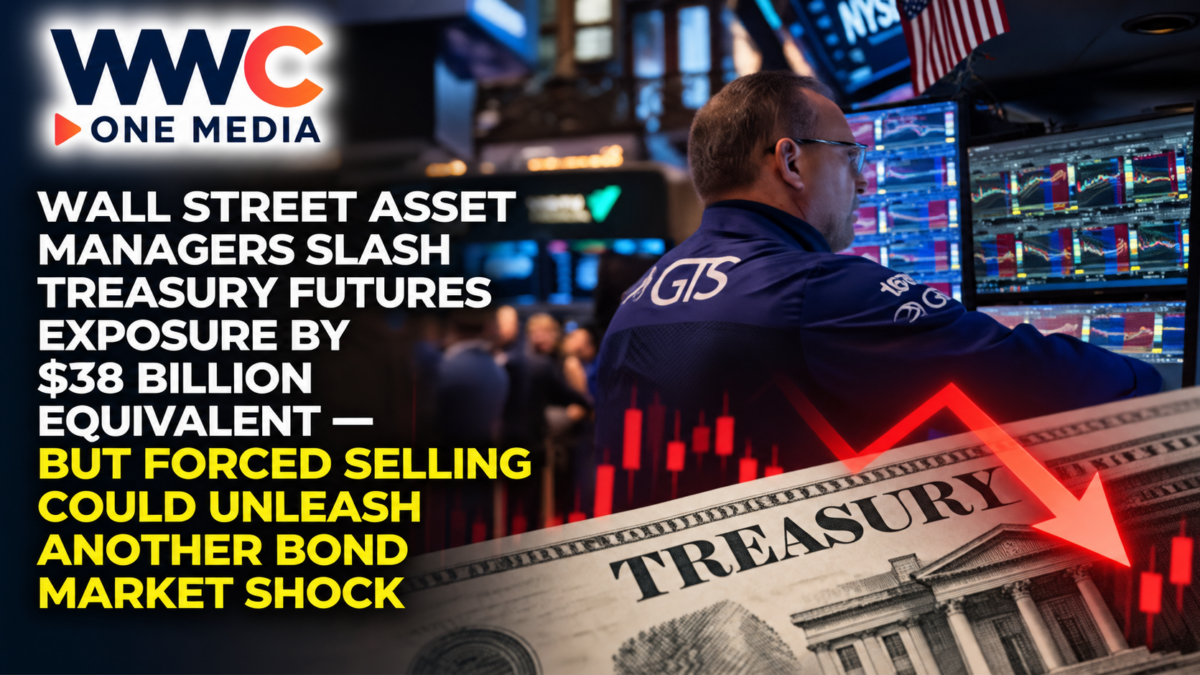
The change is equivalent to the interest-rate sensitivity of roughly $38 billion in benchmark 10-year Treasury notes.
The adjustment comes as the 30-year US Treasury yield recently reached approximately 5.68%, its highest level in around 24 years.
Data from the Commodity Futures Trading Commission suggest that the selling is not simply a routine change in investment sentiment.
Instead, technical features of Treasury futures contracts may be compelling institutional investors to reduce exposure as market yields rise.
The development adds another risk to a government bond market already struggling with inflation fears, elevated energy prices and concerns about growing federal debt.
The bigger question is whether this wave of institutional deleveraging is nearing an end — or whether mechanical selling could amplify another surge in US borrowing costs and send fresh volatility through global financial markets.
Asset Managers Are Cutting Long-Term Treasury Futures Positions
The latest warning comes from the Commodity Futures Trading Commission’s weekly Commitments of Traders data.
The report tracks the futures positions of different market participants, including asset managers, dealers and leveraged funds.
Bloomberg’s analysis found that institutional investors had substantially reduced their net bullish exposure to ultra-long Treasury bond futures during the two weeks ending October 6.
The adjustment represented approximately $27 million in dollar value per basis point of interest-rate sensitivity.
The figure provides a measure of how much less exposed those portfolios have become to small changes in bond yields.
It does not mean that investors withdrew $27 million from the market.
Nor does it represent a loss of $27 million.
Instead, it measures the change in a portfolio’s sensitivity to interest-rate movements.
For a market that depends heavily on institutional trading and hedging, a rapid reduction of that magnitude can be significant.
The $38 Billion Figure Is an Equivalent Risk Measure
One of the most important figures in Bloomberg’s report is the estimated $38 billion equivalent reduction.
That number deserves careful explanation.
Futures contracts and cash bonds do not have identical characteristics.
A Treasury futures position may provide exposure to a particular set of government bonds, with its sensitivity determined by contract specifications and underlying deliverable securities.
Analysts therefore often translate futures exposure into a comparable cash-bond amount.
In this case, the reduction in interest-rate risk was described as equivalent to approximately $38 billion in current 10-year Treasury notes.
The figure is useful for understanding scale.
However, it is not proof that asset managers sold exactly $38 billion in physical Treasury securities.
It also does not establish that one identifiable investment firm sold that amount.
The CFTC data aggregate positions across categories of market participants.
The selling pressure is significant, but the financial measure must not be confused with confirmed cash transactions.
Why Treasury Yields Have Reached Multidecade Highs
The deleveraging comes during an exceptionally difficult period for US government bonds.
Bloomberg reported that the 30-year Treasury yield reached approximately 5.68%, a level not seen in around 24 years.
Reuters separately reported on October 9 that the 10-year yield was near 5.23%, while the 30-year yield remained above 5.6%.
Several factors have contributed to the pressure.
Higher energy costs have increased concerns about persistent inflation.
The conflict involving Iran has disrupted global energy supplies and complicated the outlook for consumer prices.
Investors are also paying close attention to America’s fiscal position and the amount of government borrowing expected in coming years.
At the same time, large corporate investments in artificial intelligence infrastructure are creating additional demands for capital.
The combination has pushed investors to demand higher compensation for holding long-term government bonds.
Because bond prices move inversely to yields, the increase in interest rates has driven down the market value of existing long-duration securities.
Forced Selling Creates a Different Kind of Market Risk
Financial markets experience ordinary buying and selling every day.
Investors change their portfolios because of economic forecasts, valuation differences and changing risk preferences.
Forced selling is different.
It occurs when investors must reduce positions because of constraints involving leverage, collateral, risk limits or the mechanics of the instruments they hold.
A trader may still believe that an asset offers attractive long-term value but find that maintaining the position requires more capital or risk capacity than is available.
Such selling can be especially disruptive during volatile periods.
If numerous institutions need to reduce similar exposures at the same time, their combined activity can push prices lower.
Lower prices can then create additional pressure on investors who remain exposed.
That process can contribute to a self-reinforcing cycle.
The current Treasury futures data raise concerns that some selling may be driven by these mechanical forces rather than a simple decision that bond prices are too high.
The Hidden Problem: Cheapest-to-Deliver Bonds
A major part of the story involves a technical feature of Treasury futures contracts known as the cheapest-to-deliver bond.
Treasury bond futures can be settled through the delivery of eligible government securities.
However, not every eligible bond is equally economical to deliver.
Market participants calculate which security provides the most advantageous delivery economics after accounting for contract conversion factors and market prices.
That security is known as the cheapest-to-deliver, or CTD, bond.
The identity of the CTD bond can change as Treasury yields move.
This matters because the bond’s maturity and duration influence the futures contract’s sensitivity to interest rates.
A change in the deliverable bond can therefore alter the risk of an existing futures position even when the investor has not increased the number of contracts held.
For institutional investors managing exposure within defined limits, the change can require immediate adjustments.
How Switch Risk Can Force Investors to Sell
Bloomberg highlighted a phenomenon known as switch risk.
As the market moves, the cheapest-to-deliver bond underlying a Treasury futures contract can shift toward a different security.
If the new CTD bond has longer duration, each futures contract may represent greater interest-rate sensitivity.
An investor who previously held an appropriate amount of risk can suddenly find that the portfolio is more sensitive to yields than intended.
The institution may then need to sell futures contracts to bring exposure back within its target.
This can occur even when the manager has not fundamentally changed its view of the Treasury market.
The investor is adjusting the number of contracts because the risk per contract has changed.
The process can generate additional selling pressure as yields rise.
It also explains why technical details in futures contracts can have meaningful consequences for prices in the wider bond market.
Seven Consecutive Sessions Show a Reduction in Open Interest
Another warning sign has emerged in ultra-long Treasury futures open interest.
Open interest measures the number of futures contracts that remain outstanding.
It differs from trading volume, which measures how many contracts change hands during a period.
Bloomberg reported that ultra-long Treasury futures open interest declined for seven consecutive sessions.
The cumulative reduction represented nearly $20 million in interest-rate risk per basis point.
The falling open interest occurred while Treasury yields were rising.
Together, those developments are consistent with existing long positions being reduced or closed.
However, the interpretation requires care.
Open interest is not a direct measure of every individual trader’s intentions.
A decline indicates that contracts are being closed on a net basis, but it does not identify the precise reason each participant exited.
The combination of reduced asset-manager exposure, falling open interest and declining futures prices nevertheless supports concerns about deleveraging.
The Treasury Market Is Facing Several Sources of Selling Pressure
The futures unwind is occurring alongside other challenges.
Reuters identified several signs of stress in the US bond market on October 9.
One involves increased demand for options that protect investors against further rises in yields.
Another concerns heavy corporate debt issuance to finance artificial intelligence infrastructure.
A third involves mortgage-related hedging activity, which can require investors to sell Treasuries or Treasury futures as interest rates rise.
The final concern involves growing demand for additional compensation to hold long-term government debt.
These pressures can interact.
For example, rising yields can change the interest-rate sensitivity of mortgage securities.
Investors may then increase hedges by selling government bond futures.
That activity can place additional upward pressure on yields.
Separately, CTD switch risk may require asset managers to reduce ultra-long futures positions.
The combined effect can make bond-market movements sharper than expected from economic news alone.
Mortgage Hedging Is Adding to the Pressure
The US mortgage market plays an important role in Treasury trading.
Many American mortgages allow homeowners to refinance when interest rates decline.
When rates rise, refinancing becomes less attractive.
As a result, mortgage-backed securities may remain outstanding for longer than investors initially anticipated.
This can increase the interest-rate sensitivity of mortgage portfolios.
To manage that risk, investors may sell Treasury securities or futures.
The process is known as convexity hedging.
During periods of rapidly rising rates, such hedging can amplify market movements.
Reuters cited heightened mortgage-related hedging activity as one of the warning signs affecting the bond market.
However, mortgage hedging and Treasury futures CTD switch risk are distinct mechanisms.
Both can produce selling pressure, but they arise from different financial exposures.
Artificial Intelligence Spending Is Also Affecting Bond Markets
The rapid expansion of artificial intelligence infrastructure has become another factor influencing fixed-income markets.
Technology companies are investing heavily in data centers, computing equipment, electricity supply and other facilities.
Some are financing these projects by issuing corporate bonds.
Those securities compete with government debt for investor capital.
The expansion of corporate borrowing can also require dealers and investors to hedge interest-rate exposure using Treasury futures.
This can affect demand for government bonds and add complexity to market positioning.
But AI investment is not the sole explanation for the Treasury selloff.
Inflation expectations, monetary policy, government borrowing and geopolitical risks remain important.
The broader lesson is that the AI boom is influencing capital markets beyond technology stocks.
Its financing requirements can also affect interest-rate markets.
Pimco Warns That 10-Year Treasury Yields Could Reach 6%
The concerns about Treasury futures are emerging as major investors warn that US borrowing costs could climb even further.
In an interview reported by Reuters on October 9, Pimco Group Chief Investment Officer Dan Ivascyn said the benchmark 10-year Treasury yield could reach 6%.
Such a level would be the highest since around 2000.
Ivascyn cited inflation pressure, elevated oil prices and growing government debt among the major risks.
He also warned that leverage and technical market factors could worsen bond-market conditions.
However, the 6% level is a risk scenario, not an established forecast of what will certainly happen.
Other market participants have identified signs that the selloff may be stabilizing.
The direction of yields will depend on inflation data, Federal Reserve policy, government borrowing and investor demand.
The possibility of 6% yields illustrates the market’s concern, but it should not be portrayed as inevitable.
Higher Treasury Yields Affect More Than Bond Traders
The US Treasury market forms a central foundation of the international financial system.
Treasury yields influence the pricing of mortgages, corporate loans, government securities and other financial assets.
When long-term yields rise, borrowers may face higher financing costs.
Companies planning investments can encounter more expensive debt.
Households seeking mortgages may face higher monthly payments.
Financial markets may also reassess the value of equities and other assets when safer government bonds offer higher returns.
However, the relationship is not always immediate or uniform.
Individual borrowing rates depend on credit conditions, market spreads and other factors.
A futures-market unwind can contribute to yield volatility without being the sole cause of changes in consumer borrowing costs.
Could Forced Selling Trigger a Broader Market Crisis?
The presence of deleveraging does not automatically mean that the Treasury market is entering a crisis.
Financial institutions routinely adjust positions when volatility rises.
Exchanges and clearinghouses also impose margin and risk-management requirements intended to reduce counterparty exposure.
A reduction in leveraged positions can sometimes improve market stability over time.
The danger arises when multiple investors need to unwind positions rapidly and market liquidity is insufficient to absorb their trades.
Prices may then move abruptly.
Large price changes can trigger further selling or additional collateral requirements.
This is why traders monitor open interest, positioning and market liquidity alongside economic indicators.
The latest CFTC figures provide evidence of a significant adjustment.
They do not prove that a market-wide failure is underway.
Why Federal Reserve Policy Will Remain Critical
The Federal Reserve’s decisions continue to shape the outlook for interest rates.
Inflation, economic growth and labor-market developments influence expectations about the future path of monetary policy.
A reduction in inflation pressure could help stabilize longer-term Treasury yields.
Persistent inflation, by contrast, could keep borrowing costs elevated.
Investors will also watch whether the central bank views recent bond-market volatility as a normal adjustment or a threat to financial-market functioning.
However, the Fed does not control every long-term yield movement.
Term premiums, Treasury issuance and investor positioning can all influence bond prices independently of short-term policy rates.
The current futures-market unwind demonstrates why technical trading conditions matter even when economic fundamentals remain unchanged.
Why Asian Markets and the Philippines Should Pay Attention
Changes in US Treasury yields can influence financial conditions across the world.
For Asian economies, higher US yields may affect dollar financing costs, currency markets and international capital flows.
The Philippines is connected to these developments through its government borrowing, banking sector and corporate debt markets.
If US yields rise sharply, investors may demand higher returns on some international bonds.
That can make foreign-currency financing more expensive.
Currency movements can also influence the peso value of dollar-denominated obligations.
However, the impact depends on local economic conditions, investor demand and central-bank policy.
The latest Bloomberg report does not establish that Philippine borrowing costs will rise by a specific amount.
Instead, it highlights why movements in the world’s benchmark bond market deserve attention across ASEAN.
What Investors Should Watch Next
Several indicators will help determine whether the Treasury futures unwind is losing momentum or intensifying.
The CFTC’s next Commitments of Traders reports will show how institutional positions continue to change.
Traders will also monitor open interest in ultra-long Treasury bond futures.
Falling open interest alongside declining prices may indicate further position reductions.
Changes in the cheapest-to-deliver bond and the duration of futures contracts will remain important.
Investors will watch 10-year and 30-year Treasury yields, inflation releases and demand at government debt auctions.
Together, these indicators can provide a clearer picture of market risk.
No single number can determine whether the selloff is over.
The Bigger Picture: A Technical Trade Can Become a Global Financial Problem
The Treasury futures market is often viewed as a specialized area used by professional investors.
But its role extends far beyond individual trading desks.
Treasury futures help institutions manage enormous amounts of interest-rate exposure.
They are connected to the cash government bond market through hedging, delivery mechanisms and arbitrage.
When their mechanics create unexpected changes in risk, the effects can spread.
The current deleveraging illustrates how financial market stress can arise from the interaction of high yields, leverage and contract design.
It also challenges the idea that every sharp market movement reflects a sudden change in investors’ fundamental economic outlook.
Sometimes, prices move because institutions are compelled to adjust positions.
That distinction is crucial for understanding the risks facing the bond market.
THE BOTTOM LINE
US asset managers have sharply reduced their bullish exposure to ultra-long Treasury futures, according to Commodity Futures Trading Commission data analyzed by Bloomberg.
The reduction during the two weeks ending October 6 amounted to approximately $27 million in interest-rate risk per basis point.
That is equivalent to the rate sensitivity of roughly $38 billion in benchmark 10-year Treasury notes.
The decline comes as long-term government bond yields remain near multidecade highs.
Technical features involving cheapest-to-deliver bonds may be forcing investors to reduce positions as their interest-rate exposure changes.
Meanwhile, falling futures open interest suggests a broader reduction in outstanding positions.
Other pressures — including inflation concerns, mortgage hedging, government borrowing and AI-related corporate debt issuance — are contributing to market uncertainty.
The biggest question is whether this wave of deleveraging will help stabilize the Treasury market once excess exposure has been removed — or whether continued forced selling will push bond yields even higher.
The world’s most important bond market is being tested not only by inflation and government debt, but also by the hidden mechanics of how Wall Street trades interest-rate risk.