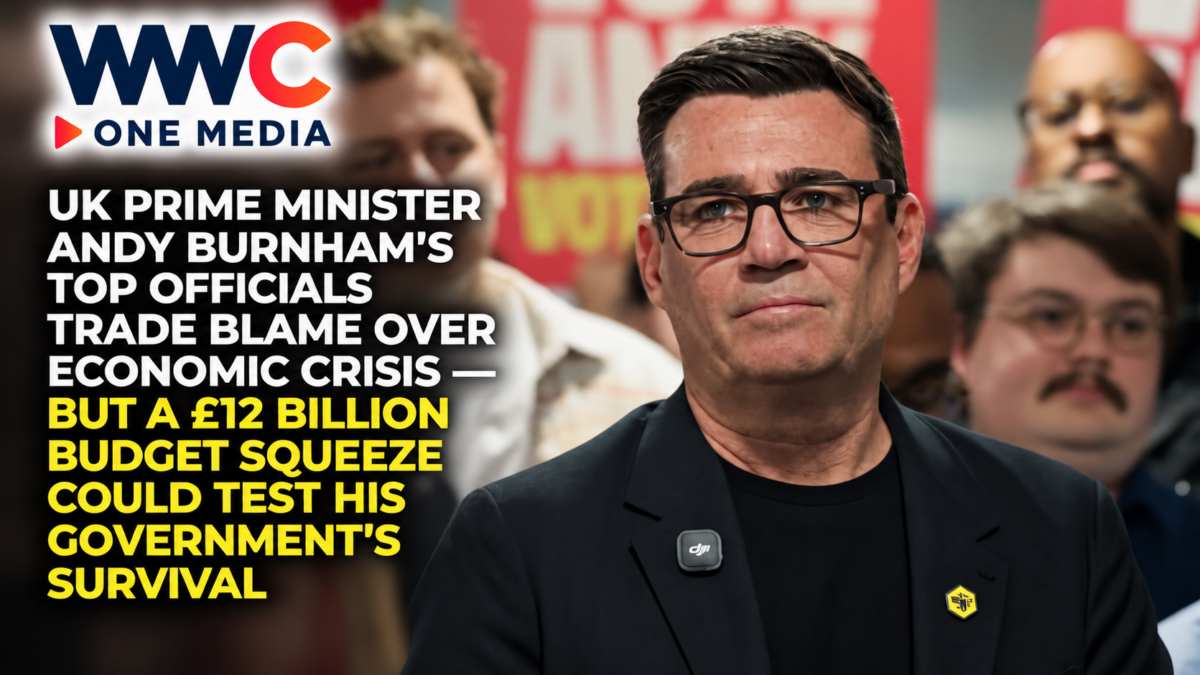
LONDON, United Kingdom — October 10, 2026 — A growing dispute inside British Prime Minister Andy Burnham’s government is threatening to overshadow his promise of economic renewal, as senior officials confront rising borrowing costs, expensive energy, mounting pressure on public services and difficult choices ahead of the country’s October 28 Budget.
Bloomberg reported on Saturday that senior officials in Burnham’s administration were trading blame over the economic pain confronting Britain.
The report arrives at a particularly sensitive moment for the new prime minister.
Burnham has enjoyed a political boost following Labour’s party conference and an important parliamentary by-election victory. But the government is struggling to turn public optimism into improvements in household finances.
His chancellor, John Healey, faces growing pressure to deliver cost-of-living relief without undermining confidence in Britain’s public finances.
Meanwhile, Labour officials remain divided over how quickly the government should pursue Burnham’s ambitious plans for economic reform.
Independent reporting by The Guardian and the Financial Times reveals mounting tension between Downing Street’s push for visible change and the Treasury’s determination to maintain financial discipline.
The situation has been complicated by the war involving Iran, which has driven up energy prices and global borrowing costs.
The bigger question is whether Burnham can unite his government behind a credible economic plan — or whether internal disagreements will weaken his administration before its first major Budget is even delivered.
Burnham’s Economic Team Faces Growing Internal Pressure
Burnham entered Downing Street in July promising to restore optimism and deliver substantial improvements in living standards.
His political message emphasized the cost of essentials, regional development, public services and greater control over infrastructure.
That approach initially helped distinguish his leadership from the previous government under Keir Starmer.
But the economic environment has deteriorated.
Energy prices have remained elevated, mortgage costs have increased and government borrowing has become more expensive.
These developments are creating tensions over who should be responsible for the government’s economic difficulties and how it should respond.
Bloomberg’s October 10 report describes senior officials trading blame over the pain confronting households and businesses.
The public evidence independently available also confirms disagreements over fiscal policy, spending priorities and the distribution of power between Downing Street and the Treasury.
However, the complete Bloomberg report is not publicly accessible, so specific private accusations attributed to unnamed individuals should not be presented as established quotations without further verification.
Downing Street and the Treasury Have Different Priorities
One of the central tensions involves Burnham’s political team and Chancellor John Healey’s Treasury.
The prime minister wants to demonstrate that his government can make meaningful changes to Britain’s economic direction.
His priorities include reducing household costs, improving public services and shifting economic power away from Westminster.
Healey, meanwhile, must maintain financial credibility in a bond market that is demanding increasingly high returns from the British government.
The Guardian reported in September that some of Burnham’s closest allies were concerned that the chancellor could become too cautious under the influence of established Treasury thinking.
Treasury figures, by contrast, emphasized the importance of stable policymaking and avoiding decisions that could unsettle investors.
The disagreement reflects a familiar problem for governments.
Political leaders want visible results.
Finance ministers must determine how those promises will be paid for.
Both objectives can be legitimate, but they become harder to reconcile when borrowing costs are rising.
Britain’s Budget Buffer Has Shrunk by About £12 Billion
The most immediate challenge is the weakening of Britain’s public finances.
Financial Times reporting indicates that the government’s fiscal headroom has fallen from an earlier estimate of approximately £23.6 billion to around £12 billion.
That represents a deterioration of almost £12 billion.
Fiscal headroom measures how much room a government has beneath its borrowing or spending limits, based on economic forecasts.
It is not a reserve of cash sitting in a bank account.
A reduction in headroom means the government has less flexibility to respond to economic shocks or introduce expensive new commitments while meeting its fiscal rules.
Higher debt-servicing costs have been an important driver of the deterioration.
As yields on government bonds rise, issuing new debt and refinancing existing obligations can become more expensive.
Inflation also affects parts of public spending and the government’s economic outlook.
For Healey, the decline leaves fewer easy choices in the October 28 Budget.
UK Government Borrowing Costs Reach a 28-Year High
The pressure on the Treasury intensified during the first week of October.
Reuters reported that Britain’s 30-year government bond yield reached 6.036% on October 7, its highest level in approximately 28 years.
The benchmark 10-year yield also rose to around 5.48%, nearing levels not seen since 2007.
Government bond yields influence the cost of public borrowing.
When investors demand higher returns, financing new debt becomes more expensive.
Bond yields also influence private-sector financial conditions, including mortgage and corporate borrowing costs.
The increases have been linked partly to a global bond-market selloff and rising energy prices.
However, investors are also evaluating Britain’s debt burden, spending commitments and economic growth prospects.
The result is an uncomfortable situation for Burnham.
He has promised to deliver major change, but financial markets are making those ambitions more expensive.
The Iran Conflict Is Adding to Britain’s Economic Pain
The war involving Iran has become a major source of economic pressure.
Disruptions to international energy supplies have pushed oil prices higher and contributed to inflation concerns.
Britain is vulnerable to these developments because imported energy and global commodity prices affect households and businesses.
Higher fuel costs can increase transportation expenses.
Businesses may face more expensive electricity, heating and logistics.
Consumers can experience higher prices for everyday goods and services.
At the same time, stronger inflation expectations can put upward pressure on market interest rates.
That combination reduces the government’s ability to deliver financial relief cheaply.
The conflict is an important external factor, but it does not explain every weakness in the British economy.
Longstanding problems involving productivity, public debt and infrastructure remain relevant.
Chancellor John Healey Faces His First Major Budget Test
Healey is scheduled to present the government’s Budget on October 28.
That announcement will provide one of the clearest assessments yet of how Burnham intends to finance his economic program.
The chancellor must weigh demands for household support against the need to reassure investors.
Measures reportedly under consideration include assistance with energy bills, support for small businesses and possible changes to certain taxes.
Reuters has also reported discussion of potential adjustments to property-related taxation and bank levies.
However, those measures remain options rather than confirmed Budget decisions.
Healey could ultimately introduce a different package.
The key question will be whether the Budget produces a credible combination of financial discipline and economic support.
A poorly received announcement could create additional market uncertainty.
A credible one may help stabilize confidence, although it cannot guarantee an immediate reduction in prices or borrowing costs.
Labour Officials Fear Modest Measures Will Not Be Enough
The Guardian reported on October 10 that Labour insiders are increasingly concerned about public expectations.
Some believe the government needs to deliver more than limited assistance and small policy adjustments.
Burnham’s appeal has been built partly around the promise of meaningful change.
But voters facing expensive mortgages, high energy bills and stagnant living standards may judge the government on immediate financial conditions.
The problem is especially difficult because many structural reforms take years to deliver results.
New housing, infrastructure investment and productivity improvements cannot transform household finances overnight.
Short-term support, meanwhile, requires money that the Treasury has limited room to provide.
This creates a political dilemma.
The government can promise long-term improvements, but voters may demand evidence of progress much sooner.
NHS Funding Adds Another Source of Tension
Pressure on Britain’s National Health Service is complicating the Budget discussions.
The Times reported that Health Secretary Yvette Cooper sought additional funding to address staffing and service pressures.
The request was resisted by Treasury officials concerned about the overall spending envelope.
The NHS faces challenges involving waiting lists, workforce costs and demand for care.
Additional spending could help address some immediate problems.
But increasing one department’s allocation can require savings elsewhere, higher taxes or additional borrowing.
Health spending is particularly sensitive because it directly affects voters’ experiences of government.
For Burnham, disagreements over NHS funding could undermine the image of a united administration working toward shared priorities.
However, the precise amount of any final NHS funding adjustment has not yet been settled in the forthcoming Budget.
Burnham Wants to Shift Economic Power Away From the Treasury
The disagreement extends beyond individual spending decisions.
Burnham has supported transferring greater responsibility for economic growth toward local leaders and a government office known as No. 10 North in Manchester.
The initiative is intended to support regional development and reduce excessive concentration of decision-making in London.
Bloomberg previously reported that the changes were encountering resistance from some Treasury officials.
Supporters argue that local decision-makers may be better placed to identify opportunities for investment and growth.
Critics worry that shifting responsibilities could create confusion or weaken coordination.
The issue is partly administrative but also political.
It concerns which institutions control Britain’s economic agenda.
If Burnham’s team and the Treasury disagree over their responsibilities, the government may struggle to implement policy quickly.
But organizational reform alone will not solve the immediate problems caused by inflation or high borrowing costs.
Businesses Remain Uncertain About Future Tax Policy
British companies are also watching the disagreement closely.
At Labour’s recent conference, Burnham and Healey emphasized reducing the cost of doing business.
Yet Financial Times reporting indicated that many executives remained uncertain about how the government would deliver that objective.
Businesses are particularly concerned about possible tax increases, energy costs and regulatory changes.
Some financial-sector groups have warned that additional taxes could discourage investment.
Others argue that profitable industries should contribute more to funding public services and household support.
There is no simple consensus.
Higher taxes could improve government revenue, but some measures may also discourage economic activity.
Reducing taxes could support businesses while leaving the Treasury with less money for public services.
The Budget will need to balance those considerations.
Economists Disagree on the Best Solution
The debate is not confined to politicians.
Former Goldman Sachs economist Lord Jim O’Neill has advised against large new tax increases.
According to the Financial Times, he suggested that the government could accept a smaller fiscal buffer rather than undermine economic confidence through additional taxation.
Others emphasize the risks of allowing borrowing costs and debt obligations to rise.
A separate Financial Times editorial argued that Britain’s Budget should focus on controlling spending and strengthening growth.
These perspectives reflect different judgments about how much fiscal risk the government should accept.
Supporters of greater investment believe well-designed spending can improve long-term productivity.
Advocates of stricter fiscal restraint argue that investors must be convinced public finances are sustainable.
The eventual policy choice will depend on the government’s economic forecasts and political priorities.
Labour’s Election Victory Offers Relief but Not a Solution
Burnham received a political boost when Labour retained the Holborn and St Pancras parliamentary seat in an October 9 by-election.
Reuters reported that Labour candidate Sagal Abdi-Wali defeated Green Party leader Zack Polanski.
The victory demonstrated that Labour still had substantial electoral support in an important London constituency.
It also strengthened Burnham’s position after months of political competition with parties on the left.
However, a by-election victory does not remove broader economic pressures.
Voters may support the government in one contest while remaining dissatisfied with prices, wages or public services.
For Labour, the challenge is converting political momentum into measurable improvements in living standards.
The October 28 Budget will be a more direct test of the government’s economic priorities.
Britain’s Opposition Is Watching for Signs of Failure
Conservative leader Kemi Badenoch and other opposition figures are seeking to capitalize on Labour’s economic difficulties.
The Conservatives argue that Burnham’s interventionist agenda risks adding to spending pressures and undermining market confidence.
Labour counters that Britain’s vulnerabilities reflect longstanding structural weaknesses, including low growth and earlier policy choices.
Both sides offer different explanations for the country’s economic problems.
The evidence suggests that current conditions involve a combination of international shocks and domestic economic challenges.
The Iran conflict and global bond selloff have increased costs.
But Britain’s productivity problems, fiscal constraints and infrastructure needs predate Burnham’s premiership.
A credible assessment must recognize both factors rather than assign every difficulty to one government or political party.
What This Means for the British Pound and Global Investors
Investors are closely monitoring the government’s response because UK fiscal policy can affect bond and currency markets.
A Budget perceived as financially credible may support confidence in British government debt.
Unexpected borrowing or unclear tax and spending commitments could increase market volatility.
However, exchange rates and bond yields depend on many variables beyond domestic politics.
Global interest rates, commodity prices and economic growth expectations also matter.
The impact on international investors will therefore depend on both the Budget’s contents and wider financial conditions.
For markets, the key issue is whether the government can provide a predictable economic strategy.
Political disputes can become more consequential when they create uncertainty about policy implementation.
Why the Philippines and Asia Should Pay Attention
Britain’s economic difficulties are relevant to financial markets and businesses across Asia.
The United Kingdom remains an important international financial center and trading partner.
Changes in British interest rates, investment demand and consumer spending can influence global capital markets.
For the Philippines, economic developments in the UK can affect businesses with British customers or financial relationships.
Overseas Filipino workers and families connected to Britain may also be sensitive to changes in employment conditions, inflation and the pound’s exchange rate.
However, the internal political dispute does not automatically translate into a specific change in Philippine remittances or trade.
Those effects would depend on actual economic outcomes.
The wider lesson for Asian governments is that high borrowing costs can restrict policy flexibility even when leaders have ambitious spending and development plans.
Can Burnham Restore Unity Before the Budget?
The immediate political challenge is coordination.
Burnham must demonstrate that his administration can make difficult decisions without allowing disagreements to dominate public attention.
Healey must show that the Treasury can maintain financial discipline while supporting the government’s broader economic objectives.
Cabinet ministers must understand what funding is realistically available.
And voters will expect a clear explanation of when living standards might improve.
Disagreement within government is not necessarily evidence of dysfunction.
Finance ministries routinely challenge spending demands.
But persistent public blame-trading can weaken confidence if it suggests that senior officials do not share a coherent plan.
The next two weeks will therefore be critical.
THE BOTTOM LINE
Prime Minister Andy Burnham’s government is facing growing internal pressure as Britain struggles with expensive energy, high borrowing costs and limited fiscal flexibility.
Bloomberg reports that senior officials are trading blame over the country’s economic difficulties.
Independent reporting confirms tensions between Downing Street’s ambitions and the Treasury’s cautious approach.
The government’s fiscal headroom has reportedly fallen by approximately £12 billion, while the 30-year UK government bond yield recently reached a 28-year high.
Chancellor John Healey is due to deliver the Budget on October 28.
The government must decide how much financial support it can provide without damaging investor confidence or weakening its fiscal commitments.
The biggest question is whether Burnham and Healey can turn competing economic priorities into a credible plan — or whether the pressure of rising costs and internal disagreements will erode the optimism that brought Burnham to power.
Britain’s economic pain is already testing households and businesses. Now it is testing the unity of the government promising to deliver relief.