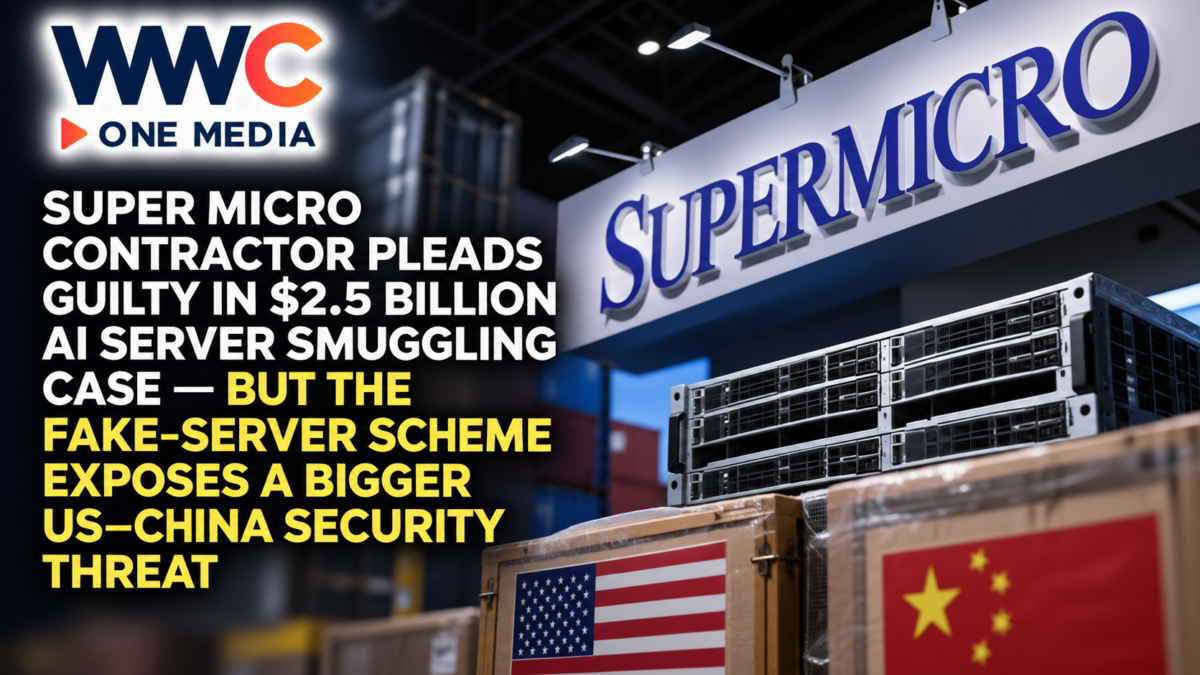
NEW YORK, United States — October 10, 2026 — A former contractor linked to American AI server manufacturer Super Micro Computer has pleaded guilty to helping illegally divert advanced computing equipment containing Nvidia chips to China, marking a major development in a federal prosecution involving approximately $2.5 billion worth of high-performance servers.
Ting-Wei “Willy” Sun, a Taiwanese national described by prosecutors as a broker and fixer, entered his guilty plea in Manhattan federal court on Thursday, October 8. Court records reported by Reuters and Bloomberg confirmed the development the following day.
Sun pleaded guilty to four counts involving conspiracies to violate US export controls, smuggle goods from the United States, defraud the government and obstruct justice.
The case centers on a sophisticated operation in which prosecutors allege that restricted servers were ordered through a Southeast Asian company, transported through international supply chains and secretly redirected to customers in China.
To hide what was happening, participants allegedly prepared false documents and substituted thousands of nonworking imitation servers during compliance inspections.
The guilty plea is a significant breakthrough for US authorities seeking to enforce restrictions on advanced AI technology.
But the case also raises uncomfortable questions about how easily high-value computing equipment can move through legitimate international supply networks before reaching prohibited end users.
The bigger question is whether tighter export controls can stop sensitive American AI technology from reaching China when brokers can manipulate paperwork, shipping routes and even physical inspections.
Willy Sun Pleads Guilty in Manhattan Federal Court
Sun’s guilty plea marks the first reported conviction-related development among the three principal defendants charged in the Super Micro-linked export case.
According to Reuters, he admitted guilt on October 8, with the development appearing in court records and being reported publicly on October 9.
The charges include conspiracies involving violations of export-control laws, unlawful smuggling, fraud against the United States and obstruction of justice.
Sun had been accused of coordinating transactions involving advanced American computing hardware destined for China.
He was described in the original indictment as a third-party broker who worked with individuals employed by Super Micro Computer and other business intermediaries.
His role allegedly involved helping arrange transactions and conceal their true destinations.
The case is being handled in the US District Court for the Southern District of New York.
According to reporting on the court documents, sentencing is scheduled for September 8, 2027.
The eventual punishment will be determined by the court.
A guilty plea does not establish that every separate allegation against the other defendants has been proven.
A $2.5 Billion Scheme Involving Restricted AI Servers
Federal prosecutors originally announced the case on March 19, 2026.
The Justice Department alleged that a Southeast Asian company purchased approximately $2.5 billion worth of servers from a US manufacturer during 2024 and 2025.
The machines incorporated advanced graphics processing units used to train and operate powerful artificial intelligence systems.
The equipment was subject to US export restrictions limiting shipments to China without the required authorization.
According to prosecutors, the defendants arranged for the Southeast Asian buyer to appear to be the legitimate end user.
The actual intention, authorities alleged, was to transfer the servers to customers in China.
The $2.5 billion figure describes the approximate value of server purchases connected to the alleged operation.
It should not automatically be interpreted as the proven personal profit of Sun or as the amount of a fine imposed by the court.
The case demonstrates the enormous financial scale of efforts to acquire restricted AI hardware.
How the Servers Allegedly Reached China
The Justice Department’s March indictment describes an international routing arrangement.
Servers were often assembled in the United States and shipped to the manufacturer’s facilities in Taiwan.
They were then delivered to a company in Southeast Asia.
The intermediary allegedly used shipping and logistics providers to repackage the equipment into unmarked boxes.
The servers were then redirected to their intended destinations in China.
Prosecutors say false records were prepared to make it appear that the Southeast Asian buyer was the final customer.
The scheme allegedly involved coordination among business executives, brokers and sales personnel.
The important legal issue is the end use and ultimate destination of the equipment.
A shipment to a permitted intermediary does not necessarily make a later transfer lawful when export restrictions prohibit delivery to the real customer.
That is why US regulators increasingly examine the entire chain of distribution rather than only the first destination listed in shipping documents.
More Than $510 Million in Servers Allegedly Diverted in Weeks
One of the most striking figures in the indictment concerns the speed of the alleged operation.
According to the Justice Department, at least approximately $510 million worth of servers assembled in the United States were diverted to China between late April and mid-May 2025.
That represents an extraordinary value of computing equipment allegedly moved over a relatively short period.
The volume also explains why prosecutors view the matter as a national-security concern rather than an ordinary customs violation.
Advanced AI servers can contain processors and other components capable of supporting large-scale computing workloads.
US export controls are designed to restrict certain technologies considered strategically sensitive.
However, the $510 million figure is part of the broader alleged $2.5 billion procurement scheme.
The two figures should not be added together as though they represent separate, unrelated transactions.
Thousands of Fake Servers Used to Mislead Inspectors
The most unusual element of the case involves the use of dummy servers.
Prosecutors allege that participants created thousands of nonworking physical replicas of genuine Super Micro equipment.
The imitation machines were arranged in warehouses to make it appear that servers purchased by the Southeast Asian intermediary remained in its possession.
In reality, prosecutors say the genuine equipment had already been shipped to China.
The imitation hardware was intended to deceive compliance personnel conducting inventory checks.
Some of the dummy servers were displayed during an August 2025 audit by the manufacturer.
Others were later staged for an inspection involving the US Department of Commerce.
The use of physical decoys shows that the alleged operation went beyond falsifying electronic records.
It involved building a misleading physical inventory to reinforce the false paperwork.
Surveillance Cameras Captured the Alleged Cover-Up
The Justice Department released details from surveillance footage showing preparations for the inspections.
Authorities said Sun and another broker were recorded handling dummy equipment inside a warehouse.
The footage allegedly showed them unpacking imitation servers, moving labels and serial-number stickers, and placing the replicas inside manufacturer-branded boxes.
Prosecutors said the individuals used a hair dryer to remove and reattach some of the identification stickers.
The purpose was to create the appearance that the warehouse contained authentic equipment corresponding to legitimate purchase records.
These allegations illustrate the challenges facing corporate compliance teams.
A physical inspection may appear reassuring when equipment, packaging and identification numbers seem consistent.
But sophisticated deception can make a staged inventory look genuine.
The case may encourage manufacturers to strengthen verification procedures beyond visual checks and paperwork reviews.
Super Micro Co-Founder Also Charged
The case involves two other prominent defendants.
One is Yih-Shyan “Wally” Liaw, a co-founder of Super Micro Computer who previously served as a senior vice president and board member.
The other is Ruei-Tsang “Steven” Chang, a former manager associated with the company’s Taiwan operations.
Federal prosecutors accused the three men of participating in the wider diversion conspiracy.
Liaw has pleaded not guilty, according to Bloomberg’s October 9 reporting.
Chang has not appeared in the US case and was described by authorities as a fugitive.
These distinctions are essential.
Sun’s guilty plea does not mean Liaw or Chang have been convicted.
Charges against those individuals remain allegations unless established through a guilty plea or court verdict.
Their legal positions should not be treated as identical to Sun’s.
Super Micro Says It Is Not a Defendant
Super Micro Computer has emphasized that the corporation itself was not named as a defendant in the federal indictment.
Following the March charges, the company said the alleged actions contradicted its policies and compliance requirements.
It placed the implicated employees on leave and ended its relationship with Sun.
Liaw subsequently resigned from the company’s board.
Chief Executive Charles Liang said the company was shocked by the allegations and believed it had been deceived by the individuals involved.
Super Micro has also stated that it is cooperating with the government investigation.
In later commentary cited by Bloomberg, the company said an independent review found no knowledge of the alleged scheme among its current senior management.
Those statements represent the company’s position and the reported findings of its internal review.
They should not be confused with a final court judgment concerning every aspect of corporate oversight.
Nevertheless, the absence of charges against the company itself is a significant legal distinction.
Why Nvidia Chips Are at the Center of the Case
The servers contained advanced graphics processing units associated with Nvidia’s AI computing technology.
Processors in Nvidia’s high-performance product families are widely used in AI data centers.
They can support computationally demanding tasks such as training and deploying large machine-learning models.
The United States has imposed export controls on specified advanced chips and systems containing them.
The rules are intended to restrict access to technologies that American officials believe could strengthen military, intelligence or other strategically sensitive capabilities.
The controls have affected access to advanced Nvidia products including certain H100, H200 and Blackwell-series chips, depending on the product, destination, licensing requirements and applicable rules.
Not every Nvidia processor is prohibited from export to China.
Restrictions depend on the technical specifications and current regulatory framework.
The legal issue in this case concerns equipment whose transfer required authorization that prosecutors say the defendants did not obtain.
Why Washington Is Restricting Advanced AI Hardware
Artificial intelligence has become a major area of competition between the United States and China.
Both countries are investing heavily in computing infrastructure, semiconductors, research and industrial applications.
Advanced chips are central to developing powerful AI systems.
US officials argue that access to certain computing technologies could accelerate capabilities with military and national-security implications.
That reasoning has informed export restrictions affecting advanced processors and related equipment.
Supporters believe those measures can limit access to strategically important technology.
Critics question whether restrictions can be enforced consistently across a complex global supply chain.
Some also argue that controls may encourage foreign competitors to develop alternative technologies.
The Super Micro case illustrates the central enforcement challenge.
A restriction on direct exports may have limited effectiveness if prohibited buyers can use intermediaries to acquire the same equipment.
Southeast Asia’s Role Raises Supply-Chain Questions
The alleged scheme relied on a company in Southeast Asia.
US prosecutors did not identify that intermediary by name in the original public indictment.
Its role was to purchase the equipment as an apparent end user and then allegedly facilitate the transfer to China.
The case does not justify accusing an entire country or regional technology industry of wrongdoing.
Southeast Asia includes major legitimate centers for electronics assembly, testing, logistics and data-center investment.
Businesses throughout the region participate lawfully in the global semiconductor economy.
However, the case highlights how international trading hubs can be exploited by individuals seeking to disguise the ultimate destination of controlled goods.
Manufacturers may face greater pressure to verify customer identities, assess end-use risks and review unusual purchasing activity.
Companies operating across Taiwan, Malaysia, Singapore and other regional markets may also need to examine the risks associated with third-party brokers and distributors.
A Separate $300 Million Case Shows Wider Enforcement Pressure
The Super Micro case is not the only recent American prosecution involving alleged AI server diversion.
On October 1, the Justice Department announced the arrest of a California technology-company owner accused of smuggling more than $300 million worth of restricted servers to China.
In that separate case, prosecutors alleged that shipments were routed through third countries and supported by misleading documentation.
The defendant, Greg Lui, faces charges involving export controls, smuggling and money laundering.
He is presumed innocent unless proven guilty.
The separate case should not be merged with Sun’s prosecution or presented as part of the same conspiracy without evidence.
But the two cases show that US authorities are actively investigating attempts to move controlled AI computing hardware through international supply networks.
They also demonstrate why regulators are paying closer attention to intermediary buyers and destination records.
What the Guilty Plea Means for Super Micro Investors
Super Micro is a major supplier of servers and other computing infrastructure used in AI data centers.
Its products help customers build systems for demanding computing workloads.
The company’s growth opportunities depend partly on continued investment in artificial intelligence infrastructure.
An export-control scandal involving people associated with a technology manufacturer can raise concerns about compliance, governance and reputational risk.
For investors, the key questions include whether the company faces new legal exposure, whether customer relationships are affected and whether compliance expenses increase.
However, the October 9 reports do not establish that Super Micro has been criminally charged.
They also do not prove that current management authorized the activities described in the indictment.
A careful assessment must distinguish individual criminal responsibility from corporate legal liability.
The company’s future performance will depend on business demand, competitive conditions and its ability to maintain regulatory compliance.
The Next Legal Milestone Is Sun’s Sentencing
Sun’s guilty plea moves his case into a new stage.
According to reporting on the court records, sentencing is scheduled for September 8, 2027.
The sentence will be determined by the judge based on the applicable law, plea agreement and other relevant considerations.
The court may consider factors such as the defendant’s conduct, level of participation and cooperation.
However, any specific sentence remains uncertain until the judge issues a decision.
For the other defendants, the legal process continues separately.
Liaw’s not-guilty plea preserves his right to contest the charges.
Chang’s absence from the proceedings raises a different challenge for prosecutors.
No further convictions should be assumed merely because Sun has admitted guilt.
What the Case Means for Asian Technology Companies
The prosecution offers a warning to companies involved in AI computing, electronics manufacturing and technology distribution across Asia.
Export-control compliance is increasingly important as governments treat advanced computing capacity as strategically sensitive.
A purchase order from an apparently legitimate business is not always enough to establish that a sale meets regulatory requirements.
Companies may need to understand who ultimately controls the buyer and where the technology will be used.
They may also have to review transactions involving unusual shipping arrangements, inconsistent end-user information or intermediaries with unclear business purposes.
For the Philippines, the broader relevance lies in the country’s participation in global electronics and semiconductor supply chains.
Businesses serving international customers can be affected by export-control requirements attached to American technology.
However, the Justice Department’s indictment does not establish that a Philippine company participated in the Super Micro case.
The unnamed Southeast Asian intermediary should not be identified as Philippine without supporting evidence.
The Bigger Picture: The AI Race Is Becoming an Enforcement Battle
The US–China competition in artificial intelligence is no longer limited to research laboratories and semiconductor manufacturing.
It now extends into shipping routes, warehouse inspections, customer records and corporate compliance programs.
Governments can restrict sales of certain technologies.
But effective enforcement depends on determining whether the products reach their declared destinations.
The Super Micro case demonstrates how determined intermediaries may attempt to exploit weaknesses in that system.
For manufacturers, the challenge is maintaining commercial relationships and legitimate international sales while preventing unauthorized diversion.
For regulators, the challenge is identifying unlawful networks without disrupting lawful trade.
For investors, the challenge is evaluating whether companies have the controls needed to operate in an increasingly sensitive industry.
THE BOTTOM LINE
Ting-Wei “Willy” Sun, a former contractor connected to Super Micro Computer, has pleaded guilty to federal offenses related to a scheme involving restricted AI servers sent to China.
Prosecutors allege that a Southeast Asian intermediary purchased approximately $2.5 billion worth of servers during 2024 and 2025.
They say at least $510 million worth of equipment was unlawfully diverted to China during a period of several weeks in 2025.
The alleged operation included false documents, concealed shipments and thousands of dummy servers used to deceive compliance inspectors.
Two other individuals, including Super Micro co-founder Wally Liaw, were charged. Liaw has pleaded not guilty, while Steven Chang has not appeared in the US proceedings.
Super Micro says it is not a defendant and has cooperated with investigators.
The bigger question is whether US authorities can prevent sophisticated intermediaries from bypassing AI export controls — even when equipment moves through legitimate companies and established international supply chains.
Sun’s guilty plea marks a major step in the case. But the fight to control where advanced AI technology ultimately ends up may prove much harder than prosecuting the individuals caught trying to divert it.