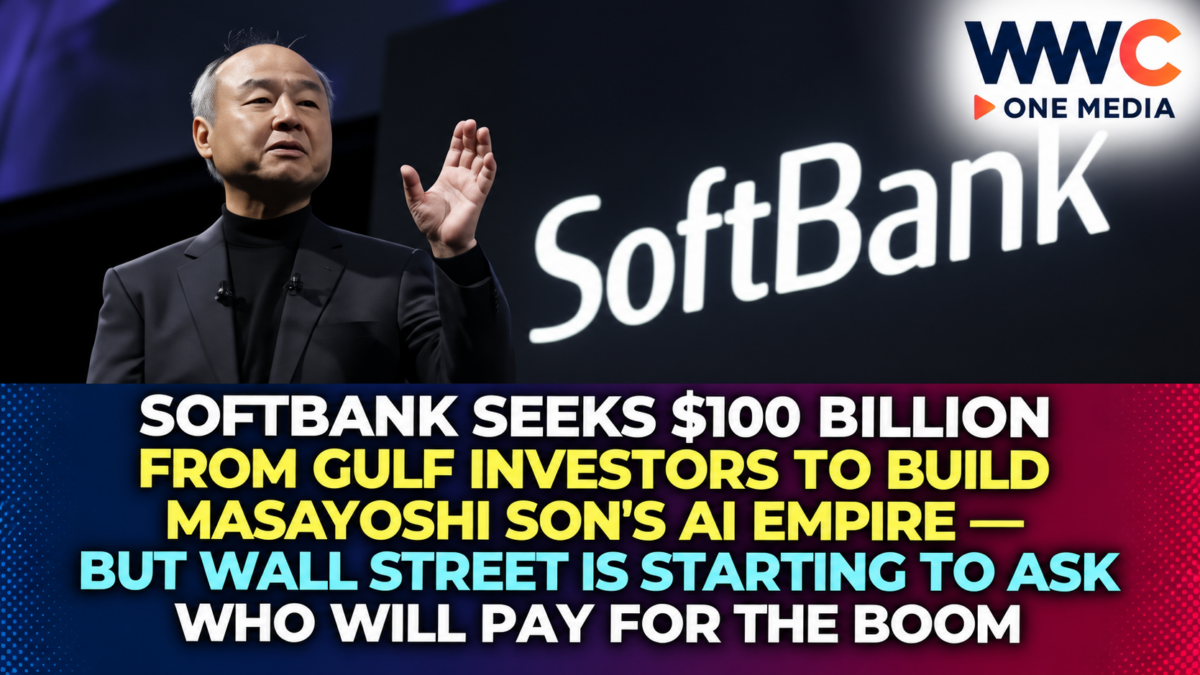
TOKYO — Masayoshi Son is reportedly preparing one of the biggest artificial-intelligence fundraising drives ever attempted, seeking as much as $100 billion from investors in the Gulf as SoftBank races to build an AI empire stretching from OpenAI and Arm chips to robotics, data centers and power infrastructure.
The reported fundraising target is extraordinary:
up to $100 billion.
That would be larger than many sovereign investment funds.
It would dwarf most technology venture funds.
And it would give SoftBank enough firepower to acquire entire companies rather than simply take minority stakes.
According to the Financial Times, Son has recently held discussions with senior figures in the:
United Arab Emirates
and potentially other Gulf states.
The plan reportedly involves creating a new investment vehicle that would:
Acquire companies
and then use:
Artificial intelligence
Robotics
and
Advanced technology
to transform their operations.
But there is an important caveat.
The talks remain:
reported discussions.
SoftBank has not publicly announced a $100 billion fund.
Reuters was unable to independently confirm the negotiations.
So the number should not yet be treated as committed capital.
Still, the strategy fits perfectly with what Son has been building for the past two years.
And it reveals just how enormous his ambitions have become.
SOFTBANK NO LONGER WANTS TO BE JUST AN INVESTOR
For years, SoftBank was primarily known as:
a technology investment conglomerate.
Its Vision Fund placed massive bets on companies including:
Uber
DoorDash
WeWork
and
ByteDance.
Some became enormous winners.
Others became spectacular failures.
The Vision Fund era was built around identifying fast-growing technology companies and buying stakes in them.
Son’s new strategy is different.
He does not simply want SoftBank to invest in the AI revolution.
He wants SoftBank to own critical parts of the entire AI system.
That includes:
Models
Semiconductors
Data centers
Robotics
Energy
and
Infrastructure.
OPENAI SITS AT THE CENTER OF THE BET
SoftBank’s largest and most controversial commitment is:
OpenAI.
The Japanese group has committed approximately:
$64.6 billion
to the ChatGPT developer.
SoftBank recently completed another:
$30 billion investment tranche
connected to OpenAI’s fundraising.
That gives Son enormous exposure to one company.
OpenAI is one of the fastest-growing technology businesses in history.
But it is also one of the most capital-intensive.
Training and operating frontier AI models requires:
Nvidia GPUs
Data centers
Electricity
Cooling
and
Networking infrastructure.
Those costs are enormous.
That means SoftBank is not simply betting that ChatGPT becomes popular.
It is betting that OpenAI eventually becomes profitable enough to justify one of the largest private-company valuations ever seen.
OPENAI’S LATEST REVENUE NUMBER CREATED NEW QUESTIONS
That confidence is being tested.
OpenAI recently told investors that its September annualized revenue was close to:
$50 billion.
That is extraordinary growth.
But it was below the roughly:
$70 billion
figure that some investors had previously been using.
Part of the gap was caused by different accounting treatment around revenue generated through:
cloud partners.
So this was not necessarily a sudden $20 billion collapse in demand.
But markets reacted nervously anyway.
Why?
Because AI infrastructure spending has become so large that investors need:
massive revenue growth
to justify it.
The difference between:
$50 billion
and
$70 billion
therefore matters enormously.
SOFTBANK IS ALREADY BORROWING HEAVILY TO FUND THE AI PUSH
Only weeks before reports of the Gulf fundraising emerged, SoftBank raised:
$11.1 billion
through dollar- and euro-denominated bonds.
It was described as the:
largest high-yield corporate bond sale ever.
The debt carried yields ranging roughly from:
7.1%
to
9.75%.
That is expensive money.
SoftBank also raised approximately:
$6.3 billion
through a separate retail bond issuance.
The message is clear.
Son needs enormous amounts of capital.
And SoftBank’s own balance sheet cannot finance everything he wants to build.
THIS IS WHY THE GULF MATTERS
The Gulf has something SoftBank desperately needs:
capital.
Saudi Arabia and the UAE have accumulated enormous sovereign wealth through:
oil
and
gas revenues.
They are now trying to convert that wealth into ownership of future industries.
Artificial intelligence has become one of their biggest priorities.
Saudi Arabia has invested aggressively through the:
Public Investment Fund.
The UAE has built major investment platforms including:
Mubadala
ADQ
and
MGX.
Those institutions are increasingly investing in:
AI
Semiconductors
Data centers
and
Cloud infrastructure.
That makes the Gulf a natural destination for Son.
THIS WOULD NOT BE SON’S FIRST MAJOR GULF PARTNERSHIP
Saudi Arabia played a central role in SoftBank’s original:
Vision Fund.
The kingdom committed tens of billions of dollars.
That relationship helped SoftBank create what was then the world’s largest technology investment fund.
Now Son appears to be returning to the same basic playbook.
But instead of:
internet startups
the focus is:
artificial intelligence infrastructure.
And the potential amount is even larger.
THE UAE HAS ITS OWN REASONS TO LISTEN
The UAE wants to become a global AI hub.
It has invested heavily in:
data centers
semiconductors
AI models
and
international technology partnerships.
Abu Dhabi-backed MGX has already participated in major AI investments.
The country also has access to:
large amounts of capital
and
cheap energy.
Those two advantages are becoming increasingly important.
AI is ultimately a capital-intensive and electricity-intensive business.
Countries that control both money and power have strategic leverage.
SOFTBANK’S NEW FUND COULD BUY ENTIRE COMPANIES
This is where the reported plan becomes especially interesting.
The proposed vehicle would not simply invest in AI startups.
It could reportedly:
buy established companies
and then use AI to improve them.
That is closer to:
private equity
than traditional venture capital.
Imagine buying a logistics company and using AI to optimize routes.
Or acquiring a manufacturing company and introducing:
robotics
and
automation.
Or buying a healthcare business and using AI to improve:
diagnostics
scheduling
and
administrative work.
Son increasingly believes AI will transform every industry.
He wants ownership of the companies undergoing that transformation.
SOFTBANK’S ROBOTICS BUSINESS COULD PLAY A CENTRAL ROLE
SoftBank has also been rebuilding its robotics ambitions.
The group has been assembling assets around:
AI-powered automation.
Its robotics platform could help acquired companies automate:
warehouses
factories
logistics
and
service operations.
That creates a potentially powerful combination.
SoftBank can provide:
capital.
OpenAI can provide:
AI intelligence.
Arm can provide:
chip architecture.
Robotics companies can provide:
physical automation.
And DigitalBridge can provide:
infrastructure.
Son is attempting to connect them all.
ARM IS ONE OF SOFTBANK’S MOST IMPORTANT ASSETS
SoftBank controls a majority stake in:
Arm Holdings.
Arm designs chip architectures used across:
Smartphones
Servers
Automobiles
and increasingly
AI computing.
Its intellectual property sits inside billions of devices.
That makes Arm central to Son’s vision.
If AI eventually spreads from massive cloud data centers into:
robots
cars
phones
and
industrial equipment,
Arm could become one of the biggest beneficiaries.
This gives SoftBank exposure to the semiconductor layer without directly manufacturing chips.
DIGITALBRIDGE ADDS THE PHYSICAL INFRASTRUCTURE
SoftBank recently completed its acquisition of:
DigitalBridge.
The acquisition price for DigitalBridge’s equity was approximately:
$3.1 billion
after the transaction had originally been announced at roughly:
$4 billion enterprise value.
DigitalBridge specializes in:
Data centers
Fiber networks
Cell towers
Edge infrastructure
and
Digital assets.
That is strategically important because AI models are useless without physical infrastructure.
Someone has to build:
the buildings
the power connections
and
the networks
that run the GPUs.
DigitalBridge gives SoftBank expertise in exactly that area.
SOFTBANK IS EFFECTIVELY BUILDING AN AI STACK
The pieces increasingly look deliberate.
OpenAI: intelligence.
Arm: computing architecture.
DigitalBridge: infrastructure.
Robotics: physical automation.
Energy assets: electricity.
And potentially a new:
$100 billion fund
to buy companies that use all of those technologies.
That is far more ambitious than the original Vision Fund.
Son is not simply choosing AI winners.
He is attempting to create an ecosystem where SoftBank owns multiple layers of the value chain.
BUT THE STRATEGY IS EXTREMELY CAPITAL INTENSIVE
This is the central risk.
AI requires staggering amounts of money.
Morgan Stanley estimates the AI infrastructure buildout could require approximately:
$1.5 trillion in external financing by 2028.
That means even enormous companies are borrowing.
Technology giants have already issued hundreds of billions of dollars of bonds to fund:
data centers
power plants
and
chip purchases.
SoftBank faces the same challenge.
Except unlike Microsoft or Alphabet, SoftBank does not generate tens of billions of dollars every quarter from highly profitable:
cloud
or
advertising businesses.
It depends heavily on:
investment value
and
capital markets.
THAT MAKES SOFTBANK MORE VULNERABLE TO MARKET SENTIMENT
When AI valuations rise:
SoftBank’s asset values rise.
It can borrow more easily.
It can sell assets at higher prices.
It can raise capital.
But when AI valuations fall, the process reverses.
Assets lose value.
Credit becomes more expensive.
Investors become cautious.
That was one of the lessons from SoftBank’s earlier Vision Fund cycle.
Companies that looked unstoppable during easy-money periods suddenly struggled when markets tightened.
SON HAS BEEN HERE BEFORE
Masayoshi Son is famous for making enormous concentrated bets.
His early investment in:
Alibaba
became one of the greatest venture investments in history.
But his support for:
WeWork
became one of SoftBank’s biggest disasters.
Son’s strength and weakness are essentially the same characteristic.
He thinks:
very big.
When he is right, SoftBank can generate extraordinary returns.
When he is wrong, losses can also be extraordinary.
The OpenAI bet may become the defining investment of his career.
THIS TIME THE NUMBERS ARE EVEN LARGER
SoftBank’s original Vision Fund was about:
$100 billion.
Now Son is reportedly looking for another pool of capital of similar size.
But this comes after SoftBank has already committed tens of billions to OpenAI.
It has already borrowed heavily.
It has already bought infrastructure assets.
And the overall AI industry is spending at a pace never before seen in technology.
The combined exposure is enormous.
INTEREST RATES MAKE EVERYTHING HARDER
Another problem is the cost of money.
U.S. long-term bond yields are near multi-decade highs.
The 30-year Treasury recently reached approximately:
5.6%.
That pushes borrowing costs higher across global markets.
AI infrastructure is particularly sensitive to this.
A data center may require billions of dollars upfront.
The return comes over many years.
If financing costs increase, the project needs significantly more revenue to remain attractive.
That changes the economics.
THIS IS WHY GULF EQUITY CAPITAL IS SO ATTRACTIVE
Equity capital can reduce pressure on SoftBank’s balance sheet.
Instead of borrowing another:
$100 billion,
Son can persuade outside investors to provide capital.
SoftBank could then:
manage the fund
and
invest alongside it
without carrying the entire financial burden itself.
This is similar to how:
private equity firms
and
infrastructure managers
operate.
They use outside investors’ money while earning:
management fees
and
investment returns.
DigitalBridge could help SoftBank institutionalize this model.
GULF INVESTORS ALSO WANT SOMETHING FROM SON
This would not be charity.
Saudi Arabia and the UAE want access to:
technology
jobs
data centers
and
AI expertise.
A SoftBank partnership could help attract:
OpenAI infrastructure
Arm technology
and
global AI companies
into the Gulf.
That could accelerate regional diversification away from oil.
The arrangement therefore has strategic logic for both sides.
AI AND ENERGY ARE BECOMING INSEPARABLE
This may be one of the biggest reasons Gulf countries matter.
AI needs enormous amounts of:
electricity.
A modern AI data-center campus can consume hundreds of megawatts.
Future clusters could consume:
gigawatts.
Countries with abundant:
natural gas
solar resources
and
investment capital
therefore have a natural advantage.
The Gulf possesses all three.
That makes it increasingly attractive as a location for AI infrastructure.
POWER COULD BECOME MORE IMPORTANT THAN CHIPS
For years, investors thought AI’s biggest bottleneck was:
Nvidia GPUs.
Now the bottleneck is expanding.
Companies also need:
Transformers
Grid connections
Cooling
Land
and
Electricity.
A company can have billions of dollars and still struggle to find enough power for a giant AI campus.
This changes the strategic value of energy-rich economies.
It also explains why Son is interested in:
power infrastructure
not just software.
SOFTBANK IS TRYING TO GET AHEAD OF THAT BOTTLENECK
Son’s infrastructure strategy appears designed around this reality.
If SoftBank owns or finances:
Data centers
energy projects
and
chip infrastructure,
it can capture more of the AI value chain.
That reduces dependence on simply guessing which software company will win.
Even if multiple AI-model companies compete, all of them still need:
compute.
That is the infrastructure thesis.
BUT PUBLIC MARKETS ARE STARTING TO PUSH BACK
The timing of the reported $100 billion fundraising is important.
Investors are becoming more skeptical about AI infrastructure valuations.
Australian data-center operator:
Firmus
just canceled a planned IPO that could have raised more than:
$5 billion.
The company had Nvidia and Blackstone backing.
But public investors refused to accept the valuation.
That was a warning.
AI enthusiasm remains enormous.
But investors are no longer willing to fund every project at any price.
AI STOCKS HAVE ALSO BECOME MORE VOLATILE
Technology shares have experienced repeated selloffs whenever investors question:
AI spending
or
revenue growth.
Nvidia.
Broadcom.
AMD.
Micron.
Oracle.
All have become sensitive to evidence that AI customers might slow spending.
That does not mean the AI boom is ending.
It means investors are demanding more evidence that the economics work.
SOFTBANK IS BETTING THE OPPOSITE
Son appears convinced that the world is still:
underinvesting
in AI.
His view is that artificial intelligence will eventually become more powerful than humans across many forms of intellectual work.
He refers to the long-term destination as:
Artificial Super Intelligence.
From that perspective, today’s massive investments are still early.
If he is right, $100 billion may ultimately look small.
If he is wrong, it could become another Vision Fund-style excess.
THE NEW FUND WOULD ALSO REDUCE SOFTBANK’S DEPENDENCE ON OPENAI’S IPO
SoftBank had hoped public markets would eventually provide another source of liquidity for:
OpenAI.
But OpenAI’s listing plans have faced delays.
That matters because an IPO would create:
a market price
and potentially
liquidity
for SoftBank’s enormous stake.
Without that event, much of SoftBank’s OpenAI value remains:
private and illiquid.
That makes outside financing more important.
A Gulf-backed fund could allow Son to keep investing without waiting for OpenAI to list.
THE STRATEGY RESEMBLES A NEW VERSION OF PRIVATE EQUITY
This could become one of the most interesting developments in global finance.
Traditional private equity buys companies.
It reduces costs.
Improves operations.
And eventually sells them.
Son appears to be proposing something similar.
But the transformation tool would be:
AI.
Buy a company.
Automate processes.
Install AI systems.
Reduce labor costs.
Increase productivity.
Then sell the improved company at a higher valuation.
If successful, SoftBank could create an entirely new form of AI-driven private equity.
BUT THE EXECUTION RISK IS ENORMOUS
AI transformation sounds simple.
In practice, companies contain:
old software
complex workflows
regulatory constraints
and
organizational politics.
Installing ChatGPT does not automatically transform a corporation.
Many AI projects still struggle to demonstrate measurable returns.
That means SoftBank would need strong:
operational expertise
not simply capital.
The acquisition of DigitalBridge and investment in robotics suggest Son understands that challenge.
But proving the model at scale will take years.
ANOTHER RISK IS CONCENTRATION
SoftBank’s exposure increasingly centers on one theme:
AI.
That can produce enormous upside.
But diversification is limited.
If AI valuations fall sharply, SoftBank could be hit across multiple assets simultaneously.
OpenAI.
Arm.
Data centers.
Robotics.
Infrastructure.
Those investments may all respond to the same underlying market cycle.
That creates correlation risk.
GULF INVESTORS WILL HAVE TO DECIDE WHETHER THAT RISK IS WORTH IT
For sovereign wealth funds, the calculation is different from ordinary investors.
They have:
long time horizons
and
enormous capital bases.
They can tolerate volatility.
They also care about strategic benefits.
If a $100 billion SoftBank fund brings:
AI infrastructure
technology transfer
and
economic diversification
into the Gulf, the return may not be measured only financially.
That could make them more receptive to Son’s pitch.
THE SIZE ALONE WOULD CHANGE THE GLOBAL AI INVESTMENT LANDSCAPE
A $100 billion AI-focused vehicle would immediately become one of the largest pools of technology capital in the world.
It could compete for acquisitions with:
Private equity firms
Sovereign funds
and
Big Tech.
It could finance:
Semiconductor companies
Power projects
Data centers
Robotics firms
and
AI software businesses.
That gives SoftBank enormous influence.
Son would essentially become one of the world’s most important allocators of AI capital.
THE BIGGER STORY: SON IS TRYING TO BUILD AN AI EMPIRE BIGGER THAN SOFTBANK’S OWN BALANCE SHEET
This is the real significance of the reported fundraising.
Masayoshi Son’s ambition has grown beyond what SoftBank can comfortably finance alone.
The company has already:
committed roughly $64.6 billion to OpenAI.
Raised:
$11.1 billion in record high-yield bonds.
Bought:
DigitalBridge.
Built exposure to:
Arm.
Expanded:
robotics.
And invested in:
power and AI infrastructure.
Now Son reportedly wants Gulf investors to provide as much as:
another $100 billion.
That would allow him to continue expanding without putting every dollar directly onto SoftBank’s balance sheet.
It is an audacious strategy.
And it comes at exactly the moment markets are becoming more skeptical about:
AI debt
AI valuations
and
whether revenue can catch up with spending.
That makes this one of the biggest tests yet of the AI investment cycle.
If Gulf investors commit enormous amounts of capital, Son will gain the firepower to accelerate his plan and potentially reshape entire industries.
If they hesitate, it may signal that even the deepest pools of global capital are beginning to question how much money the AI boom can absorb.
Masayoshi Son is asking the Gulf to help finance the next $100 billion stage of his AI empire — but with borrowing costs rising and investors demanding proof of real returns, the bigger question is whether the world still believes AI deserves virtually unlimited capital.