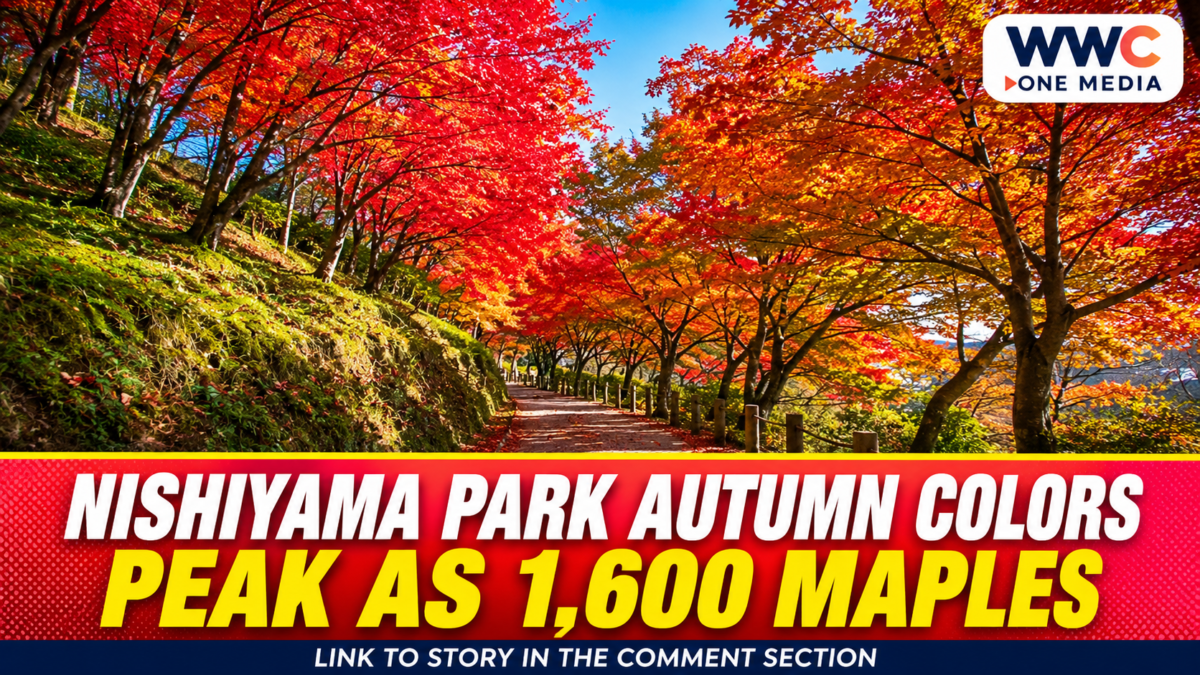
SABAE, Fukui Prefecture, Japan — November 24, 2026 — Nishiyama Park is entering one of its most attractive periods of the year, with Japanese maple trees displaying autumn colors across several sections of the grounds, according to a November 23 update from Sabae City.
The park contains approximately 1,600 maple trees, and the municipality’s latest photographs show areas around the observation deck, Nishiyama Bridge and the upper garden at their seasonal viewing stage.
For visitors, the appeal goes beyond a collection of colorful trees. Nishiyama Park combines landscaped gardens, historic surroundings, recreational facilities and seasonal lighting, making it an example of how regional destinations can build tourism around natural attractions rather than relying solely on major Japanese cities.
The timing is important. The city’s tourism information identifies mid-November through early December as the usual viewing period for the park’s maple foliage, although actual conditions vary from year to year.
Nishiyama Park autumn foliage reaches its viewing stage
Sabae City’s November 23 update provides a location-by-location picture of the changing leaves.
The municipality marked the areas near the Path of Prayer and observation deck as being at their best viewing stage. It gave the same assessment to the surroundings of Nishiyama Bridge and the upper garden near Shodoan, a traditional tea-service facility.
The photographs accompanying the update were taken on November 23, giving visitors a recent official reference rather than relying entirely on a general seasonal forecast. めがねのまちさばえ 鯖江市
The distinction matters for travelers planning a short visit. Foliage does not necessarily develop uniformly across an entire park. Different sections, tree varieties and growing conditions can produce variations in color and timing.
The city’s tourism map lists the usual maple-viewing season as mid-November to early December. That makes the current period a relevant opportunity for visitors, but it should not be treated as a guarantee that every tree will remain at peak color until the end of the month. めがねのまちさばえ 鯖江市
A collection of 1,600 maples gives the park its seasonal identity
The scale of the planting helps explain why Nishiyama Park becomes a destination during autumn.
Sabae City’s published park inventory identifies approximately 1,600 maple trees distributed across three areas: 761 in Koyo Garden, 436 around Nishiyama and 403 between the observation deck and the Mizuochi direction.
The inventory also identifies several varieties, including Japanese mountain maple, Japanese maple, painted maple, large-leaf maple, weeping maple and Nomura maple. めがねのまちさばえ 鯖江市
This variety gives the grounds a broader horticultural identity than a single-species display. The trees are distributed across different parts of the park, allowing visitors to encounter changing scenery while moving between its landscaped sections.
The city’s tourism guide describes Nishiyama Park as a natural area of approximately 56 hectares, with a history extending more than 150 years. It also notes the park’s selection for Japan’s Top 100 Historical Parks.
Its grounds include Nishiyama Zoo, open spaces, a children’s athletic area and Koyo Garden, which recreates a garden associated with the former Sabae domain. めがねのまちさばえ 鯖江市
That combination gives the destination more than one reason to attract visitors. Autumn foliage is the seasonal draw, while the wider park provides additional places to explore.
Seasonal lighting extends the experience beyond daylight
Nishiyama Park’s autumn programme also includes a scheduled maple illumination period.
Sabae City’s published procurement notice for the park’s illumination installation identifies October 9 through November 30, 2026, as the operating period for the maple lighting. The same notice lists a separate autumn and winter illumination period running from November 1, 2026, through January 15, 2027. めがねのまちさばえ 鯖江市
The distinction between the two schedules is worth noting. The maple illumination is a seasonal programme with a November 30 end date, while the broader autumn and winter lighting programme continues into January.
Lighting can change how visitors experience a landscaped park, particularly when trees and garden features are viewed after sunset. It also gives destinations an opportunity to spread visits beyond the usual daytime sightseeing period.
However, visitors should check the municipality’s latest announcements for operating hours and any changes before making a dedicated evening trip. The official schedule reviewed for this report confirms the dates, but does not establish the reported daily 6 p.m. to 9 p.m. hours.
More than a foliage stop: the park’s historical and recreational setting
Nishiyama Park’s appeal is rooted in its development as a public landscape.
The Sabae tourism guide traces part of its history to Koyo-kei, a garden created around 150 years ago by Akiyoshi Manabe, the seventh lord of the Sabae domain. The landscaped grounds became the foundation for the present park.
Today, the municipality presents the site as a destination for different seasons. Spring brings cherry blossoms and azaleas, early summer features irises and wisteria, autumn highlights the maples, and winter brings snow-covered scenery. めがねのまちさばえ 鯖江市
The park also includes an observation deck overlooking Sabae, a bridge connecting its eastern and western sections, open recreation spaces and a zoo.
For travelers, this broader mix can make the destination more practical than a stop built around a single photo opportunity. Families and visitors with different interests can spend time in the same public space without limiting the trip to foliage viewing.
The wider popularity of seasonal experiences also fits into Japan’s continuing tourism appeal. WWC previously examined Japan’s record October visitor arrivals, which highlighted autumn foliage among the factors supporting travel demand.
Why regional parks matter to Japan’s tourism mix
Japan’s best-known destinations often dominate international travel planning, but regional parks offer a different kind of experience.
Nishiyama Park is located in Sabae, Fukui Prefecture, outside the country’s largest metropolitan tourism centres. Its seasonal attraction demonstrates how municipalities can use established public spaces, landscaping and local history to encourage visitors to explore beyond the most familiar urban destinations.
For Filipino travelers considering Japan, this offers another possible addition to an itinerary. WWC has also explored why Japan remains attractive to Filipino holidaymakers, particularly those looking for cooler weather and seasonal experiences.
A regional park visit, however, requires practical planning. Travelers should consider transport connections, daylight hours, weather conditions and the amount of time needed to explore the grounds. A foliage destination is most rewarding when visitors have enough time to experience the setting rather than simply arriving for a quick photograph.
Other Asian cities are also promoting accessible green spaces and seasonal landscapes. WWC’s feature on Seoul Botanic Park as an autumn destination provides another example of how urban parks can become part of a city’s visitor experience.
What happens next
The maple illumination schedule published by Sabae City runs through November 30, while the broader autumn and winter lighting programme is scheduled to continue until January 15, 2027.
The municipality’s latest foliage update, dated November 23, remains the most useful official reference for visitors checking the condition of specific areas. Because leaf color changes with weather and time, travelers should review the city’s latest photographs and notices before departure.
For now, Nishiyama Park offers a timely opportunity to experience one of Fukui Prefecture’s established seasonal attractions. Its appeal lies not only in the number of maples, but also in the gardens, history and public spaces that give the autumn scenery its setting.
FAQ
1. Where is Nishiyama Park located?
Nishiyama Park is in Sabae City, Fukui Prefecture, Japan. Its listed address is 3-7-20 Sakuramachi, Sabae.
2. How many maple trees are in Nishiyama Park?
Sabae City’s park inventory lists approximately 1,600 maple trees across several sections of the grounds.
3. When is the best time to see autumn leaves at Nishiyama Park?
The city’s tourism information identifies mid-November to early December as the usual maple-viewing period. Actual conditions vary each year.
4. How long will the 2026 maple illumination run?
The official municipal schedule lists October 9 through November 30, 2026, for the maple illumination programme.
5. What else can visitors see at Nishiyama Park?
The grounds include Koyo Garden, an observation deck, Nishiyama Bridge, recreational spaces and Nishiyama Zoo.