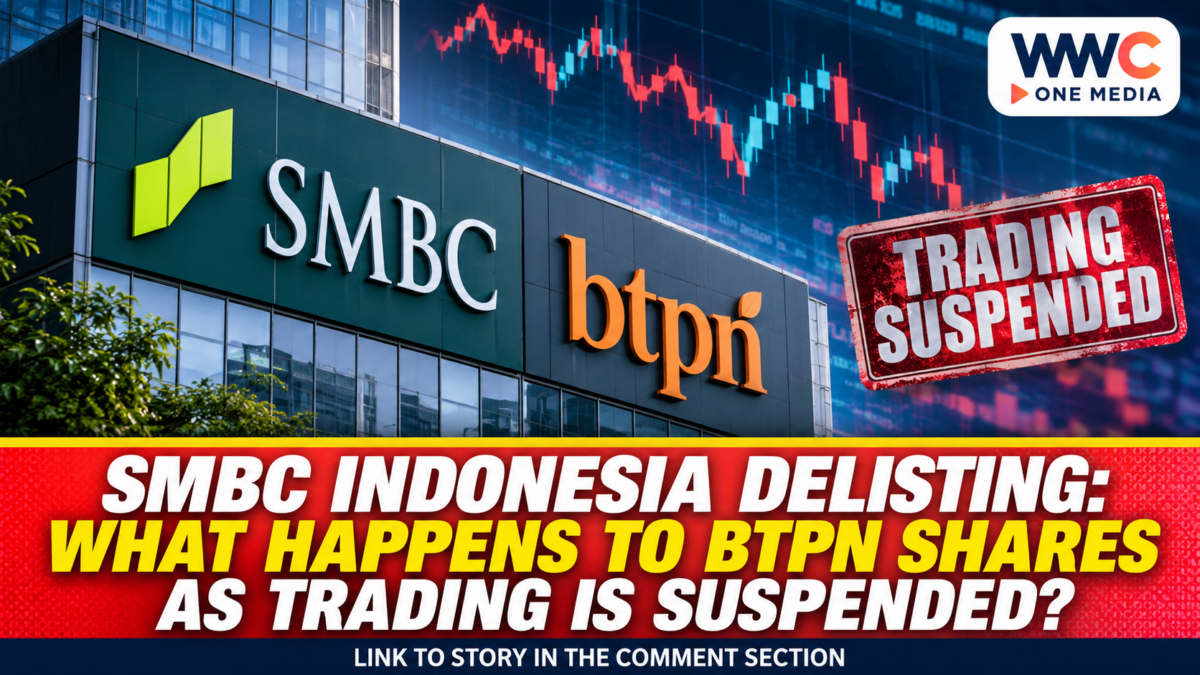
JAKARTA — November 24, 2026 — PT Bank SMBC Indonesia Tbk has formally notified Indonesia’s financial regulator and stock exchange of its plan to seek approval for a transition from a publicly listed company to a privately held business, setting in motion a process that could remove its shares from the Indonesia Stock Exchange (IDX).
The exchange suspended trading in the bank’s shares, listed under the ticker BTPN, from the pre-opening session on November 23, citing the proposed voluntary delisting and move to private ownership. The company has said fuller details will accompany the announcement of an extraordinary general meeting of shareholders scheduled for November 30.
The proposal puts a major question before investors: what happens to the shares that remain outside the controlling shareholder’s hands? For now, the public disclosures establish the intended corporate action and trading suspension, but do not yet provide the complete terms shareholders would need to assess the transaction.
SMBC delisting: What the official notice actually confirms
The company’s November 20 disclosure, filed under reference S.102/CCS/XI/2026, says it has submitted to the Financial Services Authority, known as OJK, and the IDX a plan to convene an extraordinary general meeting of shareholders.
The proposed meeting concerns changing the company’s status from a listed public company to a private company and removing all its shares from the exchange. The notice identifies November 30 as the date when more detailed information will be released alongside the meeting announcement.
The company also states that it will comply with applicable laws and regulations during the process.
That is an important but limited disclosure. It confirms a plan to pursue delisting; it does not establish that shareholders have already approved the move or that the delisting has taken effect. The company’s notice also says the operational, legal and financial implications will be explained in a subsequent disclosure.
The IDX’s November 23 announcement separately confirms that BTPN trading was suspended in all markets, with the stated reason being “Voluntary Delisting dan Go Private.” The suspension began at the pre-opening session and remains subject to a further exchange announcement.
Who owns SMBC Indonesia — and why public shareholders matter
SMBC Indonesia’s published shareholder composition, dated June 30, 2026, shows that Sumitomo Mitsui Banking Corporation held 91.05% of the bank’s shares.
The same disclosure lists PT Bank Central Asia Tbk with 1.03%, PT Bank Negara Indonesia (Persero) Tbk with 0.11%, and public investors with 7.81%. The total number of shares shown is 10,645,945,748.
This ownership structure helps explain why the treatment of the remaining shares is central to the proposed transaction. Although the controlling shareholder already holds a substantial majority, a meaningful portion of the company remains outside that stake.
The 7.81% public holding is not a transaction price, a tender-offer amount or a guaranteed payout. It is the company’s reported public shareholding as of the stated date. Investors will need the forthcoming disclosure to understand how the company intends to address shares held by public shareholders.
The bank’s ownership page also identifies Sumitomo Mitsui Financial Group as the ultimate parent of Sumitomo Mitsui Banking Corporation, which it names as the bank’s controlling shareholder.
A trading suspension is not the same as a completed delisting
For investors, the immediate practical development is that BTPN shares cannot be traded on the exchange while the suspension is in force.
But a suspension should not be confused with the final removal of a company’s shares from the exchange. The exchange announcement describes a temporary suspension. The company disclosure, meanwhile, describes a proposed process that still requires further information and shareholder action.
The distinction is particularly important for investors who may be considering whether to hold, sell or otherwise manage their positions. With trading suspended, the usual exchange mechanism for buying or selling the listed shares is unavailable. The public documents reviewed so far do not state when trading might resume, whether it will resume at all before the proposed delisting, or what arrangements will apply to remaining shareholders.
The wider Indonesian market has also been dealing with questions about share ownership transparency and the availability of shares for public trading. WWC previously examined those market-wide concerns in its report on Indonesia’s stock-market transparency and the risk of losing global index access. That broader debate provides context, but it does not establish the reason SMBC Indonesia has chosen to pursue this particular corporate action.
Why the next disclosure will be more important than speculation
The November 20 notice does not give a detailed explanation for the proposed move. It also does not publish a proposed purchase price for public shares, a tender-offer timetable, a payment mechanism or the expected effective date of the delisting.
Those omissions matter. Without the terms, shareholders cannot reliably calculate what the proposed transaction could mean for the value or liquidity of their holdings.
Investors should also distinguish the bank’s corporate decision from the financial condition of its operating business. A proposal to change listing status does not, by itself, establish that a bank is in financial distress, that its deposits are at risk or that its services will stop.
The bank’s status as a regulated financial institution is a separate matter from whether its shares remain listed. SMBC Indonesia’s investor information identifies the company as licensed and supervised by OJK and Bank Indonesia and as a participant in Indonesia’s deposit-insurance system.
That distinction is important for customers. The current announcement concerns the company’s ownership and stock-market status, not a disclosed suspension of banking operations.
WWC has also covered how enforcement and transparency issues can affect confidence in Indonesia’s securities market. Its report on the OJK investigation into alleged warrant-market manipulation concerns a separate matter, but illustrates why clear disclosures and reliable market information matter to investors.
What happens next
The next scheduled milestone is November 30, when SMBC Indonesia says it will publish further information alongside the announcement of the extraordinary shareholders’ meeting.
That disclosure should be examined for the proposed meeting date, agenda, approval requirements, treatment of public shareholders, any offer or purchase arrangements, price-setting method, deadlines and the expected sequence of regulatory and exchange steps.
Until those details are available, investors should avoid treating the proposed delisting as completed or assuming a particular payment outcome. The exchange’s suspension remains in place pending further announcement.
For broader regional context, WWC has previously explained how bank earnings and market valuations can shape investor sentiment in its coverage of Southeast Asia’s major banking groups and their stock-market performance. The SMBC Indonesia case, however, will ultimately turn on the specific terms disclosed to its own shareholders.
Frequently asked questions
Is SMBC Indonesia delisting from the IDX?
The bank has notified OJK and the IDX of its plan to seek shareholder approval for a move to private-company status and the removal of all its shares from the exchange. The delisting has not yet been confirmed as completed.
Why were BTPN shares suspended?
The IDX announced a trading suspension beginning November 23, 2026, citing the proposed voluntary delisting and move to private ownership.
When will SMBC Indonesia provide more details?
The company says it will release a more detailed disclosure together with the announcement of the extraordinary general meeting of shareholders on November 30, 2026.
What percentage of SMBC Indonesia is publicly held?
The company’s shareholder composition dated June 30, 2026, lists public investors as holding 7.81% of its shares.
Will public shareholders automatically receive payment?
The November 20 notice does not specify a purchase price, payment method or final arrangement for public shareholders. Those details remain to be disclosed.