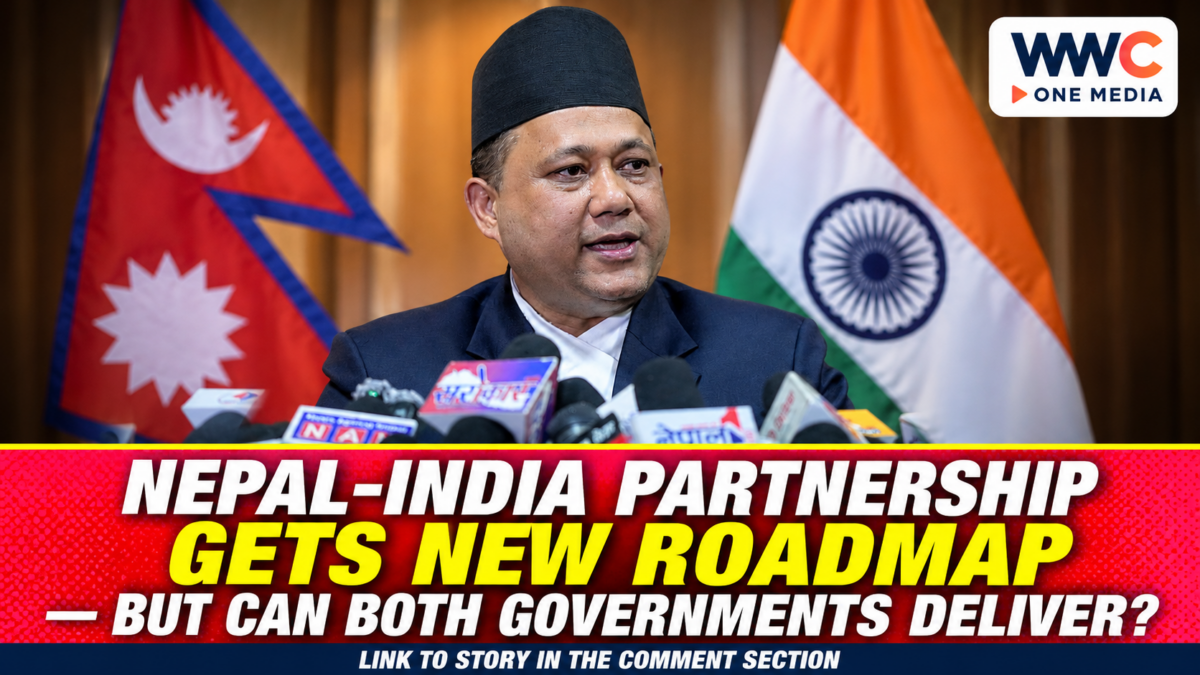
NEW DELHI — November 24, 2026 — Nepal and India have adopted a 10-pillar roadmap for expanding bilateral cooperation after Prime Minister Balendra Shah’s two-day state visit to India on November 22–23, placing trade, infrastructure, energy, technology and disaster resilience at the centre of their next phase of engagement.
The joint programme also includes an Indian development-assistance commitment valued at INR 15,000 crore, or NPR 24,000 crore, combining grant assistance for reconstruction and infrastructure with a separate line of credit for energy projects. The two governments have agreed to establish a monitoring mechanism, but individual projects and the arrangements for delivering the assistance still require further consultation.
The significance of the visit lies in the shift from broad diplomatic intentions towards a more detailed programme of cooperation. Yet the announcement is a framework, not evidence that every proposed project has financing, approvals or a construction schedule. For Nepal, the real test will be whether the commitments translate into infrastructure, stronger commercial links and benefits that reach communities and businesses.
Nepal-India partnership puts economic cooperation at the centre
The joint vision adopted by Prime Minister Shah and Indian Prime Minister Narendra Modi identifies comprehensive economic and development cooperation as its first pillar.
The programme calls for reviewing existing frameworks and agreements covering trade and investment, opening additional transit connections and air routes, and exploring cross-border special economic zones near the India-Nepal border. It also identifies cooperation on industrial supply chains and information technology parks.
India has also committed to encouraging investment in Nepal’s priority sectors, with the stated aim of improving investor confidence and the ease of doing business.
These proposals address practical constraints facing a landlocked economy. Better transit links can widen access to markets, while more predictable investment arrangements can help businesses assess the cost and risks of operating across borders.
However, a policy commitment to encourage investment is not the same as a confirmed investment deal. The joint vision does not identify a complete list of private investors, individual project costs or construction deadlines for the proposed economic zones and IT parks.
The commercial impact will depend on the next stage: identifying viable projects, agreeing on terms and obtaining the necessary approvals.
The INR 15,000 crore assistance package has two different parts
The financial component of the joint vision deserves careful attention because it combines two forms of assistance.
India will extend development assistance of INR 15,000 crore, equivalent to NPR 24,000 crore. This comprises INR 3,500 crore in grant assistance, equivalent to NPR 5,600 crore, for post-disaster reconstruction and new infrastructure projects in Nepal.
The remaining INR 11,500 crore, equivalent to NPR 18,400 crore, is a rupee-denominated line of credit for energy-sector projects.
The distinction matters. A grant does not carry the same repayment structure as a credit facility. A line of credit is financing that must be governed by its applicable terms; it should not be described as a cash grant or as money already transferred to Nepal.
The joint vision states that specific projects and the arrangements for providing the assistance will be finalised through mutual consultations.
That leaves important questions open, including which infrastructure projects will receive support, how the credit will be allocated, what conditions will apply and when funding will become available.
The reconstruction component also comes at a significant time. Nepal is still confronting the economic consequences of the August 2026 Rasuwa–Trishuli basin floods and related debris flows. WWC’s coverage of Nepal’s estimated NPR 723 billion flood-recovery requirement examined the scale of the damage and the difference between assessed recovery needs and financing already available.
The new Indian assistance commitment could become part of that wider recovery effort, but the joint vision does not yet assign the full grant amount to specific flood-damaged facilities.
Energy and water cooperation move beyond electricity trade
Energy remains one of the most commercially important parts of the relationship.
The two governments agreed to encourage Indian investment in Nepal’s hydropower and transmission infrastructure, while Nepal would provide cooperation and facilitation through an enabling framework for such investments.
They also agreed that relevant authorities would explore opportunities to expand electricity trade based on mutual benefit and market demand.
The programme specifically identifies the Pancheshwar and Saptakoshi–Sunkoshi multipurpose projects for accelerated implementation work. These projects connect energy cooperation with water-resource management and the potential to reduce adverse flood impacts.
The agreement also includes a proposed pilot project on green hydrogen in Nepal and stronger cooperation on climate resilience. The two sides intend to improve real-time sharing of hydrometeorological information, glacial-lake monitoring and early-warning systems.
This agenda has a direct connection to Nepal’s recent infrastructure challenges. WWC previously examined the practical obstacles facing Nepal-India power cooperation, including the difference between diplomatic discussions, approved electricity trade and completed transmission infrastructure.
The new joint vision broadens the agenda, but it does not mean that every hydropower or multipurpose project has received final approval, funding or a completion date.
Connectivity, digital payments and technology enter the agenda
The joint vision also places physical and digital connectivity among its priorities.
The leaders welcomed the launch of direct express rail service between Ayodhya in India and Janakpur in Nepal, as well as a motorable bridge across the Mahakali River between Dharchula and Darchula.
They also called for progress on integrated check posts, railway links and additional road connections. The programme identifies the completion of sections of the Jayanagar–Bardibas and Jogbani–Biratnagar railway lines as priorities.
On the digital side, the governments agreed to expedite cross-border retail payments, building on the linkage between India’s Unified Payments Interface and Nepal’s national payment system.
Technology cooperation is another part of the roadmap. The proposals include expanding the India-Nepal Startup Partnership Network, developing a startup centre of excellence in Kathmandu and a digital nomads and innovation hub in Pokhara, and facilitating digital parks and data centres in Nepal.
The countries also intend to strengthen cooperation in artificial intelligence, including work towards a large language model for the Nepali language.
These initiatives could help businesses, travellers and technology companies if they progress beyond policy documents. For aviation, for example, a discussion about connectivity is not automatically an operational approval. WWC’s examination of the requirements for expanding Nepal-India air routes explains why technical and regulatory steps matter alongside diplomatic support.
The 1950 treaty and unresolved issues remain part of the conversation
The joint vision also addresses the legal framework underpinning the bilateral relationship.
The two leaders agreed that existing bilateral agreements, including the 1950 Treaty of Peace and Friendship, could be reviewed on the basis of mutual consent as part of an updated framework reflecting contemporary political, economic and technological realities.
The document does not announce that the treaty has been amended or replaced. It establishes that a review may take place through mutual agreement.
The leaders also recognised that outstanding issues involving water resources, energy, trade and commerce, and the boundary should be resolved through discussion and dialogue.
That wording is significant because it keeps sensitive matters within a diplomatic process rather than presenting them as settled.
A stronger economic partnership will depend not only on new projects but also on the ability of both governments to manage difficult questions through established channels.
What happens next
The governments have agreed to activate a High-Level Monitoring Group led by Nepal’s Foreign Secretary and India’s Ambassador. It is expected to meet at least once every six months to accelerate implementation of the proposed projects and initiatives and facilitate necessary clearances and approvals.
The group will report to the India-Nepal Joint Commission, which is co-chaired by the two countries’ foreign ministers. The next meeting of that commission is scheduled for 2027.
These mechanisms give the roadmap an institutional structure. They do not guarantee that every proposal will be completed on schedule.
The next indicators to watch are the publication of specific project lists, the finalisation of funding arrangements, progress on infrastructure approvals and evidence that trade, energy and connectivity initiatives are becoming operational.
For Nepal and India, the November visit has produced a broad agenda and a substantial financial commitment. Whether it becomes a lasting improvement in the relationship will depend on implementation rather than the number of announcements.
Frequently asked questions
What did Nepal and India agree during Prime Minister Balendra Shah’s visit?
They adopted a 10-pillar joint vision covering economic cooperation, connectivity, energy, water resources, climate resilience, governance, technology, education, health and agriculture.
How much assistance will India provide to Nepal?
The joint vision sets out development assistance of INR 15,000 crore, equivalent to NPR 24,000 crore. It includes INR 3,500 crore in grants and an INR 11,500 crore line of credit.
Is the entire INR 15,000 crore a grant?
No. The announced amount combines grant assistance for reconstruction and infrastructure with a separate rupee-denominated line of credit for energy projects.
Did Nepal and India amend the 1950 Treaty of Peace and Friendship?
No amendment was announced. The two leaders agreed that existing bilateral agreements, including the 1950 treaty, could be reviewed by mutual consent.
When will the next India-Nepal Joint Commission meeting take place?
The leaders decided that the next meeting of the India-Nepal Joint Commission will be held in 2027.