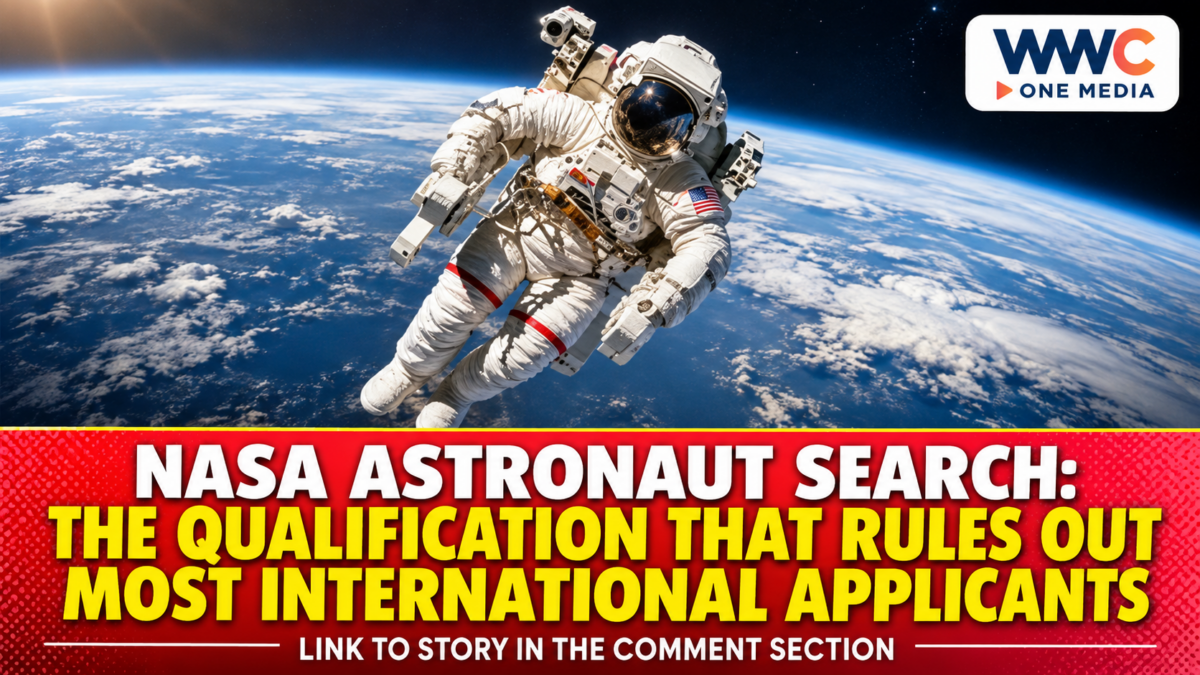
NASA is recruiting candidates for its next astronaut class, with applications scheduled to close on Dec. 3, 2026. But the most important condition for many people considering the opportunity is not a science degree or flight experience: applicants must be US citizens.
The vacancy offers a detailed look at the experience, education and physical standards NASA expects from people who may eventually work in space. It also highlights a distinction that can be missed in the excitement around astronaut recruitment: being selected as an astronaut candidate is the start of an intensive training programme, not an immediate ticket to a spaceflight.
For Philippine readers, the announcement is relevant as a measure of the expertise required in human space exploration. However, the current NASA vacancy is not open to Filipino citizens who do not also meet its US citizenship requirement.
NASA astronaut requirements begin with citizenship
The official USAJOBS vacancy states that the position is open to US citizens. It also lists US citizenship as a condition of employment.
That makes nationality the first eligibility question for anyone considering an application. A strong academic record or extensive technical experience does not remove this requirement. Foreign education may be considered when it meets the stated equivalency and documentation rules, but that is separate from citizenship eligibility.
NASA’s application window opened on Nov. 7, 2026, and the vacancy is scheduled to close at 11:59 p.m. Eastern Time on Dec. 3. The application must include the required online assessment, questionnaire and supporting documents.
The deadline is not simply a date to begin preparing paperwork. USAJOBS says the complete application package must be submitted by the closing time to receive consideration. Applicants who are directed to complete USA Hire assessments must also follow the assessment instructions and deadline shown in their application.
A master’s degree is the standard route, but not the only one
NASA’s education requirement centres on a master’s degree from an accredited institution in an appropriate technical field. The listed fields include engineering, biological science, physical science, computer science and mathematics.
The vacancy also recognises alternative ways to meet the education requirement. These include at least two academic years of qualifying doctoral study, specified medical degrees, and completion of or current enrolment in a nationally or internationally recognised test-pilot school programme, provided the programme is completed by July 2027.
There are important conditions attached to these alternatives. For example, applicants relying on test-pilot school as their only advanced technical qualification must also meet the specified undergraduate STEM degree requirement.
Applicants must provide the relevant transcripts or other documentation. The announcement says foreign education used to meet the requirements must be supported by an evaluation showing that it is equivalent to education from an accredited US institution.
This is more precise than simply saying NASA wants applicants with a science or engineering background. The agency identifies which academic routes qualify and requires applicants to document them.
Experience matters as much as academic credentials
For applicants who are not applying under the pilot route, the vacancy requires at least three years of progressively responsible professional experience gained after completing the qualifying degree. NASA also says related technical teaching experience at the kindergarten-to-Grade 12 level may be acceptable when the applicant meets the education requirement.
Pilots have a separate route based on flight experience. The listed minimums include 750 hours of pilot-in-command time in high-performance jet aircraft; 1,500 total hours in other fixed-wing aircraft, including 750 as pilot in command; or 1,000 total hours in rotary-wing aircraft, including 300 as pilot in command.
The announcement also makes clear that initial flight-training hours are not counted, and time controlling an unmanned aircraft system does not qualify as pilot flight time under the stated pilot requirements.
Medical doctors may count residency training towards the professional experience requirement, provided the residency is completed by July 2027.
These pathways show that NASA is not recruiting only one type of professional. Its criteria accommodate several technical and operational backgrounds, but applicants must fit a defined route and provide evidence that they meet it.
Selection does not mean an immediate spaceflight
The recruitment process continues long after the application deadline. NASA’s published timeline places the initial application review between December 2026 and April 2027. Initial interviews and selection assessments are scheduled for spring 2027, followed by final interviews and assessments in summer.
NASA expects to announce its 2027 astronaut candidate class in fall 2027. Those selected are scheduled to report to Johnson Space Center in winter 2027–2028. The agency cautions that the schedule may change depending on the number of applications.
The USAJOBS announcement says astronaut candidates spend approximately two years training in core skills such as spacewalking, robotics, leadership and teamwork. After completing training, they join the active astronaut corps and become eligible for spaceflight assignments.
That distinction matters. Selection is an important milestone, but it does not mean every candidate will immediately receive a mission assignment. Until assigned to a flight, candidates and astronauts have responsibilities within the astronaut office, including supporting crew members and advising on spacecraft development.
What the previous selection cycle tells us
NASA says its previous application cycle opened in 2024 and attracted more than 8,000 applications. Ten astronaut candidates were selected in 2025 and were completing nearly two years of training when the agency announced the new recruitment round.
The figures illustrate the scale of interest and the small number ultimately selected. They should not, however, be treated as a precise acceptance rate for applicants who met every eligibility condition: the total application figure does not show how many submissions passed the initial qualification review or advanced through each selection stage.
The agency also says it has selected 370 people to train as astronaut candidates since the 1960s. Its announcement listed 32 active astronauts in the corps at the time of publication.
Where the Philippines fits into the wider space sector
The US citizenship condition closes this particular recruitment route to many international applicants, but it does not mean that space-related work is limited to astronaut positions.
Scientific research, satellite engineering, communications, data analysis and technology development are separate areas in which people can contribute. WWC has previously covered a Filipino student team’s CubeSat research opportunity at the University of the Philippines Diliman, a different part of the wider space and satellite ecosystem.
The practical value of satellite technology is also visible in communications. WWC has reported on Globe’s Starlink satellite-to-mobile roaming arrangement with KDDI, which concerns connectivity rather than astronaut recruitment.
Technology development can involve many other disciplines as well. WWC’s coverage of Taiwanese technology showcased in the Philippines provides another example of how engineering and applied research extend beyond spaceflight itself.
These are not substitutes for NASA’s astronaut programme. They illustrate that participation in the broader technology and space ecosystem can take forms other than becoming an astronaut.
What happens next
NASA’s current vacancy is scheduled to close on Dec. 3, 2026, at 11:59 p.m. Eastern Time. The agency plans to review applications through April 2027, conduct interviews and assessments during the following months, and announce its next astronaut candidate class in fall 2027.
Applicants should rely on the full USAJOBS announcement rather than summaries of the requirements. The official vacancy sets out the education routes, experience categories, documentation and assessment process that determine whether an application can be considered.
For readers outside the United States, the key point is straightforward: the announcement describes a US federal position with a US citizenship requirement. The wider ambition of space exploration may be international, but this particular recruitment is not.
Frequently asked questions
Can Filipino citizens apply for NASA’s 2026 astronaut vacancy?
The vacancy is open to US citizens. Filipino citizens who do not also meet that citizenship requirement are not eligible for this recruitment.
What degree does NASA require?
The standard route is a qualifying master’s degree in an appropriate STEM field from an accredited institution. NASA also recognises specified doctoral study, medical qualifications and test-pilot school training under stated conditions.
How many years of work experience are required?
The general requirement is at least three years of progressively responsible professional experience after the qualifying degree. Pilots may meet the requirement through specified flight-hour minimums.
When does the application period close?
The USAJOBS announcement lists Dec. 3, 2026, at 11:59 p.m. Eastern Time as the closing deadline.
When will NASA announce the next astronaut class?
NASA’s current timeline lists fall 2027 for the announcement of the 2027 astronaut candidate class. The schedule is subject to change.