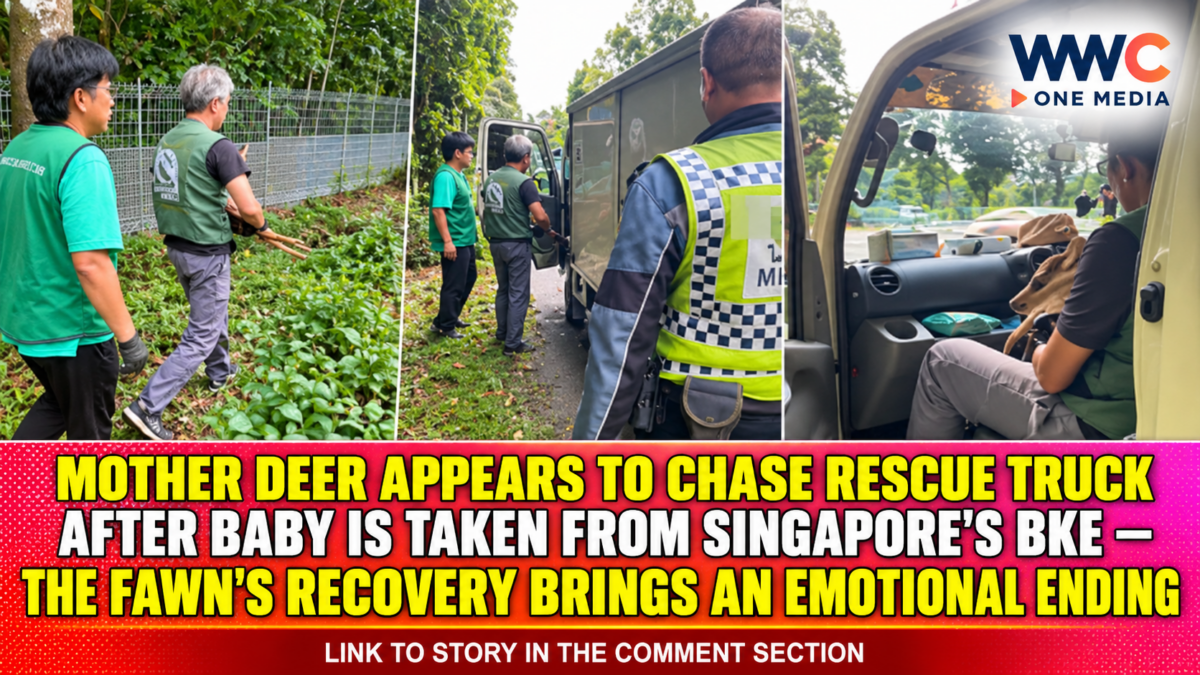
A young sambar deer found weak and lying beside Singapore’s Bukit Timah Expressway (BKE) has been rescued, treated for severe dehydration and released into a forested area near where it was discovered.
The rescue drew widespread attention after a motorcyclist who stopped to help described an emotional moment: the fawn’s mother appeared from behind a roadside barrier and seemed to follow the vehicle carrying her young away.
The incident happened on November 8, 2026, shortly after the Kranji Expressway (KJE) exit along the southbound BKE. A motorist spotted the young deer on the expressway shoulder and contacted the authorities, concerned that it might wander into moving traffic.
The National Parks Board (NParks) subsequently rescued the animal and sent it to the Mandai Wildlife Centre for veterinary treatment. In a joint update with Mandai Nature on November 9, the agencies confirmed that the fawn had been weak and severely dehydrated when found. After treatment and overnight monitoring, its condition improved sufficiently for it to be released near the rescue location. The Straits Times+2
A Motorcyclist Stops to Help a Stranded Fawn
The rescue began when motorcyclist James Lee spotted the young sambar deer lying on the grass beside the southbound BKE at around 2pm on November 8.
Concerned that the animal might wander onto the busy expressway, Lee stopped approximately 100 metres ahead and returned to check on it.
A Land Transport Authority (LTA) patrol officer was also nearby and had noticed the deer. The two approached cautiously, but the fawn appeared weak and moved unsteadily towards a grassy patch beneath a tree.
Lee contacted NParks and remained in the area for approximately 45 minutes while waiting for the rescue team.
ACRES, the Animal Concerns Research and Education Society, also sent personnel to assist. After the teams arrived, it was agreed that NParks would take responsibility for the rescue.
Lee later described the moment the fawn cried out as it was carried towards the rescue vehicle. Its mother, which had apparently been nearby but hidden from view, emerged and seemed to follow the vehicle as it departed.
The sight left the motorcyclist deeply affected, particularly because the mother appeared to be responding to her young animal’s calls. The Online Citizen+2
Conservation Group Initially Raised Concerns About the Fawn’s Condition
Before the official veterinary update was released, the local conservation initiative Save Sambar Deer reported that the rescued animal was in an unstable condition.
The group suggested that the fawn might have become trapped outside a wildlife enclosure for some time, potentially contributing to malnutrition and its weakened state.
It also suggested that the animal may have escaped through an unfinished section of fencing rather than jumping over the barrier.
These were preliminary observations shared by the conservation group, not a confirmed finding from NParks.
The subsequent joint statement from NParks and Mandai Nature confirmed that the fawn was severely dehydrated and weak when it arrived at the Mandai Wildlife Centre. Veterinarians conducted blood tests and radiographs, assessed its overall health and began treatment to stabilise its condition.
Following close monitoring overnight, the animal improved and was considered fit for release. 8world+2
Why Singapore’s Sambar Deer Need Protection
The rescue has also highlighted the challenges of protecting wildlife in a densely developed city.
Sambar deer are among the largest deer species in the world. They are generally shy animals that tend to avoid people and are often more active during the evening and at night.
According to a Channel NewsAsia report published in May 2026, Singapore’s sambar deer population had grown from approximately 15 in 2021 to an estimated 120. The animals are found across several forested areas, including Mandai, Gali Batu, Chestnut Nature Park and Nee Soon Swamp Forest.
The population’s recovery is significant because the species was once thought to have disappeared from Singapore following hunting and habitat loss.
However, a growing population also brings new challenges. Wildlife encounters near roads and residential areas have become a concern, particularly when animals move between forest habitats.
Sambar deer are classified as Vulnerable on the International Union for Conservation of Nature’s Red List, making habitat protection and responsible wildlife management especially important. CNA
Eco-Link@BKE and Wildlife Crossings Help Animals Move Between Forests
The location of the rescue is particularly significant because the BKE runs through an area where roads and wildlife habitats meet.
Singapore has introduced wildlife-friendly infrastructure to reduce the impact of major roads on animal movement. One example is Eco-Link@BKE, a vegetated ecological bridge connecting forest habitats across the expressway.
Wildlife crossings and underground culverts help animals move between habitats while reducing the need to cross busy roads.
NParks has also installed exclusion fencing and speed-regulating measures along roads where wildlife sightings are more frequent.
These measures are important because vehicle collisions remain a threat to animals moving through Singapore’s fragmented natural habitats.
The rescued fawn’s appearance beside the BKE demonstrates why continued monitoring, suitable fencing and safe wildlife corridors matter. CNA
WWC ONE MEDIA has previously examined Singapore’s continuing struggle to balance development and wildlife protection in Tagore Forest at a Crossroads: Singapore Says No Nature Reserve Status — But What Happens to Its Rare Wildlife Next?.
The publication also reported on an unusual wildlife encounter involving macaques dismantling roadside lighting equipment in Singapore’s ‘Monkey Repair Crew’ Strips Lampposts Along Old Upper Thomson Road.
Another report explored the risks of encounters between people and wild animals in Wild Boar Attack Leads to Lawsuit Against NParks — But the Agency Says There’s More to the Story.
Animal welfare has also been a subject of public discussion following Singapore Cabby’s Moving Aquarium Sparks Animal Welfare Concerns After Viral Video Raises Questions Over Fish Safety.
NParks Warns Public Not to Handle Injured Wildlife
Following the rescue, NParks and Mandai Nature reminded members of the public not to approach, touch or attempt to handle injured wild animals themselves.
Even animals that appear weak or harmless may become frightened and react unpredictably when approached.
Members of the public who encounter injured wildlife requiring urgent assistance should contact NParks’ 24-hour Animal Response Centre at 1800-476-1600.
When reporting an incident, people should provide the animal’s location and condition while maintaining a safe distance.
Motorists should also remain alert when travelling near forested areas, especially at night and during periods when wildlife is more active.
The authorities’ advice is particularly important around expressways, where stopping unexpectedly or approaching an animal can create additional risks for both people and wildlife. The Straits Times+1
A Successful Rescue, but a Bigger Wildlife Challenge Remains
The young sambar deer was fortunate to be spotted by someone willing to stop and alert the authorities before it wandered into the path of traffic.
Its recovery and release represent a positive outcome, especially given the initial concerns about its condition and the emotional sight of its mother following the rescue vehicle.
However, the incident also raises a wider question about how Singapore can protect its growing wildlife population while expanding roads, housing and other infrastructure.
For conservationists, the challenge is not simply rescuing animals after they become stranded. It is ensuring that wildlife can move safely between habitats without becoming trapped or exposed to dangerous traffic.
The fawn’s story ended with a return to the forest. Whether Singapore can prevent similar roadside emergencies in the future will depend on continued conservation efforts, better wildlife connectivity and public awareness.