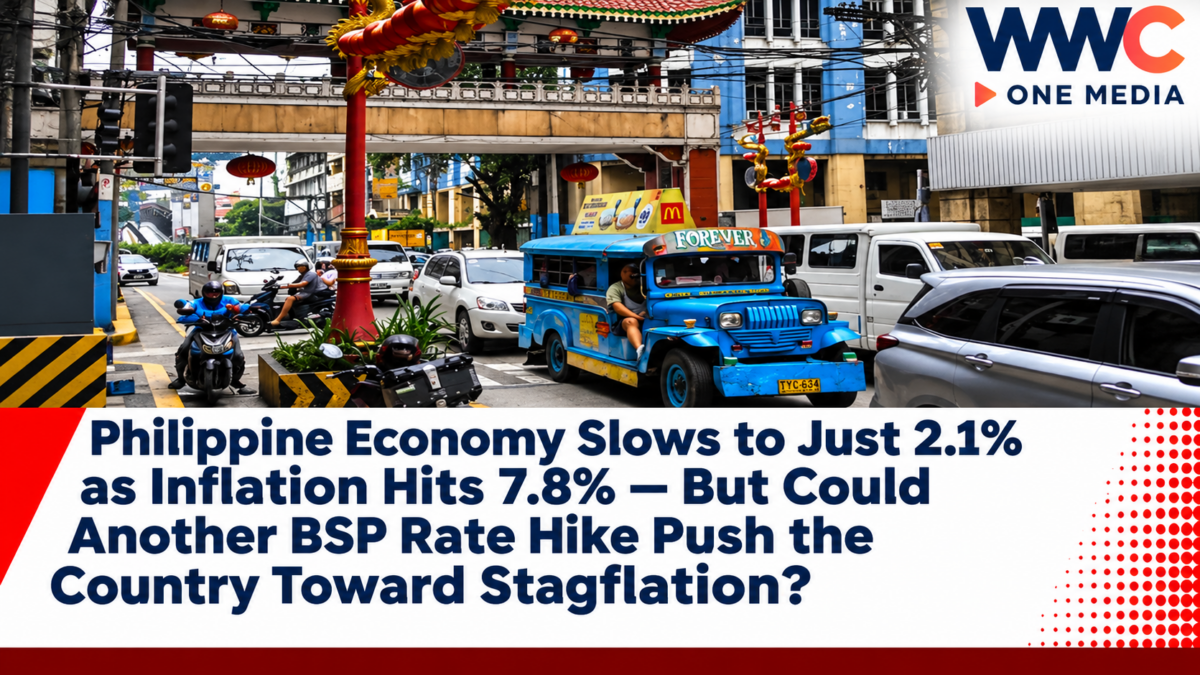
MANILA, PHILIPPINES — November 10, 2026 — The Philippine economy is facing one of its most difficult periods in more than a decade after growth plunged to just 2.1% in the third quarter, triggering urgent calls for government intervention and raising questions about whether the Bangko Sentral ng Pilipinas should continue increasing interest rates.
The latest economic data reveal a troubling combination of weakening household spending, declining agricultural production, sluggish investment and stubbornly high inflation.
According to the Philippine Statistics Authority (PSA), gross domestic product expanded only 2.1% between July and September from a year earlier, slowing from a revised 2.4% growth rate in the second quarter.
The result was substantially worse than the 3.1% median forecast in a Bloomberg survey and the 3.0% consensus in a separate Reuters poll.
Excluding the pandemic period, the latest expansion was the weakest since the final quarter of 2009, when the economy grew just 1.8%.
But the bigger concern is what happens next.
Consumer inflation accelerated to 7.8% in October, while the BSP’s benchmark interest rate has climbed to 5.50% following a surprise 50-basis-point increase.
Business organizations are now demanding stronger action to restore investment confidence, accelerate infrastructure projects and protect households from rising costs.
Meanwhile, economists are debating whether another interest-rate increase could worsen the slowdown without solving the supply problems driving inflation.
As the Philippine economy struggles with its weakest non-pandemic growth since 2009, could aggressive government action prevent a deeper downturn—or will inflation, expensive loans and weak investment push the country toward stagflation?
Philippine GDP Growth Slows for Fifth Consecutive Quarter
The Philippine economy expanded by only 2.1% year over year during the third quarter of 2026.
That was lower than the revised 2.4% increase in the second quarter and the 4.0% growth recorded during the same period in 2025.
The slowdown extended a sequence of five consecutive quarters of weakening annual GDP growth.
On a seasonally adjusted basis, the economy grew just 0.1% from the preceding quarter.
The figure indicates that economic activity was nearly stagnant during the July-to-September period, although output still increased slightly.
The latest data bring economic growth for the first nine months of 2026 to approximately 2.5%.
That is significantly below the government’s full-year target of 3.5% to 4.5%.
Economic Planning Secretary Arsenio Balisacan acknowledged that achieving the official target had become extremely difficult.
For the economy to reach even the lower end of the target range, fourth-quarter GDP would need to expand approximately 6.3%.
That would require a dramatic acceleration from the third quarter’s 2.1% pace.
The government’s Development Budget Coordination Committee is expected to reassess its economic assumptions and targets.
Agriculture Contracts 4.8% as Weather Disrupts Production
One of the biggest weaknesses in the latest GDP report came from agriculture.
The PSA reported that agriculture, forestry and fishing contracted 4.8% from a year earlier.
This reversed the sector’s 2.9% expansion during the previous quarter.
Heavy rains, typhoons and disruptions to agricultural production contributed to the decline.
The setback is particularly important because agriculture supports rural employment, household income and the country’s food supply.
Reduced production can affect farmers’ earnings and contribute to higher prices for certain agricultural commodities.
That creates a difficult economic cycle.
Weak farm output reduces economic growth while supply shortages can increase food inflation.
Higher food prices then reduce the purchasing power of households, particularly lower-income families spending a large portion of their income on essential goods.
Business groups are also warning that a potentially severe El Niño episode could create additional agricultural risks in the coming months.
Drought conditions could threaten irrigation supplies, crop yields and electricity generation.
The extent of those effects remains uncertain and will depend on actual weather developments.
Filipino Households Are Spending More Cautiously
Household consumption, historically one of the Philippines’ most important economic growth drivers, continued losing momentum.
The PSA reported that household final consumption expenditure increased only 2.4% from a year earlier.
That compared with 2.9% during the second quarter.
The slowdown reflects the financial strain caused by higher food prices, expensive fuel, electricity costs and transportation expenses.
Inflation reduces the purchasing power of money, requiring families to spend more to purchase the same quantity of goods and services.
When households devote additional income to essential purchases, they may reduce spending on restaurants, clothing, leisure and other discretionary items.
The impact can spread across the economy.
Retailers may experience slower sales growth.
Small businesses may face weaker customer demand.
Companies may postpone expansion plans if they expect consumption to remain subdued.
WWC ONE MEDIA previously examined how inflation is changing consumer behavior in O!Save Hits 1,000 Stores in Just 5 Years as Philippine Inflation Soars to 7.8% — But Could Its Low-Price Strategy Threaten Traditional Supermarkets?.
The report highlighted growing demand for affordable groceries as Filipino households become increasingly careful about spending.
The latest GDP figures suggest that consumer caution is now an important constraint on national growth.
Public Construction Falls for Sixth Straight Quarter
Another major concern involves government infrastructure activity.
Public construction contracted 15.1% year over year during the third quarter, marking its sixth consecutive quarterly decline.
The contraction was smaller than the 33.4% decline recorded in the preceding quarter, but the sector remained a significant economic drag.
Balisacan attributed the weakness partly to weather disruptions and delays in project validation and payments.
Governance concerns surrounding flood-control infrastructure have also undermined confidence in public spending.
The Philippine government has been dealing with allegations of corruption involving infrastructure contracts, project implementation and the use of public funds.
These controversies have intensified demands for transparency and stronger oversight.
However, the existence of allegations does not establish wrongdoing by every contractor or government official connected with infrastructure projects.
Investigations and legal proceedings must establish responsibility in individual cases.
The economic consequences can nevertheless be substantial.
When construction is delayed, contractors may reduce activity, workers can face employment uncertainty and related industries may experience weaker demand.
WWC ONE MEDIA previously examined infrastructure spending concerns in DPWH Seeks ₱644 Billion for 2027—But Where Will the Extra ₱113 Billion Go?.
The report explored questions about infrastructure priorities, accountability and the need to ensure that public investment produces useful and completed projects.
Business Leaders Demand Immediate Government Action
The Makati Business Club (MBC) warned that the latest GDP figure should serve as a serious warning about the economy’s deteriorating performance.
Executive Director Julia Andrea Abad identified persistent inflation, weak investment, declining purchasing power and higher operating costs as major problems.
The organization called for stronger measures to improve the investment environment and protect economic activity.
Its recommendations emphasize more reliable and affordable energy, improved infrastructure, workforce development, predictable regulation and institutional stability.
MBC also urged greater transparency and accountability in the national budget process.
Business leaders want government spending directed toward projects that deliver genuine economic and social benefits.
The group welcomed the Senate’s creation of the RISE Ad Hoc Committee as a potential avenue for cooperation between policymakers and the private sector.
For businesses, the challenge is not simply attracting more government spending.
It is ensuring that projects are implemented efficiently, funds are properly accounted for and the resulting infrastructure supports productivity.
Confidence can remain weak when investors are uncertain whether public projects will proceed as planned.
Inflation Surges to 7.8% as Growth Weakens
The economy’s slowdown is especially concerning because inflation remains elevated.
Official data showed consumer prices rising 7.8% year over year in October, compared with 7.2% in September.
The latest reading is far above the BSP’s 2%–4% target range.
Food, transportation, electricity and fuel expenses have contributed to the increase.
Higher imported oil prices associated with the conflict involving Iran have placed additional pressure on local costs.
Because the Philippines imports substantial quantities of petroleum, global energy disruptions can influence transportation expenses, manufacturing costs and electricity prices.
The peso’s depreciation has also made some dollar-priced imports more expensive in local-currency terms.
WWC ONE MEDIA previously examined these risks in Philippine Inflation Could Hit 7.7% in October and Breach 8% in November — But Will Another BSP Rate Hike Push Filipino Families to the Brink?.
That earlier article discussed economists’ projections before the official October inflation data became available.
The PSA subsequently confirmed an actual October inflation rate of 7.8%, slightly above the 7.7% estimate discussed in that report.
The distinction matters because economic forecasts must be updated when official figures are released.
BSP Faces Pressure to Reconsider Further Rate Hikes
The BSP is confronting an increasingly difficult monetary-policy environment.
The central bank has raised its benchmark rate by a cumulative 125 basis points since April 2026.
Its latest move was a surprise 50-basis-point increase in October, bringing the policy rate to 5.50%.
The objective is to contain inflation, prevent rising prices from becoming embedded in expectations and support financial stability.
But higher interest rates can also weaken economic growth.
Businesses may face increased financing expenses and postpone investments.
Households may reduce borrowing or delay purchases as loan costs rise.
The effects can become particularly challenging when consumer demand is already slowing.
WWC ONE MEDIA covered the October decision in BSP Stuns Markets With a 50-Basis-Point Rate Hike — What Happens Next to Loans, Prices and the Peso?.
The latest GDP report strengthens the argument for caution, but it does not establish that the central bank must stop raising rates.
Monetary-policy decisions also depend on inflation expectations, currency developments and the persistence of underlying price pressures.
Economic Planning Chief Stops Short of Demanding a Rate-Hike Pause
An important distinction emerged during the November 9 economic briefing.
Although the disappointing GDP figures intensified debate about interest rates, Balisacan did not explicitly demand that the BSP stop tightening monetary policy.
Instead, he acknowledged that the central bank was attempting to restore price stability.
He argued that bringing inflation expectations back toward target could eventually support consumption and investment.
That position reflects an important trade-off.
Higher rates can reduce demand and make credit more expensive.
But prolonged inflation can also undermine growth by weakening purchasing power and confidence.
For policymakers, the challenge is determining how much additional monetary restraint is necessary.
A pause may reduce immediate pressure on borrowing costs.
However, moving too slowly against inflation could create other risks, including further peso weakness or rising inflation expectations.
No decision on a December pause or additional increase has been confirmed.
BPI Economist Warns That Smaller Rate Hikes Could Weaken the Peso
Bank of the Philippine Islands lead economist Emilio Neri Jr. offered a different perspective on the interest-rate outlook.
According to Bloomberg, Neri believes the BSP may consider a smaller rate increase in December because of concerns about economic growth.
However, he warned that insufficient monetary tightening could create additional pressure on the peso.
A weaker currency can increase the peso cost of imported fuel and other commodities.
That could worsen inflation and complicate the central bank’s efforts to restore price stability.
Neri has argued that underlying inflation is becoming increasingly persistent.
The dilemma is therefore more complicated than choosing between high interest rates and economic growth.
If monetary policy is too restrictive, it could deepen the slowdown.
If it is too accommodative, inflation and currency pressures could persist.
The appropriate policy depends on incoming economic data and market conditions.
A Weaker Peso Is Adding to Economic Uncertainty
The Philippine peso has experienced considerable volatility during 2026.
Bloomberg reported that the currency had weakened by almost 7% during the year at the time of its November 9 coverage.
The peso also declined following the disappointing GDP announcement.
A weaker currency can affect imported fuel, machinery, industrial materials and other products priced in US dollars.
But it may also benefit certain exporters and recipients of foreign-currency remittances when measured in pesos.
The overall economic impact depends on the composition of imports, exports and financial obligations.
WWC ONE MEDIA previously examined currency developments in Philippine Peso Rebounds 70 Centavos From Record Low After Marcos’ ‘Don’t Panic’ Assurance — But Can the Recovery Last Without Another BSP Rate Hike?.
That report highlighted how exchange-rate movements are influenced by investor sentiment, energy prices and central-bank expectations.
For the Philippines, sustained currency stability could help reduce some imported inflation pressures.
However, interest-rate increases cannot guarantee that the peso will strengthen.
S&P Global Warns About Stagflation Risks
The economic slowdown has intensified concerns about stagflation.
Stagflation generally describes a situation involving weak economic activity and high inflation, often alongside labor-market weakness.
S&P Global Ratings senior economist Vishrut Rana recently characterized Philippine conditions as stagflationary because growth had fallen significantly below its longer-term trend while inflation remained elevated.
The institution expects Philippine economic growth of approximately 2.9% in 2026, according to its latest forecast.
But government officials are more cautious about applying the label.
Balisacan argued that a broader assessment of economic conditions is necessary before drawing a definitive conclusion.
The disagreement illustrates how economists can interpret the same indicators differently.
The Philippines is experiencing weak growth and high inflation.
Whether those conditions represent a sustained stagflation episode will depend on employment, output and price developments over time.
A single quarterly GDP release cannot establish the entire economic outlook.
Government Spending Could Help — But Execution Matters
Business groups and economists are increasingly calling for stronger government action.
Potential priorities include accelerating high-impact infrastructure projects, improving food supply, reducing logistics bottlenecks and strengthening social protection for vulnerable households.
However, spending additional public money is not automatically beneficial.
Poorly planned projects can waste resources without improving productivity.
And stimulus that increases demand without expanding the supply of goods and services can worsen inflation.
For public investment to support sustainable growth, projects need credible budgeting, transparent procurement and effective implementation.
Better roads, ports, irrigation systems and electricity networks could improve economic efficiency over the longer term.
But the benefits depend on whether projects are completed and deliver the expected services.
The government also needs to consider fiscal constraints and borrowing costs.
Large infrastructure programs may require financing at a time when domestic interest rates remain elevated.
Can the Philippines Still Reach Its 2026 Growth Target?
The government’s official growth target for 2026 is 3.5% to 4.5%.
Following the latest GDP figures, the economy grew by an average of only 2.5% during the first three quarters.
To reach 3.5% for the full year, fourth-quarter GDP would need to expand approximately 6.3%.
That would require a substantial improvement in consumer demand, investment, agricultural production and other economic activities.
Balisacan acknowledged that meeting the target would be extremely challenging.
However, he expressed hope that fourth-quarter performance could improve.
Lower global oil prices, if sustained and reflected in domestic costs, might provide some relief.
A rebound in agricultural activity could also support growth.
But those outcomes remain uncertain.
Weather conditions, delayed infrastructure projects, fragile business confidence and elevated inflation all create risks.
A recovery will require more than a favorable quarter of economic data.
What the Slowdown Means for Filipino Families
For households, the economic implications are immediate.
Slower growth can reduce business expansion and employment opportunities.
High inflation simultaneously increases the cost of essential purchases.
Higher interest rates may make some loans more expensive, particularly those with variable or repricing provisions.
Families may respond by cutting discretionary expenditure and prioritizing food, transport, housing and education.
That cautious behavior can further weaken consumer demand.
The challenge is particularly difficult for low-income households because essential spending absorbs a larger share of their budgets.
Government support targeted toward those most affected may help reduce hardship.
But long-term improvements in living standards require stronger productivity, reliable employment and sustainable income growth.
What Happens Next for the Philippine Economy?
Several developments will shape the economic outlook.
The government is expected to reassess its growth assumptions and identify ways to accelerate economic activity.
Business organizations will continue pressing for transparent infrastructure spending, investment reforms and improved public services.
The BSP must decide whether additional monetary tightening is necessary to contain inflation and stabilize expectations.
The Monetary Board’s next scheduled policy meeting is December 17, 2026.
Before then, policymakers will assess inflation, the peso, global energy prices and other economic indicators.
Further developments involving El Niño and agricultural production could also affect food prices and economic activity.
For investors and businesses, the central issue will be whether the Philippines can restore confidence while maintaining price and financial stability.
The Bigger Picture: The Philippine Economy Faces a Defining Test
The latest GDP report has exposed the seriousness of the Philippines’ economic difficulties.
Growth has slowed to 2.1%, its weakest non-pandemic pace since 2009.
Agriculture is contracting.
Household consumption is losing momentum.
Public construction remains weak.
Meanwhile, inflation has climbed to 7.8%, and the BSP’s benchmark interest rate stands at 5.50%.
The government faces pressure to act, but policymakers must avoid solutions that aggravate the inflation problem.
For President Ferdinand Marcos Jr., restoring public confidence, improving infrastructure implementation and supporting productive investment are becoming increasingly urgent priorities.
For the BSP, the challenge is bringing inflation under control without unnecessarily intensifying the economic slowdown.
And for Filipino households, the stakes are measured in the cost of daily necessities, access to employment and the ability to maintain a decent standard of living.
As the Philippine economy records just 2.1% growth while inflation approaches 8%, the biggest question is whether decisive government action and carefully calibrated interest-rate policy can revive economic momentum—or whether the country is entering a prolonged period of expensive living costs, weak investment and slower growth.