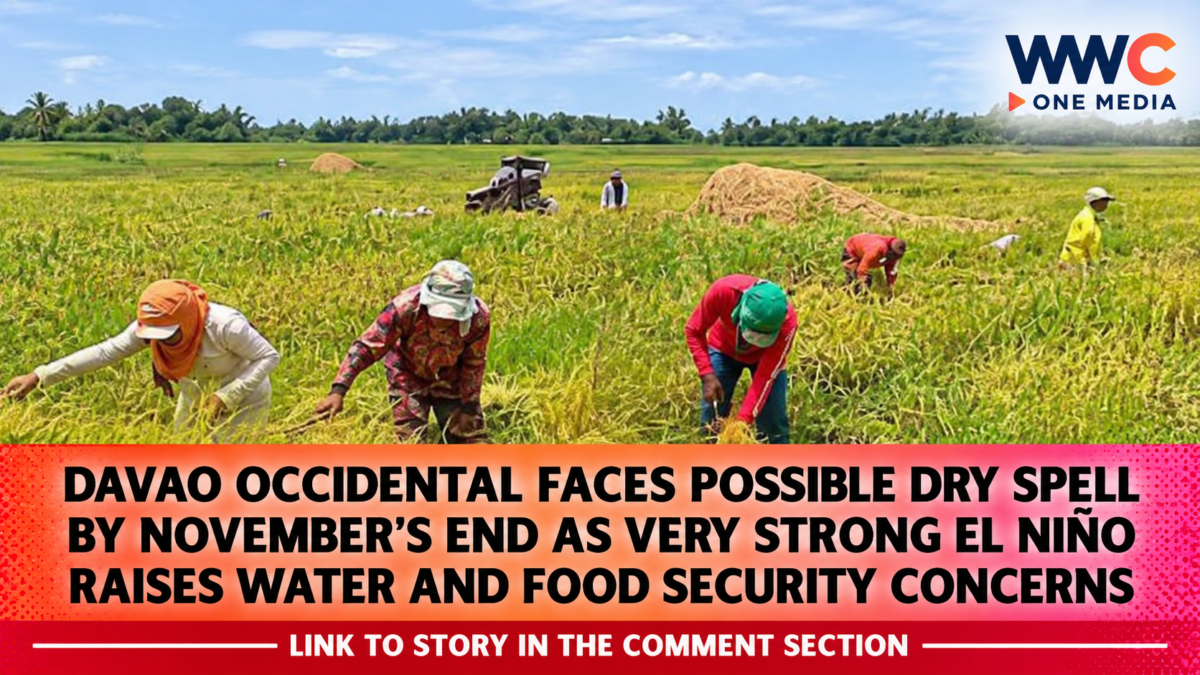
Davao Occidental could enter a dry spell by the end of November 2026 if below-normal rainfall continues, raising concerns over water availability, agricultural production and the livelihood of communities across the Davao Region.
The warning comes from the Philippine Atmospheric, Geophysical and Astronomical Services Administration (PAGASA), which presented its assessment during its 201st Climate Forum. As of October 25, Davao Occidental was still experiencing below-normal rainfall, prompting forecasters to warn that the province could meet the criteria for a dry spell if the pattern persists throughout November. SunStar Publishing Inc.+1
Engr. Alan Ray Ribo of PAGASA-Davao said the province was likely to experience a dry spell if the rainfall situation continued. The forecast is a warning of a possible developing condition, not a declaration that the province is already officially experiencing a dry spell.
Under PAGASA’s classification, a dry spell occurs when an area records either three consecutive months of below-normal rainfall, equivalent to a 21 to 60 percent reduction, or two consecutive months of way-below-normal rainfall, representing a reduction of more than 60 percent.
Southern Davao Oriental Also Being Monitored
The rainfall situation is not the same across all provinces in the Davao Region.
PAGASA reported that Davao de Oro, Davao del Norte, Davao del Sur and northern Davao Oriental recorded near-normal rainfall from October 1 to 25. However, the southern portion of Davao Oriental continued to experience below-normal rainfall.
If the dry pattern persists, parts of southern Davao Oriental could reach dry-condition status by late November.
The uneven distribution of rainfall highlights the importance of localized monitoring. Even neighboring communities can experience different levels of rainfall, water availability and agricultural exposure during an El Niño event. Philippine Information Agency+1
Very Strong El Niño Could Intensify the Threat Through 2027
The regional warning comes as PAGASA confirms that a very strong El Niño is present in the tropical Pacific.
In its November 4, 2026 press release, the weather bureau said the climate phenomenon was expected to persist until the first half of 2027 and could reach its peak toward the end of 2026.
PAGASA also warned that below-normal to way-below-normal rainfall was expected over most parts of the Philippines in November. Several provinces could experience meteorological drought or dry-spell conditions by the end of the month.
The agency cautioned, however, that El Niño does not mean the entire country will remain completely rain-free. Tropical cyclones and other rain-bearing weather systems can still bring episodes of heavy rainfall even while the broader climate pattern increases the likelihood of prolonged rainfall shortages. PAGASA+1
Farmers and Agricultural Communities Face Growing Risks
Agriculture is among the sectors most vulnerable to prolonged dry conditions. Reduced rainfall can affect crop development, irrigation schedules, soil moisture and the availability of water for livestock.
The threat is particularly serious for farmers who rely on rain-fed agriculture or have limited access to irrigation facilities. If water sources decline, planting schedules may be disrupted, harvests could suffer and farming households may face additional financial pressure.
The Davao Region has already recorded substantial agricultural losses associated with prolonged dry conditions. In a separate report, WWC ONE MEDIA reported that agricultural damage and production losses in the region had reached approximately ₱584.68 million, affecting 6,205 farmers and 6,634 hectares of farmland, based on a Department of Agriculture assessment presented in late October.
Rice accounted for the largest share of the reported losses, highlighting the potential consequences of continued water shortages for food production.
Water Security Is Becoming an Urgent Concern
The effects of El Niño are also being felt beyond farms.
In Davao Oriental, the municipality of Manay has already faced water-supply difficulties that required emergency water distribution through municipal fire trucks. The situation illustrates how prolonged dry conditions can affect communities even before an entire province is officially classified as experiencing drought.
WWC ONE MEDIA previously reported on Manay’s emergency water-rationing response and the contingency measures being considered by authorities as the region prepares for potentially worsening conditions.
The situation reinforces the need for local governments and water providers to monitor supply levels, prepare alternative sources and encourage responsible water use before shortages become more severe.
Davao Region Activates El Niño Preparedness Measures
In response to the growing threat, the Regional Disaster Risk Reduction and Management Council in Davao Region is implementing its El Niño Action Plan, which covers five priority areas:
- Food security
- Water security
- Energy security
- Health security
- Public safety
The council’s Crisis Communication Committee has also introduced an El Niño Communication Plan intended to provide communities and vulnerable sectors with information to help them prepare for changing weather conditions.
These measures are designed to strengthen local preparedness and reduce the potential effects of prolonged rainfall shortages.
The regional response is particularly important as the possible impacts of El Niño extend beyond agriculture. Reduced water availability can affect households, businesses, public services and other essential activities.
Up to 85 Provinces Could Face Dry Conditions, Dry Spells or Drought
Davao Occidental’s potential dry spell is part of a wider national weather concern.
WWC ONE MEDIA previously reported on PAGASA projections indicating that as many as 85 provinces could experience dry conditions, dry spells or drought through March 2027 as El Niño strengthens.
The outlook underscores the need for coordinated preparation across the country, particularly in communities dependent on agriculture and rainfall-sensitive water sources.
PAGASA has urged government agencies and the public to implement appropriate conservation and mitigation measures, particularly the efficient management of water resources.
The Critical Weeks Ahead Could Determine How Severe the Impact Becomes
For Davao Occidental, the coming weeks will be crucial in determining whether the province meets the meteorological criteria for a dry spell.
Authorities and residents will need to closely monitor updated rainfall assessments, protect available water supplies and prepare agricultural communities for the possibility of prolonged dry conditions.
The situation also serves as a reminder that a dry spell can develop gradually, with serious consequences for farming, household water access and local economic activity.
With very strong El Niño conditions expected to persist into 2027, the challenge is no longer simply anticipating less rainfall. It is ensuring that communities have enough water, farmers receive timely support and local governments are prepared before conditions worsen.