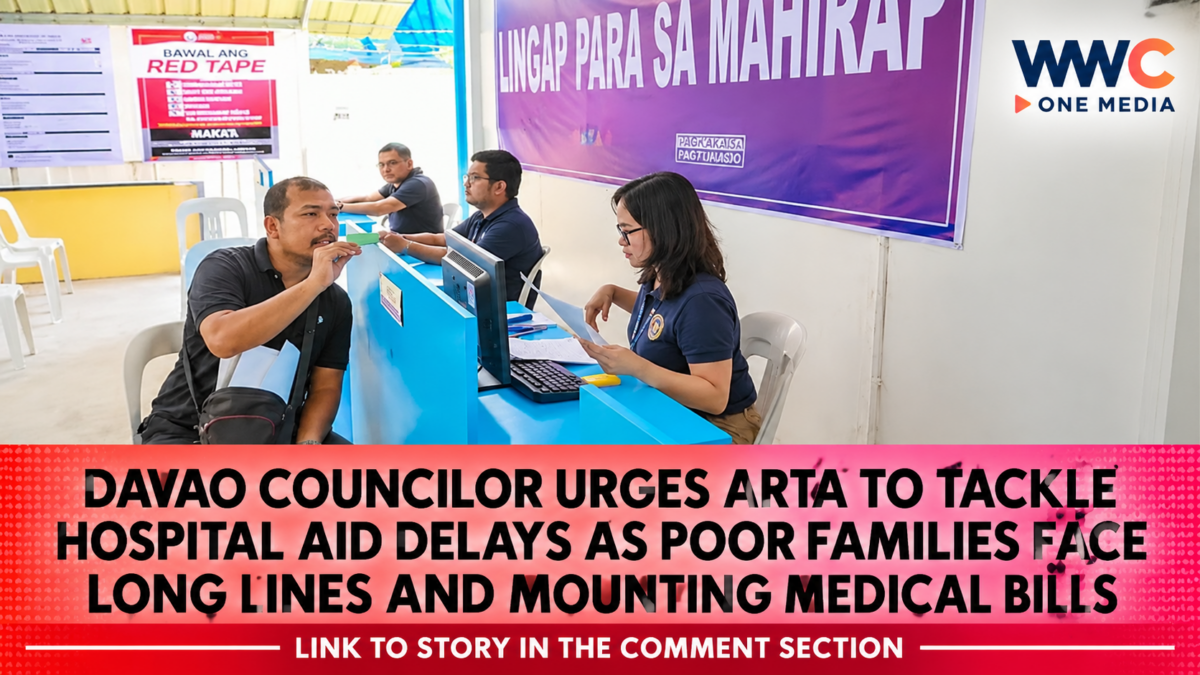
Families struggling to pay hospital bills should not have to visit multiple government offices, line up before sunrise and approach different agencies just to secure financial assistance, Davao City Councilor Arnulfo Ricardo Cabling has told the Anti-Red Tape Authority (ARTA).
Cabling is urging ARTA to expand its anti-red-tape campaign beyond business permits and commercial transactions, arguing that government reforms must also make social services faster, simpler and more accessible—especially for patients in public hospitals.
He raised the issue on November 5, 2026, during ARTA’s first regional rollout of the Philippine Ease of Doing Business Reform Guidebook in Davao City. Cabling, who chairs the City Council Committee on Ethics and Good Government, clarified that he was speaking in his personal capacity and that his remarks did not represent the official position of the city government. SunStar Publishing Inc.+1
Hospital Bills Reach ₱100,000 as Davao Councilor Challenges ARTA to Make Social Assistance Faster
Cabling said families seeking help with hospital expenses often have to approach several government offices, national agencies and party-list representatives to gather enough money to pay their bills. Instead of receiving assistance through a coordinated process, patients’ relatives may be forced to repeat applications and endure long queues while dealing with an already stressful medical emergency.
He cited the Southern Philippines Medical Center (SPMC), where hospital bills can reportedly reach ₱50,000 to ₱100,000, despite the facility being a government hospital.
According to Cabling, some families receive around ₱5,000 from each agency or party-list office they approach, while the city government may provide approximately ₱10,000. He also described how some applicants begin lining up as early as 5 a.m. to seek financial assistance.
His proposed solution is to make social-service applications easier to process, potentially through digitized requests and better coordination among government offices. SunStar Publishing Inc.+1
Cabling Questions Why Anti-Red-Tape Reforms Focus So Much on Businesses
Cabling’s central argument is that government efficiency should not be measured only by how quickly businesses obtain permits or investors complete transactions.
He said the presentations during ARTA’s regional forum concentrated largely on improving the business environment, while giving less attention to digitizing requests for social assistance.
He wants the agency to give comparable attention to health care, medical assistance and scholarship programs.
The distinction matters because ordinary citizens also depend on government transactions during critical moments. A delayed business permit may affect an entrepreneur’s operations, but a delayed medical-assistance application can add pressure to a family struggling to secure treatment for a sick relative.
Cabling also called on businesses operating public-interest services, particularly transportation and utilities, to regularly measure customer satisfaction. He argued that companies benefiting from a business-friendly environment should also be expected to provide reliable services to the public.
Davao’s Budget Figures Add Another Dimension to the Debate
Cabling said the city previously had greater flexibility to cover hospital bills in full but has had to limit financial assistance because of what he described as restricted national government budget allocations.
However, figures cited in the SunStar report show that Davao City’s national tax allotment increased by 14.86 percent in 2026, bringing its budget to ₱15.8 billion from ₱14.3 billion in 2025.
That increase is important context, but it does not by itself establish how much money is available for medical assistance. A city’s overall budget covers multiple responsibilities, and its total allocation should not be confused with the amount specifically assigned to a particular assistance program.
The figures therefore raise a broader question about how local governments distribute available resources and how effectively they connect residents to the assistance they need. SunStar Publishing Inc.+1
Lingap Para sa Mahirap Shows the Scale of Davao’s Social-Service Demand
Davao City already operates Lingap Para sa Mahirap, a flagship assistance program that provides medical, laboratory, funeral and other financial support to qualified residents.
The city government’s January 2026 report said the program served 159,241 clients in 2025 through its main and satellite offices. That included 118,009 public-assistance clients and 41,232 private-assistance clients.
The volume illustrates the importance of making application and assessment procedures manageable for both residents and frontline personnel.
The city also provides information about its medical-assistance services through its official website, including contact details for the Lingap Para sa Mahirap program.
The challenge is not simply making assistance available. It is ensuring that people who qualify can access it without unnecessary paperwork, repeated visits and confusing requirements. City Government of Davao+1
ARTA Says Government Transactions Must Become Faster and More Convenient
ARTA’s Eastern Mindanao Regional Field Office chief administrative officer, Eldie Barrientos, emphasized that the purpose of ease-of-doing-business reforms is to make government transactions faster, easier and more convenient for citizens and businesses.
His remarks came as agencies and local government units participating in the Davao rollout identified persistent problems affecting public transactions.
A separate SunStar report on the same regional workshop highlighted several obstacles:
- Unstable internet connections and system outages.
- Inadequate equipment and server capacity.
- Inconsistent requirements and interpretations of policies.
- Lengthy approval procedures and remaining manual transactions.
- Limited budgets, insufficient personnel and inadequate staff training.
- Uneven digital literacy among the public.
Participants recommended better coordination between national and local agencies, stronger digital infrastructure, additional personnel and clearer processing timelines.
These problems are relevant to Cabling’s proposal because digitizing social-assistance applications will not automatically eliminate delays if offices continue to operate with disconnected systems, insufficient staff or inconsistent requirements. SunStar Publishing Inc.+1
The 3-7-20 Rule Is Supposed to Prevent Endless Government Delays
The Ease of Doing Business and Efficient Government Service Delivery Act of 2018, or Republic Act No. 11032, establishes processing-time standards for government transactions.
Under the 3-7-20 rule, the prescribed periods are:
- Three days for simple transactions.
- Seven days for complex transactions.
- Twenty days for highly technical transactions.
ARTA’s Eastern Mindanao office said some complaints involve transactions that should take only a few days but instead stretch into weeks or even months.
Barrientos said the public can submit complaints through the regional office, in person, by email or through the Electronic Complaints Management System available on the eGov app.
For residents, the Citizen’s Charter of the relevant government office is also important because it identifies the requirements, fees and processing periods for specific services.
ARTA Also Moves to Address Unnecessary Identification Requirements
Another issue raised during the reform rollout concerns the requirement for multiple identification documents.
ARTA Director General Ernesto Perez told GMA Network’s Unang Hirit on November 6 that government agencies should no longer require two valid IDs for transactions when one valid ID is sufficient.
The Philippine Identification System also provides a legal basis for using the national ID as proof of identity and age in government and private transactions under Executive Order No. 162.
The policy is part of the wider effort to remove unnecessary requirements that make public transactions more difficult.
For families seeking medical assistance, reducing redundant identification and documentation requirements could make the process less burdensome—provided that agencies also improve coordination and processing procedures.
Digital Government Reform Must Reach Beyond Business Permits
Davao City’s digital-government initiatives offer another example of how technology could help reduce administrative delays.
WWC ONE MEDIA previously reported that the city was preparing to become the first local government unit authorized to process and approve digital-signature applications for its own employees through an agreement with the Department of Information and Communications Technology.
The proposed arrangement is intended to address delays in securing digital certificates, which can affect the processing of official documents.
The broader challenge is making sure that digital transformation improves services that ordinary residents actually use, including medical assistance, scholarship applications and other social-welfare programs.
WWC ONE MEDIA has also examined the financial pressures facing organizations that deliver social services across the country.
Read more: Filipinos Keep Giving—So Why Are Social Service Groups Still Struggling to Pay the Bills?
Cabling Wants Cooperation, Not Just Punishment
Cabling said he supports government accountability and transparency but urged ARTA and public agencies to pursue reforms through cooperation rather than a purely punitive approach.
He said the objective should be to work together to improve government systems instead of simply penalizing offices struggling with operational difficulties.
His remarks highlight the balance facing anti-red-tape authorities: agencies must be held accountable for unnecessary delays, but they also need adequate personnel, technology and resources to deliver the services expected of them.
For Davao residents, the real test will be whether these discussions lead to shorter queues, fewer documents, clearer requirements and faster access to financial assistance.
The issue goes beyond business competitiveness. It concerns families who need help paying hospital bills, students seeking scholarships and vulnerable residents who depend on public programs.