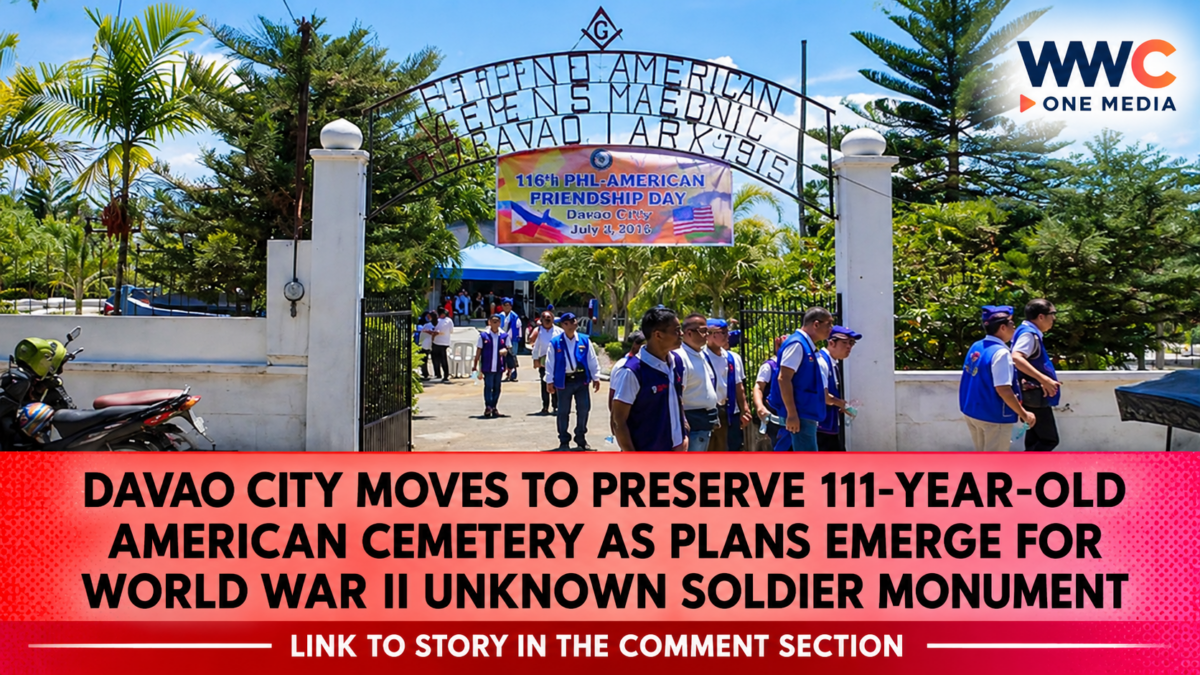
A forgotten chapter of Davao City’s history is receiving renewed attention as local officials explore plans to install an official historical marker or monument near the Tomb of the Unknown Soldier inside the Filipino American Veterans Masonic Memorial Park.
Known to many Dabawenyos as the Masonic Cemetery, the four-hectare site in Madapo Hills, Barangay 6-A, is more than a burial ground. Established in 1915, it preserves the stories of American settlers, military veterans and soldiers connected to Davao’s development and its experience during World War II.
The Davao City Government, through its Office of the Culture and Arts (OCA), is coordinating with the Masonic organization that maintains the property to formalize recognition of the historic burial site.
OCA head Oscar Casaysay said the city hopes to pursue another resolution as part of an ordinance that would authorize the installation of an official marker.
The proposed project could give greater recognition to a historic site that has remained relatively unfamiliar to younger generations, despite its connection to Davao’s American-era history and the sacrifices of Filipino, American and Japanese soldiers during the war. SunStar Publishing Inc.+2
A Cemetery Established in 1915 Holds More Than a Century of Davao History
The Filipino American Veterans Masonic Memorial Park is located in Madapo Hills, near Davao City’s central area. The surrounding district is also known as Wireless because an old wireless telegraph station once operated there.
The cemetery was established in 1915, during the American colonial period, when local authorities designated burial grounds for the growing community.
It was originally intended for American Masons but eventually became the resting place of American military veterans and settlers who had established lives in Davao.
During the early 1900s, Davao attracted American investors and former military personnel who became involved in the region’s expanding abaca and coconut industries. The profitable abaca trade helped transform the local economy and encouraged the establishment of large plantations.
The cemetery therefore preserves a physical connection to a period when American settlers played a significant role in Davao’s commercial and civic development.
It was initially maintained by the American Cemetery Association. In the late 1950s, American veteran and Mason Alfred W. Roberts negotiated the transfer of the cemetery’s land rights to the Davao Masonic Association Inc., which continued maintaining the property.
Today, the cemetery remains one of the surviving reminders of Davao’s early American-era community. SunStar Publishing Inc.+1
Graves of American Pioneers and a Former Presidential Representative
Among the notable individuals buried at the cemetery are American settlers Henry Roscom, David Jacobson, Harry Hughes, Henry Pahl and Edward Christensen.
Another prominent figure is Colonel George Thompson, who served as a special representative of US President Calvin Coolidge to the Philippines.
Thompson reportedly helped attract capital investments to Davao, reflecting the economic and diplomatic connections that developed during the American period.
Their graves offer a glimpse into the people who helped shape the city’s early commercial networks and relationships with the United States.
The cemetery’s historical value extends beyond individual biographies. Its existence documents the movement of American settlers into Mindanao, the development of plantation agriculture and the changing social landscape of Davao during the first decades of the 20th century. SunStar Publishing Inc.+1
Tomb of the Unknown Soldier Remembers Filipino, American and Japanese War Dead
One of the cemetery’s most significant areas is the Tomb of the Unknown Soldier, which contains the remains of several American, Filipino and Japanese individuals who died during World War II.
The tomb is located near the edge of the cemetery. It was once marked by a simple white cross but has since undergone improvements, including a larger cross, a steel marker and concrete posts connected by steel chains to define the memorial area.
The presence of soldiers from different nationalities reflects the devastating impact of the war on Davao and the wider Mindanao region.
During World War II, Davao experienced Japanese occupation and intense fighting as Allied forces returned to the city. Soldiers and civilians from different communities suffered during the conflict.
The city now holds its annual Liberation of Davao commemoration at the cemetery every May 3, marking the return of American forces and the end of Japanese occupation in Davao City.
The memorial serves as a reminder that the city’s wartime history involved not only military forces but also Filipino communities caught in the conflict. SunStar Publishing Inc.+1
Effort to Identify 32 American and Filipino Soldiers Began in 2018
The cemetery also carries an unresolved historical mission.
According to the report, American veterans living in Davao through American Legion Post 66 began efforts in 2018 to identify the remains of 32 American and Filipino soldiers believed to be buried at the Tomb of the Unknown Soldier.
The initiative reflects the continuing importance of identifying wartime dead and preserving their individual identities rather than allowing their stories to disappear with time.
Identifying remains from a conflict that ended more than 80 years ago can be difficult. It may require historical military records, burial documentation, family information and forensic examination.
The latest report does not establish that all 32 soldiers have been identified. The effort is an important part of the cemetery’s historical significance and the continuing work to account for those who died during the war. SunStar Publishing Inc.+1
Davao City Wants an Official Monument — But Coordination Comes First
The proposed marker or monument is being considered by the Davao City Government through its Office of the Culture and Arts.
Casaysay said the city is coordinating with the Masonic organization because the group maintains the cemetery and has already installed an initial marker at the Tomb of the Unknown Soldier.
The city hopes to pursue an official resolution and ordinance that would formalize its participation in recognizing the site.
The proposal is not yet confirmation that construction has begun or that a final design, budget or completion date has been approved.
The coordination is important because the cemetery is maintained by the Masonic organization, and any government initiative must take its existing stewardship of the property into account.
An official monument could strengthen the site’s recognition as part of Davao’s cultural and historical landscape, particularly during annual Liberation Day activities and other commemorations. SunStar Publishing Inc.+1
Davao’s American-Era Legacy Is Still Visible in Its Historic City Hall
The cemetery is not the only surviving reminder of the city’s American period.
Davao City Hall, a century-old civic structure, also reflects the architectural and administrative legacy of the period.
Its history gained renewed attention during the first official Davao visit of US Ambassador MaryKay Carlson’s successor, as discussions explored opportunities for stronger cooperation between the United States and Mindanao.
WWC ONE MEDIA covered the diplomatic visit in US Ambassador Makes First Official Davao Visit as Washington Eyes Deeper Mindanao Cooperation.
The historical connection between Davao and the United States is also part of a wider story involving the development of Mindanao, its communities and international relationships.
Davao’s Japanese History Also Forms Part of the City’s Past
The cemetery’s historical significance is particularly notable because it includes the remains of Japanese war dead alongside American and Filipino soldiers.
Davao also has a long history of Japanese migration and settlement dating back to the early 1900s. Japanese migrants became involved in agriculture, business and other activities that influenced the region’s development.
That connection continues to shape cultural and diplomatic exchanges today.
WWC ONE MEDIA explored this historical relationship in Japan Signals Deeper Partnership With Mindanao as Tourism, Investment and Peace Ties Expand.
The history of the cemetery therefore provides an opportunity to remember the complex experiences of different communities whose lives became intertwined in Davao, including those who fought on opposing sides during World War II.
Preserving War History Requires More Than Building Monuments
The proposed marker also raises a broader question about how the Philippines protects historical sites and preserves the stories of people who shaped its past.
WWC ONE MEDIA previously reported on President Ferdinand Marcos Jr.’s call to honor Filipino and American soldiers who fought during World War II in Marcos Urges Filipinos to Honor WWII Heroes Through Action.
Another report examined the continuing struggle to establish a permanent historical institution for victims of a different period in Philippine history: 8 Years, Millions in Funds, Still No Museum: Why UP’s Martial Law Memorial Remains Unbuilt.
These projects involve different historical periods, but they share an important concern: preserving the physical places, records and personal stories that help future generations understand the country’s past.
For Davao, the Masonic cemetery offers a rare opportunity to protect a surviving landmark connected to the city’s American-era development and wartime experience.
Why the Cemetery Deserves Greater Recognition
The Filipino American Veterans Masonic Memorial Park is not simply a place where historical figures and soldiers were buried. It is a record of Davao’s transformation, its international connections and the human cost of war.
Its graves preserve the memory of American pioneers who settled in the city, while the Tomb of the Unknown Soldier remembers people whose identities and stories may still be waiting to be recovered.
The city’s proposed marker could help ensure that the site receives greater public recognition. It could also encourage more historical documentation, educational visits and cooperation with organizations working to identify wartime remains.
For now, the Davao City Government is still coordinating with the Masonic organization before pursuing the formal approval process.
But the importance of the cemetery is already clear. More than a century after its establishment, it remains one of the few physical links to a chapter of Davao’s history that could otherwise fade from public memory.
The question now is whether Davao can turn its plan into a lasting historical landmark — and finally give the unknown soldiers buried there the recognition their sacrifices deserve.