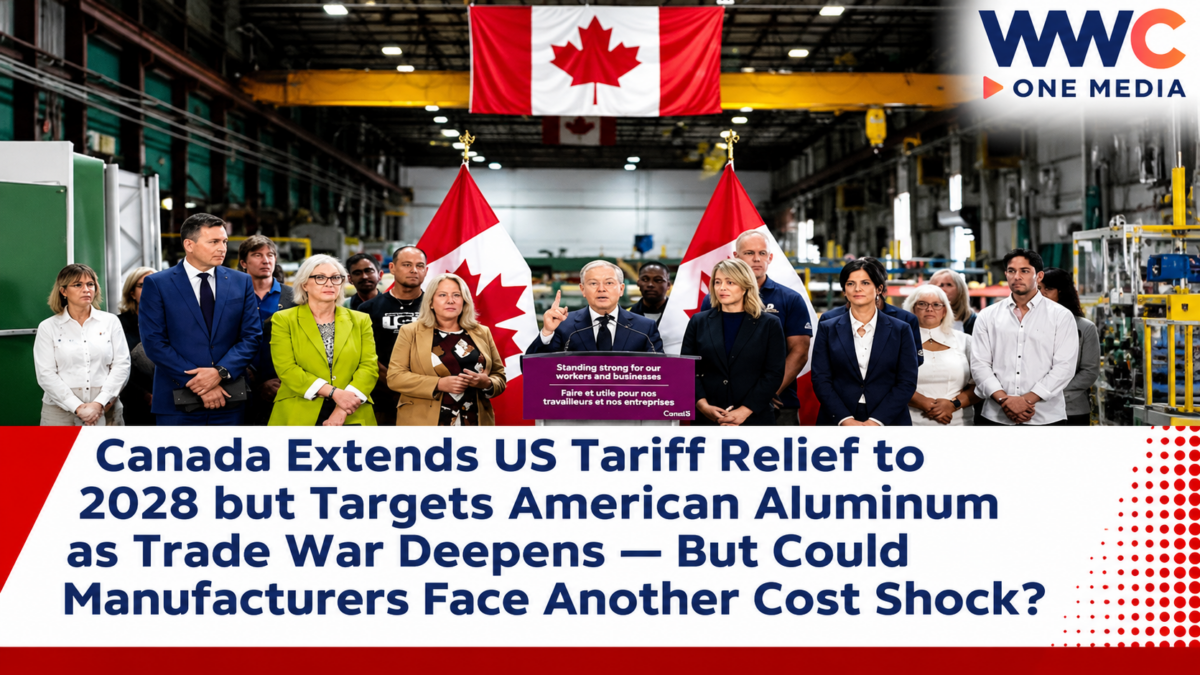
OTTAWA, CANADA — November 10, 2026 — Canadian Prime Minister Mark Carney’s government is reshaping its trade-war strategy against the United States, expanding tariff exemptions for businesses that depend on American products while removing relief from selected US-made aluminum and industrial goods to encourage domestic manufacturing.
The changes, announced by Finance Minister François-Philippe Champagne on November 9 and reported by Bloomberg on November 10, will extend Canada’s broad tariff-relief program until June 30, 2028.
The government will also expand eligibility to additional American-made products used in mining, quarrying, oil and gas extraction, and public education.
But there is a catch.
Ottawa is withdrawing automatic tariff relief from certain trailers starting December 1, 2026, followed by selected aluminum wire, extrusions and paperboard products on February 1, 2027.
The announcement comes as Canada continues battling US President Donald Trump’s tariffs while attempting to protect domestic manufacturers, preserve jobs and reduce dependence on American suppliers.
With billions of dollars in tariffs already affecting cross-border trade, could Canada’s latest changes protect its struggling industries—or force manufacturers into another round of expensive supply-chain adjustments?
Canada Expands US Tariff Exemptions Until June 2028
Canada’s Department of Finance confirmed that its horizontal tariff-remission program will be extended by another year, moving the expiration date to June 30, 2028.
The program allows qualifying importers to obtain relief from Canadian retaliatory tariffs imposed on selected American goods.
The purpose is to prevent trade retaliation from unnecessarily damaging Canadian businesses that rely on US materials, equipment and other inputs.
Under the updated rules, eligible imports include non-steel goods used in manufacturing, processing, agriculture, mining, quarrying, and oil and natural gas extraction.
Goods used by certain public health, safety and national-security organizations also qualify.
The government has extended eligibility to public education entities, including organizations operating under Indigenous mandates.
The changes took effect on November 9, subject to the conditions established in Canada’s remission orders.
This means businesses in eligible sectors may continue accessing certain American products without paying the full applicable Canadian surtaxes.
However, not every US import qualifies automatically. Product classifications, intended uses and other conditions remain important.
The extension is particularly significant because Canadian industries have spent months adjusting to trade restrictions introduced during the latest confrontation between Ottawa and Washington.
Why Canada Is Offering Tariff Relief While Fighting Trump’s Trade War
The policy reflects a difficult economic reality.
Canada wants to retaliate against US tariffs without making essential materials prohibitively expensive for its own businesses.
In March 2025, the Canadian government introduced retaliatory tariffs after the Trump administration imposed new duties on Canadian products.
Ottawa subsequently established procedures allowing importers to request relief when Canadian alternatives were unavailable or circumstances created significant economic hardship.
Additional trade restrictions followed in 2026.
On September 8, Canada imposed further counter-tariffs ranging from 15% to 50% on selected US imports.
The measures targeted industries exposed to American trade restrictions, including metals, manufacturing and related products.
But retaliatory tariffs can create unintended consequences.
A Canadian factory purchasing specialized American equipment may face additional expenses even if there is no domestic supplier capable of providing the same product.
Higher input costs can reduce competitiveness, discourage investment or eventually increase consumer prices.
Canada’s remission program is intended to reduce those pressures.
The government is therefore pursuing two objectives simultaneously: maintaining pressure on Washington and protecting Canadian companies from the consequences of its own retaliatory measures.
WWC ONE MEDIA previously examined the escalating trade dispute in Trump Backs Down on Key Canada Trade Demands as Carney Claims Major Breakthrough — But Will Washington Finally Lift Its 50% Tariffs?.
That report explored efforts to revive negotiations after disagreements over industrial tariffs and Canada’s economic independence.
Canada Cuts Tariff Relief on Selected American Aluminum Products
The most controversial part of the new announcement involves aluminum and other goods for which the Canadian government believes domestic alternatives are available.
According to the Department of Finance, automatic relief will end on February 1, 2027, for specified aluminum wire, aluminum extrusions and paperboard products.
Certain aluminum pipes and tubes also appear in the government’s detailed exclusion schedule.
These changes are designed to encourage Canadian businesses to purchase from domestic suppliers rather than rely on American imports.
The restrictions will not necessarily apply to every aluminum product entering Canada from the United States.
They concern specified products identified in the government’s published schedules.
This distinction is important because aluminum is used in numerous industries, including construction, transportation, electrical equipment and manufacturing.
Businesses importing affected products may need to reassess their suppliers and determine whether alternative Canadian sources can meet their specifications.
Companies that cannot obtain appropriate substitutes may still seek case-by-case tariff relief under applicable rules.
But approval is not guaranteed.
For importers that lose automatic eligibility, the changes could increase costs unless they secure other relief or successfully reorganize their supply chains.
Why Canada’s Aluminum Industry Wants More Protection
Canada’s aluminum producers are confronting difficult market conditions.
The United States is a major destination for Canadian aluminum exports, making the industry highly sensitive to American import duties.
Trump’s administration has imposed substantial tariffs affecting Canadian metals, creating additional pressure on producers seeking access to the US market.
Meanwhile, some Canadian manufacturers argue that Ottawa’s tariff-relief program has made it easier for domestic customers to continue purchasing American aluminum products without facing the full effect of retaliatory duties.
That can leave Canadian producers at a disadvantage in their home market.
If an American product receives tariff relief while Canadian aluminum manufacturers face expensive restrictions when exporting to the United States, domestic producers may struggle to compete.
The government’s latest adjustment attempts to address that imbalance.
By limiting relief for selected products already manufactured in Canada, Ottawa hopes to encourage domestic sourcing and strengthen demand for Canadian output.
But the strategy also creates trade-offs.
Businesses requiring specialized aluminum components may face higher prices or difficulties finding suitable substitutes.
The effectiveness of the policy will depend on whether Canadian suppliers have sufficient capacity, competitive prices and the technical ability to meet buyers’ requirements.
C$14.1 Billion in Tariffs Assessed — But Much Less Collected
One of the most revealing details in Bloomberg’s report concerns the financial scale of Canada’s tariff-remission system.
From March 2025 through October 26, 2026, Canada assessed approximately C$14.1 billion in tariffs on imports from the United States.
However, approximately C$8.9 billion was remitted or otherwise relieved.
That left net tariff revenue of approximately C$5.2 billion.
The difference illustrates how extensively Ottawa has used exemptions to protect businesses from its own countermeasures.
<box> **Canadian counter-tariffs, March 2025–October 26, 2026**
| Measure | Amount |
|---|---|
| Tariffs assessed | C$14.1 billion |
| Remitted or relieved | C$8.9 billion |
| Net revenue | C$5.2 billion |
</box>
The figures do not mean the Canadian government simply abandoned its trade response.
Instead, they show that a substantial portion of tariff assessments was offset by relief mechanisms.
For policymakers, that creates a difficult balancing act.
Strict enforcement could increase pressure on American exporters but also raise costs for Canadian businesses.
Extensive exemptions could protect Canadian importers while weakening some of the economic incentives to switch to domestic suppliers.
The November policy changes attempt to refine that balance.
Canadian Manufacturers Face New Supply-Chain Decisions
The removal of selected exemptions could force some businesses to reconsider where they purchase materials and equipment.
For companies using affected aluminum components, the most immediate issue is whether Canadian alternatives are commercially viable.
Domestic sourcing may reduce exposure to international trade barriers.
It may also improve supply-chain resilience by shortening transportation distances and reducing dependence on cross-border shipments.
However, changing suppliers can involve significant expenses.
Manufacturers may need to test new materials, renegotiate contracts, adjust production processes or certify alternative components.
Those costs can be especially challenging for smaller businesses.
The government has provided transition periods to allow importers to prepare.
Affected trailer products lose specified relief beginning December 1, while the aluminum and paperboard changes take effect February 1.
Ottawa says companies can use that time to adjust purchasing arrangements or request individual relief where appropriate.
The ultimate impact will depend on how many businesses use the affected products and whether alternative supply is available.
Canada’s Great Lakes Trade Network Could Feel the Effects
The policy also matters for one of North America’s most important industrial corridors.
The Great Lakes region supports extensive cross-border trade in steel, aluminum, machinery, agricultural products and other industrial goods.
Factories in the United States and Canada frequently depend on materials crossing the border several times during production.
A Canadian manufacturer might import components from an American supplier, use them to produce finished goods and subsequently export those products back to the United States.
Tariffs at different stages can increase costs throughout that process.
WWC ONE MEDIA previously explored those vulnerabilities in The Great Lakes Built a $376 Billion Trade Lifeline — Trump’s Tariffs Are Now Putting It Under Pressure.
The report examined the enormous economic importance of North American industrial integration.
Canada’s expanded relief may help companies that depend on American inputs, while reduced exemptions could encourage other businesses to purchase more Canadian-made materials.
Both effects could occur simultaneously.
That is why the latest announcement is better understood as a targeted industrial-policy adjustment than a straightforward escalation or retreat in the trade war.
Carney’s Government Wants Canada to Become More Economically Independent
The tariff changes reflect Prime Minister Mark Carney’s broader objective of reducing Canada’s economic vulnerability.
The United States remains Canada’s most important trading partner.
Geographic proximity, integrated transportation networks and decades of commercial cooperation have created deep economic connections between the two countries.
But repeated tariff disputes have exposed the risks associated with excessive reliance on a single export market.
Carney’s government has emphasized strengthening domestic manufacturing, expanding infrastructure and developing alternative international trade relationships.
That strategy includes greater engagement with Europe and Asia.
Canada has also recently made progress in trade discussions with China.
WWC ONE MEDIA reported on those developments in China Promises Deeper Trade Cooperation With Canada as Both Countries Extend Tariff Relief — What the New Agreement Means for Global Trade.
The report examined new arrangements affecting agriculture, seafood, metals and electric vehicles.
Those initiatives are separate from the latest US tariff-relief changes.
Nevertheless, they highlight Ottawa’s broader effort to provide Canadian businesses with more diversified trade opportunities.
Could Trump’s Tariffs Still Threaten Canada-US Trade Negotiations?
Despite the new exemptions, the broader trade dispute remains unresolved.
Washington and Ottawa have been negotiating possible changes to tariffs affecting steel, aluminum, automobiles and other products.
Carney recently suggested that the Trump administration had softened some negotiating demands.
However, neither country has confirmed a comprehensive final agreement eliminating the disputed tariffs.
The latest Canadian changes do not constitute such an agreement.
They are unilateral adjustments to Canada’s existing counter-tariff relief arrangements.
US tariffs on Canadian exports are governed by separate American measures.
Likewise, a Canadian exemption for imports from the United States does not automatically require Washington to grant similar treatment to Canadian goods.
The distinction is crucial for businesses trying to forecast future trade costs.
An importer might qualify for relief under Canadian law while its exports to the United States remain subject to American duties.
The eventual outcome will depend on separate bilateral negotiations and formal government decisions.
What the Changes Mean for American Exporters
The policy sends mixed signals to US suppliers.
American companies selling eligible equipment and materials into Canada’s mining, energy, manufacturing or public-service sectors may benefit from extended tariff relief.
That could help preserve access to Canadian customers that would otherwise face higher import costs.
But suppliers of selected aluminum products, trailers and paperboard may encounter greater difficulties after the scheduled exemptions expire.
Canadian buyers could become more inclined to purchase domestic alternatives, particularly if full tariffs substantially increase the price of American goods.
The effects will depend on product classifications, available substitutes and individual contractual arrangements.
It would therefore be misleading to describe the announcement as a blanket reduction or increase in Canadian tariffs on every US product.
The government is expanding relief in some areas while deliberately withdrawing it in others.
Could the Changes Raise Prices for Canadian Consumers?
Tariff policies can influence consumer prices, but the effects are rarely uniform.
Higher import duties generally increase the landed cost of affected products unless suppliers or importers absorb some of the expense.
Businesses may then pass part of those costs to customers.
But Canadian-made alternatives could limit price increases if they are competitively priced and readily available.
Expanded exemptions may also prevent cost increases for companies that rely on scarce imported inputs.
In sectors such as mining and energy, access to essential equipment can affect project expenses and operating efficiency.
The ultimate consumer impact will depend on how businesses respond.
Some companies may benefit from lower input costs.
Others may face additional expenses as automatic relief ends.
There is currently insufficient evidence to establish a specific nationwide inflation effect from the November changes.
What Happens Next?
Businesses affected by the new tariff rules face several important deadlines.
The broad remission program has been extended through June 30, 2028.
Selected trailers will lose automatic eligibility on December 1, 2026.
Specified aluminum wire, extrusions and paperboard products will be excluded beginning February 1, 2027.
The Department of Finance is also publishing detailed product schedules to help importers understand which goods qualify.
Companies should review the relevant tariff classifications and remission conditions rather than assume that all products in an industry receive identical treatment.
Meanwhile, negotiations between Canada and the United States remain critical.
A comprehensive trade agreement could eventually alter the wider tariff environment.
But until formal changes are announced, businesses must plan around the existing legal measures.
The Bigger Picture: Canada Is Fighting a Trade War on Two Fronts
Canada’s latest tariff-relief announcement reveals the complexity of protecting domestic industries during an international trade dispute.
On one side, Ottawa wants to prevent retaliatory tariffs from damaging Canadian companies that depend on American inputs.
On the other, it wants to strengthen domestic manufacturers that have struggled with US tariffs and competition from American suppliers.
The result is a selective strategy.
More American goods used in strategically important industries will qualify for relief.
At the same time, selected products that Canada believes it can manufacture domestically will lose automatic exemptions.
For Carney, the challenge is ensuring that these policies support industrial resilience without creating unnecessary cost increases or supply shortages.
For Canadian businesses, the immediate priority is understanding which products remain eligible and preparing for the approaching deadlines.
And for Washington, the announcement demonstrates that Ottawa is continuing to refine its trade response even as bilateral negotiations remain unresolved.
As Canada extends selected US tariff exemptions until 2028 while withdrawing relief from American-made aluminum products, one question now hangs over North America’s industrial economy: Can Mark Carney protect Canadian manufacturers without making the country’s trade war with Donald Trump even more expensive?