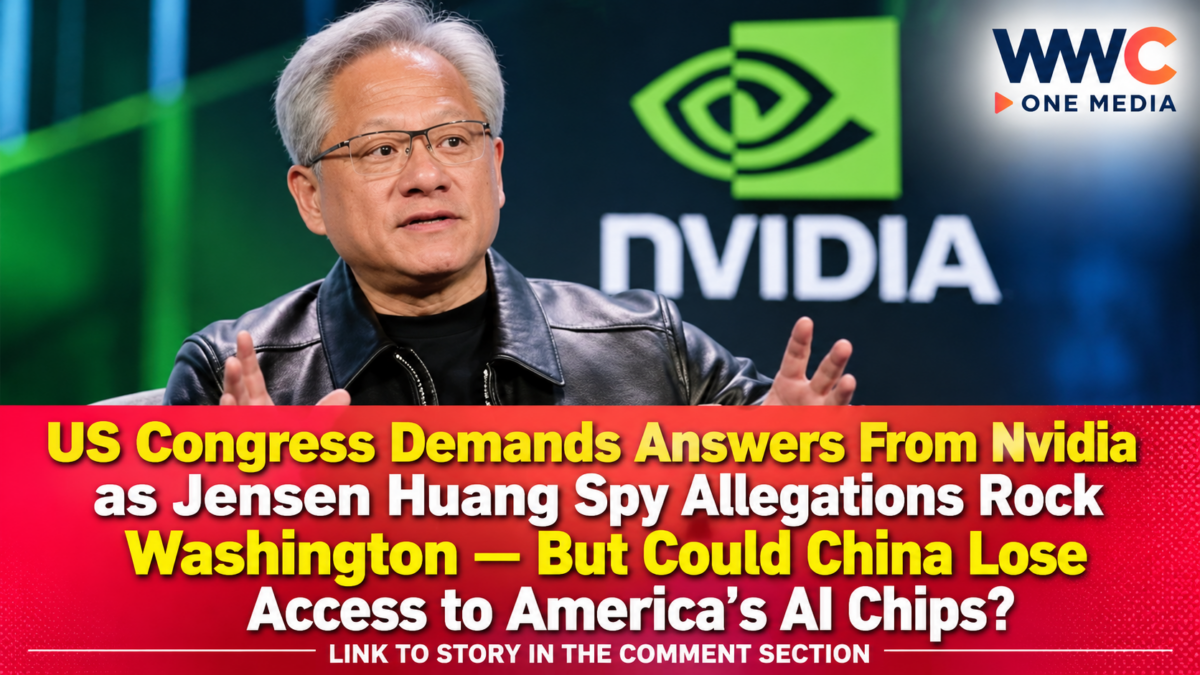
WASHINGTON, D.C. — November 10, 2026 — Nvidia is facing an extraordinary political and corporate crisis as US lawmakers from both parties demand answers about allegations involving chief executive Jensen Huang, a suspected Chinese intelligence operation and possible national-security risks surrounding America’s most valuable artificial intelligence technology.
The controversy has already triggered an independent investigation by Nvidia’s board, requests for congressional briefings and renewed efforts to tighten restrictions on the sale of advanced AI chips to China.
It has also shaken Wall Street.
Nvidia shares plunged as much as 8.8% during trading on November 9 before recovering some losses to close down 4.3% at $178.67.
The closing decline erased approximately $190 billion from the semiconductor giant’s market capitalization.
The political stakes are growing even faster.
Senate Majority Leader John Thune, House Democratic leader Hakeem Jeffries and several senior senators have called for more information about allegations that Huang was targeted by an intelligence effort involving a Chinese businesswoman.
Lawmakers are also examining whether Nvidia’s relationships with overseas customers and its lobbying on semiconductor exports warrant stronger scrutiny.
But with no public finding that Huang knowingly participated in espionage or disclosed sensitive technology, could the allegations still accelerate a sweeping crackdown on America’s multibillion-dollar AI chip trade with China?
US Lawmakers Demand Answers From Nvidia
The controversy reached Capitol Hill on November 9 as congressional leaders began seeking explanations from Nvidia and intelligence officials.
Senate Majority Leader John Thune said Congress needed to take potential threats to US national security seriously.
He indicated that lawmakers were seeking additional information about Huang’s relationship and the possible connections surrounding it.
House Democratic leader Hakeem Jeffries also called for a more comprehensive briefing.
Jeffries said lawmakers had received limited information during a classified intelligence meeting involving CIA Director John Ratcliffe and Director of National Intelligence Jay Clayton.
However, the briefing primarily addressed other national-security matters, including Iran.
Jeffries argued that Congress needed a dedicated discussion of the Nvidia controversy.
The request reflects growing concern among lawmakers that America’s most important semiconductor companies may face intelligence and export-control risks.
It does not establish that Nvidia or Huang committed a crime.
Three Republican Committee Chairmen Request November 18 Briefing
The pressure began before the latest stock-market decline.
In a November 4 letter, three senior Republican House lawmakers requested a closed-door briefing with Huang on November 18.
They were:
- Brian Mast, chairman of the House Foreign Affairs Committee.
- Rick Crawford, chairman of the House Intelligence Committee.
- John Moolenaar, chairman of the House Select Committee on the Chinese Communist Party.
The lawmakers want information about Huang’s reported interactions with a former executive of Singapore-based Megaspeed International.
They also requested details about Nvidia’s security procedures and safeguards against potential foreign intelligence activity.
The November 18 date is a requested briefing, not confirmation that Huang has already testified or that a public congressional hearing has been scheduled.
Congressional investigators may seek additional records depending on what they learn.
For Nvidia, the inquiry represents a potentially significant escalation from internal corporate review to direct political oversight.
Why Jensen Huang Is Under Investigation
The controversy followed reports that Huang had maintained a personal relationship with a Chinese businesswoman identified in media coverage as Alice Huang, also known as Huang Le.
According to The New York Times, US intelligence officials suspected that she had gathered information for Beijing.
She previously held an executive position at Megaspeed International, a Singapore-based company involved in AI computing infrastructure.
On November 8, Jensen Huang acknowledged to Nvidia employees that he had been unfaithful to his wife.
He apologized for his conduct and said he would cooperate with the company’s investigation.
But an admission of infidelity is not an admission of espionage.
The intelligence allegations concerning the woman remain disputed, and there has been no publicly established finding that Huang knowingly assisted Chinese intelligence.
China’s Foreign Ministry has rejected the espionage accusations as unsubstantiated.
WWC ONE MEDIA previously examined Beijing’s position in China Rejects Allegations Involving Nvidia CEO Jensen Huang.
The report outlined the Chinese government’s response and the growing tensions involving semiconductor security.
Nvidia Board Launches Independent Investigation
Nvidia announced on November 8 that its board had initiated an independent review into whether Huang had been targeted by a foreign intelligence effort.
The investigation is being handled by independent directors with outside legal assistance.
Nvidia has emphasized that protecting its information and American national-security interests remains a priority.
Crucially, the company said its board had no reason at that point to believe Nvidia secrets or US national-security information had been compromised.
It also expressed confidence in Huang and his leadership team.
Huang has committed to cooperating with the investigation.
No final findings have been announced.
The company’s statement is not a guarantee that investigators will find no problems. It is its assessment based on information available when the review began.
WWC ONE MEDIA covered the initial corporate response in Nvidia Loses Billions in Market Value as Board Investigates Jensen Huang Over Alleged Chinese Spy Links.
The latest congressional demands add a separate layer of political scrutiny to that investigation.
Senators Warren and Banks Want Tougher Chip Export Controls
The case is now influencing the debate about America’s technology relationship with China.
Republican Senator Jim Banks of Indiana and Democratic Senator Elizabeth Warren of Massachusetts have urged the Commerce Department to review Nvidia’s export authorizations involving Chinese customers.
They want officials to evaluate whether the reported security concerns justify tighter restrictions.
The bipartisan intervention is particularly significant because the two senators frequently disagree on broader economic policy.
Their shared concern reflects the strategic importance of advanced AI processors.
These chips are used to train and operate sophisticated artificial intelligence models.
They can support commercial services, scientific research and potentially sensitive military or intelligence applications.
Washington has restricted exports of certain advanced semiconductors in an effort to limit the development of capabilities it considers a national-security concern.
However, the senators’ request does not mean the Commerce Department has already canceled Nvidia’s licenses.
Any suspension or revised export rule would require appropriate government action.
Three Proposed Laws Could Reshape AI Chip Exports
The controversy may increase momentum behind semiconductor legislation under consideration in Congress.
Reuters identified three proposals that lawmakers are seeking to incorporate into the annual defense authorization bill.
The AI Overwatch Act would expand congressional oversight of certain advanced semiconductor exports to countries including China.
The Chip Security Act would introduce stronger requirements aimed at tracking advanced AI chips and preventing illegal diversion.
The MATCH Act would encourage tighter restrictions on the export of semiconductor manufacturing equipment to China, including through cooperation with US allies.
These measures address different parts of the semiconductor supply chain.
Some focus on export approvals.
Others focus on monitoring chips after shipment or restricting equipment used to manufacture advanced semiconductors.
Jeffries has expressed strong support for adding China-related chip restrictions to the final defense legislation.
But the proposals have not all become law.
Their final language and implementation remain subject to congressional negotiations and applicable government processes.
Why Megaspeed International Is Central to the Questions
Megaspeed International has attracted attention because of its business involving AI computing infrastructure and Nvidia products.
US authorities have examined allegations that advanced chips acquired through overseas arrangements could have reached restricted Chinese customers.
Those concerns predate Huang’s latest public statement.
The company’s reported relationship with Alice Huang has now brought additional attention to Nvidia’s customer due-diligence and security procedures.
But it is essential to distinguish several separate questions.
One concerns whether any foreign intelligence effort targeted the Nvidia chief executive.
Another concerns whether sensitive information was obtained.
A third concerns whether specific semiconductor shipments violated US export restrictions.
Those issues may overlap, but proving one would not automatically establish the others.
Megaspeed and Nvidia have denied wrongdoing.
No publicly established finding cited here demonstrates that Huang knowingly participated in illegal chip exports.
Nvidia’s China Sales Are Becoming a Political Flashpoint
The allegations arrive during an already intense debate over Nvidia’s access to the Chinese market.
Huang has advocated allowing American chipmakers to compete internationally, arguing that export restrictions can sometimes encourage Chinese customers to develop domestic alternatives.
Supporters of a more permissive policy believe American companies can preserve their technology leadership through competition and continued investment.
National-security hawks argue that selling highly capable AI processors to China could strengthen strategic competitors.
They also question whether existing restrictions can adequately prevent diversion through intermediaries.
The Trump administration previously approved limited exports of certain Nvidia AI chips to China, subject to conditions.
The latest controversy has prompted some lawmakers to demand that those permissions be reconsidered.
WWC ONE MEDIA explored the broader political dispute in Trump’s Close Relationship With Nvidia CEO Jensen Huang Faces New Scrutiny as Spy Allegations Raise Questions Over US-China AI Chip Policy.
The issue now extends beyond Nvidia’s commercial opportunities.
It involves US industrial policy, intelligence safeguards and the future of artificial intelligence competition between Washington and Beijing.
Trump Defends Huang as Congressional Pressure Builds
President Donald Trump has publicly defended Nvidia’s chief executive.
According to contemporary reporting, Trump spoke with Huang and said he believed the executive’s explanation that he had not known of any alleged intelligence connection.
The president has praised Huang and expressed confidence in his leadership.
But Trump’s personal support does not determine the outcome of Nvidia’s board investigation or any government inquiry.
It also does not eliminate congressional authority to examine semiconductor exports.
The political dynamic is unusually complicated.
Huang has maintained close relationships with senior administration officials while advocating policies that would expand certain overseas sales.
At the same time, Republicans and Democrats are expressing concerns about China’s access to advanced computing technology.
WWC ONE MEDIA examined the White House response in Trump Backs Nvidia CEO Jensen Huang After Alleged Chinese Spy Scandal as FBI Investigates.
The latest demands for information suggest presidential support may not be enough to prevent a broader congressional review.
Nvidia Shares Fall 4.3% as Investors Reassess Risk
The controversy has already produced a significant reaction in financial markets.
Nvidia shares fell 4.3% on November 9, closing at $178.67.
The decline erased approximately $190 billion in market value based on the closing share price.
At one point during trading, the stock was down as much as 8.8%, representing a much larger temporary reduction in market capitalization.
These are different measures.
The intraday decline should not be confused with the final closing loss.
Nvidia remains one of the world’s most influential technology companies.
Its chips power major AI data centers, cloud-computing systems and advanced research projects.
But investors are increasingly concerned about the potential consequences of leadership uncertainty, tighter export rules and changes in technology spending.
WWC ONE MEDIA examined the market impact in Nvidia’s $190 Billion Stock Rout Exposes Jensen Huang Succession Crisis Amid Alleged Chinese Spy Probe.
The important distinction is that falling market capitalization reflects a change in share valuation.
It does not mean Nvidia lost $190 billion in cash.
Shareholder Lawsuit Adds Another Legal Challenge
The same day, Nvidia and Huang were named in a proposed shareholder class-action lawsuit filed in federal court in California.
The complaint alleges that investors were misled because the company failed to disclose information concerning Huang’s reported relationship and related national-security concerns.
According to Reuters, the plaintiffs are seeking unspecified damages.
The lawsuit was filed shortly after the November 9 market close.
But filing a complaint does not establish that securities fraud occurred.
The allegations remain subject to legal proceedings, potential defenses and judicial review.
Nvidia had not provided a substantive response to the new lawsuit in the Reuters report.
For shareholders, the case adds another potential source of uncertainty.
The company’s future legal exposure will depend on whether plaintiffs can establish the elements required under securities law.
Could Jensen Huang Be Forced Out?
The controversy has intensified discussion about Nvidia’s dependence on its co-founder and chief executive.
Huang has led the company since its founding in 1993.
He is closely associated with its evolution from a graphics-chip manufacturer into a central supplier of computing systems for artificial intelligence.
His influence extends across technology strategy, major customer relationships and the company’s public image.
That creates what investors often describe as key-person risk.
If an unusually influential executive becomes unavailable or loses the board’s confidence, investors may question how effectively the business can transition to new leadership.
However, Nvidia has not announced that Huang is stepping down.
The board has publicly expressed confidence in him while conducting its investigation.
Speculation about succession is therefore not confirmation of an impending leadership change.
The board’s eventual findings will be important in determining whether any corporate governance action is necessary.
What Happens Next for Nvidia?
Several developments could reshape the situation.
The requested November 18 congressional briefing may provide lawmakers with additional information if it proceeds.
The Board of Directors’ independent investigation remains ongoing.
Congressional negotiations over the annual defense authorization bill could determine whether new chip-export restrictions become law.
The Commerce Department may also face additional pressure to explain its review of Nvidia’s export permissions and security safeguards.
Meanwhile, investors will assess any findings from corporate or government inquiries.
The possibility of further regulatory or legislative action is real.
But the allegations alone do not establish what any investigation will conclude or what penalties, if any, could follow.
The Bigger Picture: America’s AI Champion Faces a National-Security Test
Nvidia’s latest controversy illustrates how deeply artificial intelligence has become intertwined with national security and international politics.
The company’s processors are critical to modern AI development.
Their commercial importance has made Nvidia one of the world’s most influential corporations.
But that strategic position also exposes it to unusually intense government scrutiny.
The allegations surrounding Huang have renewed questions about foreign intelligence threats, customer relationships, export compliance and corporate governance.
Congressional Democrats and Republicans now want further information.
Some lawmakers are seeking stronger restrictions on advanced chip exports to China.
And Nvidia’s own directors are investigating the reported intelligence concerns.
Yet the most important factual limit remains unchanged: there has been no publicly established finding that Huang knowingly helped foreign intelligence, disclosed sensitive information or authorized unlawful semiconductor transfers.
As Congress demands answers and Nvidia works to restore investor confidence, the decisive question is whether the investigation will reveal an actual breach of national-security safeguards—or whether a disputed intelligence controversy will become the political catalyst for a much broader crackdown on US artificial intelligence exports to China.