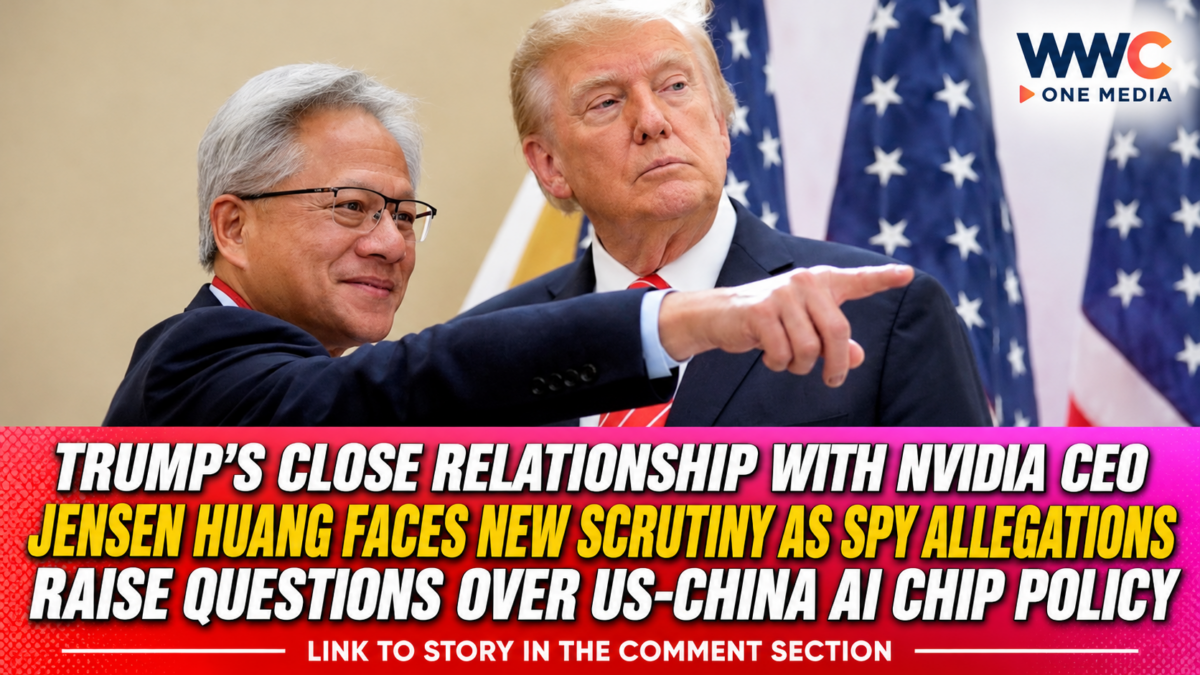
US President Donald Trump’s close relationship with Nvidia chief executive Jensen Huang is facing renewed scrutiny after allegations involving a Chinese businesswoman triggered an independent investigation by the chipmaker’s board and raised fresh national-security concerns in Washington.
The controversy goes beyond Huang’s private life. It has placed the relationship between one of the world’s most powerful technology executives and the US president under the spotlight, particularly because Nvidia’s advanced artificial intelligence chips are at the centre of the technology rivalry between the United States and China.
The latest scrutiny follows reports that US intelligence officials suspected Alice Huang, also known as Huang Le, a former executive associated with Singapore-based data-centre company Megaspeed International, of passing information to Beijing. The New York Times reported that she had a close relationship with Jensen Huang and that Trump had been briefed about the intelligence concerns.
Nvidia has announced an independent investigation into whether its chief executive was targeted by a foreign intelligence operation. The company said its board has no reason to believe that US national security or Nvidia’s confidential information was compromised, but that the inquiry will examine all available information. Reuters+2
Trump and Jensen Huang’s Relationship Comes Under the Microscope
Huang has become one of the most influential technology executives in Washington as Nvidia’s processors have become essential to the global artificial intelligence industry.
His relationship with Trump has included high-profile meetings, policy discussions and appearances alongside the president. Huang travelled with Trump to China in May 2026 and attended a White House state dinner for Chinese President Xi Jinping in September.
Nvidia also reportedly pledged US$25 million towards Trump’s planned White House ballroom project.
Their relationship has attracted particular attention because Huang has repeatedly urged Washington to allow Nvidia to sell more advanced AI chips in international markets, including China.
Reuters reported that the administration’s decisions have included easing plans to restrict certain Nvidia chip exports and later allowing sales of the company’s H200 processors to China subject to a 25 per cent fee.
These policy developments have intensified questions about how the administration balances national-security restrictions with the commercial interests of America’s leading semiconductor companies. However, the existence of a close relationship or favourable policy decisions does not, by itself, establish improper influence or wrongdoing. Reuters+1
Trump Says Huang Told Him He Did Not Know the Woman Was Allegedly a Spy
Trump addressed the controversy on November 9, saying he had spoken with Huang after the allegations became public.
According to Reuters, Trump said he asked the Nvidia chief whether he knew that the woman was allegedly a spy. Huang reportedly told him that he had no idea.
Trump said he believed Huang and expressed confidence that the Nvidia chief would be able to address the allegations.
The president also said the FBI was looking into the matter.
His comments marked a change from his earlier public remarks, when he had said he had not discussed the allegations with Huang and described the executive as an honourable person.
The New York Times had previously reported that Trump was briefed about intelligence concerns involving Alice Huang roughly a year earlier. The president’s latest comments have therefore intensified questions about what he knew, when he knew it and how the government handled the information. Investing.com+1
Why Alice Huang and Megaspeed Are Central to the Controversy
The allegations involve Alice Huang, a former executive associated with Megaspeed International, a Singapore-based company involved in AI computing infrastructure.
US authorities have reportedly examined whether Megaspeed’s business network helped Chinese technology companies obtain advanced Nvidia processors despite American export restrictions.
The concern is that some high-performance chips purchased through overseas data-centre arrangements could potentially be redirected to customers in China who are not authorised to receive them.
The New York Times reported that US intelligence officials suspected Alice Huang of gathering information for Beijing and were concerned that her relationship with Jensen Huang could have provided access to information about Nvidia’s business plans and discussions over American export policy.
The allegations have not been established through publicly released intelligence documents or a criminal conviction. Jensen Huang has not been publicly charged with espionage or accused of knowingly helping a foreign intelligence operation.
Nvidia has defended its business dealings with Megaspeed. Huang previously described the relationship as normal and said the company had examined the deployment of its GPUs to ensure they were not illegally diverted to China.
He also said Alice Huang was no longer associated with Megaspeed. CNA+2
A Separate US Government Investigation Raises More Questions
The controversy became more serious after The New York Times published a separate report about the handling of an earlier Commerce Department investigation into Megaspeed.
According to the newspaper’s November 9 report, Commerce Department investigators had been examining the Singapore-based company over suspicions that Nvidia AI chips were being smuggled into China.
The investigation was reportedly transferred to the Justice Department after Nvidia general counsel Tim Teter contacted Commerce Department officials seeking information about the inquiry.
Teter reportedly told investigators that a senior Commerce Department official had given Nvidia permission to contact them. Some investigators considered the interaction unusual, particularly because Nvidia had not been ruled out as a potential subject of the wider inquiry.
The report said the Justice Department subsequently requested that the Commerce Department pause its work while the matter was handled by federal investigators.
It remains unclear whether other factors contributed to the transfer or whether the decision ultimately affected any potential enforcement action.
A representative for Megaspeed said the company was conducting its own investigation into allegations of chip diversion and had offered to cooperate with US authorities. The company has also denied wrongdoing.
The revelations have intensified questions about whether Nvidia received preferential access to government officials while authorities were investigating a business connected to its supply chain. They do not, however, establish that Trump personally intervened to stop the investigation or that Nvidia was cleared of every possible concern. Inquirer.com+1
Congress Wants Answers From Jensen Huang
The controversy is also drawing attention from US lawmakers concerned about China’s access to advanced artificial intelligence technology.
Three senior Republican lawmakers requested a closed-door briefing from Huang, seeking explanations about the reported intelligence concerns and Nvidia’s procedures for protecting sensitive information.
The request was made in a letter dated November 4 by House Foreign Affairs Committee chairman Brian Mast, House Select Committee on China chairman John Moolenaar and House Intelligence Committee chairman Eric Crawford.
They requested that Huang appear on November 18 to discuss the allegations and the company’s safeguards against foreign intelligence operations.
Nvidia responded that Huang regularly meets executives from thousands of customers and that regional cloud customers receive ordinary business information, not sensitive company trade secrets or information affecting US national security.
The congressional interest suggests that the controversy could develop into a wider examination of how American technology companies protect critical information while conducting business internationally. Investing.com+1
Could the Allegations Lead to Tougher Restrictions on China’s AI Chip Access?
One of the biggest potential consequences is the effect on US export-control policy.
Nvidia’s advanced graphics processing units, or GPUs, are essential for training and operating sophisticated AI systems. Washington has restricted exports of certain high-performance processors to China because of concerns about their potential military and strategic applications.
The reported Megaspeed investigation has strengthened calls for more aggressive monitoring of advanced chips once they leave American factories.
Reuters reported that lawmakers and policy advocates believe the controversy could increase support for three proposed measures:
- AI Overwatch Act: A proposal that would give Congress a greater role in decisions involving advanced chip exports.
- Chip Security Act: A proposal requiring businesses to track advanced chips to help prevent smuggling and unauthorised transfers.
- MATCH Act: A measure intended to encourage US allies to impose tighter restrictions on semiconductor-manufacturing equipment supplied to China.
These proposals are not the same as enacted laws. Their future will depend on congressional negotiations and whether they are included in the fiscal 2027 defence authorisation legislation.
If adopted, they could increase compliance obligations for semiconductor manufacturers, data-centre operators, cloud providers and international technology distributors. Investing.com+1
Trump’s Nvidia Connection Also Raises Questions About Policy and Business Interests
Huang’s relationship with Trump has become particularly sensitive because Nvidia stands to benefit from decisions about which processors can be exported to China.
The company has argued that restricting its products too heavily could allow Chinese semiconductor manufacturers to strengthen their own positions and reduce America’s influence in the global technology market.
The Trump administration has taken a different approach from the strictest export restrictions previously considered, allowing certain Nvidia products to be sold to China under specific conditions.
Reuters also reported that Trump awarded Huang the United States’ highest scientific honour in October 2026. On the same day, the president disclosed purchases of up to US$1.6 million and sales of up to US$1 million in Nvidia shares during the summer.
A White House spokesperson previously said Trump’s investment portfolio was independently managed by third-party financial institutions.
These disclosures have added to questions about transparency and potential conflicts of interest, but they do not establish that the president’s investment activity influenced government decisions.
The broader issue is whether US technology policy can maintain public confidence when the administration is closely connected to executives whose companies are directly affected by export-control decisions. Reuters+1
Nvidia Shares Fall as Investors Assess the Fallout
The controversy has also created uncertainty for Nvidia shareholders.
Reuters reported that Nvidia shares closed Monday’s trading session down approximately 4.3 per cent, reaching their lowest level in seven months. The decline reduced the company’s market value by roughly US$190 billion.
The drop came as investors weighed the potential impact of the investigation, political scrutiny and existing concerns about the sustainability of spending on artificial intelligence infrastructure.
Nvidia remains a central supplier to the AI industry, but its business is increasingly exposed to geopolitical decisions involving China, export restrictions and the international movement of advanced computing equipment.
The immediate financial impact of the controversy remains uncertain. Investors will be watching for the board’s findings, any developments from US investigators and possible changes to export-control legislation. Investing.com+1
Nvidia and Jensen Huang Face a Proposed Shareholder Lawsuit
The controversy has also reached the courts.
Reuters reported that Nvidia and Huang were sued in a proposed shareholder class action filed in federal court in San Jose, California, on November 9.
The complaint alleges that the company and its chief executive misled investors by failing to disclose Huang’s alleged relationship with Alice Huang and the potential national-security and business risks associated with the situation.
The plaintiffs are seeking unspecified damages.
These are allegations in a lawsuit, not findings of liability. Shareholder litigation can follow significant stock-price declines, and the claims will have to be tested through the legal process.
Nvidia had not immediately responded to Reuters’ request for comment on the lawsuit at the time of its report. Investing.com
China Rejects the Espionage Allegations
Beijing has rejected claims that Alice Huang was working for Chinese intelligence.
China’s Foreign Ministry described the allegations as baseless and accused those making them of attempting to discredit the country.
The response adds another diplomatic dimension to the dispute, which is already tied to US efforts to limit China’s access to advanced semiconductor technology.
The allegations have not been independently established through publicly released intelligence evidence, and the Chinese government’s denial does not resolve the questions being examined by US authorities.
For Singapore, the case also carries regional significance because Megaspeed is associated with the country’s technology and data-centre industry.
Singapore has previously stressed that it does not tolerate businesses deliberately using the country to circumvent or violate other jurisdictions’ export-control rules. Its authorities have also clarified that separate investigations involving Megaspeed are ongoing and that Singapore does not automatically implement unilateral foreign export controls.
WWC ONE MEDIA previously examined the regional implications in US Intelligence Investigates Alleged Chinese Spy With Links to Nvidia’s CEO — Could Singapore’s AI Data-Centre Industry Face Tougher Scrutiny Next?.
What Happens Next for Trump, Nvidia and Jensen Huang?
Several major questions remain unanswered.
Will Nvidia’s independent investigation find evidence that sensitive information was exposed? Will US authorities establish that any restricted AI processors were illegally redirected to China? Will Congress push through new legislation requiring stricter tracking of advanced chips?
And perhaps most importantly, will the controversy change the relationship between the Trump administration and one of America’s most strategically important technology companies?
For now, Nvidia says its board has confidence in Huang, who has pledged to cooperate with the investigation and continue leading the company. Trump has publicly defended the executive, while US lawmakers are demanding further explanations.
There is no established public finding that Huang knowingly assisted Chinese intelligence or compromised American national security.
But the controversy has exposed a much bigger challenge for Washington: how to protect sensitive technology, enforce export restrictions and maintain America’s competitive advantage in artificial intelligence when its most powerful technology companies operate through complex global networks.
The outcome could influence not only Nvidia’s future, but also the rules governing the international AI industry and the increasingly fragile technology relationship between the United States and China.