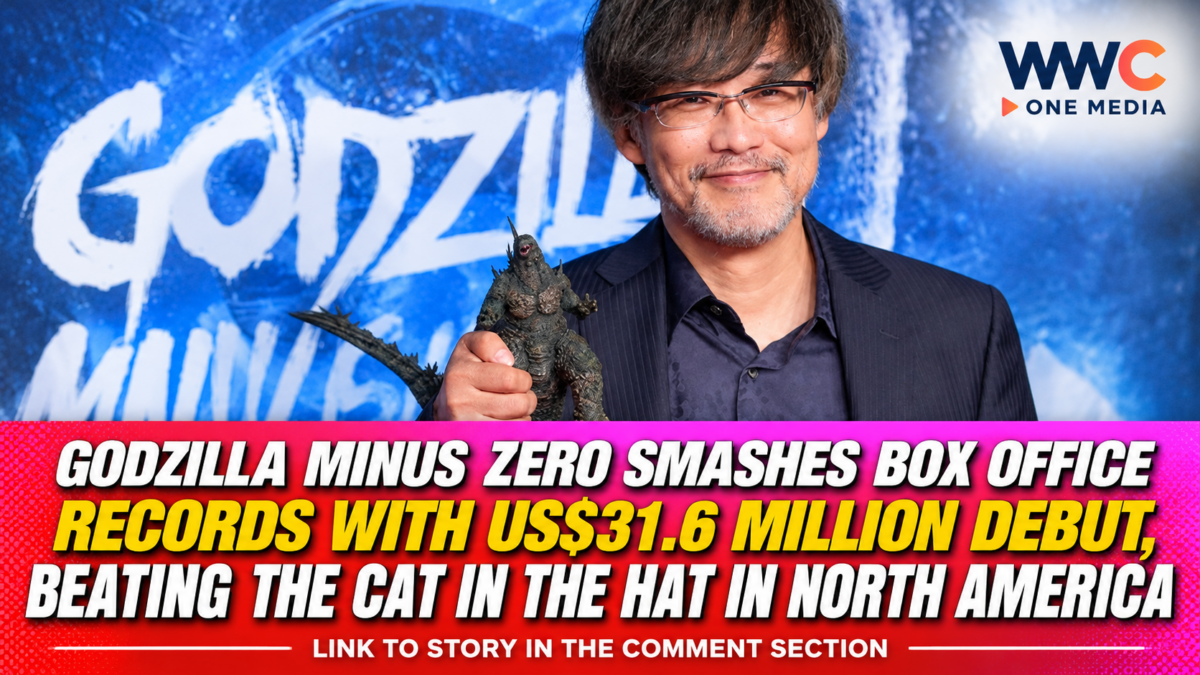
Godzilla has once again proved that the legendary Japanese monster remains a global box-office powerhouse. Godzilla Minus Zero, the highly anticipated sequel to the Oscar-winning Godzilla Minus One, has stormed into cinemas with an estimated US$31.6 million opening weekend in the United States and Canada, setting a new record for a live-action foreign-language film in the North American market.
The Japanese-language blockbuster, directed by Takashi Yamazaki, earned approximately S$40.5 million at the North American box office, comfortably beating Warner Bros.’ animated release The Cat in the Hat, which opened with US$20.5 million domestically.
The result is another major milestone for Japan’s film industry, demonstrating that international productions can compete directly with major Hollywood releases without abandoning their original language or cultural identity.
According to Associated Press reporting published on November 9, 2026, Godzilla Minus Zero generated approximately US$63 million worldwide during its opening weekend, including its strong performance in Japan and other international markets. AsiaOne+2
Godzilla Beats Hollywood’s The Cat in the Hat
The biggest surprise of the weekend was not simply that Godzilla topped the box-office charts. It was how convincingly the Japanese production defeated a major Hollywood animated release.
The Cat in the Hat, featuring the voice of Bill Hader, collected an estimated US$20.5 million in North America and another US$10 million internationally.
By comparison, Godzilla Minus Zero delivered US$31.6 million in North America alone.
The result gave the Japanese blockbuster a commanding lead over its Hollywood competitor and highlighted the growing commercial appeal of international films.
The achievement is particularly significant for GKIDS, the North American distributor of the movie and a subsidiary of Toho. The opening established a new box-office record for the distributor, surpassing its previous opening-weekend milestone set by The Boy and the Heron.
The film also nearly tripled the US$11.4 million opening weekend of its predecessor, Godzilla Minus One, which arrived in North American cinemas in 2023. TheWrap+1
Japan’s Godzilla Minus Zero Also Makes History at Home
The film’s success began before its North American release.
Godzilla Minus Zero opened in Japan on November 3, 2026, coinciding with Godzilla Day, which commemorates the original monster film’s Japanese theatrical debut on November 3, 1954.
According to Toho and GKIDS, the sequel generated approximately ¥910 million, or US$5.75 million, on its opening day, attracting more than 590,000 admissions.
The result established a record for the highest opening-day box-office revenue for a live-action film in Japan.
The Japan Times also reported that the movie surpassed one million domestic admissions within its first four days.
Its strong performance at home helped establish momentum ahead of its international release, allowing the production to reach audiences in Japan and overseas within a relatively short period. Godzilla+1
IMAX Delivers a Massive Share of the Opening Weekend
Another major contributor to the film’s success was its performance in premium large-format cinemas.
According to IMAX Corporation, Godzilla Minus Zero generated US$21.3 million worldwide through IMAX screenings during its opening period.
That represented approximately 34 per cent of the film’s global box-office revenue, despite IMAX screens accounting for less than one per cent of the total screens showing the movie.
In North America, IMAX screenings generated US$12.7 million, representing approximately 40 per cent of the film’s domestic opening-weekend earnings.
The figures demonstrate how premium cinema formats can significantly contribute to a film’s theatrical performance, particularly when the production features large-scale visual effects and spectacular action sequences.
Yamazaki filmed the movie using IMAX-certified digital cameras, with more than half of the film presented in an expanded aspect ratio designed for the format.
It also became the first Japanese feature film filmed specifically for IMAX, according to the company. IMAX Corporation+1
A Sequel to an Oscar-Winning Japanese Blockbuster
The enormous opening builds on the international success of Godzilla Minus One, the 2023 film that revived the franchise’s reputation among critics and global audiences.
Directed by Yamazaki, the predecessor earned widespread praise for its visual effects, storytelling and return to the franchise’s postwar Japanese roots.
It eventually won the Academy Award for Best Visual Effects at the 96th Oscars in 2024, becoming the first Japanese film to win the category.
The film also earned approximately US$105 million worldwide, according to The Japan Times, and became the highest-grossing Japanese-language live-action film in North American box-office history at the time.
Its success demonstrated that a Japanese production with a comparatively modest budget could compete internationally against much larger Hollywood franchises.
The sequel now appears positioned to surpass its predecessor’s North American theatrical earnings, although its final worldwide performance remains to be seen.
For more on the growing international influence of Japanese cinema, read WWC ONE MEDIA’s report on the Japanese Film Festival 2026, which brings 16 films to cinemas across the Philippines.
Why Godzilla Continues to Attract Audiences Worldwide
Godzilla is more than a movie monster. The character has become one of Japan’s most recognisable cultural exports.
First introduced in 1954, the original film reflected the anxieties of postwar Japan, particularly the destruction associated with nuclear weapons.
Over seven decades, the franchise has evolved through numerous Japanese and international productions, introducing different interpretations of the monster while maintaining its central themes of destruction, survival and humanity’s relationship with powerful forces beyond its control.
Yamazaki’s recent films have returned to a more emotionally grounded approach, combining spectacular monster sequences with the struggles of ordinary people.
That combination has helped distinguish the newer Japanese productions from some of the franchise’s larger Hollywood-style interpretations.
The commercial performance also suggests that audiences are increasingly willing to watch subtitled films when the storytelling and cinematic experience are compelling.
WWC ONE MEDIA has also examined how Asian entertainment properties are expanding beyond traditional film formats in its coverage of Stephen Chow’s plans to revive iconic movie characters through AI-generated animation.
A Relatively Modest Budget Makes the Box Office Result Even More Impressive
One of the most striking aspects of Godzilla Minus Zero is its reported production budget.
The film was made for less than US$20 million, according to Associated Press reporting.
That is considerably lower than the production budgets of many major Hollywood blockbusters, which can exceed US$100 million before marketing and distribution expenses.
Although box-office revenue is not the same as studio profit, the film’s opening performance gives Toho and its distribution partners a potentially significant commercial advantage.
The result also reinforces the growing importance of international film financing, global distribution and established intellectual property.
As WWC ONE MEDIA previously reported in its analysis of private investment flowing into Hollywood and its potential impact on which movies get made, the entertainment industry is increasingly exploring different financial models to support film production and distribution.
Godzilla’s success offers another example of how international studios can build global audiences without relying exclusively on Hollywood’s traditional production system.
Ramayana Also Makes a Strong International Debut
Godzilla was not the only international production attracting attention during the same box-office weekend.
The Hindi-language epic Ramayana: Rise of a Legend also delivered a strong performance, earning approximately US$8.7 million in North America and US$32 million in India.
Its worldwide opening reached approximately US$55.7 million, according to industry reporting.
The film’s North American release was also described as the widest theatrical release for an Indian production in the region.
The simultaneous success of Japanese and Indian productions demonstrates the growing commercial opportunities for non-English-language films in international markets.
For Hollywood, this could mean greater competition from overseas studios capable of producing visually ambitious films with strong cultural identities and established audiences.
The Next Challenge Is Keeping the Momentum Alive
Despite its historic opening, Godzilla Minus Zero still faces the challenge of maintaining strong ticket sales in the weeks ahead.
A successful opening weekend does not automatically guarantee long-term box-office dominance. Audience interest, repeat viewings, competition from upcoming releases and international theatrical performance will all influence its final earnings.
The next major test will be whether the sequel can surpass the US$57.1 million North American total reported for Godzilla Minus One.
Its strong opening, positive audience reception and impressive IMAX performance provide encouraging signs, but the final result will depend on how well it holds up after its debut.
The film’s success could also influence expectations for the next Hollywood Godzilla production, Godzilla x Kong: Supernova, scheduled for release in March 2027.
For now, Takashi Yamazaki’s sequel has achieved something few foreign-language productions manage: it has defeated a major Hollywood release, established a new North American opening record and demonstrated the worldwide commercial power of Japanese cinema.
Godzilla may have been created more than 70 years ago, but its latest box-office rampage suggests the monster is nowhere near retirement.