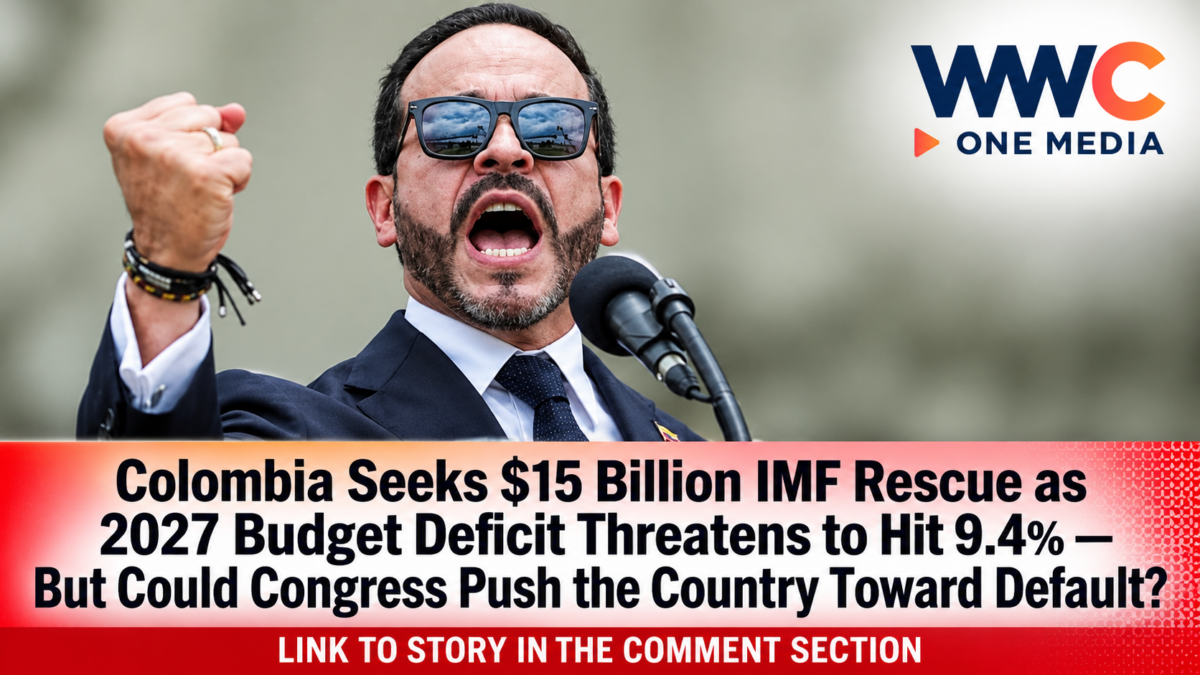
BOGOTÁ, COLOMBIA — November 10, 2026 — Colombia is negotiating a potential $15 billion financing agreement with the International Monetary Fund (IMF) as its government struggles to contain rising public debt, widening budget deficits and mounting fears about the country’s ability to meet its future financial obligations.
The proposed arrangement could become one of the most consequential economic decisions facing President Abelardo de la Espriella, who took office in August and inherited a severely strained fiscal position.
According to Bloomberg’s November 9 report, officials are discussing a Stand-By Arrangement that could provide financing to stabilize government accounts while Colombia pursues spending cuts and tax reforms.
But the proposed loan is far from guaranteed.
Reuters independently confirmed that negotiations are ongoing and that no final agreement is expected in the coming weeks. One source said the financing amount could be lower than $15 billion.
The urgency is clear.
Colombia’s government projects a fiscal deficit equal to 7.2% of gross domestic product in 2026, potentially widening to a record 9.4% in 2027 without corrective measures.
Officials have proposed a sweeping fiscal adjustment package intended to reduce spending, increase revenue and rebuild investor confidence.
However, the legislation faces resistance in Congress, including objections from political allies concerned about the proposed tax increases.
With Colombia seeking billions from the IMF while lawmakers remain divided over painful economic reforms, could an international rescue stabilize the country’s finances—or will political gridlock push the government closer to a debt crisis?
Colombia Negotiates a $15 Billion IMF Financing Package
Colombia’s government is discussing a potential financing arrangement of approximately $15 billion with the IMF, according to people familiar with the negotiations cited by Bloomberg.
The proposed financing would help the government address its growing borrowing requirements and strengthen confidence in public finances.
The discussions reportedly concern a Stand-By Arrangement, an IMF lending mechanism designed to help countries confronting short-term or potential balance-of-payments difficulties.
Such arrangements can provide financial support subject to agreed economic policies and reviews.
Colombia’s proposed financing would be intended for use rather than maintained solely as a precautionary credit line, Bloomberg reported.
However, Reuters emphasized that the precise amount and type of arrangement have not been finalized.
Earlier discussions considered financing in a range of $8 billion to $20 billion.
The IMF and Colombia’s Finance Ministry did not publicly confirm a $15 billion agreement when the reports emerged.
No funds from the proposed package have been approved or disbursed.
Why Colombia Is Turning to the IMF
Colombia’s fiscal position has deteriorated after years of high spending, weaker-than-expected tax revenue and increasing public borrowing.
The government needs substantial resources to finance its budget, service existing debt and meet other financial obligations.
As borrowing needs increase, investors may demand higher interest rates to compensate for perceived risks.
That can create a difficult cycle.
Higher debt-service costs consume more government revenue, leaving fewer resources for public services and investment.
The government may then need to borrow even more or reduce spending.
President De la Espriella has described the fiscal situation as exceptionally serious.
His administration argues that restoring confidence requires a credible combination of expenditure restraint, revenue measures and international financial support.
The IMF talks form part of that strategy.
But the Fund’s involvement would not automatically resolve the underlying deficit.
Any durable improvement would depend on reforms that reduce the gap between government spending and revenue.
Colombia’s 2027 Deficit Could Reach a Record 9.4%
The most alarming figure in the government’s fiscal outlook is its projected 2027 deficit.
Without corrective measures, Colombia expects the budget shortfall to reach approximately 9.4% of GDP.
That compares with a projected deficit of 7.2% in 2026.
A fiscal deficit occurs when government spending exceeds revenue during a given period.
It is different from the country’s total outstanding public debt.
A deficit equivalent to 9.4% of GDP means the annual shortfall is projected to be substantial relative to the size of the economy.
It does not mean Colombia’s total debt equals 9.4% of GDP.
The government hopes to reduce next year’s projected deficit through a fiscal reform package.
Officials say the proposed adjustment could improve the deficit by roughly two percentage points of GDP.
However, that improvement depends on the measures being approved and implemented.
If Congress rejects or significantly weakens the proposals, Colombia may face greater financing requirements.
Congress Approves a 634.9 Trillion-Peso Budget
Colombia’s Congress approved a 2027 national budget of approximately 634.9 trillion Colombian pesos, equivalent to about $206.6 billion at the exchange rate used in contemporaneous reporting.
The September decision came despite warnings that the government’s fiscal position was becoming increasingly difficult to manage.
Finance Minister Miguel Gómez acknowledged the constraints surrounding the budget.
The administration subsequently advanced proposals to reduce expenditures and raise additional tax revenue.
The planned legislation has become known as the Rescue Law.
Its success is increasingly important to the IMF negotiations because international lenders want evidence that Colombia can stabilize its debt.
But there is political opposition.
Centro Democrático, a party supporting the government, has criticized portions of the proposed tax increases.
The party favors an alternative approach relying more heavily on spending reductions.
This disagreement creates uncertainty about whether the government can pass a sufficiently strong adjustment before the end of the year.
Colombia’s Vice President Warns of Possible Default
The crisis has also prompted increasingly forceful warnings from senior officials.
Vice President José Manuel Restrepo said Colombia could face a risk of default if Congress fails to approve a credible fiscal adjustment.
His warning, reported by Bloomberg on November 1, reflected concern that the government could struggle to maintain access to affordable financing.
Default occurs when a borrower fails to meet an obligation under the terms of its debt.
But Colombia has not been reported as having defaulted on its sovereign debt in the current episode.
Restrepo’s comments describe a potential future risk, not an event that has already happened.
That distinction matters.
Countries can face serious fiscal pressure while continuing to meet debt payments.
A successful adjustment plan, continued market access and possible multilateral support could help reduce that risk.
However, an inability to stabilize government finances could increase borrowing costs and undermine investor confidence.
The IMF Says Colombia Needs Fiscal Consolidation
The IMF has already expressed concern about Colombia’s debt trajectory.
Its officials have emphasized the importance of fiscal consolidation, meaning policies designed to reduce government deficits and stabilize debt over time.
These may involve lower spending, greater revenue or a combination of both.
In September, IMF Deputy Managing Director Nigel Clarke met Colombian authorities, and the country’s Finance Ministry confirmed discussions about closer cooperation.
Colombian officials subsequently traveled to Washington for additional talks.
The IMF has supported the principle of a domestically designed reform program.
But receiving financing would require more than expressing a commitment to fiscal discipline.
The Fund would need to assess the country’s proposed measures, financing requirements and ability to meet the conditions of a specific lending facility.
The final decision would be subject to the IMF’s applicable approval processes.
Stand-By Arrangement or Precautionary Credit Line?
One significant question remains unresolved: what type of IMF financing should Colombia pursue?
Bloomberg reported discussions about a Stand-By Arrangement.
Earlier Reuters reporting suggested that the Fund’s Precautionary and Liquidity Line could also be a possible option.
The programs serve different purposes and have different eligibility requirements.
A Stand-By Arrangement can provide support to address short-term balance-of-payments needs.
A Precautionary and Liquidity Line is intended for countries with relatively sound economic fundamentals and institutions but remaining vulnerabilities.
Analysts have noted that Colombia has strengths including central-bank independence and a functioning financial system.
However, its weakening fiscal outlook presents a major challenge.
The country’s eligibility for a precautionary facility would depend partly on demonstrating credible progress toward debt sustainability.
The government may prefer financing that can be used directly to address its fiscal pressures.
Still, neither the financing mechanism nor the final loan amount has been formally settled.
What Happened to Colombia’s Previous IMF Credit Line?
Colombia previously maintained a Flexible Credit Line with the IMF.
That arrangement was designed to provide financial protection to countries meeting strong policy and institutional standards.
During the COVID-19 pandemic, Colombia accessed approximately $5.4 billion from the facility.
The country subsequently repaid the borrowing and canceled the credit line in 2025.
The earlier arrangement differed from the program now being considered.
A precautionary credit line can act as financial insurance, even if the country does not draw on it.
The current talks reportedly involve a larger financing package that the government intends to use.
For investors, that distinction could influence perceptions of Colombia’s financial position.
Seeking an actively used IMF loan may signal more immediate financing pressure than maintaining an unused precautionary facility.
But it does not automatically mean a country is insolvent.
Inflation Complicates the Government’s Rescue Strategy
Colombia’s fiscal problems are unfolding alongside persistent inflation.
Official figures released on November 9 showed annual consumer inflation increasing slightly to 6.30% in October, from 6.29% in September.
The result was lower than economists had expected.
However, inflation remains more than twice the central bank’s 3% target.
Higher food, healthcare, education and restaurant costs continue putting pressure on consumers.
WWC ONE MEDIA examined the latest data in Colombia Inflation Climbs to 6.30% as Food and Restaurant Prices Soar — But Could the Central Bank Be Forced Into Another Rate Hike?.
The relationship between inflation and fiscal reform is important.
Government spending cuts can reduce demand in some parts of the economy.
Tax increases may improve public finances but can also affect household purchasing power and business activity.
Some tax measures can raise prices directly, depending on their design.
Colombia’s policymakers therefore face a difficult balance between restoring fiscal stability and protecting economic growth.
High Interest Rates Add to Colombia’s Debt Burden
Colombia’s central bank held its policy interest rate at 12.25% during its October 30 meeting.
Four board members supported the decision, while three favored another 25-basis-point increase.
The high benchmark rate reflects ongoing concerns about inflation.
But expensive borrowing also places pressure on the economy.
Businesses may postpone investment when credit becomes costly.
Households may reduce borrowing and spending.
And government financing expenses can remain elevated when investors demand high yields on public debt.
A credible IMF agreement could potentially strengthen confidence and improve access to financing.
But it would not automatically reduce Colombia’s central-bank policy rate or eliminate the cost of servicing existing debt.
Monetary policy is determined separately by Banco de la República.
Why Latin American Investors Are Watching
Colombia’s negotiations matter beyond the country’s borders.
International investors monitor fiscal deficits, public debt, inflation and political stability when deciding whether to hold emerging-market assets.
A credible adjustment plan could reassure bondholders and potentially improve financing conditions.
But uncertainty surrounding congressional approval may keep markets cautious.
WWC ONE MEDIA previously explored the broader regional investment environment in Latin America Has Its Best Investment Tailwinds in Decades — But the Biggest Opportunity May Still Be Hiding in Plain Sight.
That report examined how commodity prices, international capital flows and domestic policy credibility influence investment opportunities across the region.
Colombia illustrates why economic fundamentals remain essential.
A favorable global environment cannot fully compensate for persistent government deficits or weak confidence in fiscal management.
Investors will want evidence that officials can deliver a realistic reform program.
Brazil Provides Another Warning About Fiscal Credibility
Colombia’s difficulties also echo financial pressures elsewhere in Latin America.
In Brazil, policymakers have faced challenging decisions involving inflation, government spending, currency volatility and elevated borrowing costs.
WWC ONE MEDIA examined the situation in Brazil Freezes Interest Rates at 13.75% After Lula’s Election Comeback as Real Plunges 9%.
Brazil and Colombia have different economic structures and fiscal conditions.
Their experiences should not be treated as interchangeable.
However, both demonstrate how investor perceptions of government finances can influence currencies, borrowing costs and monetary-policy expectations.
When markets question whether deficits are sustainable, financing can become more expensive even before a country misses any debt payment.
That is why credible fiscal plans matter.
Earthquake Recovery Creates Additional Spending Pressure
Colombia’s financial challenges have also been complicated by reconstruction needs following the devastating August earthquake.
The magnitude-7.4 disaster damaged homes, infrastructure and public facilities.
Recovery and rebuilding can require substantial government expenditure at a time when fiscal resources are already limited.
WWC ONE MEDIA previously reported on the international response in U.S. Expands Colombia Earthquake Aid to $26.5 Million — But the Hardest Part of the Crisis May Be Next.
The article examined US humanitarian assistance and the transition from emergency relief to longer-term reconstruction.
The earthquake is not the sole cause of Colombia’s fiscal deterioration.
The underlying budget problems developed over several years.
Nevertheless, disaster recovery adds to the competing demands on public finances.
Reducing expenditure while maintaining essential services and supporting reconstruction will be one of the government’s most difficult tasks.
Could IMF Financing Prevent a Debt Crisis?
An IMF agreement could offer several potential benefits.
It may provide access to financing on terms more favorable than some market borrowing.
It could strengthen confidence that the government has a credible fiscal adjustment strategy.
And it may help Colombia manage near-term financing requirements while reforms take effect.
However, the advantages depend on the eventual agreement.
IMF financing is not a grant.
It generally creates repayment obligations and comes with policy expectations or conditions.
A large borrowing arrangement may provide immediate liquidity without solving structural problems involving tax revenue and expenditure.
If Colombia fails to meet agreed commitments, future disbursements could be delayed or affected.
Financial-market confidence could also deteriorate if promised reforms are abandoned.
The success of any program will depend on implementation, not simply the amount announced.
What Happens Next?
The immediate focus is on the government’s discussions with the IMF and the fate of the Rescue Law in Congress.
Colombian officials need to demonstrate how they intend to reduce the fiscal deficit and stabilize public debt.
Lawmakers must decide whether to approve the proposed spending reductions and tax increases, amend the legislation or pursue an alternative plan.
The IMF will assess the country’s financial needs and the credibility of its policy proposals.
Reuters reported on November 9 that no decision is expected in the coming weeks.
That means the reported $15 billion should remain described as a potential arrangement under negotiation.
Investors will also monitor Colombian government-bond yields, the peso, inflation and economic activity.
Those indicators could provide clues about whether confidence is improving or deteriorating.
The Bigger Picture: Colombia Faces a Defining Fiscal Test
Colombia’s attempt to secure IMF support shows how serious its public-finance challenges have become.
The government faces a projected 7.2% fiscal deficit this year and a potential 9.4% shortfall in 2027 without corrective measures.
Public borrowing requirements are rising.
Interest rates remain high.
And political disagreements threaten to complicate a fiscal rescue package that officials consider essential.
A $15 billion IMF arrangement could give the government valuable financial breathing room.
But the financing has not been approved, and it would not eliminate the need for difficult policy decisions.
Colombia must find a way to manage spending, strengthen revenue and restore investor confidence without unnecessarily damaging growth or essential public services.
The government also needs congressional cooperation to implement the reforms it has proposed.
As Colombia negotiates a potential $15 billion rescue package with the IMF and its projected budget deficit approaches a record 9.4% of GDP, the decisive question is whether international financing and a credible fiscal reform can restore stability—or whether political deadlock will leave the country facing an even more dangerous debt crisis in 2027.