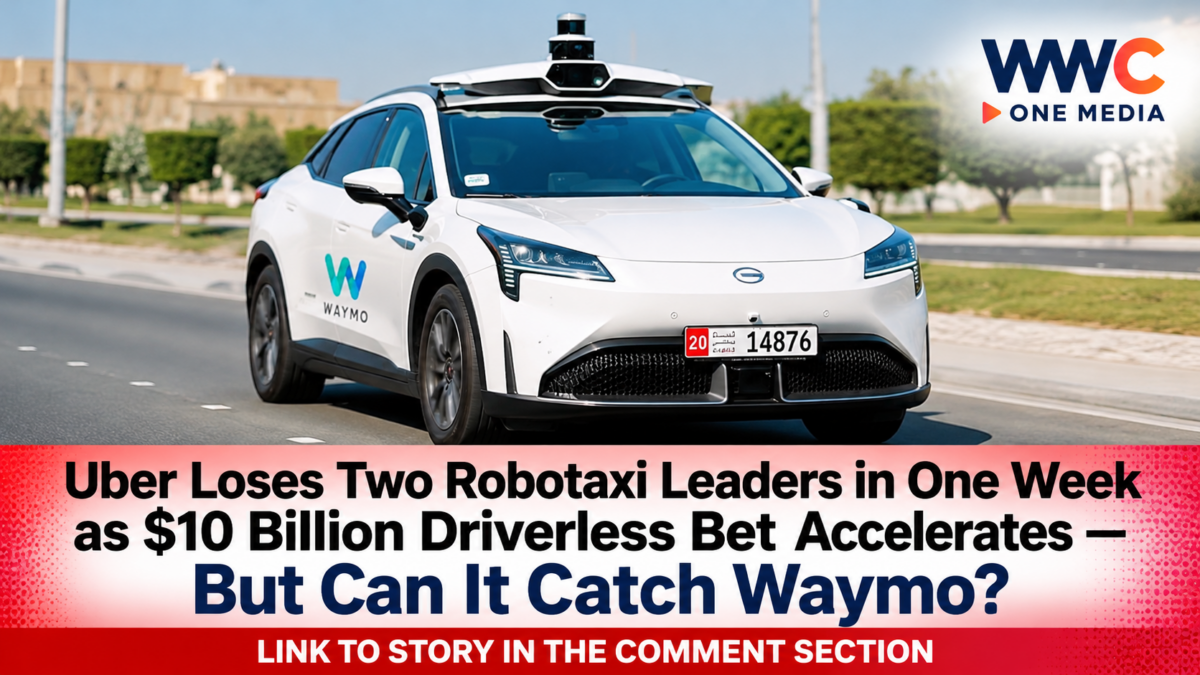
SAN FRANCISCO — November 10, 2026 — Uber Technologies is losing another senior executive responsible for its robotaxi engineering systems and delivery network, deepening a leadership shake-up at the ride-hailing giant just as it prepares to invest more than $10 billion in the future of autonomous transportation.
Danny Guo, Uber’s vice president of engineering and science, will leave the company on November 16 after nearly 12 years, according to an internal email reported by Bloomberg on November 9.
His departure comes as Sarfraz Maredia, Uber’s global head of autonomous mobility and delivery, is also preparing to leave on the same day.
The departures raise questions about leadership continuity within one of the most important strategic businesses at Uber.
Guo helped oversee the engineering infrastructure supporting autonomous-vehicle partnerships, maps, the Uber One membership program and the back-end systems used by the company’s delivery network.
Maredia, meanwhile, was responsible for expanding Uber’s partnerships with self-driving vehicle developers and bringing autonomous transportation services to more cities.
Both executives are leaving for opportunities outside the transportation industry, according to company statements reported by Bloomberg.
The timing is striking.
Uber recently announced plans to eliminate approximately 3,300 jobs, equivalent to about 10% of its workforce, while simultaneously increasing investment in robotaxis and other future technologies.
At the same time, its third-quarter gross bookings surged 20% to $59.8 billion.
Despite that strong growth, the company faces an increasingly aggressive challenge from Alphabet-owned Waymo, which is building its own direct relationship with passengers.
As Uber loses two experienced leaders while pouring billions into driverless transportation, can its partnership-based strategy scale quickly enough—or could Waymo and other autonomous-vehicle developers eventually bypass the ride-hailing giant entirely?
Danny Guo to Leave Uber After Nearly 12 Years
Bloomberg reported that Guo’s departure was communicated to employees on Monday, November 9.
He reports to Uber Chief Technology Officer Praveen Neppalli Naga.
Guo’s responsibilities have included engineering and science functions across several critical operations.
These include the technical infrastructure that supports Uber’s autonomous initiatives, its subscription services, mapping systems and delivery logistics.
He has spent nearly 12 years at the company, making him one of its more experienced engineering leaders.
According to Uber, Guo is accepting a position outside the transportation industry.
The company did not disclose his next employer.
Guo did not immediately respond to Bloomberg’s request for comment.
Many of the engineering leaders who previously reported through Guo’s organization will now report directly to Naga, an Uber spokesperson said.
This indicates that Uber is planning to redistribute responsibilities rather than announce an immediate like-for-like replacement.
However, the complete longer-term organizational structure has not been publicly detailed.
Why Guo’s Departure Matters to Uber’s Robotaxi Plans
Uber is no longer trying to develop every component of its self-driving technology internally.
Instead, it increasingly relies on partnerships with specialist autonomous-driving companies and vehicle manufacturers.
That makes the technology connecting those partners to Uber’s platform especially important.
A robotaxi service needs considerably more than a vehicle capable of driving itself.
It requires reliable routing, passenger matching, location data, charging arrangements, fleet monitoring, customer support and coordination with other vehicles.
Guo’s engineering teams have contributed to several of those underlying systems.
Their work helps Uber connect third-party autonomous vehicles to its existing transportation marketplace.
This is strategically important because Uber’s proposed future business model depends on providing the customer network and operating infrastructure for autonomous fleets.
If that infrastructure works well, robotaxi developers may find it attractive to use Uber to reach more passengers.
If it fails to deliver reliable availability or cost advantages, those developers may have stronger incentives to operate independently.
The leadership transition therefore comes at a sensitive moment.
Another Robotaxi Chief Is Also Leaving November 16
Guo is not the only senior executive leaving.
Sarfraz Maredia, who oversaw Uber’s global autonomous mobility and delivery operations, is scheduled to depart on November 16.
Maredia has also worked at Uber for more than 12 years.
His responsibilities included partnerships, fleet development and the commercialization of autonomous vehicles.
Bloomberg first reported his departure on October 13.
According to that report, Maredia will pursue a senior executive position at an unidentified company outside the transportation industry.
His responsibilities are being divided between two existing Uber leaders.
Samarth Kejriwal, who oversees driverless-vehicle operations, will take on additional responsibilities involving autonomous mobility.
Aaron Emrich, who leads autonomous delivery, will take on additional responsibilities in that business.
Maredia expressed confidence in Uber’s autonomous-vehicle strategy as he prepared to leave.
His comments emphasized the company’s shift toward expanding the number of cities served and increasing vehicle availability.
The departure of two experienced executives does not establish that Uber’s autonomous strategy is failing.
But it places greater responsibility on the remaining leadership team to deliver the company’s ambitious growth targets.
Uber’s Autonomous Division Has Lost Several Executives
The latest departures follow other leadership changes.
Guy Peterson, previously responsible for autonomous-vehicle business development, moved to Also, a micromobility company associated with Rivian.
Lando Juarez, formerly a legal leader for Uber’s autonomous business, joined Bedrock Robotics.
The company has also experienced changes outside its robotaxi division.
Jill Hazelbaker, Uber’s longtime communications executive and president, recently joined OpenAI as its chief corporate affairs officer.
Together, the departures represent a significant turnover of experienced personnel.
However, employees leave large technology companies for many reasons, including career advancement and opportunities in other industries.
The publicly available reporting does not establish that the departures were coordinated, forced or caused by internal conflict.
Uber’s official explanations point to outside career opportunities.
The more important operational question is whether the company can preserve technical knowledge and project continuity during the transition.
Uber Cuts 3,300 Jobs While Business Continues Growing
The executive changes come during a broader restructuring.
In September, Uber announced plans to eliminate approximately 3,300 positions, representing about 10% of its global workforce.
Management said the reductions were intended to simplify its organization and reduce bureaucracy.
The company had expanded significantly across ride-hailing, food delivery, freight, subscriptions and autonomous mobility.
That growth created additional management layers and overlapping organizational responsibilities.
Chief Executive Dara Khosrowshahi argued that Uber needed a simpler structure to make decisions and execute projects more efficiently.
The restructuring was not presented as a response to collapsing customer demand.
In fact, the company continued reporting strong business growth.
WWC ONE MEDIA previously examined the contradiction in Uber Is Cutting 3,300 Jobs Even as Business Booms — But the Real Shake-Up Is About What Comes After Human Drivers.
That report explained how Uber is redirecting organizational attention and financial resources toward automation while its conventional businesses continue generating substantial revenue.
The latest leadership departures add another dimension to that transformation.
Uber Reports $59.8 Billion in Third-Quarter Bookings
Uber’s financial results show that its core business remains substantial.
On November 4, the company reported third-quarter gross bookings of approximately $59.8 billion.
That represented 20% growth from a year earlier.
Revenue increased 10% to $14.8 billion.
The company completed approximately 4.1 billion trips during the quarter, up 16%.
Monthly active platform consumers reached 215 million, an increase of 14%.
Adjusted EBITDA rose 31% to approximately $3 billion.
Uber also reported $1.4 billion in operating income and $512 million in net income attributable to shareholders.
These figures demonstrate that the platform continues attracting customers and generating revenue.
But they also highlight why management is under pressure to defend Uber’s long-term position.
A company with hundreds of millions of users has considerable value as a marketplace.
The question is whether that marketplace will remain essential when transportation providers increasingly operate self-driving fleets.
Uber’s $10 Billion Robotaxi Strategy
Uber has indicated that it expects to commit more than $10 billion toward autonomous-vehicle partnerships and infrastructure over the coming years.
The strategy involves investments in vehicle developers, commitments to autonomous fleets and support for the infrastructure required to operate those vehicles commercially.
Unlike Waymo or Tesla, Uber is not primarily attempting to develop its own autonomous-driving software.
Its approach is to connect customers with vehicles developed by partners.
Those partners can supply the vehicles and autonomous-driving systems.
Uber provides its customer network, booking platform and operational expertise.
Management believes this structure could help vehicle developers achieve higher utilization and improve the economics of their fleets.
However, the planned investment represents a significant financial commitment.
The $10 billion figure is not an amount already spent during the latest quarter.
It covers expected investments and commitments over multiple years.
Some expenditures and vehicle deployments will depend on development milestones and commercial arrangements.
Uber Wants More Than 2,000 Driverless Vehicles by 2027
Uber has set an ambitious near-term target.
The company expects approximately 700 fully driverless vehicles on its platform by the end of 2026.
It aims to increase that figure to more than 2,000 during 2027.
Longer-term plans involve substantially larger fleets in more international markets.
Management has discussed reaching tens of thousands of autonomous vehicles from 2028 onward.
These targets indicate how seriously Uber is pursuing the technology.
But they remain projections, not completed deployments.
The company still needs regulatory approvals, reliable autonomous-driving systems, vehicles, maintenance arrangements and sufficient customer demand.
Robotaxi services also need to operate profitably.
A fleet may generate substantial revenue while facing high costs involving vehicle acquisition, insurance, charging, cleaning, maintenance and technical support.
The pace of expansion will therefore depend on both engineering performance and business economics.
Waymo’s 4,000-Vehicle Fleet Puts Pressure on Uber
Uber’s challenge becomes clearer when compared with Alphabet’s Waymo.
According to Bloomberg, Waymo already operates approximately 4,000 driverless vehicles across the United States.
That is roughly twice the number Uber hopes to have available through its platform by the end of 2027.
However, the comparison requires care.
Waymo is primarily a developer and operator of autonomous-driving technology.
Uber operates a broader ride-hailing marketplace and partners with multiple vehicle developers.
The two companies are therefore not identical businesses.
Nevertheless, they are competing for passengers, vehicle availability and leadership in the emerging robotaxi market.
Waymo already offers direct booking through its own application in several cities.
That creates a strategic risk for Uber.
If customers can summon a Waymo vehicle directly, they may not need Uber as an intermediary.
Waymo Is Ending Its Exclusive Uber Arrangement in Two Cities
The competition intensified in early November.
Waymo announced that it would end the exclusive Uber booking arrangement for autonomous rides in Austin and Atlanta in January 2028.
Passengers will then be able to book Waymo vehicles directly through the Waymo app in those markets.
Waymo co-chief executive Tekedra Mawakana explained that customers wanted a more consistent way to obtain driverless rides.
Under the existing arrangement, passengers using Uber could not always be certain that an autonomous vehicle would be available.
The decision represents a significant challenge to Uber’s strategy of becoming the leading marketplace for autonomous transportation.
Waymo may continue working with Uber in some areas while competing directly elsewhere.
The relationship is therefore becoming increasingly complex.
Reuters Breakingviews described the companies as having complementary strengths but competing ambitions.
Uber has extensive experience matching transportation demand with available supply.
Waymo possesses advanced autonomous-driving technology and a growing driverless fleet.
The long-term question is whether cooperation or direct competition will produce better financial results.
Rivian and Lucid Are Key to Uber’s Expansion
Uber is attempting to reduce dependence on any single autonomous-vehicle supplier.
That strategy includes partnerships with electric-vehicle manufacturers and autonomous-driving specialists.
Rivian is one important partner.
Uber has agreed to make potential investments of up to $1.25 billion in Rivian through 2031, subject to specified milestones.
The companies are working toward deploying autonomous Rivian R2 vehicles on Uber’s platform.
Initial operations are targeted for 2028.
WWC ONE MEDIA examined the financial and strategic implications in Rivian Revenue Surges 38% to $2.16 Billion as R2 Becomes Its Best-Seller — But Can the EV Maker Survive Its $1.1-Billion Cash Burn?.
Uber is also working with Lucid and autonomous-driving company Nuro.
The partnership aims to deploy autonomous vehicles built using Lucid technology and equipped with Nuro’s driving systems.
WWC ONE MEDIA previously examined the project in Lucid Delivers 3,806 EVs in Q3 as Production Plunges 38% — But Its Bigger Battle Is Burning Less Cash.
These partnerships could allow Uber to access autonomous vehicles without developing every component internally.
But future vehicle orders and investment commitments do not guarantee that the planned fleets will be deployed on schedule.
The Delivery Network Is Just as Important as Robotaxis
Guo’s responsibilities extended beyond autonomous ride-hailing.
He also oversaw engineering systems supporting Uber’s delivery network.
That infrastructure is increasingly important because delivery has become almost as large as mobility in gross bookings.
During the third quarter of 2026, Uber reported approximately $29.5 billion in mobility gross bookings.
Delivery gross bookings reached approximately $28.5 billion.
That represents a relatively narrow difference between the company’s two largest business segments.
However, gross bookings are not the same as revenue or profit.
They represent the total value of transactions processed through Uber’s platform under its published metric.
The company generated approximately $7.5 billion in mobility revenue and $5.5 billion in delivery revenue during the quarter.
Strong delivery growth creates opportunities involving restaurants, supermarkets and local retailers.
It also increases the importance of efficient logistics systems.
Uber’s future could involve autonomous delivery vehicles alongside human couriers.
The company must therefore maintain reliable engineering infrastructure while expanding its transportation technology.
Delivery Hero Acquisition Could Expand Uber’s Global Network
Uber’s delivery ambitions also include corporate acquisitions.
The company announced a proposed acquisition of Delivery Hero valued at approximately $14.8 billion.
The transaction would expand Uber’s international food-delivery operations if completed.
Delivery Hero owns businesses including South Korea’s Woowa Brothers, operator of Baemin.
The deal remains subject to regulatory approvals and other closing conditions.
WWC ONE MEDIA examined the regional implications in Naver Drops Baemin Stake Plan as Uber Moves to Take Over Delivery Hero.
The report explained how Uber’s proposed acquisition could reshape competition in South Korea’s food-delivery industry.
For Uber, the deal would increase the size and geographical reach of its delivery business.
But a larger network also requires sophisticated routing, merchant systems, customer support and technology integration.
Those are precisely the types of engineering challenges that become more important when experienced technical leaders depart.
Asia Could Become a Major Battleground for Autonomous Transport
The autonomous-vehicle market is expanding beyond the United States.
Singapore, Japan and other Asian countries are preparing for wider commercial testing and deployment.
Waymo plans to introduce driverless ride-hailing in Singapore by 2028.
WWC ONE MEDIA previously reported on the announcement in Waymo Picked Singapore for Its First SEA Robotaxi — So Why Wait Until 2028?.
The Singapore program includes a gradual preparation period, with mapping and operational development before commercial deployment.
For Uber and its partners, expansion into international markets will require adapting systems to different traffic conditions, laws and customer expectations.
Dense Asian cities may offer significant transportation demand.
But they also present regulatory and engineering challenges involving motorcycles, pedestrians, complex intersections and high traffic volumes.
No company can assume that successful operations in one US city will automatically translate into equally successful deployment in Asia.
What Happens Next for Uber?
Uber’s immediate challenge is managing the transition after Guo and Maredia leave on November 16.
The company must maintain continuity in engineering, autonomous operations and delivery logistics.
It also needs to execute its organizational restructuring without disrupting the core services that generate most of its revenue.
Investors will monitor progress toward the target of approximately 700 driverless vehicles by the end of 2026.
They will also assess whether Uber can scale to more than 2,000 by the end of 2027.
The development of Waymo’s direct-booking services will be another important competitive test.
Meanwhile, Uber’s relationships with Rivian, Lucid, Nuro, Wayve and other developers must translate into reliable passenger services.
The long-term financial question is whether Uber can generate attractive returns from its autonomous investments.
The Bigger Picture: Uber’s Next Battle Is Over Who Controls the Passenger
Uber has already transformed urban transportation by connecting millions of riders with drivers through a smartphone application.
But autonomous vehicles could change the structure of that market.
Today, Uber’s business depends heavily on coordinating human drivers and couriers.
In the future, more journeys may be completed by vehicles that require no human driver.
That creates enormous opportunities to improve transportation efficiency.
It also introduces a threat to Uber’s position between customers and transportation providers.
Waymo, Tesla and other autonomous developers may prefer to build direct customer relationships.
Uber is betting that its global customer network, operational infrastructure and partnerships will make its platform indispensable.
The departures of Danny Guo and Sarfraz Maredia are significant because they involve leaders connected to that transition.
But the company’s strong financial performance shows that it still has substantial resources to pursue its strategy.
As Uber prepares to lose two experienced autonomous-vehicle leaders while investing billions in robotaxis and delivery technology, the defining question is whether its remaining leadership can turn ambitious partnerships into a global driverless transportation network—or whether Waymo and other developers will eventually take control of the customer relationship that made Uber successful.