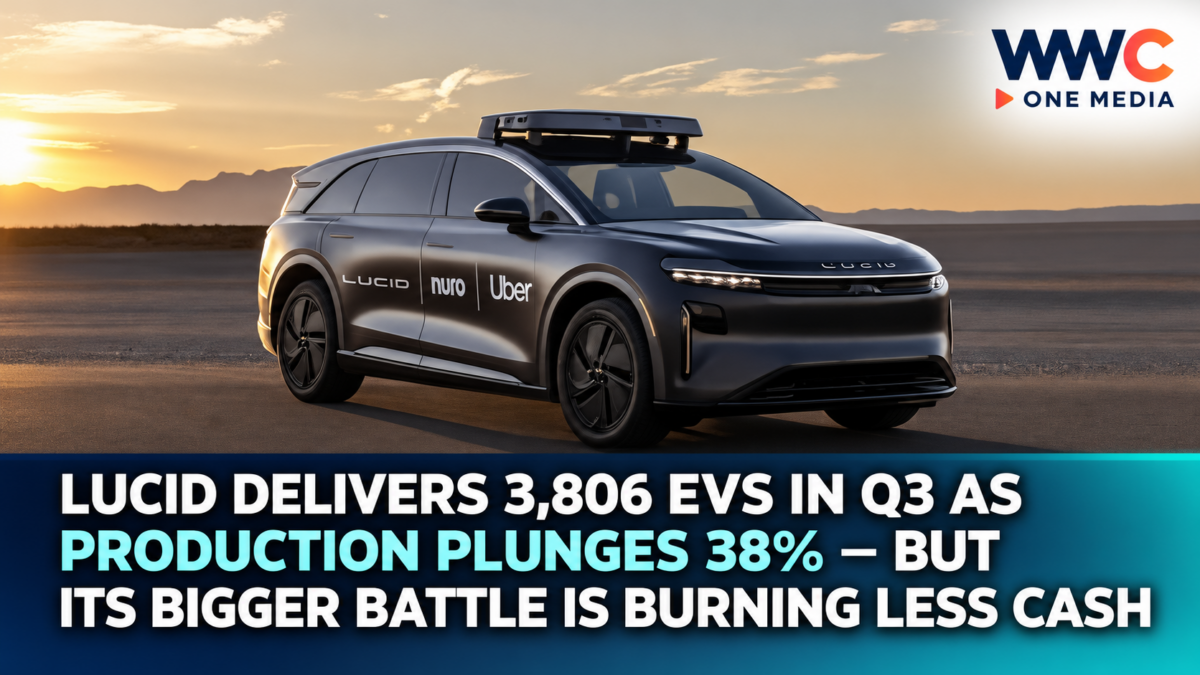
NEWARK, California — Lucid Group delivered 3,806 electric vehicles in the third quarter of 2026, but the luxury EV maker dramatically reduced factory output as it tries to clear unsold inventory, slash cash burn and rebuild its business around the Gravity SUV, a delayed midsize vehicle and a major robotaxi partnership with Uber.
Lucid produced only 2,954 vehicles during the three months ended September 30, down 38% from the 4,774 vehicles built in the second quarter.
Deliveries also slipped from 3,953 in Q2 to 3,806 in Q3 and came well below the roughly 4,687 vehicles Wall Street analysts had expected, according to Visible Alpha data cited by Reuters.
The production decline, however, was not simply the result of a factory problem.
Lucid says it deliberately slowed manufacturing after eliminating the second production shift at its AMP-1 plant in Arizona, part of a broader restructuring intended to better match production with actual customer demand.
That makes the Q3 numbers unusual.
For an automaker trying to grow, producing fewer vehicles would normally look like bad news.
For Lucid, management is arguing that making fewer cars may actually be necessary to save the company money.
Lucid delivered 852 more vehicles than it produced
The clearest evidence of Lucid’s strategy is the gap between production and deliveries.
Lucid delivered 3,806 vehicles but manufactured only 2,954, meaning customer deliveries exceeded new production by 852 units during the quarter.
That suggests Lucid was actively selling vehicles that had already been sitting in inventory.
The company explicitly described the effort as an inventory reduction program designed to convert existing vehicles into cash rather than continue producing cars faster than customers buy them.
That is central to Lucid’s current turnaround.
Unsold cars tie up enormous amounts of capital.
The company has already paid for batteries, motors, electronics, labor and factory overhead—but has not yet received the customer’s money.
Reducing inventory therefore releases working capital and can improve cash flow even without a major increase in sales.
Production has fallen dramatically since the start of the year
Lucid began 2026 much more aggressively.
The company manufactured 5,500 vehicles in Q1, followed by 4,774 in Q2.
Production then dropped to 2,954 in Q3.
That means Lucid produced approximately 13,228 vehicles during the first nine months of 2026.
Deliveries during the same period totaled 10,852 vehicles:
3,093 in Q1;
3,953 in Q2;
and 3,806 in Q3.
The slowdown marks a major change from Lucid’s original ambitions.
At the beginning of 2026, the company forecast production of 25,000 to 27,000 vehicles for the full year.
But Lucid later suspended that guidance while management reviewed the business following supplier problems, leadership changes and weaker-than-expected execution.
That original target should therefore no longer be treated as active guidance.
Deliveries are also running below Wall Street expectations
Reuters said Lucid has delivered 10,852 vehicles through September.
Analysts tracked by Visible Alpha expected roughly 17,070 deliveries for the full year.
To reach that figure, Lucid would need to deliver about 6,200 vehicles in the fourth quarter.
That would be difficult.
Lucid’s current quarterly delivery record is 5,345 vehicles, set in the fourth quarter of 2025.
In other words, the company would need to beat its historical quarterly record by a significant margin simply to reach the current analyst estimate.
That makes Q4 extremely important.
Gravity was supposed to change Lucid’s trajectory
Lucid’s biggest product bet is the Gravity SUV.
The company spent years building its identity around the Lucid Air luxury sedan, a technologically impressive vehicle praised for range and efficiency.
But sedans represent a smaller portion of the U.S. premium market than SUVs.
Gravity was supposed to give Lucid access to a much larger customer base.
The launch, however, ran into problems.
During Q1, a quality issue involving Gravity’s second-row seats disrupted deliveries for 29 days.
Lucid said the problem was corrected and introduced tighter quality controls and supplier oversight afterward.
The company now says Gravity demand has “continued to regain momentum,” although it did not disclose separate Q3 delivery numbers for the SUV.
That missing number matters.
Investors need to know whether Gravity is actually becoming the high-volume product Lucid needs—or merely improving from a difficult launch.
Lucid is undergoing a $1.4-billion reset
The weaker production numbers are part of what Lucid calls an operational reset.
In August, the company said it had identified approximately $1.4 billion in potential 2026 cash-flow improvements through reductions in operating expenses, capital spending and working capital.
Management organized the program around three priorities:
Cash and Cost;
Customer and Quality;
and Culture and Team.
The message from CEO Silvio Napoli was unusually candid.
Lucid has strong technology and products, he said, but “potential is not performance.”
That sentence effectively summarizes the company’s problem.
Lucid’s engineering has rarely been the biggest concern.
Scaling that engineering into a profitable mass-production business has been much harder.
Lucid has already cut thousands of jobs and factory capacity
Cost reduction has included significant workforce cuts.
In June, Lucid announced plans to eliminate roughly 18% of its U.S. workforce, including employees, contractors and manufacturing workers.
That came after another workforce reduction earlier in the year.
The company also eliminated the second shift at its Arizona plant—the same decision now contributing to lower Q3 production.
Lucid estimated the June restructuring could generate around $158 million in annualized savings.
The company is therefore making a deliberate trade-off.
It is sacrificing some near-term production capacity in exchange for lower fixed costs and better cash discipline.
The affordable Lucid has also been delayed
Perhaps the most important product in Lucid’s future is not Air or Gravity.
It is the company’s planned midsize EV platform.
Lucid’s existing vehicles compete primarily in the premium segment, limiting the number of customers who can afford them.
A lower-priced midsize vehicle could dramatically expand the company’s addressable market.
But Lucid’s operational reset has pushed the planned launch into the second half of 2027, later than previously expected.
That delay increases the pressure on Air and Gravity to carry the company for longer.
It also gives competitors more time to introduce their own affordable EVs.
Rivian is showing why a cheaper model matters
The contrast with rival Rivian is striking.
Rivian delivered a record 19,248 vehicles in Q3 2026, beating analyst expectations after launching its more affordable R2 SUV.
Rivian also produced 19,751 vehicles during the quarter.
Lucid delivered 3,806.
The companies occupy different niches and are at different stages of development, but the comparison demonstrates how powerful a lower-priced product can be.
Rivian’s R2 expands its potential customer base beyond buyers willing to pay premium R1 prices.
Lucid needs its midsize vehicle to perform a similar role.
But that opportunity is now pushed further into 2027.
Tesla has also regained momentum
Lucid is competing in an EV market where Tesla’s automotive business is showing signs of recovery.
Tesla delivered 486,532 vehicles during Q3 2026, beating analyst forecasts and putting the company on track to return to annual delivery growth after two years of declines.
Lucid is not realistically competing with Tesla on global scale today.
But Tesla’s improvement matters because it reinforces how crowded the premium EV market remains.
Legacy automakers are also expanding electric offerings, while Chinese brands continue advancing rapidly in battery technology, software and manufacturing efficiency.
Lucid therefore does not have unlimited time to solve its scale problem.
Saudi Arabia remains Lucid’s financial lifeline
Lucid has survived its long period of heavy losses largely because of substantial support from Saudi Arabia’s Public Investment Fund, or PIF.
An affiliate of PIF invested another $550 million in convertible preferred stock in April.
Lucid also expanded a delayed-draw term-loan facility backed by PIF by $500 million, drawing $500 million while retaining roughly $2 billion in remaining undrawn capacity at the time.
Lucid ended the second quarter with around $3 billion in liquidity and said available financing and operational measures should provide sufficient funding well into 2027.
That gives Lucid breathing room.
But financing is not the same thing as profitability.
Eventually, the business needs to generate enough cash from selling vehicles and technology to sustain itself without repeatedly raising capital.
Saudi Arabia is also becoming a manufacturing base
Lucid’s relationship with Saudi Arabia goes beyond investment.
The company operates a manufacturing facility in the kingdom and is developing its AMP-2 plant there.
In August, Lucid said AMP-2 had moved from construction into industrialization, with manufacturing equipment being installed and calibrated.
The plant is expected to become increasingly important to Lucid’s future production strategy, including its midsize platform.
The Saudi government has a strategic interest in building a domestic automotive industry as part of its broader effort to diversify the economy away from oil.
That alignment gives Lucid something many EV startups lack:
a wealthy long-term shareholder with both financial and industrial reasons to keep the company alive.
Uber could eventually become one of Lucid’s biggest customers
Another potential lifeline comes from robotaxis.
Lucid, Uber and autonomous-driving technology company Nuro are developing a robotaxi service built around Lucid vehicles.
In April, Uber expanded its planned commitment to at least 35,000 Lucid vehicles for its future autonomous ride-hailing fleet.
Uber also invested another $200 million in Lucid, bringing its total commitment to $500 million.
Production-validation Gravity vehicles are already being tested for the program in areas including the San Francisco Bay Area and Houston.
If deployed at scale, the partnership could give Lucid something extraordinarily valuable:
a large institutional customer buying thousands of vehicles instead of relying entirely on individual consumers.
But those future commitments should not be confused with current retail deliveries.
The robotaxi business is still developing.
Lucid’s technology remains one of its strongest assets
Lucid continues to enjoy a strong engineering reputation.
Its powertrain and battery systems are widely regarded as highly efficient.
The company’s vehicles have achieved some of the longest EPA-rated driving ranges available in the EV market.
Lucid has also increasingly presented itself not simply as an automaker but as a technology company capable of licensing powertrain, software and vehicle-platform technology to other manufacturers.
That creates a potential alternative business model.
If Lucid cannot rapidly reach Tesla-like manufacturing scale, it may still monetize technology through partnerships.
The company is also investing in autonomous-driving-ready architectures and software-defined vehicles.
But those businesses will take time to become significant.
For now, selling cars remains crucial.
Lucid still loses substantial amounts of money
This remains the central investor concern.
Revenue increased 56% year over year to $405 million in Q2, but Lucid continued reporting significant losses and its adjusted loss was worse than Wall Street expected.
The company has therefore shifted away from a “grow production at all costs” mentality.
Producing cars that remain unsold can actually make the financial problem worse.
That explains why Lucid’s Q3 production decline may look alarming but fits the current strategy.
Management would rather produce fewer vehicles and sell down inventory than keep factories running simply to report a higher production number.
But lower production brings another risk
There is a danger in cutting output too far.
Automotive manufacturing depends heavily on scale.
Factories cost billions of dollars.
Engineering programs are expensive.
Supply chains require large fixed investments.
Producing more vehicles allows manufacturers to spread those costs across a larger number of units.
Lucid therefore faces a difficult balance.
Too much production creates unsold inventory and burns cash.
Too little production keeps per-vehicle costs high and delays economies of scale.
Finding the right level of output is essential.
The Q3 result exposes Lucid’s biggest contradiction
Lucid needs to become bigger.
But right now, it also needs to become smaller.
It needs more customers.
But it cannot afford to build cars faster than customers buy them.
It needs to invest billions in new models, Saudi manufacturing and autonomous technology.
But it also needs to conserve cash.
It needs the affordable midsize EV as quickly as possible.
But management believes rushing another product launch could repeat earlier execution problems.
That is why Q3 cannot be judged only by the headline delivery number.
Lucid’s real objective has changed.
November 9 will reveal the financial cost
Lucid will report its full Q3 financial results on November 9, 2026.
That report will be more important than the production announcement because investors will finally see what the inventory reduction and factory slowdown did to:
revenue;
gross margin;
operating losses;
cash burn;
and liquidity.
The company may also provide more detail on Gravity demand, progress toward its $1.4-billion improvement plan and the timing of its midsize platform.
Until then, production and delivery numbers tell only part of the story.
Lucid itself cautions that vehicle volumes should not be treated as sole indicators of quarterly financial performance.
The next phase is about survival through discipline
Lucid has already demonstrated that it can design extraordinary electric vehicles.
That is no longer enough.
The company now has to prove that it can manufacture them economically, sell them consistently and stop consuming capital faster than its backers can provide it.
Q3 gives investors a mixed picture.
Deliveries missed expectations.
Production plunged.
But inventory declined, Gravity demand is reportedly recovering and management is finally prioritizing cash preservation over factory output.
Lucid delivered 3,806 vehicles in Q3—but produced only 2,954 because it is deliberately shrinking inventory and cutting costs.
That means the headline question is no longer simply how many EVs Lucid can build.
It is whether Lucid can burn cash slowly enough to reach the cheaper midsize vehicle, Saudi expansion and robotaxi business that it hopes will finally give the company real scale.