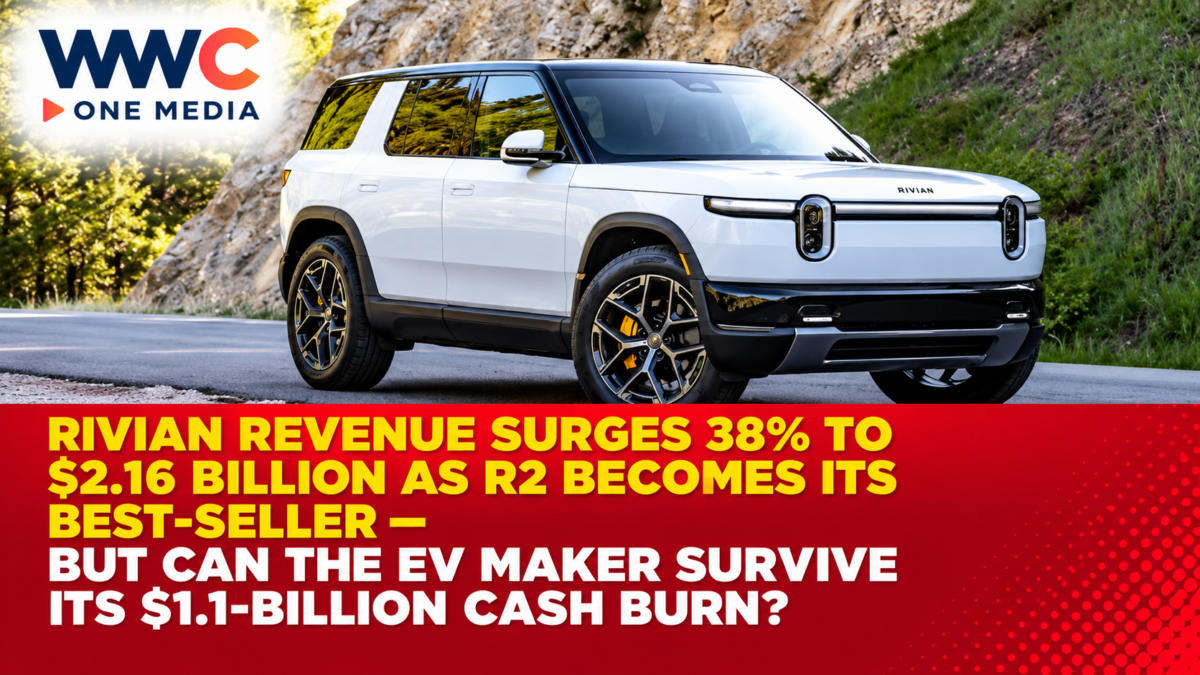
IRVINE, California — October 30, 2026. American electric vehicle manufacturer Rivian Automotive has delivered one of its strongest quarterly performances, reporting record vehicle deliveries, a 38% revenue increase and a smaller net loss as its more affordable R2 SUV begins transforming the company’s business.
Rivian announced on October 29 that third-quarter revenue reached $2.155 billion, compared with $1.558 billion in the same period last year.
The electric vehicle maker delivered 19,248 vehicles, an increase of approximately 46% year over year, as the new R2 became its best-selling model by volume.
The results exceeded Wall Street’s expectations and prompted Rivian to raise its full-year delivery guidance.
But the headline growth comes with a warning for investors.
Rivian still lost $913 million during the quarter, its automotive division remained unprofitable at the gross-profit level, and free cash flow was negative $1.124 billion.
The company is now betting that rising R2 production, a major software partnership with Volkswagen and future autonomous driving technology can transform record deliveries into a sustainable business.
The crucial question is whether Rivian can improve its economics fast enough to reduce its enormous cash requirements.
Rivian beats Wall Street with $2.16 billion in quarterly revenue
Rivian’s third-quarter revenue increased 38% to $2.155 billion, beating analyst expectations of approximately $1.99 billion.
Its adjusted loss was $0.48 per share, compared with market forecasts for a loss of around $0.64 per share, according to Investing.com.
Both measures represented improvements from the year-earlier quarter.
But the company remained unprofitable on a net-income basis.
Rivian reported a net loss attributable to common shareholders of $913 million, narrower than the $1.173-billion loss recorded in the third quarter of 2025.
The company also reported an adjusted EBITDA loss of $435 million, compared with a loss of $602 million a year earlier.
Adjusted EBITDA is a non-GAAP performance measure and should not be confused with net profit or free cash flow.
The results show meaningful progress, but they also demonstrate how expensive it remains to build vehicles, develop technology and expand production.
R2 becomes Rivian’s best-selling vehicle
The biggest development in the quarter was the rapid expansion of Rivian’s R2 SUV.
The R2 is designed to reach a broader customer base than the company’s larger and more expensive R1 vehicles.
During the third quarter, the R2 became Rivian’s top-selling model by volume, surpassing the R1 family and its commercial electric delivery vans.
Rivian did not disclose the exact number of R2 vehicles sold separately.
That means the company’s 19,248 total deliveries should not be presented as R2-only sales.
The new SUV is central to the company’s growth strategy because its smaller size and lower starting price give Rivian a potential opportunity to compete in a much larger market.
Chief Executive RJ Scaringe said the vehicle has attracted customers from a wide range of competing brands, including BMW, Land Rover, Jeep, Ford and Toyota.
The company is also planning more affordable R2 versions, with a version expected to start at approximately $45,000 during 2027.
However, consumer demand is only one part of the equation.
Rivian must also demonstrate that higher R2 production can reduce manufacturing costs enough to improve profitability.
Rivian sets records for production and deliveries
During the July–September quarter, Rivian produced 19,751 vehicles at its factory in Normal, Illinois.
It delivered 19,248 vehicles to customers.
Both figures marked substantial improvements from a year earlier.
In the third quarter of 2025, the company produced 10,720 vehicles and delivered 13,201.
That means production increased approximately 84%, while deliveries rose approximately 46%.
The company’s latest results also show significant sequential growth from the second quarter of 2026, when it delivered 12,194 vehicles.
The jump demonstrates that the R2 production ramp is beginning to contribute substantially to overall output.
But rising production also creates new challenges.
Manufacturers must coordinate suppliers, labor, quality control, logistics and inventory management as factories accelerate.
The success of the R2 will depend on whether Rivian can continue increasing production without allowing costs or manufacturing problems to undermine the business.
Rivian raises its 2026 vehicle delivery forecast
Following the stronger-than-expected quarter, Rivian increased its full-year delivery guidance.
The company now expects to deliver between 67,000 and 70,000 vehicles in 2026, compared with its previous forecast of 65,000 to 70,000.
The change raises the lower end of its forecast by 2,000 vehicles while leaving the upper end unchanged.
Rivian has also improved its expectations for adjusted EBITDA and capital spending.
Management now forecasts a full-year adjusted EBITDA loss of between $1.75 billion and $1.85 billion.
The previous guidance implied a larger loss.
Capital expenditures are expected to total approximately $1.4 billion to $1.5 billion, lower than the earlier forecast.
However, the company indicated that improved guidance partly reflects higher regulatory credit revenue, a tariff refund receivable and the timing of capital expenditures.
These distinctions matter.
Lower reported spending in one year may result from delayed expenditures rather than permanent reductions in future investment requirements.
The guidance also represents management’s expectations rather than completed results.
Positive gross profit does not mean Rivian is profitable
One of the most easily misunderstood figures in Rivian’s earnings report is its $176-million consolidated gross profit.
That represents an improvement of $152 million compared with the same quarter last year.
However, consolidated gross profit is not the same as net income.
Gross profit measures revenue minus the direct costs of goods and services.
It excludes significant expenses such as research and development, selling costs and general administrative expenses.
Rivian’s positive consolidated gross profit also does not mean its vehicle manufacturing operation has become profitable.
The automotive division reported an $80-million gross loss during the quarter.
That was better than the $130-million automotive gross loss recorded a year earlier.
Nevertheless, the company was still spending more to produce and sell vehicles than it was recognizing in automotive revenue after direct costs.
The difference was offset by profitability in Rivian’s software and services business.
That segment generated $256 million in gross profit.
For investors, this distinction is critical when evaluating the company’s progress toward sustainable profitability.
Volkswagen partnership becomes a major source of revenue
Rivian’s software and services business is playing an increasingly important role in its financial performance.
The division generated $605 million in quarterly revenue, an increase of approximately 45% from a year earlier.
Its gross profit reached $256 million, representing a margin of approximately 42%.
One major contributor was Rivian’s partnership with Volkswagen Group.
Approximately $354 million, or 59% of Rivian’s software and services revenue, was attributable to the joint venture during the quarter.
The partnership involves vehicle electrical architecture and software development technologies.
It provides Rivian with an opportunity to monetize technology beyond its own electric vehicles.
Volkswagen, in turn, gains access to software and electrical systems intended for future models.
The companies expect the first Volkswagen vehicle using Rivian technology to launch in Europe in 2027.
That launch remains a future milestone rather than a completed commercial introduction.
Rivian’s software revenue demonstrates the financial potential of licensing automotive technology.
But investors must assess how much of that revenue can recur over the long term and how dependent it is on development agreements with major partners.
The $1.12-billion cash burn remains Rivian’s biggest challenge
Rivian’s most pressing financial issue is its continuing cash consumption.
The company reported negative free cash flow of $1.124 billion during the third quarter.
This reflected approximately $758 million in cash used by operating activities and $366 million in capital spending.
By comparison, free cash flow was negative $421 million in the same quarter last year.
That means the latest quarter’s free cash flow deteriorated significantly despite stronger revenue and improved gross profit.
The company attributed part of the increase in operating cash use to working-capital changes, including inventory purchases supporting the R2 launch and changes in deferred revenue.
Such changes can fluctuate as manufacturing activity expands.
Nevertheless, the cash outflow illustrates why Rivian needs substantial liquidity to continue operating and investing.
The company ended September with approximately $5.502 billion in cash, cash equivalents and short-term investments.
Its total available liquidity, including a revolving-credit facility, stood at approximately $6.095 billion.
Rivian also reported that a $1-billion Volkswagen loan received in October would increase its pro forma available liquidity to approximately $7.095 billion.
Those resources provide financial flexibility.
But the company must continue managing its cash requirements carefully.
Uber could provide another major growth opportunity
Rivian’s ambitions extend beyond conventional consumer vehicle sales.
The company has a partnership with ride-hailing giant Uber focused on autonomous electric vehicles.
Under the agreement, Uber could invest up to $1.25 billion in Rivian through 2031, depending on agreed technology and operational milestones.
Reuters reported on October 29 that Rivian was on track to meet a year-end autonomy milestone that could unlock an additional $250 million in Uber funding.
The two companies are targeting the introduction of driverless R2 vehicles on Uber’s platform beginning in 2028.
The initial deployments are expected to involve a limited number of cities, with plans for broader expansion if the technology and commercial operations succeed.
WWC ONE MEDIA previously explored Uber’s robotaxi strategy in Uber Is Cutting 3,300 Jobs Even as Business Booms — But the Real Shake-Up Is About What Comes After Human Drivers.
The report examined how Uber is positioning itself as a platform for autonomous mobility through partnerships with vehicle manufacturers and technology developers.
For Rivian, the opportunity could eventually create an additional market for its vehicles and software.
However, the planned robotaxi rollout is not yet a fully deployed commercial service.
Future investment payments and vehicle orders remain dependent on agreed conditions and successful development.
Rivian targets more advanced autonomous driving features
Rivian is also expanding the autonomous-driving capabilities offered to vehicle owners.
The company says its Autonomy+ platform already supports hands-free operation on millions of miles of roads under specified conditions.
It is preparing a more advanced Point to Point feature designed to navigate routes involving city streets, intersections and highways while requiring driver supervision.
A limited rollout is planned for later in 2026, with a broader release expected during 2027.
The company has also acquired Third Dimension AI to support its simulation and autonomous-driving development.
Rivian plans to provide additional details during its Autonomy and AI Day on December 9.
These announcements signal an effort to generate revenue from software subscriptions and technology services.
But driver-assistance features should not be described as completely autonomous transportation unless they meet the relevant technical and regulatory standards.
Rivian’s planned Point to Point feature will still require driver supervision.
The company’s ability to turn this technology into meaningful recurring revenue remains to be demonstrated.
Tesla’s strong deliveries show how competitive the EV market remains
Rivian’s growth comes during an uneven period for the global electric vehicle industry.
Tesla reported 486,532 vehicle deliveries during the third quarter of 2026, significantly exceeding Wall Street expectations.
But Tesla’s deliveries were still slightly lower than the year-earlier period.
WWC ONE MEDIA analyzed the contrasting results in Tesla Delivers 486,532 Vehicles and Beats Wall Street — But the Bigger EV Recovery Is Far From Even.
That report also highlighted Rivian’s earlier record delivery figures.
The comparison illustrates the scale difference between the manufacturers.
Rivian delivered approximately 19,000 vehicles during the quarter.
Tesla delivered more than 486,000.
Both companies compete in electric mobility, but their production volumes, product ranges and financial positions are substantially different.
Rivian must continue expanding while maintaining a distinctive brand and improving manufacturing efficiency.
The company’s stronger results are encouraging, but they do not eliminate the competitive advantages of larger manufacturers.
Lucid’s experience highlights the danger of cash burn
Rivian is not the only American electric vehicle manufacturer trying to balance production growth with financial discipline.
Lucid Group has also faced pressure to manage inventory, control spending and expand its customer base.
WWC ONE MEDIA examined its recent operating results in Lucid Delivers 3,806 EVs in Q3 as Production Plunges 38% — But Its Bigger Battle Is Burning Less Cash.
The report detailed Lucid’s decision to reduce factory output and focus on financial efficiency.
Lucid and Rivian are different companies with different products and financing arrangements.
However, both illustrate the challenges of establishing an automotive manufacturer in a capital-intensive industry.
Building vehicles requires investment in factories, equipment, engineering, warranties, distribution and customer service.
A company may increase deliveries without generating enough cash to fund its operations.
For investors, cash flow therefore remains a crucial measure of business sustainability.
Chinese automakers are intensifying global EV competition
Rivian also operates in an increasingly competitive global automotive market.
Chinese manufacturers have expanded their electric and hybrid vehicle offerings through aggressive pricing and rapid product development.
Their overseas expansion has accelerated amid weaker domestic automobile demand.
WWC ONE MEDIA examined the trend in China Exports Over 7 Million Cars as Domestic Sales Plunge 22% — But Is Its Auto Industry Heading for a Global Trade War?.
The article highlighted how Chinese manufacturers are using exports to reach new customers while facing domestic pricing pressure.
The United States maintains significant trade restrictions affecting Chinese electric vehicles.
Nevertheless, international competition influences vehicle technology, consumer expectations and investment decisions.
For Rivian, achieving a competitive cost structure will become increasingly important as electric vehicles continue evolving.
Its success will depend not simply on producing attractive vehicles, but on manufacturing them profitably at scale.
The Philippines offers a different perspective on electric vehicle demand
The electric vehicle market is developing differently across Asia.
In the Philippines, demand for electrified vehicles is growing, particularly in the hybrid and plug-in hybrid segments.
WWC ONE MEDIA previously reported on this trend in BYD Philippines Nearly Doubles Sales to 28,399 Units — But One Type of Vehicle Is Driving Almost 80% of the Boom.
The report documented the growing local presence of Chinese automotive brands.
Rivian has not announced a comparable official Philippine retail expansion.
Its current growth strategy remains concentrated on North America and selected technology partnerships.
However, the wider industry demonstrates how consumer demand can differ substantially by market.
Pricing, charging infrastructure, government incentives and product availability all influence electric vehicle adoption.
These factors also determine how quickly manufacturers can expand beyond their existing customers.
What investors should watch next
Several developments will determine whether Rivian can continue improving its financial performance.
The most important is the R2 production ramp.
Higher output could help spread factory costs across more vehicles.
However, management must reduce costs enough to improve automotive gross margins.
Another critical factor is software revenue.
The Volkswagen partnership provides a potentially valuable income stream, but its long-term contribution will depend on future development milestones and licensing activity.
Investors will also monitor Rivian’s cash position, capital expenditures and access to financing.
Additional technology milestones connected to Uber could provide funding, but those payments are conditional.
Finally, the company must demonstrate that stronger deliveries translate into better profitability rather than simply higher revenue accompanied by continued losses.
The bigger question: Is Rivian finally approaching a sustainable business model?
Rivian’s third-quarter results show genuine operational progress.
Revenue increased 38%, deliveries rose 46%, the R2 became the company’s best-selling vehicle, and the net loss narrowed substantially from a year earlier.
The company also raised its delivery guidance and continued developing valuable software partnerships.
Those achievements strengthen the argument that Rivian is becoming more than a niche electric vehicle manufacturer.
But the financial risks remain considerable.
The automotive division still recorded a gross loss.
Free cash flow was negative by more than $1.1 billion.
And continued expansion will require investment in manufacturing, technology and future products.
For investors, the next challenge is determining whether the company’s improving vehicle economics can eventually outweigh its substantial cash requirements.
Rivian has proved that it can sell more electric vehicles, grow revenue and attract powerful technology partners. But until it can build cars profitably and substantially reduce its cash burn, the most important test of its R2 revolution is still ahead.