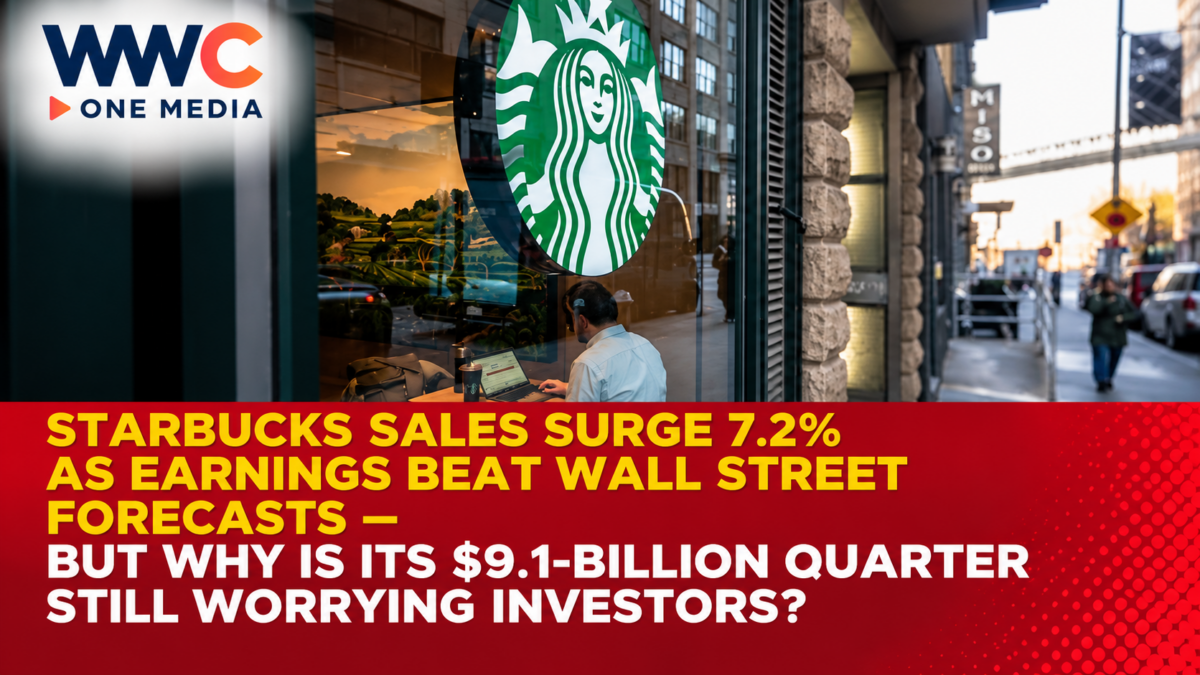
SEATTLE, United States — October 30, 2026. Starbucks is showing signs of a stronger-than-expected recovery as customers return to its coffeehouses, helping the world’s largest coffee chain beat Wall Street’s quarterly sales and earnings forecasts.
The company reported a 7.2% increase in global comparable coffeehouse sales during its fiscal fourth quarter ended September 27, 2026, exceeding the approximately 5.4% growth analysts had anticipated.
Adjusted earnings reached $0.80 per share, compared with market expectations of $0.72, according to Reuters.
The results suggest that CEO Brian Niccol’s two-year effort to rebuild Starbucks around faster service, better-staffed stores, simplified menus and a more welcoming coffeehouse experience is delivering measurable progress.
But there is a significant complication.
Starbucks’ total quarterly revenue fell 4% to approximately $9.1 billion, and management expects reported revenue to decline again in fiscal 2027.
The weakness primarily reflects a major change in the accounting and operating structure of its Chinese business, rather than a collapse in customer demand across the entire company.
Even so, investors remain concerned about whether Starbucks can maintain rising customer traffic, restore profitability and succeed in a fiercely competitive global coffee market.
Starbucks beats Wall Street expectations as customers return
Starbucks’ fourth-quarter earnings provided encouraging evidence that the company’s turnaround has gained momentum.
Global comparable-store sales rose 7.2%, comfortably ahead of the 5.4% increase forecast by analysts surveyed by LSEG.
The improvement was driven by two factors.
Average spending per transaction increased 5.2%, while the number of comparable transactions rose 1.8%.
This distinction is important.
A company can report higher comparable sales simply because customers are paying more.
But Starbucks also recorded an increase in the number of transactions, suggesting that customer activity improved alongside average spending.
In the United States, comparable sales increased 7.7%.
Transaction growth reached 2.4%, while the average customer ticket rose 5.2%.
The US performance marks a meaningful change from earlier periods when Starbucks struggled with weaker traffic, higher operating costs and growing competition.
However, management must still demonstrate that the improvement can continue as year-earlier comparisons become more challenging.
Adjusted earnings climb 54% as operating margins improve
Starbucks reported adjusted earnings of $0.80 per share for the quarter, up approximately 54% from $0.52 a year earlier.
The result exceeded analysts’ expectations of approximately $0.72 per share.
On a generally accepted accounting principles basis, earnings rose to $0.59 per share from $0.12.
Starbucks’ GAAP operating margin expanded to 10.8%, compared with approximately 2.9% a year earlier.
Its adjusted operating margin reached 14%, up from approximately 9.4%.
The margin recovery reflects improved operating leverage and lower restructuring costs compared with the year-earlier period.
The company has also benefited from stronger sales at established locations.
Nevertheless, the GAAP and adjusted figures measure performance differently.
Adjusted earnings exclude specified items and should not be described as identical to audited GAAP earnings.
Investors will be watching whether operating profitability remains strong as Starbucks continues investing in workers, technology and store upgrades.
Why Starbucks revenue declined despite stronger coffee sales
One of the most important details in the earnings announcement is the contrast between rising comparable sales and declining consolidated revenue.
Quarterly net revenue fell approximately 4% to $9.1 billion.
The decline was primarily caused by Starbucks’ decision to move its China retail operations into a licensed joint venture structure.
Under the arrangement with Boyu Capital, Starbucks no longer reports all Chinese retail sales in the same way it did when the operations were directly controlled.
The accounting change means consolidated revenue can fall even when underlying customer demand improves in other markets.
Investors must therefore distinguish changes in the corporate structure from trends in coffeehouse sales.
However, this accounting explanation does not eliminate the need for Starbucks to maintain strong financial performance.
The company must demonstrate that its revised business structure can generate attractive earnings and cash flow.
Brian Niccol’s Back to Starbucks plan begins delivering results
When Brian Niccol took over as Starbucks chief executive in 2024, the company faced declining customer traffic, operational problems and concerns that its coffeehouses had lost some of their appeal.
Niccol introduced the Back to Starbucks strategy, designed to improve the experience of both customers and employees.
The program includes simplifying menus, improving staffing, reducing wait times and creating more welcoming stores.
Starbucks has invested heavily in labor and operating improvements.
Reuters reported that the company has committed nearly $500 million toward staffing-related measures as part of its turnaround.
The company is also introducing technology and operational changes intended to make order preparation more efficient.
The latest sales figures suggest that those investments are helping restore customer demand.
Starbucks reported its fifth consecutive quarter of positive comparable-sales growth and its third consecutive quarter of improving operating margins.
But maintaining that progress will require continued discipline.
Better service can attract more customers, but additional staffing and store investments also increase operating expenses.
The challenge is finding a sustainable balance between customer satisfaction and profitability.
Starbucks closes 250 North American stores despite improving sales
The company’s recovery strategy has involved difficult restructuring decisions.
In September, Starbucks announced plans to close approximately 250 underperforming North American coffeehouses.
The move followed earlier closures and workforce reductions as management sought to concentrate resources on locations with stronger long-term potential.
WWC ONE MEDIA previously examined the restructuring in Starbucks to Close 250 North American Stores in Second Major Wave of Closures.
The closures illustrate a central contradiction in Starbucks’ recovery.
The company is experiencing stronger customer demand at established locations while eliminating stores that it believes cannot deliver acceptable financial returns.
Closing underperforming locations may improve profitability, but the decisions can also affect employees and communities.
The latest earnings show that Starbucks is pursuing growth through a more selective approach rather than simply increasing its store count everywhere.
For investors, the test is whether improvements at the remaining stores outweigh the financial and operational costs of restructuring.
China joint venture reshapes Starbucks’ international business
Starbucks’ agreement with Boyu Capital represents one of the most significant changes in the company’s international strategy.
Under the transaction, Boyu took control of a majority stake in Starbucks’ Chinese retail operations, while Starbucks retained a 40% interest.
The arrangement was designed to provide greater local expertise and improve the company’s ability to compete in China.
The Chinese coffee market has become intensely competitive.
Domestic chains such as Luckin Coffee and Cotti Coffee have expanded rapidly through aggressive pricing, digital ordering and frequent new product launches.
Starbucks continues to position itself as a premium coffeehouse brand, but lower-priced rivals are increasingly challenging that model.
WWC ONE MEDIA previously explored the broader competition in US and Chinese Fast-Food Chains Are Crossing Into Each Other’s Markets — And the Food Fight Is Getting Bigger.
The report highlighted how Chinese brands are expanding internationally while American restaurant and coffee chains adapt to changing consumer preferences in China.
The joint venture could give Starbucks more flexibility in local marketing, pricing and expansion.
But it also means the company’s international growth will increasingly depend on the performance of franchise and licensed arrangements.
China’s coffee competition extends beyond pricing
Starbucks is also navigating commercial and political challenges as it expands in China.
In September, the company opened its first two stores in Xinjiang, an area facing international scrutiny over human-rights allegations and labor practices.
The openings triggered criticism from some US lawmakers.
WWC ONE MEDIA reported on the development in Starbucks and Luckin Push Deeper Into Xinjiang as China’s Coffee War Expands — But Forced-Labor Scrutiny Could Follow Them Abroad.
The controversy illustrates how business expansion can create reputational and regulatory challenges beyond ordinary competition.
Operating coffeehouses in the region does not by itself establish that Starbucks products involve forced labor.
But multinational companies face growing expectations regarding supply-chain verification, human rights and business transparency.
For Starbucks, success in China will require commercial competitiveness while managing these wider concerns.
Starbucks’ Asian licensing network faces another major restructuring
The company’s international transformation also extends across Southeast Asia.
DFI Retail Group has announced a transaction to gain full control of the Starbucks-licensed business across seven Asian markets, including Singapore, Thailand, Vietnam, Cambodia and Laos, as well as Hong Kong and Macau.
The arrangement involves more than 1,100 coffeehouses and forms part of a broader corporate restructuring involving Maxim’s Caterers.
WWC ONE MEDIA covered the proposed deal in DFI Retail to Take Full Control of Starbucks Business Across Seven Asian Markets.
The transaction remains subject to regulatory approvals and other completion conditions.
Its significance is that Starbucks can pursue expansion through regional operating partners rather than directly owning every coffeehouse.
A licensed model may require less direct capital investment, although it also changes how revenue and operating profits are recognized.
The development matters for Southeast Asian consumers because regional licensees influence store expansion, local operations and customer experience.
It does not establish any immediate change in the ownership of Starbucks Philippines, which is outside the seven-market transaction.
International sales growth remains much weaker than in the United States
Despite the strength of its North American business, Starbucks’ international results were more subdued.
International comparable coffeehouse sales rose only 0.9%.
Average transaction value increased 3.7%, but the number of transactions declined 2.8%.
That means the international business benefited from higher average spending while experiencing fewer customer visits at qualifying locations.
The contrast with the United States is important.
In the US, both transactions and spending per visit increased.
Internationally, weaker transaction activity offset much of the benefit from higher average spending.
The figures suggest that Starbucks still faces challenges rebuilding customer frequency outside North America.
Regional competition, consumer spending conditions and different operating structures could all influence performance.
Management will need to demonstrate that its international business can generate stronger underlying customer demand.
Matcha and afternoon beverages become important growth opportunities
One of the more interesting developments in Starbucks’ latest earnings is the growing role of matcha and other nontraditional beverages.
According to Associated Press reporting, Starbucks’ matcha business has reached approximately $1 billion in scale.
The company is also seeing growing consumer interest in afternoon beverages.
These trends matter because Starbucks increasingly competes for customers whose preferences extend beyond conventional hot coffee.
Younger consumers may be attracted by iced drinks, customized beverages, tea-based products and seasonal offerings.
The challenge is building menu innovation without making store operations too complicated.
Niccol’s turnaround strategy emphasizes simpler processes and better service.
Starbucks therefore needs to introduce new products while maintaining operational efficiency.
If successful, newer beverage categories could help increase customer visits and broaden the brand’s appeal.
Tariff refunds and restructuring effects complicate earnings comparisons
Starbucks’ profit improvement should also be considered alongside other financial developments.
During fiscal 2026, the company disclosed that it had received substantially all of the tariff refunds it requested following changes to US trade rules.
WWC ONE MEDIA examined the broader issue in Nike and Starbucks Get Billions Back From Tariffs — But Wall Street Barely Blinks.
The report discussed how refunds and other temporary financial benefits can improve reported results without necessarily changing the underlying economics of a business.
It is important not to attribute the entire fourth-quarter earnings increase to tariff refunds.
Starbucks’ official release identifies improved sales leverage and lower restructuring costs as important factors supporting the operating-margin recovery.
The broader lesson is that investors should distinguish sustainable improvements in demand and efficiency from one-time accounting or financial effects.
For Starbucks, continued comparable-sales growth and stronger operating margins are important evidence that its turnaround is progressing.
Starbucks expects revenue to decline in fiscal 2027
Looking ahead, Starbucks is forecasting adjusted earnings per share of $3.15 to $3.25 for fiscal 2027.
The midpoint of $3.20 was slightly higher than analysts’ expectations of approximately $3.14.
That suggests management expects further profitability improvements.
However, Starbucks also forecasts consolidated revenue will decline approximately 1% compared with fiscal 2026.
The company attributes much of the expected decline to the change in its China operating structure.
Its forecast also includes the effects of a 53-week fiscal year.
Starbucks expects North American comparable coffeehouse sales to increase approximately 4%.
That would represent slower growth than the 6.6% achieved during fiscal 2026.
The company projects adjusted operating margins of 13.5% to 14%.
It also plans approximately 1,200 net new coffeehouses globally.
These projections represent management guidance, not guaranteed outcomes.
Actual results will depend on consumer demand, labor costs, competition, international operations and execution of the turnaround strategy.
Starbucks announces plans to resume share repurchases
Alongside the earnings release, Starbucks signaled confidence in its financial outlook through its capital-return plans.
Reuters reported that the company announced a $1-billion share repurchase initiative.
Management has also highlighted its recently increased dividend and plans to resume repurchases during fiscal 2027.
Share buybacks can return capital to investors and potentially reduce the number of shares outstanding.
But repurchases do not automatically create shareholder value.
Their financial effectiveness depends on the price paid for shares, the company’s cash generation and competing investment requirements.
Starbucks must continue funding store upgrades, technology, staffing and international expansion.
The company therefore faces the challenge of balancing investment in its recovery with shareholder distributions.
Why Starbucks shares fell despite the earnings beat
Despite the stronger-than-expected comparable sales and adjusted earnings, Starbucks shares fell approximately 2% in after-hours trading following the announcement.
Investors appeared concerned about the revenue shortfall and management’s fiscal 2027 outlook.
The reaction reflects an important reality of stock markets.
Strong earnings do not always produce a higher share price.
If investors expected even stronger revenue growth or a more optimistic outlook, a company may face selling pressure despite beating some estimates.
Starbucks’ revenue decline has an identifiable accounting explanation involving China.
But shareholders still want evidence that its revised operating structure can generate sustainable future earnings.
The market reaction suggests that the company has made progress but has not yet completely restored investor confidence.
What Starbucks’ turnaround means for coffee chains in the Philippines
Starbucks’ recovery also offers lessons for coffee chains operating in the Philippines.
The local market has become increasingly competitive, with consumers choosing among international brands, independent cafés, specialty coffee outlets and budget-oriented beverage businesses.
Starbucks’ results suggest that customer experience, service speed and a differentiated menu remain important factors in attracting customers.
However, a strategy that works in the United States may not produce identical results in the Philippines.
Local purchasing power, operating costs, competition and customer preferences differ.
The company’s US earnings also do not provide a separate measure of Starbucks Philippines’ financial performance.
Nevertheless, the global results show why coffeehouse operators are investing in efficient service, welcoming store environments and new beverage categories.
The challenge for the industry is ensuring those improvements translate into sustainable margins, not simply higher operating expenses.
The bigger question: Is Starbucks finally back?
Starbucks ended fiscal 2026 with several important achievements.
Global comparable sales are growing, US transaction volumes have improved, adjusted earnings have rebounded and operating margins have expanded.
Those developments support management’s argument that its Back to Starbucks plan is producing results.
But the company’s recovery remains incomplete.
Revenue comparisons are being affected by the China transaction, international customer traffic remains weak, and the business faces ongoing costs associated with store renovations and operational improvements.
The fiscal 2027 outlook also suggests slower North American comparable-sales growth than the company achieved in 2026.
For investors, the next test will be whether Starbucks can maintain customer loyalty and improve earnings while managing a more complicated international structure.
For customers, the turnaround will be judged through everyday experiences: service times, beverage quality, pricing and the atmosphere inside each coffeehouse.
Starbucks has demonstrated that customers are returning and profits are improving. But with quarterly revenue still falling and another reported decline expected in fiscal 2027, Brian Niccol’s biggest challenge is proving that the comeback can become a sustainable growth story—not merely a successful turnaround headline.