CANBERRA, Australia — October 31, 2026
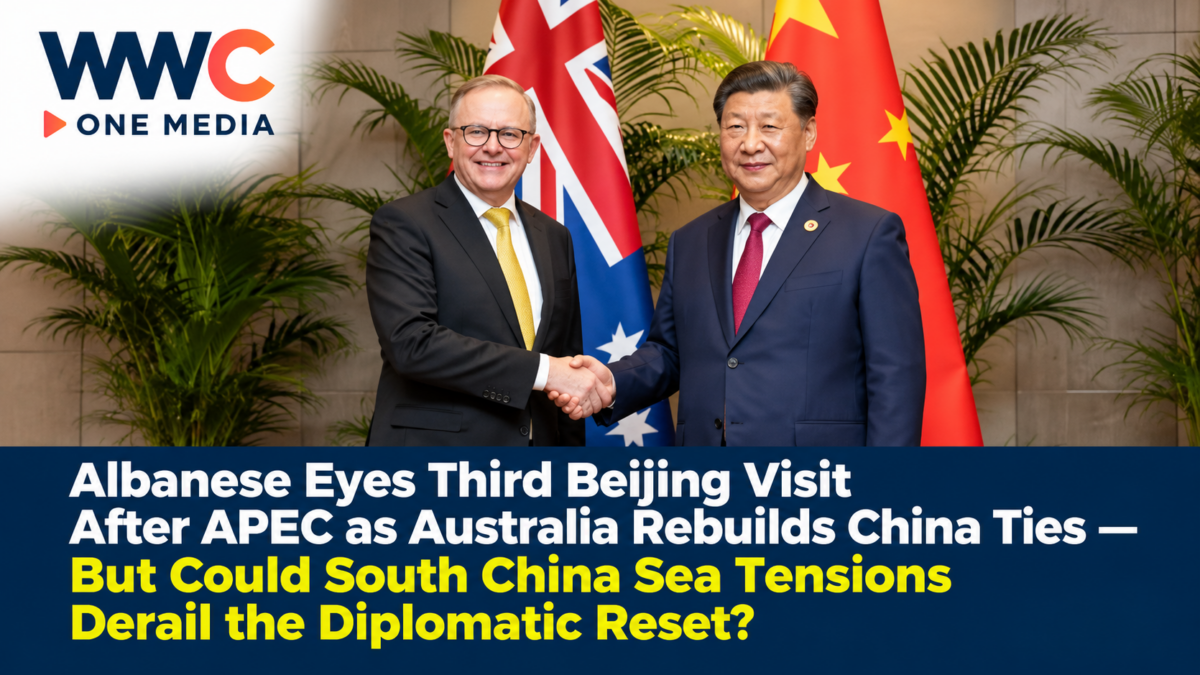
Australian Prime Minister Anthony Albanese is expected to travel to Beijing following November’s Asia-Pacific Economic Cooperation (APEC) leaders’ summit, setting the stage for another potentially significant diplomatic engagement with China as economic cooperation and regional security tensions pull the two countries in different directions.
The proposed visit comes as Canberra attempts to preserve its economic relationship with Beijing while strengthening security partnerships with the United States and other regional allies.
According to an October 30 report by the South China Morning Post, citing people familiar with the arrangements, Albanese is expected to attend the APEC Economic Leaders’ Meeting in Shenzhen on November 18–19 before continuing to the Chinese capital.
The trip would mark his third visit to Beijing since becoming prime minister in 2022, following earlier visits in November 2023 and July 2025.
But as of October 31, the additional Beijing visit should be treated as a reported plan rather than a fully confirmed official itinerary.
The timing is particularly sensitive.
China remains Australia’s largest trading partner, purchasing substantial quantities of iron ore, agricultural commodities, energy products and other exports.
At the same time, Canberra has repeatedly expressed concern about Chinese military activity in the South China Sea, dangerous encounters involving defense aircraft and growing strategic pressure across the Indo-Pacific.
As Albanese prepares for another high-profile encounter with China’s leadership, one question is becoming increasingly difficult to avoid: Can Australia protect its economic interests in China without weakening its security partnerships or compromising its position on regional stability?
Albanese Expected to Visit Beijing After Shenzhen APEC Summit
China will host the 2026 APEC Economic Leaders’ Meeting in Shenzhen on November 18–19.
The gathering will bring together leaders and representatives from 21 Asia-Pacific economies, which collectively account for a major share of global trade and economic output.
Australia is a founding APEC member and considers the organization an important platform for regional economic cooperation.
The Australian prime minister confirmed during an October 29 press conference that he expected to participate in the APEC gathering alongside Chinese President Xi Jinping and US President Donald Trump.
He stressed Australia’s commitment to free and fair trade.
Separate reporting indicates that Albanese may extend his China visit by traveling to Beijing after the summit.
However, the Australian government has not publicly established the complete post-APEC itinerary in the official materials reviewed.
Nor has a new Xi-Albanese meeting in Beijing been independently confirmed.
Any announcement concerning formal talks, signed agreements or additional destinations will need to come from the relevant governments.
Why a Third Beijing Visit Would Matter
Albanese’s relationship with Beijing has evolved significantly since he took office.
When his Labor government entered office in 2022, Australia-China relations were emerging from a prolonged diplomatic confrontation.
Disagreements over technology security, foreign interference, trade restrictions and the origins of COVID-19 had severely damaged the bilateral relationship.
Beijing imposed restrictions on several Australian exports, including barley, wine, coal and other products.
Australia considered many of the measures unjustified.
The economic consequences were substantial for affected exporters.
After taking office, Albanese sought to restore high-level communication while retaining Australia’s security policies and alliances.
His first visit to Beijing as prime minister took place in November 2023.
That trip was the first by an Australian prime minister since 2016 and marked an important step toward stabilizing diplomatic relations.
He returned in July 2025 for further talks with Xi and Premier Li Qiang.
A third visit would demonstrate the continuation of that diplomatic engagement.
But continued dialogue does not mean that underlying strategic disagreements have disappeared.
The 2025 Xi-Albanese Meeting Established a Framework for Cooperation
During Albanese’s July 2025 visit, Australian and Chinese leaders discussed trade, investment, climate change, people-to-people exchanges and regional affairs.
The official joint outcomes statement reaffirmed support for a mature and constructive relationship.
Both sides emphasized the importance of managing disagreements while maintaining economic engagement.
Albanese said Australia’s approach involved cooperation in areas of shared interest while maintaining differences where necessary.
China’s government described the relationship as having recovered from a difficult period.
The visit also reinforced the role of trade in Australia’s economic strategy.
For Canberra, improved access to the Chinese market benefits exporters and businesses operating across agriculture, mining, energy and services.
For Beijing, stable trade with Australia supports access to important raw materials and other commodities.
The relationship is therefore economically valuable to both governments, even when political and military disagreements remain unresolved.
China Remains Australia’s Most Important Trading Partner
Economic interdependence is one of the strongest reasons for maintaining diplomatic communication.
China is Australia’s largest trading partner and a major buyer of Australian resources.
Iron ore is particularly important because Chinese steel production depends heavily on imported raw materials.
Australia also exports energy products, agricultural goods and minerals used in manufacturing and emerging technologies.
China, meanwhile, supplies Australia with manufactured goods, electronics, machinery and other products.
The relationship supports businesses and employment in both countries.
But reliance on one major trading partner can create vulnerabilities.
Changes in Chinese demand, commodity prices, trade regulations or diplomatic relations can affect Australian exporters.
Canberra has therefore sought to preserve trade with Beijing while developing other markets.
For Albanese, the challenge is balancing economic opportunity with diversification and national security.
Iron Ore Tensions Show Why Trade Remains Complicated
Even as diplomatic relations have improved, disagreements involving major commodities have continued.
Recent reporting by the Australia-China Relations Institute at the University of Technology Sydney highlighted commercial tensions between Chinese iron ore buyer China Mineral Resources Group and Australian producers.
The institute noted that Fortescue had raised concerns about the potential consequences of unresolved purchasing disputes.
China’s consolidated buying arrangements have created questions about its growing bargaining power in global iron ore markets.
For Australia, this matters because iron ore exports represent an important source of national income.
China’s demand supports large Australian mining operations, but disputes over purchasing terms and pricing can affect producers.
These issues are commercial rather than direct military confrontations.
Nevertheless, they show that stable diplomatic relations do not eliminate economic competition.
A prospective Beijing visit may create opportunities to discuss trade concerns, although no particular settlement has been confirmed.
South China Sea Tensions Remain the Biggest Security Test
The most difficult disagreements between Australia and China concern security.
Australian officials have repeatedly raised concerns about close encounters involving Chinese military aircraft and Australian defense operations in international airspace.
Canberra maintains that its military activities are conducted in accordance with international law.
Beijing has challenged some Australian operations and accused Canberra of contributing to regional tensions.
The disagreements reflect different interpretations of security interests in the South China Sea.
Australia supports freedom of navigation and overflight and opposes coercive actions that could destabilize the region.
China maintains expansive maritime claims and has rejected the 2016 arbitral ruling in the South China Sea dispute involving the Philippines.
The July 2016 tribunal ruling rejected the legal basis for China’s claimed historic rights beyond the maritime entitlements permitted by the United Nations Convention on the Law of the Sea.
China does not accept the decision.
For Australia, the South China Sea remains important because major international trade routes pass through the region.
Disruptions or military escalation could affect regional commerce and security well beyond the directly involved countries.
Australia’s Defense Minister Warns of Growing Regional Pressure
During ASEAN-related defense discussions in the Philippines, Australian Deputy Prime Minister and Defense Minister Richard Marles expressed concern about the effects of China’s growing military capabilities.
He described an increasingly difficult security environment across Southeast Asia and emphasized cooperation with regional partners.
The comments highlight a central contradiction facing Australia’s foreign policy.
Canberra wants stable commercial relations with Beijing.
But it also sees the expansion of China’s military capabilities as a potential challenge to regional stability.
That creates a diplomatic balancing act.
Australia must communicate its security concerns while avoiding unnecessary escalation with its largest trading partner.
A high-level visit could provide another opportunity to manage differences directly.
But there is no guarantee that dialogue will produce agreement on military operations or maritime disputes.
Why the Philippines Has a Major Stake in Australia-China Relations
The outcome of Australia’s diplomatic engagement with China matters to the Philippines.
Manila and Canberra are important defense partners, while both countries have interests in maintaining freedom of navigation and regional stability.
Australia has supported international law and opposed coercive activities in the South China Sea.
The Philippines faces its own maritime disputes with Beijing, particularly around Ayungin Shoal and other features in the West Philippine Sea.
WWC ONE MEDIA previously examined these tensions in Teodoro Warns China: Forcibly Towing BRP Sierra Madre Could Trigger an Act of War — What Happens Next?.
That report discussed Philippine Defense Secretary Gilberto Teodoro Jr.’s warning about the consequences of forcibly removing the grounded Philippine naval vessel.
Australia is not a claimant to the disputed Philippine maritime features.
But the security principles involved, including freedom of navigation and the peaceful settlement of disputes, are relevant to the wider region.
For Manila, Australia maintaining constructive dialogue with China while supporting international law could be valuable.
However, any diplomatic benefits remain dependent on actual government decisions and regional developments.
China’s Response to Philippine Security Concerns Highlights the Diplomatic Divide
Tensions between Beijing and Manila have also been visible in public exchanges between defense and foreign affairs officials.
WWC ONE MEDIA previously reported on the confrontation in China Fires Back at Teodoro: “Cut the Provocations and Theatrics” — But What Happens Next in the West Philippine Sea?.
The dispute followed remarks by Teodoro concerning China’s maritime claims and the 2016 arbitral ruling.
It illustrates the difficulty of building agreement over contested security questions even when countries maintain extensive trade relationships.
For Albanese, similar pressures exist in the Australia-China relationship.
Canberra can pursue economic cooperation without accepting Beijing’s interpretation of every regional security issue.
The question is whether both governments can prevent their disagreements from escalating into a wider diplomatic confrontation.
AUKUS Remains a Major Source of Strategic Friction
Australia’s security partnership with the United States and United Kingdom is another important factor.
Under AUKUS, the three countries are cooperating on advanced defense technologies and a pathway for Australia to acquire conventionally armed, nuclear-powered submarines.
Canberra argues that the arrangement is intended to strengthen deterrence and regional security.
China has criticized AUKUS, expressing concerns about military competition and nuclear proliferation risks.
The disagreement is unlikely to disappear simply because bilateral trade improves.
For Albanese, abandoning Australia’s security partnerships is not a stated condition for pursuing better relations with China.
Instead, the government has sought to maintain both diplomatic engagement with Beijing and closer security cooperation with established partners.
This approach reflects Australia’s position between deep economic connections with China and longstanding strategic ties with Washington.
Trump and Xi Could Make APEC a Major Diplomatic Flashpoint
The Shenzhen APEC summit is also expected to attract international attention because of US-China relations.
President Donald Trump and Xi Jinping have been navigating disagreements involving tariffs, critical minerals, advanced technology and strategic competition.
Recent reporting indicates that the two leaders are expected to meet again during the November gathering.
However, the outcome of any future meeting remains unknown.
Trade restrictions and access to rare-earth materials have become important concerns for businesses and governments.
Australia has opportunities in critical-minerals production, but it is also exposed to changes in global trade conditions.
A more stable US-China relationship could support business confidence.
A renewed trade confrontation could create uncertainty for exporters and investors across the Asia-Pacific.
Albanese will therefore attend APEC at a time when decisions by Washington and Beijing may have far-reaching regional consequences.
China’s Global Export Expansion Is Reshaping Trade Competition
China’s growing manufacturing capabilities add another layer to regional economic tensions.
WWC ONE MEDIA recently examined this development in China Exports Over 7 Million Cars as Domestic Sales Plunge 22% — But Is Its Auto Industry Heading for a Global Trade War?.
The report explored how Chinese automakers have increasingly relied on overseas markets as domestic competition intensifies.
Australia is among the markets where Chinese-made vehicles are competing for customers.
The expansion creates opportunities for consumers, but it can also raise questions about industrial competition, trade policy and supply-chain dependence.
For Australian policymakers, these developments reinforce the need to balance open trade with economic resilience.
An additional meeting in Beijing could address broad economic cooperation, but no specific automotive trade agreement has been confirmed.
The Philippines Is Also Experiencing China’s Expanding Trade Presence
China’s role in regional supply chains is increasingly visible in Philippine markets.
WWC ONE MEDIA previously examined this in BYD Cars Land at Subic Port for Philippine Buyers — What This Could Mean for the Country’s EV Market.
The report examined how imported electric and hybrid vehicles were entering the country through Subic Bay.
This development is unrelated to Albanese’s proposed Beijing visit.
However, it illustrates how trade and supply-chain relationships continue expanding even while governments disagree on security issues.
For the Philippines and Australia, the underlying economic challenge is similar.
Both countries must manage growing commercial links with China while protecting their own strategic and economic interests.
APEC Trade Talks Could Influence the Wider ASEAN Region
The 2026 APEC summit comes amid efforts to strengthen international cooperation on trade, artificial intelligence, digital technology and supply chains.
These issues are important to Southeast Asian economies seeking greater investment and export opportunities.
WWC ONE MEDIA previously examined related discussions in More Than 200 ASEAN-EU Officials and CEOs Are Heading to Manila — But Three Major Trade Deals Are Still Unfinished.
That report highlighted efforts to deepen ASEAN’s economic engagement with European markets.
APEC and ASEAN are separate organizations with different memberships and institutional arrangements.
Nevertheless, both serve as platforms for regional economic cooperation.
For the Philippines, diversification across Asian, European and other global trading partners may help reduce exposure to disruptions in any single market.
Could AI and Climate Cooperation Become Areas of Common Ground?
Despite their security differences, Australia and China have identified areas where cooperation may be possible.
These include climate change, clean energy, medical technology and other economic sectors.
Researchers at the University of Technology Sydney have also discussed the possibility of greater dialogue on artificial intelligence safety.
China has identified AI as an important theme for its 2026 APEC agenda.
Australia has its own concerns about technology security and the responsible use of advanced AI systems.
The two countries may therefore find some common interests in technical cooperation while maintaining different views about regulation and national security.
However, any new bilateral AI or climate agreement would require official confirmation.
The presence of shared interests is not proof that negotiations have produced a final arrangement.
The Bigger Question: Can Australia Balance China and the United States?
For Albanese, the challenge goes beyond managing one diplomatic relationship.
Australia is economically integrated with China while maintaining a close defense alliance with the United States.
Both relationships are central to its national interests.
But Washington and Beijing are increasingly competing over technology, manufacturing, critical minerals and regional influence.
This competition can create difficult choices for middle powers.
Canberra has tried to avoid framing its China policy as a decision between complete cooperation and total confrontation.
Instead, it has emphasized practical engagement while maintaining security commitments.
That approach has helped stabilize diplomatic communication.
Whether it can withstand further geopolitical shocks remains uncertain.
The Bottom Line
Australian Prime Minister Anthony Albanese is reportedly expected to travel to Beijing after the November 18–19 APEC leaders’ summit in Shenzhen, potentially marking his third visit to the Chinese capital since taking office.
The proposed visit would come after significant improvements in Australia-China trade relations following years of restrictions and diplomatic tensions.
But unresolved disagreements involving the South China Sea, AUKUS, military activity and wider US-China competition continue to complicate the relationship.
China remains Australia’s largest trading partner, making stable economic relations important to Canberra.
At the same time, Australia’s defense partnerships and regional security positions remain central to its foreign policy.
A post-APEC Beijing visit may provide another opportunity for discussion, but the final itinerary and any formal bilateral outcomes have not yet been confirmed.
As Albanese prepares to navigate between China’s enormous economic influence and Australia’s security commitments, one question could define the next stage of Asia-Pacific diplomacy: Can Canberra deepen cooperation with Beijing without sacrificing its strategic principles — or will growing tensions in the South China Sea threaten the fragile diplomatic reset?