WASHINGTON / BRASÍLIA — October 31, 2026
The United States and Brazil are preparing for a potentially decisive diplomatic meeting after US Secretary of State Marco Rubio and Brazilian Foreign Minister Mauro Vieira agreed to hold bilateral talks amid escalating tensions over President Luiz Inácio Lula da Silva’s reelection and the controversial departure of his defeated opponent, Flávio Bolsonaro, for the United States.
The agreement followed a brief conversation on Friday, October 30, during a reception for G20 foreign ministers in Atlanta, Georgia.
According to Brazil’s Folha de S.Paulo, CNN Brasil, UOL and SBT News, Rubio and Vieira agreed to arrange a longer meeting before the G20 leaders’ summit scheduled for December.
The date and location have not yet been finalized.
The diplomatic opening comes at an unusually sensitive moment.
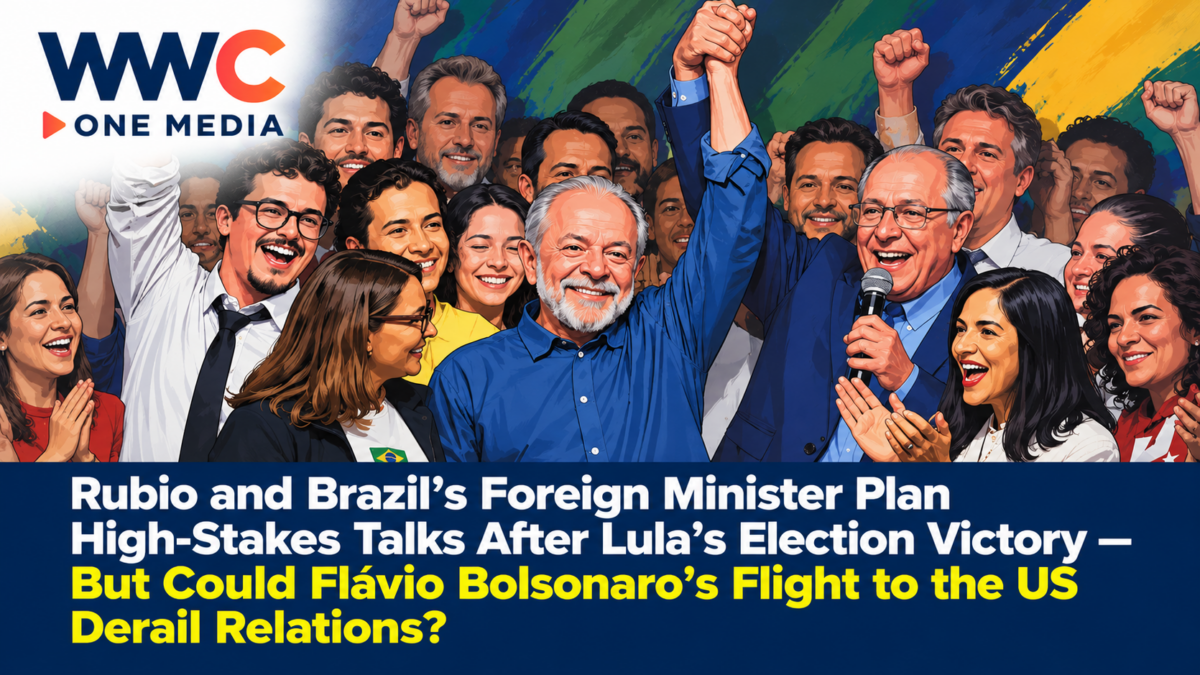
Lula secured another presidential term in Brazil’s October 25 runoff election, defeating conservative Senator Flávio Bolsonaro, the son of former President Jair Bolsonaro.
Days later, Flávio traveled to the United States despite a Brazilian court order requiring him to surrender his passports during a money-laundering investigation.
The senator denies wrongdoing and says he is being politically persecuted.
President Donald Trump has criticized Brazil’s election without presenting evidence that would establish his allegations of electoral fraud.
Meanwhile, reports that a White House adviser helped arrange Flávio’s journey and that the US granted him temporary permission to stay have further complicated relations.
As Washington and Brasília prepare for direct talks, the stakes go far beyond one defeated presidential candidate: Can the two largest democracies in the Americas rebuild trust and resolve trade disputes, or will the Bolsonaro controversy turn a diplomatic disagreement into a prolonged confrontation?
Rubio and Vieira Agree to Meet After Brief G20 Encounter
Rubio and Vieira met briefly during a G20 foreign ministers’ gathering in Atlanta on October 30.
The two officials exchanged greetings and spoke again during a reception for participating delegations.
According to Brazilian Foreign Ministry accounts reported by Folha de S.Paulo, the conversation did not cover specific bilateral issues.
The diplomats instead agreed to arrange a more substantial meeting ahead of the December leaders’ summit.
That distinction is important.
No comprehensive US-Brazil negotiating session took place during the brief reception.
No trade agreement was signed, and neither side announced a breakthrough over tariffs, election-related tensions or the Bolsonaro family’s situation.
Nevertheless, agreeing to meet represents an opportunity to restore direct communication during an increasingly difficult period.
For the United States and Brazil, regular diplomatic engagement is important because their relationship extends across trade, investment, organized crime, energy and regional security.
Lula’s Reelection Changes the Political Equation
Brazil’s October 25 presidential runoff delivered a victory for Lula over Flávio Bolsonaro.
Brazilian reporting cited a final valid-vote split of approximately 51.79% for Lula and 48.21% for Bolsonaro.
The result followed a deeply polarized campaign marked by disagreements over economic policy, corruption, public security and Brazil’s international relationships.
Flávio had finished ahead of Lula in the first round earlier in October, fueling speculation that Brazil could shift toward a government more closely aligned with Trump.
WWC ONE MEDIA examined that earlier political development in Brazil Stocks Explode to Record High as Flávio Bolsonaro Takes Election Lead — But Investors May Be Pricing In Reforms That Will Be Hard to Deliver.
The initial result triggered a strong rally in Brazilian financial markets as investors anticipated possible changes in fiscal and economic policy.
But the runoff produced a different outcome.
Lula’s victory means the current administration will continue directing Brazil’s economic and foreign policy, while the Bolsonaro movement remains an influential opposition force.
The Presidential Campaign Exposed Deep Divisions
The election campaign highlighted longstanding tensions between Lula’s Workers’ Party and Brazil’s conservative opposition.
During an October televised debate, Lula and Flávio exchanged accusations involving corruption, public spending and political credibility.
WWC ONE MEDIA covered the confrontation in Lula vs. Bolsonaro’s Son: Brazil Debate Explodes in Personal Attacks — Will It Change the Election?.
The debate underscored the difficulty of reaching political consensus in a country with sharp ideological divisions.
Flávio sought to present himself as a candidate favoring stronger fiscal discipline and economic reform.
Lula defended his government’s social policies and emphasized public spending intended to support lower-income Brazilians.
The election result settled who would hold the presidency, but it did not eliminate Brazil’s political polarization.
That domestic environment is now influencing the country’s relationship with Washington.
Flávio Bolsonaro’s Departure Creates a Diplomatic Crisis
The immediate source of tension is Flávio Bolsonaro’s departure from Brazil following his election defeat.
Reuters and the Financial Times reported that the senator traveled through Argentina and Ecuador before reaching Miami with his family.
His departure occurred amid an investigation involving suspected money laundering.
Brazilian judicial authorities had ordered him to surrender his passports and remain in the country while the matter was examined.
Flávio denies the allegations and describes the investigation as politically motivated.
His departure has raised questions about whether individuals connected to foreign governments assisted his journey.
The New York Times reported that White House adviser Jason Miller helped arrange a private aircraft used during the trip.
However, reporting about a person’s involvement in travel arrangements should not be confused with a criminal finding.
The legality of the departure, the underlying allegations and any possible consequences remain matters for the relevant authorities.
US Permission for Flávio to Stay Raises New Questions
The Trump administration has acknowledged allowing Flávio Bolsonaro and his family to enter the United States.
Brazilian and international reporting indicates that the senator received temporary humanitarian authorization permitting him to remain in the country.
The arrangement has attracted criticism from political opponents who question whether the US provided preferential treatment to an influential political ally.
Some Democratic members of the US House of Representatives have sought explanations from the State Department about the circumstances surrounding his entry.
The questions include what American officials knew about Brazilian court orders and whether US personnel assisted the travel arrangements.
Those inquiries represent political scrutiny, not a completed legal determination.
For Brazil, the controversy is especially sensitive because it involves a defeated presidential candidate facing legal questions at home.
Argentina Also Becomes Part of the Dispute
The diplomatic complications are not limited to Washington and Brasília.
Reuters reported that Brazilian officials summoned Argentina’s chargé d’affaires to discuss the circumstances of Flávio Bolsonaro’s departure.
The senator traveled through Argentina before flying onward to the United States.
Argentine Foreign Minister Pablo Quirno disputed aspects of the Brazilian account concerning requests for explanations.
The disagreement adds pressure to relations between Lula and Argentine President Javier Milei.
The two leaders have significant ideological differences, although their countries remain economically connected through regional trade and Mercosur.
Brazil’s government has sought to avoid turning the controversy into a broader confrontation that could undermine practical cooperation.
The competing accounts nevertheless show how a domestic political and legal matter can quickly develop international implications.
Trump Questions Brazil’s Election
Trump’s public reaction to Brazil’s election has become another source of diplomatic tension.
According to Brazilian reporting, the US president made repeated statements questioning the credibility of the presidential vote and criticizing the treatment of Flávio Bolsonaro.
He has not presented evidence establishing that the election result was fraudulent.
Brazil’s election outcome has been recognized through its domestic electoral institutions, and the reported result shows Lula winning the runoff.
The US president’s comments therefore represent a political position, not a verified reversal of the election result.
The dispute creates a challenge for Rubio.
As secretary of state, he must manage American diplomatic relations while operating within the administration’s political priorities.
For Vieira, the task is to protect Brazil’s sovereignty and maintain a working relationship with Washington without allowing the Bolsonaro controversy to dominate every discussion.
Why Brazil Is Avoiding a Direct Confrontation
Brazilian diplomatic reporting suggests that Lula’s government is seeking to avoid a public escalation with Trump.
The country’s foreign ministry wants to preserve negotiations on issues where the governments share practical interests.
These include trade, tariffs and cooperation against organized crime.
The strategy reflects the importance of the bilateral relationship.
The United States is a major destination for Brazilian exports and an important source of investment, technology and business partnerships.
A prolonged diplomatic dispute could create uncertainty for companies operating between the two countries.
Brazil also has an interest in maintaining cooperation with Washington on regional security and transnational criminal networks.
Consequently, Brasília appears to be separating the political controversy involving Flávio Bolsonaro from the broader diplomatic agenda.
Whether that approach succeeds remains uncertain.
Trade Tariffs Could Become a Major Topic
Trade is among the most important issues that Rubio and Vieira may discuss.
Brazilian exporters have faced US tariff measures that have complicated commercial relations.
The two governments have also been negotiating arrangements concerning market access and other trade matters.
A diplomatic dispute could make those negotiations more difficult.
However, the reported agreement to meet does not establish that Washington has offered to reduce tariffs or that Brazil has accepted any new trade terms.
Any breakthrough would require a formal announcement and details of the applicable measures.
The issue also reflects broader changes in US trade policy.
WWC ONE MEDIA previously examined negotiations involving another American trading partner in Thailand Says US Trade Deal Is Down to Final Clause as Trump Visit Nears.
Thailand’s negotiations are separate from Brazil’s, but both illustrate how tariff uncertainty has become an important issue for governments seeking stable access to the American market.
Brazilian Financial Markets Are Watching
Political developments in Brazil have also attracted attention from international investors.
The country’s October first-round election result triggered significant changes in stock and currency prices as traders reassessed the likelihood of a conservative presidency.
WWC ONE MEDIA explored related movements in PTC, Itaú and DraftKings Surge as Deals, Elections and Analyst Upgrades Shake Premarket Trading — But the Biggest Moves Are Driven by Three Very Different Bets.
That report examined how Brazilian banking shares responded to changing election expectations.
Lula’s subsequent victory has altered the political outlook.
Investors will now assess whether the reelected government can manage fiscal pressures, encourage growth and maintain constructive international economic relationships.
US-Brazil relations are one part of that calculation.
Tariff measures and diplomatic uncertainty may affect sentiment, but they are not the only factors influencing Brazilian stocks, bonds and the real.
Can Diplomacy Survive Political Disagreements?
The planned Rubio–Vieira meeting illustrates a fundamental challenge in international relations.
Governments must often cooperate with countries whose leaders disagree over major political questions.
For the United States and Brazil, shared interests include trade, energy, investment and efforts against organized crime.
At the same time, the Bolsonaro controversy raises questions about judicial sovereignty, immigration decisions and respect for electoral outcomes.
A constructive meeting could help separate negotiable policy matters from disputes that require independent legal processes.
But a diplomatic conversation alone cannot resolve all those questions.
The results will depend on whether the two governments can identify specific areas for cooperation and manage disagreements without further escalation.
The December G20 Summit Creates a Diplomatic Deadline
The approaching G20 leaders’ summit provides an important backdrop.
Rubio and Vieira have agreed in principle to meet before the summit, potentially creating an opportunity to prepare issues for discussion at the presidential level.
However, a separate Trump–Lula bilateral meeting has not been confirmed through the reporting reviewed.
An encounter during an international summit would also not automatically mean that substantive negotiations have been completed.
Diplomatic meetings can produce statements of intent, working-level arrangements or plans for further discussions.
The important test will be whether they lead to concrete outcomes.
For businesses and investors, clarity on trade policy would be particularly valuable.
For Brazilian officials, the challenge is ensuring that bilateral talks respect the country’s domestic institutions and election result.
For Washington, the question is whether it can maintain productive relations with Lula’s government despite Trump’s statements and the controversy surrounding Flávio Bolsonaro.
The Bigger Question: Can Washington and Brasília Rebuild Trust?
The October 30 encounter was brief, but its timing was significant.
It was the first direct contact between the senior diplomats since Lula’s reelection and Flávio Bolsonaro’s arrival in the United States.
The agreement to meet again creates a potential opening for more substantial discussions.
Yet the relationship remains fragile.
Political disagreements over the Brazilian election have intensified, and questions about Flávio’s departure have drawn scrutiny in both countries.
At the same time, trade and security cooperation provide reasons for maintaining communication.
Neither government can resolve every disagreement through a single diplomatic meeting.
But a refusal to engage could make an already difficult relationship more unstable.
The Bottom Line
US Secretary of State Marco Rubio and Brazilian Foreign Minister Mauro Vieira agreed during a brief October 30 encounter in Atlanta to arrange bilateral talks before December’s G20 leaders’ summit.
The planned meeting follows Lula’s victory over Flávio Bolsonaro in Brazil’s October 25 presidential runoff.
Flávio subsequently traveled to the United States amid a Brazilian money-laundering investigation and court restrictions, which he disputes.
The journey and reported assistance surrounding it have intensified tensions between the Trump and Lula administrations.
Although the diplomats did not discuss specific bilateral issues during their brief encounter, their future meeting may provide an opportunity to address trade, tariffs and cooperation against organized crime.
As Rubio and Vieira prepare to negotiate amid the fallout from Brazil’s election, a crucial question remains: Can Washington and Brasília protect their economic and security partnership—or will Trump’s support for the Bolsonaro political movement make reconciliation increasingly difficult?
SEO publishing package
SEO title: Rubio, Brazil Foreign Minister Plan Talks Amid Lula-Trump Crisis
Suggested URL slug: marco-rubio-mauro-vieira-brazil-us-talks-lula-flavio-bolsonaro-2026
Meta description: Marco Rubio and Mauro Vieira agree to talks as Lula’s reelection and Flávio Bolsonaro’s US departure strain Brazil-US relations. Can diplomacy succeed?
Primary focus keyword: Marco Rubio Mauro Vieira Brazil talks 2026
Secondary keywords: Lula Trump relations, Flávio Bolsonaro United States, Brazil election 2026, Rubio Vieira meeting, Brazil US diplomatic crisis, G20 2026, Brazil US trade tariffs, Flávio Bolsonaro investigation, Donald Trump Brazil, Brazil foreign minister
Category: World News / Politics / International Relations / Global Trade
Suggested tags: Brazil, United States, Marco Rubio, Mauro Vieira, Lula, Donald Trump, Flávio Bolsonaro, Jair Bolsonaro, G20, Diplomacy, International Trade, Latin America
WWC ONE MEDIA internal backlinks included: 4
Editorial sources
- Bloomberg — October 31, 2026: Report concerning Marco Rubio, Mauro Vieira, Lula, Flávio Bolsonaro and Trump. Full Bloomberg article was access-restricted.
- Folha de S.Paulo — October 30, 2026: Reporting on the Rubio–Vieira encounter and agreement to arrange bilateral talks.
- CNN Brasil — October 30, 2026: Rubio and Vieira arrange a meeting before the G20 summit.
- UOL — October 30, 2026: Reporting on the diplomatic agenda and controversy surrounding Flávio Bolsonaro.
- SBT News — October 31, 2026: Confirmation of the brief Atlanta conversation and plan for a future meeting.
- Reuters — October 30, 2026: Reporting on Brazil’s diplomatic inquiries into Flávio Bolsonaro’s journey through Argentina.
- Associated Press — October 31, 2026: Reporting on the Bolsonaro family’s continuing political influence after Flávio’s election defeat.
- Financial Times — October 30, 2026: Investigation into the circumstances of Flávio Bolsonaro’s departure.
Editorial note: The article distinguishes verified diplomatic developments, attributed investigative reporting, political allegations and future meeting plans. No election-fraud allegation or claim of criminal wrongdoing by US officials is presented as an established fact.
Rubio and Brazil’s Foreign Minister Plan High-Stakes Talks After Lula’s Election Victory — But Could Flávio Bolsonaro’s Flight to the US Derail Relations?
By WWC ONE MEDIA | World News, International Politics & Global Trade
WASHINGTON / BRASÍLIA — October 31, 2026
The United States and Brazil are preparing for a potentially decisive diplomatic meeting after US Secretary of State Marco Rubio and Brazilian Foreign Minister Mauro Vieira agreed to hold bilateral talks amid escalating tensions over President Luiz Inácio Lula da Silva’s reelection and the controversial departure of his defeated opponent, Flávio Bolsonaro, for the United States.
The agreement followed a brief conversation on Friday, October 30, during a reception for G20 foreign ministers in Atlanta, Georgia.
According to Brazil’s Folha de S.Paulo, CNN Brasil, UOL and SBT News, Rubio and Vieira agreed to arrange a longer meeting before the G20 leaders’ summit scheduled for December.
The date and location have not yet been finalized.
The diplomatic opening comes at an unusually sensitive moment.
Lula secured another presidential term in Brazil’s October 25 runoff election, defeating conservative Senator Flávio Bolsonaro, the son of former President Jair Bolsonaro.
Days later, Flávio traveled to the United States despite a Brazilian court order requiring him to surrender his passports during a money-laundering investigation.
The senator denies wrongdoing and says he is being politically persecuted.
President Donald Trump has criticized Brazil’s election without presenting evidence that would establish his allegations of electoral fraud.
Meanwhile, reports that a White House adviser helped arrange Flávio’s journey and that the US granted him temporary permission to stay have further complicated relations.
As Washington and Brasília prepare for direct talks, the stakes go far beyond one defeated presidential candidate: Can the two largest democracies in the Americas rebuild trust and resolve trade disputes, or will the Bolsonaro controversy turn a diplomatic disagreement into a prolonged confrontation?
Rubio and Vieira Agree to Meet After Brief G20 Encounter
Rubio and Vieira met briefly during a G20 foreign ministers’ gathering in Atlanta on October 30.
The two officials exchanged greetings and spoke again during a reception for participating delegations.
According to Brazilian Foreign Ministry accounts reported by Folha de S.Paulo, the conversation did not cover specific bilateral issues.
The diplomats instead agreed to arrange a more substantial meeting ahead of the December leaders’ summit.
That distinction is important.
No comprehensive US-Brazil negotiating session took place during the brief reception.
No trade agreement was signed, and neither side announced a breakthrough over tariffs, election-related tensions or the Bolsonaro family’s situation.
Nevertheless, agreeing to meet represents an opportunity to restore direct communication during an increasingly difficult period.
For the United States and Brazil, regular diplomatic engagement is important because their relationship extends across trade, investment, organized crime, energy and regional security.
Lula’s Reelection Changes the Political Equation
Brazil’s October 25 presidential runoff delivered a victory for Lula over Flávio Bolsonaro.
Brazilian reporting cited a final valid-vote split of approximately 51.79% for Lula and 48.21% for Bolsonaro.
The result followed a deeply polarized campaign marked by disagreements over economic policy, corruption, public security and Brazil’s international relationships.
Flávio had finished ahead of Lula in the first round earlier in October, fueling speculation that Brazil could shift toward a government more closely aligned with Trump.
WWC ONE MEDIA examined that earlier political development in Brazil Stocks Explode to Record High as Flávio Bolsonaro Takes Election Lead — But Investors May Be Pricing In Reforms That Will Be Hard to Deliver.
The initial result triggered a strong rally in Brazilian financial markets as investors anticipated possible changes in fiscal and economic policy.
But the runoff produced a different outcome.
Lula’s victory means the current administration will continue directing Brazil’s economic and foreign policy, while the Bolsonaro movement remains an influential opposition force.
The Presidential Campaign Exposed Deep Divisions
The election campaign highlighted longstanding tensions between Lula’s Workers’ Party and Brazil’s conservative opposition.
During an October televised debate, Lula and Flávio exchanged accusations involving corruption, public spending and political credibility.
WWC ONE MEDIA covered the confrontation in Lula vs. Bolsonaro’s Son: Brazil Debate Explodes in Personal Attacks — Will It Change the Election?.
The debate underscored the difficulty of reaching political consensus in a country with sharp ideological divisions.
Flávio sought to present himself as a candidate favoring stronger fiscal discipline and economic reform.
Lula defended his government’s social policies and emphasized public spending intended to support lower-income Brazilians.
The election result settled who would hold the presidency, but it did not eliminate Brazil’s political polarization.
That domestic environment is now influencing the country’s relationship with Washington.
Flávio Bolsonaro’s Departure Creates a Diplomatic Crisis
The immediate source of tension is Flávio Bolsonaro’s departure from Brazil following his election defeat.
Reuters and the Financial Times reported that the senator traveled through Argentina and Ecuador before reaching Miami with his family.
His departure occurred amid an investigation involving suspected money laundering.
Brazilian judicial authorities had ordered him to surrender his passports and remain in the country while the matter was examined.
Flávio denies the allegations and describes the investigation as politically motivated.
His departure has raised questions about whether individuals connected to foreign governments assisted his journey.
The New York Times reported that White House adviser Jason Miller helped arrange a private aircraft used during the trip.
However, reporting about a person’s involvement in travel arrangements should not be confused with a criminal finding.
The legality of the departure, the underlying allegations and any possible consequences remain matters for the relevant authorities.
US Permission for Flávio to Stay Raises New Questions
The Trump administration has acknowledged allowing Flávio Bolsonaro and his family to enter the United States.
Brazilian and international reporting indicates that the senator received temporary humanitarian authorization permitting him to remain in the country.
The arrangement has attracted criticism from political opponents who question whether the US provided preferential treatment to an influential political ally.
Some Democratic members of the US House of Representatives have sought explanations from the State Department about the circumstances surrounding his entry.
The questions include what American officials knew about Brazilian court orders and whether US personnel assisted the travel arrangements.
Those inquiries represent political scrutiny, not a completed legal determination.
For Brazil, the controversy is especially sensitive because it involves a defeated presidential candidate facing legal questions at home.
Argentina Also Becomes Part of the Dispute
The diplomatic complications are not limited to Washington and Brasília.
Reuters reported that Brazilian officials summoned Argentina’s chargé d’affaires to discuss the circumstances of Flávio Bolsonaro’s departure.
The senator traveled through Argentina before flying onward to the United States.
Argentine Foreign Minister Pablo Quirno disputed aspects of the Brazilian account concerning requests for explanations.
The disagreement adds pressure to relations between Lula and Argentine President Javier Milei.
The two leaders have significant ideological differences, although their countries remain economically connected through regional trade and Mercosur.
Brazil’s government has sought to avoid turning the controversy into a broader confrontation that could undermine practical cooperation.
The competing accounts nevertheless show how a domestic political and legal matter can quickly develop international implications.
Trump Questions Brazil’s Election
Trump’s public reaction to Brazil’s election has become another source of diplomatic tension.
According to Brazilian reporting, the US president made repeated statements questioning the credibility of the presidential vote and criticizing the treatment of Flávio Bolsonaro.
He has not presented evidence establishing that the election result was fraudulent.
Brazil’s election outcome has been recognized through its domestic electoral institutions, and the reported result shows Lula winning the runoff.
The US president’s comments therefore represent a political position, not a verified reversal of the election result.
The dispute creates a challenge for Rubio.
As secretary of state, he must manage American diplomatic relations while operating within the administration’s political priorities.
For Vieira, the task is to protect Brazil’s sovereignty and maintain a working relationship with Washington without allowing the Bolsonaro controversy to dominate every discussion.
Why Brazil Is Avoiding a Direct Confrontation
Brazilian diplomatic reporting suggests that Lula’s government is seeking to avoid a public escalation with Trump.
The country’s foreign ministry wants to preserve negotiations on issues where the governments share practical interests.
These include trade, tariffs and cooperation against organized crime.
The strategy reflects the importance of the bilateral relationship.
The United States is a major destination for Brazilian exports and an important source of investment, technology and business partnerships.
A prolonged diplomatic dispute could create uncertainty for companies operating between the two countries.
Brazil also has an interest in maintaining cooperation with Washington on regional security and transnational criminal networks.
Consequently, Brasília appears to be separating the political controversy involving Flávio Bolsonaro from the broader diplomatic agenda.
Whether that approach succeeds remains uncertain.
Trade Tariffs Could Become a Major Topic
Trade is among the most important issues that Rubio and Vieira may discuss.
Brazilian exporters have faced US tariff measures that have complicated commercial relations.
The two governments have also been negotiating arrangements concerning market access and other trade matters.
A diplomatic dispute could make those negotiations more difficult.
However, the reported agreement to meet does not establish that Washington has offered to reduce tariffs or that Brazil has accepted any new trade terms.
Any breakthrough would require a formal announcement and details of the applicable measures.
The issue also reflects broader changes in US trade policy.
WWC ONE MEDIA previously examined negotiations involving another American trading partner in Thailand Says US Trade Deal Is Down to Final Clause as Trump Visit Nears.
Thailand’s negotiations are separate from Brazil’s, but both illustrate how tariff uncertainty has become an important issue for governments seeking stable access to the American market.
Brazilian Financial Markets Are Watching
Political developments in Brazil have also attracted attention from international investors.
The country’s October first-round election result triggered significant changes in stock and currency prices as traders reassessed the likelihood of a conservative presidency.
WWC ONE MEDIA explored related movements in PTC, Itaú and DraftKings Surge as Deals, Elections and Analyst Upgrades Shake Premarket Trading — But the Biggest Moves Are Driven by Three Very Different Bets.
That report examined how Brazilian banking shares responded to changing election expectations.
Lula’s subsequent victory has altered the political outlook.
Investors will now assess whether the reelected government can manage fiscal pressures, encourage growth and maintain constructive international economic relationships.
US-Brazil relations are one part of that calculation.
Tariff measures and diplomatic uncertainty may affect sentiment, but they are not the only factors influencing Brazilian stocks, bonds and the real.
Can Diplomacy Survive Political Disagreements?
The planned Rubio–Vieira meeting illustrates a fundamental challenge in international relations.
Governments must often cooperate with countries whose leaders disagree over major political questions.
For the United States and Brazil, shared interests include trade, energy, investment and efforts against organized crime.
At the same time, the Bolsonaro controversy raises questions about judicial sovereignty, immigration decisions and respect for electoral outcomes.
A constructive meeting could help separate negotiable policy matters from disputes that require independent legal processes.
But a diplomatic conversation alone cannot resolve all those questions.
The results will depend on whether the two governments can identify specific areas for cooperation and manage disagreements without further escalation.
The December G20 Summit Creates a Diplomatic Deadline
The approaching G20 leaders’ summit provides an important backdrop.
Rubio and Vieira have agreed in principle to meet before the summit, potentially creating an opportunity to prepare issues for discussion at the presidential level.
However, a separate Trump–Lula bilateral meeting has not been confirmed through the reporting reviewed.
An encounter during an international summit would also not automatically mean that substantive negotiations have been completed.
Diplomatic meetings can produce statements of intent, working-level arrangements or plans for further discussions.
The important test will be whether they lead to concrete outcomes.
For businesses and investors, clarity on trade policy would be particularly valuable.
For Brazilian officials, the challenge is ensuring that bilateral talks respect the country’s domestic institutions and election result.
For Washington, the question is whether it can maintain productive relations with Lula’s government despite Trump’s statements and the controversy surrounding Flávio Bolsonaro.
The Bigger Question: Can Washington and Brasília Rebuild Trust?
The October 30 encounter was brief, but its timing was significant.
It was the first direct contact between the senior diplomats since Lula’s reelection and Flávio Bolsonaro’s arrival in the United States.
The agreement to meet again creates a potential opening for more substantial discussions.
Yet the relationship remains fragile.
Political disagreements over the Brazilian election have intensified, and questions about Flávio’s departure have drawn scrutiny in both countries.
At the same time, trade and security cooperation provide reasons for maintaining communication.
Neither government can resolve every disagreement through a single diplomatic meeting.
But a refusal to engage could make an already difficult relationship more unstable.
The Bottom Line
US Secretary of State Marco Rubio and Brazilian Foreign Minister Mauro Vieira agreed during a brief October 30 encounter in Atlanta to arrange bilateral talks before December’s G20 leaders’ summit.
The planned meeting follows Lula’s victory over Flávio Bolsonaro in Brazil’s October 25 presidential runoff.
Flávio subsequently traveled to the United States amid a Brazilian money-laundering investigation and court restrictions, which he disputes.
The journey and reported assistance surrounding it have intensified tensions between the Trump and Lula administrations.
Although the diplomats did not discuss specific bilateral issues during their brief encounter, their future meeting may provide an opportunity to address trade, tariffs and cooperation against organized crime.
As Rubio and Vieira prepare to negotiate amid the fallout from Brazil’s election, a crucial question remains: Can Washington and Brasília protect their economic and security partnership—or will Trump’s support for the Bolsonaro political movement make reconciliation increasingly difficult?