CAIRO / HONG KONG — October 31, 2026
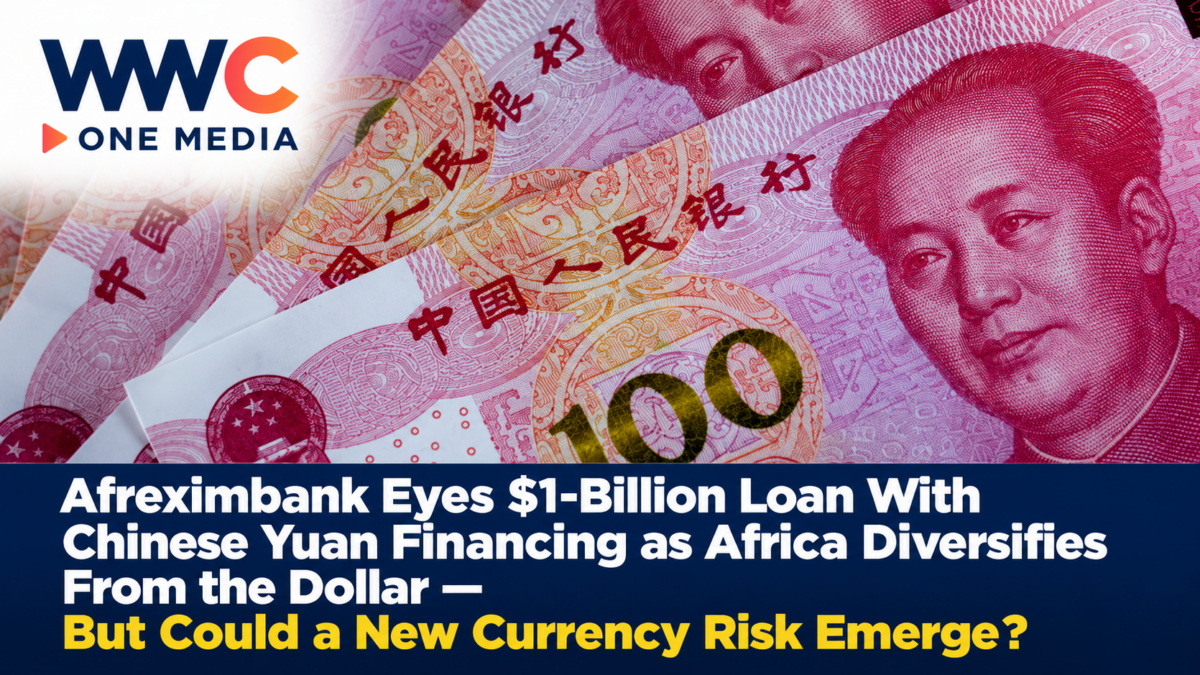
Africa’s push to diversify international borrowing is gathering momentum as the African Export-Import Bank, better known as Afreximbank, considers a $1-billion syndicated loan that would include Chinese yuan financing for the first time in its offshore borrowing program.
The proposed transaction could mark an important development in Africa’s financial relationship with China, allowing one of the continent’s leading trade-finance institutions to raise funding outside the traditional US dollar market.
But the arrangement is more than a symbolic move toward Chinese currency.
According to Bloomberg’s October 30 report, the proposed three-year facility would include both US dollar and offshore yuan tranches, with Bank of China and Standard Chartered Bank serving as global coordinators.
The transaction is intended partly to refinance existing debt while providing funding for future lending and corporate requirements.
Up to $600 million could be allocated to near-term debt maturities, future asset growth and general corporate purposes. The remaining amount would be drawn later to refinance a syndicated loan arranged in 2024.
The final size of each currency tranche will depend on the syndication process and lender demand.
The loan has not been confirmed as completed, and the final offshore yuan interest rate has not been disclosed.
For Afreximbank, the potential appeal is access to new financing sources at a time when borrowing costs remain elevated in major international markets.
For China, the transaction would represent another step toward greater international use of the renminbi.
But the development raises a critical question: Could yuan borrowing provide African financial institutions with cheaper and more flexible funding — or expose them to new currency and refinancing risks?
What Afreximbank’s Proposed $1-Billion Loan Actually Involves
Bloomberg reported that Afreximbank is planning a three-year syndicated loan with a target size of approximately $1 billion.
A syndicated loan is provided by a group of financial institutions rather than a single lender.
That allows participating banks to share exposure while enabling a borrower to raise substantial financing through one coordinated arrangement.
The proposed Afreximbank facility has two important components: a US dollar tranche and an offshore Chinese yuan tranche.
The offshore yuan, commonly designated CNH in currency markets, refers to renminbi traded outside mainland China’s domestic financial system.
Although Hong Kong is a major offshore renminbi center, yuan financing can also be arranged through other international financial hubs.
Bank of China and Standard Chartered are reportedly coordinating the proposed transaction.
The final currency allocation remains undecided.
That matters because the bank’s actual borrowing costs, currency exposure and repayment obligations will depend on the amounts successfully syndicated in each currency.
The proposed facility should therefore be understood as a financing plan, rather than a completed transaction.
Why the Loan’s Interest Rate Is Important
The dollar portion of the proposed facility offers an initial margin of 125 basis points above the term Secured Overnight Financing Rate, or SOFR.
One basis point equals 0.01 percentage point.
A 125-basis-point margin therefore represents 1.25 percentage points above the applicable benchmark rate.
The proposed margin is linked to Afreximbank’s credit ratings.
Bloomberg reported that the margin could decline to 115 basis points if the bank’s credit ratings improve, or rise to 150 basis points if they deteriorate.
At the time of the report, the bank was rated Baa2 by Moody’s and BBB+ by S&P.
These figures describe the margin above the benchmark, not the total borrowing interest rate.
The yuan portion is expected to carry a fixed interest rate, although its exact level has not been determined.
The ultimate comparison between dollar and yuan borrowing must consider benchmark rates, lender margins, transaction expenses and currency hedging costs.
A lower advertised yuan coupon does not automatically mean lower total financing costs.
Up to $600 Million Could Support Debt Repayment and Future Growth
The reported funding allocation reveals the practical purpose of the borrowing.
Up to $600 million would support near-term debt maturities, asset growth and general corporate needs.
The remaining amount would be available later to refinance borrowing raised in 2024.
Refinancing allows an institution to replace existing debt with new borrowing.
That may help extend repayment schedules or improve the management of liquidity.
However, refinancing does not necessarily eliminate debt.
It generally changes the source, timing or terms of the institution’s financial obligations.
For Afreximbank, access to a broader group of international lenders could improve flexibility.
But the financial benefit will depend on the completed transaction’s terms.
Afreximbank Has Already Raised Yuan Financing Inside China
The proposed offshore loan would not be Afreximbank’s first transaction involving the Chinese currency.
On March 28, 2025, the bank issued a three-year panda bond worth 2.2 billion yuan, equivalent to approximately $303 million at the time.
The bond carried a 2.99% coupon.
Afreximbank formally announced the transaction in April 2025.
Bank of China served as lead underwriter and bookrunner, while the Export-Import Bank of China and Industrial and Commercial Bank of China participated as joint lead underwriters.
The transaction gave Afreximbank access to China’s domestic interbank bond market.
A panda bond differs from an offshore yuan loan.
Panda bonds are renminbi-denominated securities issued by foreign borrowers within mainland China’s domestic bond market.
The new proposed facility would be a syndicated loan involving offshore yuan funding.
The distinction is essential because the proposed milestone concerns the bank’s first reported offshore renminbi borrowing, not its first access to Chinese-currency capital.
The Bank Remains an Active Borrower in Dollars and Euros
Afreximbank’s exploration of yuan financing does not mean it is abandoning Western currencies.
In March 2026, the institution completed a three-year syndicated facility worth approximately $2 billion equivalent.
The transaction included $1.73 billion in US dollar financing and €228 million in euro financing.
According to Afreximbank’s official announcement, the facility was used to refinance existing borrowing and support general corporate purposes.
In July, the institution also completed a $1.5-billion dual-tranche US dollar bond offering.
The transaction consisted of two $750-million tranches, with maturities in 2032 and 2036.
The final yields were 6.25% and 7.125%, respectively.
Investor demand reportedly reached approximately $3.8 billion at its peak.
These transactions demonstrate that Afreximbank continues to access conventional international capital markets.
Its proposed yuan loan is better characterized as a diversification of funding sources than a wholesale retreat from dollar financing.
Why Chinese Yuan Loans Are Becoming Attractive
One of the most important forces behind the shift is the difference between borrowing costs in China and major dollar markets.
Chinese interest rates have remained comparatively low, creating potential opportunities for borrowers capable of accessing renminbi funding.
Meanwhile, global dollar borrowing costs have been affected by higher US Treasury yields, monetary policy and investor demand for debt securities.
WWC ONE MEDIA previously examined these pressures in Asian Bond Sales Slow as Yields Surge — But America’s AI Debt Boom Is Raising the Cost of Capital for Everyone.
That report analyzed why borrowers in Asia were reassessing expensive dollar financing and considering alternative capital markets.
The same economic calculation can apply to African institutions.
If an offshore yuan loan offers favorable terms, Afreximbank may be able to diversify its liabilities and broaden its lending capacity.
But currency mismatch remains a potential problem.
A borrower receiving revenue in dollars or African local currencies may face additional costs if it must repay a loan in yuan and the exchange rate moves unfavorably.
The correct comparison is therefore the total risk-adjusted cost of borrowing, not simply the headline interest rate.
China–Africa Trade Is Creating New Demand for Yuan Financing
China has become one of Africa’s most important trading partners.
Chinese manufacturers supply industrial machinery, construction equipment, electronic products, vehicles, solar panels and batteries to African markets.
Chinese banks have also participated in infrastructure and development financing across the continent.
As these commercial relationships expand, more businesses may find it useful to obtain financing or settle transactions directly in Chinese currency.
Bloomberg cited research indicating that China committed approximately $33.5 billion to African infrastructure through its Belt and Road Initiative during the first half of 2026.
That was reported as the highest total for any six-month period in the research series.
The report also noted China’s removal of tariffs on eligible products from 53 African diplomatic partners starting May 1.
These developments create stronger trade links, but they do not automatically mean every African importer will switch to yuan settlement.
Businesses choose payment currencies based on contracts, exchange rates, financing costs and available banking services.
Nevertheless, deeper trade relationships can increase demand for financial products denominated in renminbi.
Offshore Yuan Borrowing Is Reaching Record Levels
The expansion of the offshore renminbi market is not limited to Africa.
According to Bloomberg-compiled data, issuers had sold more than 1 trillion yuan, or approximately $150 billion, in offshore yuan bonds during 2026 by the time of the October 30 report.
That represented an annual record in the cited data.
These instruments are often called dim sum bonds.
They are yuan-denominated debt securities issued outside mainland China, frequently through Hong Kong.
Afreximbank’s contemplated transaction, however, is an offshore yuan syndicated loan rather than a dim sum bond.
The two instruments share exposure to offshore renminbi funding markets but differ in their contractual structures and participants.
The growth in offshore issuance suggests that international borrowers increasingly view yuan funding as a viable additional option.
It does not demonstrate that renminbi financing has replaced the dollar’s dominant role in global debt markets.
China’s African Economic Strategy Goes Beyond Lending
China’s financial ambitions are closely connected to its expanding commercial presence.
The country is a leading supplier of affordable solar panels, battery systems and electric vehicles.
Those products are becoming increasingly relevant to African governments seeking to expand electricity access and industrial capacity.
WWC ONE MEDIA examined the commercial competition in China’s Green-Tech Push Is Challenging Trump’s ‘Drill, Baby, Drill’ Energy Strategy in Africa.
The report explored China’s expanding clean-technology exports and their implications for African energy investment.
Yuan lending could complement these trade relationships by providing an additional source of capital to institutions that finance cross-border commerce.
However, the proposed Afreximbank loan has not been publicly identified as financing any specific Chinese solar, battery or infrastructure contract.
Its reported uses are refinancing, asset growth and general corporate purposes.
Other Asian Financial Institutions Are Expanding Across Africa
China is not the only Asian country deepening its financial relationships with Africa.
South Korea is also expanding cooperation through export finance, development lending and infrastructure partnerships.
WWC ONE MEDIA examined those efforts in Korea Eximbank Deepens Africa Push as Seoul Targets 10 Nations for New Development Deals.
That report covered negotiations involving the Export-Import Bank of Korea and officials from 10 African countries.
These developments demonstrate that African institutions may increasingly have access to financing from multiple international partners.
Greater competition could improve financing choices in some circumstances.
However, loans from different countries may carry different interest rates, currency risks, procurement requirements and repayment obligations.
For African borrowers, comparing those conditions is more important than selecting financing solely on geopolitical considerations.
Lower Chinese Interest Rates Do Not Eliminate Credit Risk
The growing appeal of yuan financing should not be confused with a guarantee of inexpensive borrowing for every institution.
Credit ratings, loan structure, lender demand and the financial strength of the borrower remain important.
Even in markets with relatively low government bond yields, businesses carrying significant debt can face high borrowing costs.
WWC ONE MEDIA explored that distinction in Chinese Junk Dollar Bonds Face Worst Week Since April 2025 as Huafa Debt Fears Spread — But Could State-Backed Giants Be Next?.
The report examined how company-specific financial risks can pressure debt securities despite comparatively low Chinese benchmark interest rates.
Afreximbank’s circumstances differ substantially from those of a Chinese property company.
The comparison nevertheless highlights a general principle: the currency in which a loan is issued does not remove the borrower’s responsibility to repay it.
For the proposed Afreximbank facility, final pricing and credit-rating conditions will be important indicators of lender confidence.
Could the Yuan Eventually Challenge the Dollar in African Finance?
The proposed facility is part of a broader movement toward greater currency diversification in cross-border trade.
For China, wider use of renminbi financing supports efforts to internationalize its currency.
For African institutions, access to multiple financing markets can offer additional flexibility.
But the US dollar remains central to global foreign exchange markets, international reserves, trade invoicing and international debt.
The yuan also faces constraints involving convertibility, capital controls and the depth of available hedging markets.
A single $1-billion syndicated facility, even if successfully completed, would not overturn the international currency system.
Its significance would be more practical.
It could give Afreximbank another source of financing while demonstrating that offshore yuan markets are becoming accessible to a wider range of international borrowers.
What Happens Next?
The next stage will depend on the syndication process and the final terms negotiated with participating banks.
Investors and policymakers should watch for confirmation of the total amount raised, the allocation between dollars and yuan, and the fixed interest rate on the yuan tranche.
They should also examine whether the loan achieves its intended refinancing objectives and how Afreximbank manages any foreign exchange exposures.
A successful transaction could encourage other African institutions to explore similar structures.
However, the financial outcome will not be clear until the borrowing is finalized and its actual costs can be assessed.
The Bottom Line
Afreximbank is considering a $1-billion, three-year syndicated loan featuring US dollar and offshore Chinese yuan tranches.
The proposed transaction would mark the bank’s first reported entry into offshore renminbi borrowing, building on its earlier experience issuing yuan-denominated debt within China.
Bank of China and Standard Chartered are reportedly coordinating the facility.
Up to $600 million could support near-term obligations, future asset growth and general corporate requirements, with additional proceeds intended to refinance existing debt.
The proposal illustrates the growing importance of Chinese financial markets to African trade finance.
But its final cost and financial benefits have not yet been established.
As Africa explores new sources of capital and China expands the international reach of its currency, one question remains: Could offshore yuan financing give African institutions a powerful alternative to expensive dollar debt — or will the next stage of currency diversification reveal risks that borrowers cannot afford to ignore?