
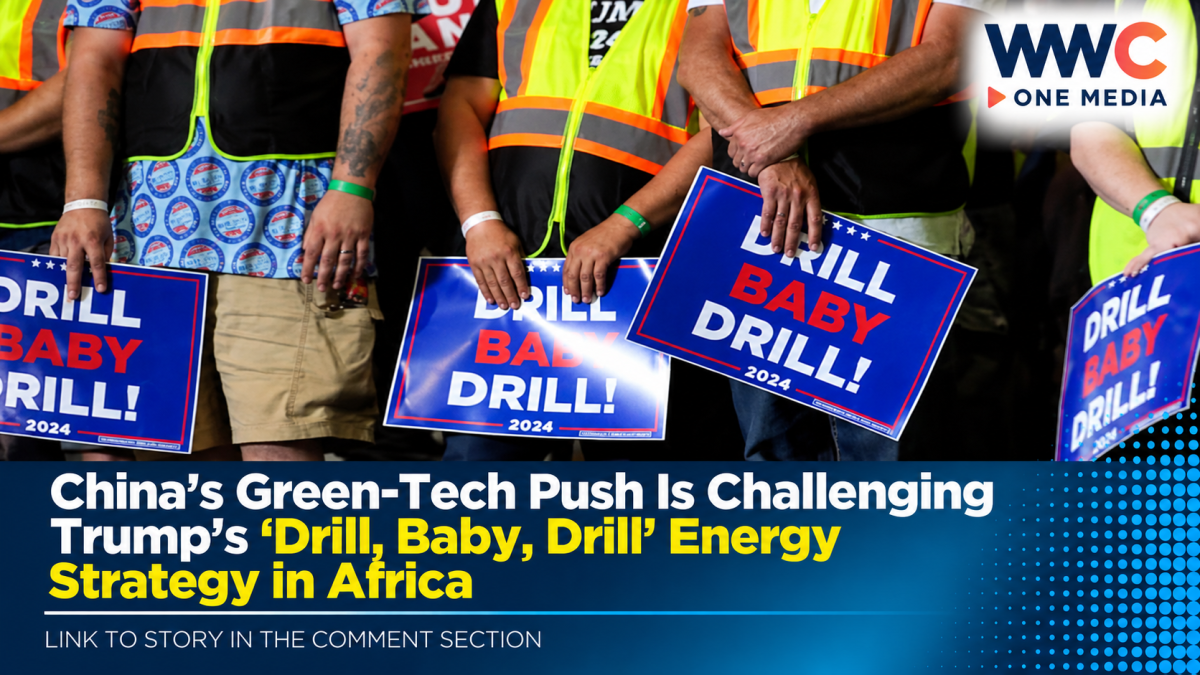
AFRICA — A new energy battle is unfolding across Africa, where the United States is promoting fossil fuels while China is rapidly expanding its influence through cheap solar panels, batteries, electric vehicles and renewable-energy infrastructure.
For many African governments, however, the choice may have less to do with geopolitics or ideology than with one simple question:
Which energy source is cheaper, faster and more reliable?
That calculation is increasingly working in China’s favour.
As US President Donald Trump doubles down on his “drill, baby, drill” approach to oil and fossil fuels, Beijing’s advances in solar technology and battery storage are helping African countries reduce their exposure to volatile global fuel prices. Record solar additions and major renewable-energy projects are accelerating the shift.
Africa’s Energy Future Is Becoming a Contest Between Oil and Solar
The contrast between Washington and Beijing’s energy strategies is becoming increasingly clear.
The Trump administration has promoted expanded oil and fossil-fuel development, while China has spent years building the world’s largest manufacturing ecosystem for solar panels, batteries and electric vehicles.
Now those technologies are becoming increasingly affordable outside China.
For African countries struggling with unreliable electricity supplies, expensive imported fuel and growing energy demand, Chinese-made renewable technology offers an alternative that can often be deployed faster than major fossil-fuel infrastructure.
Sonia Dunlop, chief executive of the Global Solar Council, said Africa’s solar expansion is spreading into new markets, with rooftop and distributed systems increasingly putting electricity directly into the hands of households and businesses.
Cheap Chinese Solar Is Changing the Equation
China’s manufacturing scale has dramatically reduced the cost of renewable technology.
Solar panels that once required major utility-scale projects can increasingly be deployed on rooftops, farms, businesses and small community networks.
When combined with batteries, solar systems can also reduce dependence on diesel generators and imported fossil fuels.
That matters enormously across Africa, where more than 600 million people still lack access to electricity, according to estimates cited in recent reporting on the continent’s energy transition.
For many communities, building a massive power plant and thousands of kilometres of transmission lines can take years.
A smaller solar-and-battery system can often be installed much faster.
That flexibility is becoming one of China’s biggest advantages.
Fossil-Fuel Shocks Are Making Renewables More Attractive
Recent global events have also strengthened the case for alternatives to oil.
The wars and geopolitical crises of recent years have repeatedly disrupted global energy markets and pushed fuel prices higher.
Africa is particularly vulnerable because many countries depend heavily on imported petroleum products.
According to the SCMP report, recent global conflicts have exposed the economic cost of dependence on fossil-fuel imports, while cheaper solar and improving battery technology have made it easier for developing countries to look for alternatives.
The argument is becoming increasingly difficult for governments to ignore.
Oil prices can be affected by wars.
Shipping disruptions.
Political decisions.
Production cuts.
And tensions thousands of kilometres away.
Sunlight does not need to be imported.
China Is Already Deeply Embedded in Africa’s Green Transition
Beijing’s influence is not limited to selling solar panels.
Chinese companies are involved in renewable-energy projects across Africa, including solar, wind and hydroelectric developments.
China’s 2025-2027 Beijing Action Plan with African countries specifically includes cooperation on solar, wind, green hydrogen, hydropower and geothermal energy.
The relationship is also expanding through trade.
Chinese exports of low-carbon technology to Africa — including solar modules, batteries, electric vehicles and pollution-control equipment — reached an estimated US$9.8 billion in 2024, according to research from Boston University’s Global Development Policy Center.
That suggests China’s green-tech influence is increasingly moving beyond government-backed infrastructure projects.
Chinese products are reaching businesses, consumers and industries directly.
Electric Vehicles Could Become Part of China’s African Strategy
Solar panels are only one part of the equation.
China is also the world’s largest producer of electric vehicles and batteries.
As EV technology becomes cheaper, African countries could potentially reduce their dependence on imported petrol and diesel in the same way they are beginning to reduce dependence on fossil fuels for electricity.
China’s own rapid electrification provides an example of how quickly oil demand can change.
Reuters recently reported that China’s carbon emissions fell in the second quarter of 2026 partly because oil consumption dropped sharply, with electric vehicles and electric trucks helping displace millions of tonnes of oil demand.
The implications for Africa could be significant.
A country that combines:
- Solar power
- Battery storage
- Electric vehicles
- Local charging infrastructure
could potentially reduce its exposure to both electricity shortages and volatile oil prices.
But Africa Is Not Turning Its Back on Oil
The story is more complicated than a simple choice between China and the United States.
Many African countries possess enormous oil and gas reserves and continue to see fossil fuels as important sources of government revenue, economic growth and industrial development.
Nigeria, for example, is working to expand its energy investment and aims to increase oil production as it develops its broader energy sector.
Uganda is also preparing to begin commercial production from its major oil reserves, with authorities recently naming the country’s crude blend Pearl Sweet.
For governments facing poverty, unemployment and infrastructure shortages, fossil fuels remain economically attractive.
The difference is that renewables are no longer viewed only as an environmental project.
They are increasingly being treated as an economic and energy-security strategy.
The Real Battle Is About Cost
That may be China’s strongest advantage.
African governments do not necessarily need to choose Beijing because they support China’s political system.
They may simply choose Chinese technology because it is affordable.
China has built enormous manufacturing capacity in solar panels and batteries, giving its companies the ability to offer equipment at prices that competitors may struggle to match.
Solar also offers another advantage: it can be scaled.
A household can install a few panels.
A business can build a larger system.
A government can develop a national solar programme.
The same technology can serve very different needs.
Oil infrastructure, by comparison, often requires much larger investments and remains vulnerable to international price movements.
Trump’s Oil Strategy Faces a Different Kind of Competition
Trump’s push for expanded oil production could still find strong support among African governments with major fossil-fuel reserves.
Oil and gas will remain important to the global economy for years.
But China’s green-tech strategy is challenging the assumption that developing countries must follow the same fossil-fuel-heavy development model used by industrial powers in the past.
Africa could potentially leapfrog parts of that model.
Instead of waiting decades to build centralised power grids, communities can adopt distributed solar.
Instead of relying entirely on imported diesel, businesses can use batteries.
Instead of expanding oil consumption indefinitely, transport systems could increasingly electrify.
That possibility is changing the geopolitical competition.
Washington is offering access to fossil fuels. Beijing is increasingly offering the tools to reduce dependence on them.
China’s Timing May Be Working in Its Favour
The timing could prove crucial.
Global energy insecurity has increased the appeal of technologies that reduce dependence on imported fuel.
China has spent years building manufacturing capacity before much of the world was ready to move away from fossil fuels.
Now, as countries confront higher energy prices and supply disruptions, Chinese-made solar panels, batteries and EVs are already available at enormous scale.
China itself reached another major milestone this year when solar power overtook coal as the country’s largest source of installed electricity-generation capacity, although coal remains ahead in actual electricity generation.
That domestic scale has helped Chinese manufacturers develop technology and production capacity that can now be exported around the world.
Africa is becoming one of the most important destinations.
The Bigger Question: Who Will Power Africa’s Future?
The competition between China and the United States in Africa is often discussed in terms of diplomacy, trade, military influence and access to natural resources.
Energy may now become one of the most important fronts.
The United States can offer investment in oil and gas.
China can offer solar panels, batteries, electric vehicles and renewable-energy infrastructure.
Africa may not choose one side exclusively.
Many countries will likely pursue both fossil fuels and renewable energy.
But the rapid fall in the cost of Chinese green technology is changing what is economically possible.
And that could make Beijing’s strategy increasingly difficult to compete with.
Trump’s “drill, baby, drill” message is built around producing more fossil fuels. China’s message, backed by the world’s largest clean-tech manufacturing machine, is increasingly offering African countries something different: the ability to need less oil in the first place.
For a continent facing enormous energy demand and rapid population growth, that difference could reshape not only Africa’s power systems — but the next chapter of the global competition between Washington and Beijing.
WWC ONE MEDIA J.M.D




Leave a Reply