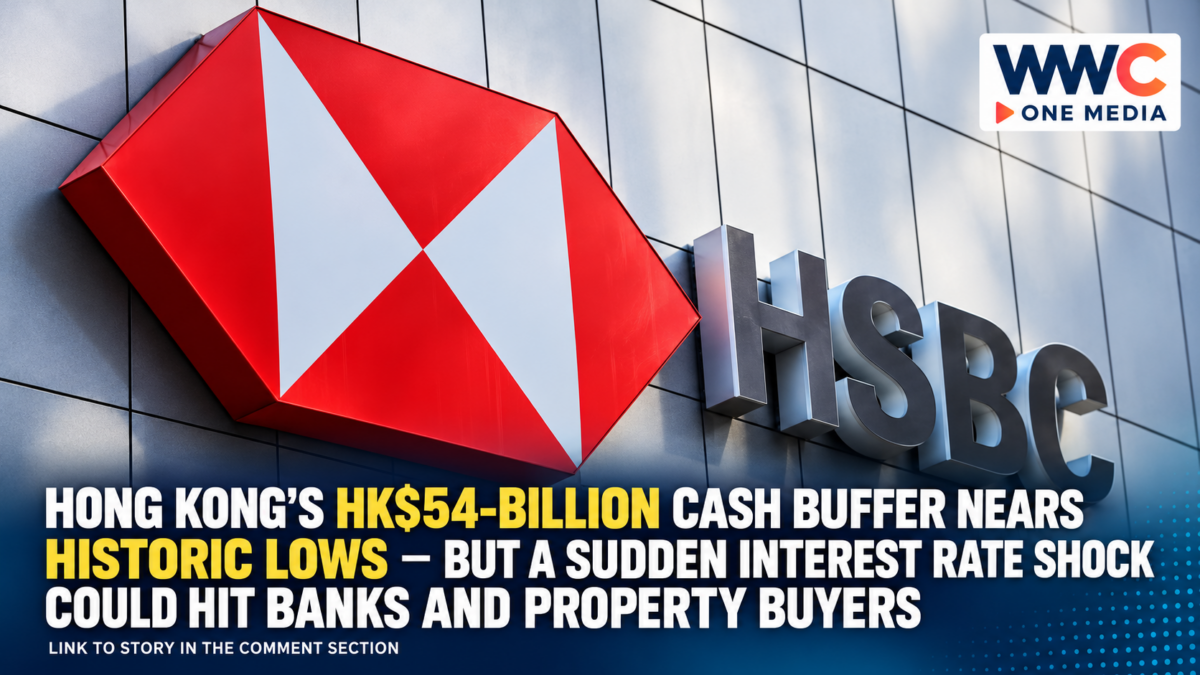
HONG KONG — October 14, 2026 — Hong Kong’s financial markets are facing renewed pressure as the banking system’s key interbank cash buffer approaches historically low levels, raising concerns that efforts to defend the Hong Kong dollar’s exchange-rate peg could trigger sharp swings in borrowing costs.
The city’s Aggregate Balance, a closely watched measure of funds held by banks in their settlement accounts with the Hong Kong Monetary Authority (HKMA), stood at approximately HK$54.1 billion (US$6.9 billion) on October 13.
The figure is approaching levels previously associated with intense currency-market intervention in 2023, when the HKMA repeatedly defended the local currency against depreciation.
At the center of the concern is the Hong Kong dollar, which has moved close to the weak end of its permitted trading band against the US dollar.
The currency operates under a linked exchange-rate system that maintains a range of HK$7.75 to HK$7.85 per US dollar.
As US interest rates and Treasury yields remain elevated, investors have found it increasingly attractive to hold American dollars instead of Hong Kong dollars.
This has added downward pressure on the local currency and increased the likelihood of intervention by Hong Kong’s monetary authorities.
The risk is not necessarily that Hong Kong’s currency peg will collapse, but that defending it could cause borrowing costs to rise more suddenly than businesses, investors and property buyers expect.
Hong Kong’s Banking Cash Buffer Falls Near Historic Lows
According to Bloomberg’s October 14 report, Hong Kong’s Aggregate Balance has declined to a level seen only rarely during previous periods of active currency defense.
Official HKMA statistics showed an Aggregate Balance of HK$54.111 billion at the close of October 13.
The balance represents funds maintained by banks for settling payments with one another through Hong Kong’s banking infrastructure.
When the Aggregate Balance is relatively high, banks generally have greater flexibility to lend surplus cash in the interbank market.
When it becomes smaller, changes in funding demand or liquidity conditions can have a larger impact on short-term interest rates.
The Aggregate Balance currently accounts for only about 2.6% of Hong Kong’s monetary base.
However, this does not mean that the city’s banking system has lost nearly all its financial resources.
The monetary base also includes currency in circulation and Exchange Fund Bills and Notes, while banks hold deposits, securities and other liquid assets.
The concern is more specific: a relatively small pool of interbank settlement funds can increase the sensitivity of short-term borrowing costs to changes in liquidity.
Why the Hong Kong Dollar Is Under Pressure
Hong Kong has maintained a linked exchange-rate system since 1983.
Under the framework, the HKMA commits to exchanging US dollars and Hong Kong dollars at specified limits.
The strong-side undertaking is HK$7.75 per US dollar, while the weak-side undertaking is HK$7.85.
This system helps maintain exchange-rate stability and supports Hong Kong’s role as an international financial center.
But it also means local monetary conditions are heavily influenced by US interest rates and capital movements.
In September 2026, the US Federal Reserve raised its benchmark interest-rate range by 25 basis points, its first increase in three years.
That move contributed to a wider difference between borrowing costs in US dollars and Hong Kong dollars.
Investors seeking higher returns have responded by borrowing comparatively cheaper Hong Kong dollars and investing in higher-yielding US dollar assets.
This strategy, commonly known as a carry trade, can place additional pressure on the Hong Kong dollar when undertaken on a large scale.
According to the HKMA, the local currency gradually weakened from levels around HK$7.83 earlier this year to approximately HK$7.8460–HK$7.8475 in recent weeks.
The movement has brought the exchange rate closer to the critical HK$7.85 boundary.
What Happens if the Hong Kong Dollar Reaches 7.85?
If the Hong Kong dollar reaches the weak-side limit of HK$7.85 per US dollar, the HKMA stands ready to buy Hong Kong dollars and sell US dollars under its currency-board arrangements.
That intervention supports the local currency.
However, it also removes Hong Kong-dollar liquidity from the banking system.
The process typically unfolds in four stages.
First, investors sell Hong Kong dollars and purchase US dollars, placing downward pressure on the local currency.
Second, the HKMA purchases Hong Kong dollars if the weak-side convertibility undertaking is triggered.
Third, the purchase withdraws Hong Kong-dollar funds from the banking system, reducing the Aggregate Balance.
Fourth, scarcer interbank liquidity tends to push Hong Kong-dollar borrowing costs higher.
Higher local interest rates can then discourage further carry trades and help stabilize the currency.
This is a deliberate feature of Hong Kong’s linked exchange-rate system rather than evidence that the mechanism is failing.
The difficulty is that adjustment can become increasingly volatile when the Aggregate Balance is already low.
DBS Warns Hong Kong Interbank Rates Could Spike
DBS Bank strategist Carie Li has warned that Hong Kong interbank interest rates could face upward pressure as liquidity tightens.
According to Bloomberg, Li expects the overall direction of Hong Kong Interbank Offered Rates, commonly known as HIBOR, to move higher.
She also cautioned that market volatility could intensify if the Aggregate Balance falls toward earlier lows.
HIBOR is a widely followed benchmark for short-term Hong Kong-dollar borrowing.
It influences funding costs across the financial system and can affect certain mortgage loans, corporate financing arrangements and other interest-rate-sensitive products.
Because Hong Kong’s banking sector relies on interbank liquidity to facilitate funding, abrupt changes in the availability of cash can produce movements in short-term rates.
But higher HIBOR does not automatically translate into equivalent increases in every mortgage or business loan.
Banks also consider their deposit costs, financing needs, lending strategies and contractual rate-setting arrangements.
Mortgage Borrowers and Property Buyers Face Fresh Uncertainty
The potential for higher HIBOR is particularly important for Hong Kong’s property market.
Many local mortgage products are linked to interbank rates, although individual loan arrangements may include pricing caps or other contractual protections.
If short-term interest rates rise, some borrowers could face higher monthly payments.
For prospective homebuyers, financing costs may influence decisions about purchasing property.
Higher borrowing expenses can also affect property developers and investors who rely on debt financing.
The HKMA has already advised the public to manage interest-rate risks carefully when making property purchases, investments and borrowing decisions.
In an October 6 commentary, HKMA Chief Executive Eddie Yue emphasized that global capital flows remain highly uncertain and that interest rates may adjust as the linked exchange-rate system responds to market conditions.
The warning highlights the importance of distinguishing exchange-rate stability from interest-rate stability.
Hong Kong can maintain a stable currency peg while allowing local borrowing costs to fluctuate significantly.
OCBC Sees Possible Measures to Ease Liquidity Pressure
While shrinking interbank liquidity has raised concerns, analysts also see potential tools that could help manage market conditions.
Oversea-Chinese Banking Corporation (OCBC) has suggested that the HKMA could influence the amount of available Hong Kong-dollar liquidity through its management of Exchange Fund Bills and Notes.
Possible measures include repurchasing securities or allowing selected maturities without issuing an equivalent amount of replacement debt.
Such operations can release additional funds into the banking system.
However, there is a complication.
Injecting liquidity while the Hong Kong dollar is under depreciation pressure could partially offset the interest-rate adjustment that normally helps support the currency.
OCBC strategist Frances Cheung has therefore warned that these competing policy considerations could prolong fluctuations in local interest rates.
The challenge is to maintain orderly money-market conditions without weakening the currency-board mechanism.
Morgan Stanley Says Hong Kong Banks Remain Liquid
Despite the low Aggregate Balance, not all analysts view the situation as a sign of systemic financial stress.
Morgan Stanley has argued that Hong Kong’s broader banking liquidity remains relatively healthy.
The bank’s analysts point to deposit growth exceeding loan growth, suggesting that financial institutions continue to have access to funding resources beyond their settlement balances at the HKMA.
This distinction is important.
The Aggregate Balance is a measure of banking-system settlement liquidity, not the total cash, deposits or liquid securities held by every bank in Hong Kong.
A low Aggregate Balance can make short-term interbank rates more volatile without necessarily indicating a banking crisis.
In addition, banks may obtain liquidity through other market channels or eligible central-bank facilities, subject to applicable conditions.
The main risk highlighted by strategists is therefore the possibility of abrupt changes in funding costs, rather than proof that Hong Kong’s banks are unable to meet their obligations.
US Interest Rates Could Determine What Happens Next
The outlook for Hong Kong’s borrowing costs is closely tied to the Federal Reserve.
Following September’s rate increase, investors are watching upcoming US inflation figures and Federal Reserve communications for clues about the future path of monetary policy.
Reuters reported on October 14 that currency markets were reassessing US interest-rate expectations as the dollar retreated from recent highs.
At that point, traders saw a greater probability that the Fed would leave rates unchanged at its October meeting than raise them immediately.
If US yields remain significantly above Hong Kong-dollar funding rates, carry trades could continue placing pressure on the local currency.
But if Hong Kong interbank rates rise, the financial incentive to borrow Hong Kong dollars and invest in US assets would narrow.
Changes in international capital flows could also alter the situation independently of Federal Reserve decisions.
For this reason, analysts are monitoring both the exchange rate and local money-market conditions.
Why Hong Kong’s Liquidity Problem Matters to Asian Markets
Hong Kong remains one of Asia’s most important banking, trading and investment centers.
It serves as a major gateway for international capital entering and leaving mainland China.
Changes in Hong Kong-dollar funding costs can therefore influence regional investment decisions, corporate treasury operations and financial-market sentiment.
Businesses with Hong Kong-dollar financing may experience higher borrowing expenses if relevant benchmark rates rise.
Investment funds using Hong Kong-dollar leverage may also become more sensitive to sudden funding-cost increases.
However, these effects depend on each institution’s financing arrangements, hedging practices and exposure to local interest rates.
There is no evidence that a low Aggregate Balance alone will automatically trigger broader financial instability across Asia.
What This Means for the Philippines
For Philippine businesses and investors with financial exposure to Hong Kong, the developments deserve attention.
Companies with Hong Kong-dollar loans may face changing interest expenses, while investors holding Hong Kong property or interest-rate-sensitive assets could experience shifts in financing costs and valuations.
Filipino investors using Hong Kong as a gateway to international stocks may also encounter changes in margin-financing costs if their borrowing arrangements are linked to local interest rates.
The Philippine peso is not part of Hong Kong’s linked exchange-rate system, so these pressures do not automatically translate into equivalent changes in Philippine interest rates.
Nevertheless, Hong Kong remains an important financial center for regional capital flows.
Significant changes in its money-market conditions could influence investor sentiment toward Asian assets.
Five Developments That Could Determine Hong Kong’s Next Move
1. The HK$7.85 exchange-rate boundary: Whether the Hong Kong dollar reaches the weak-side convertibility undertaking and triggers HKMA intervention.
2. The Aggregate Balance: Whether the interbank cash buffer falls materially below its October 13 level of HK$54.1 billion.
3. HIBOR movements: Whether overnight and one-month interbank borrowing rates rise sharply as liquidity tightens.
4. US monetary policy: Whether Federal Reserve decisions sustain or narrow the interest-rate differential between the two currencies.
5. Banking-sector liquidity: Whether deposit conditions and funding markets continue providing stability despite the smaller settlement balance.
Together, these factors will determine whether Hong Kong experiences an orderly interest-rate adjustment or a period of unusually sharp financial-market volatility.
The Bigger Picture: Hong Kong’s Currency Peg Faces a New Liquidity Test
Hong Kong’s exchange-rate system has survived decades of financial-market turbulence, including the Asian financial crisis, the global financial crisis and multiple periods of currency speculation.
The latest decline in the Aggregate Balance does not establish that the system is approaching collapse.
Instead, it demonstrates how the currency-board mechanism can transmit global interest-rate pressures into Hong Kong’s domestic financial system.
When the Hong Kong dollar weakens, official intervention can reduce local liquidity and push borrowing costs upward.
That adjustment helps defend the currency peg.
But when the Aggregate Balance is already near historical lows, even relatively modest changes in liquidity may contribute to unexpectedly sharp movements in interbank rates.
For banks, property buyers, corporations and investors, the challenge is preparing for those possible funding-cost fluctuations.
The coming weeks will reveal whether the currency stabilizes without additional intervention or whether renewed pressure leads to further withdrawals of Hong Kong-dollar liquidity.
Hong Kong’s currency peg remains firmly established, but with its interbank cash buffer near historic lows, the next major market shock may arrive not through a currency collapse — but through sudden interest-rate volatility that catches borrowers and investors off guard.