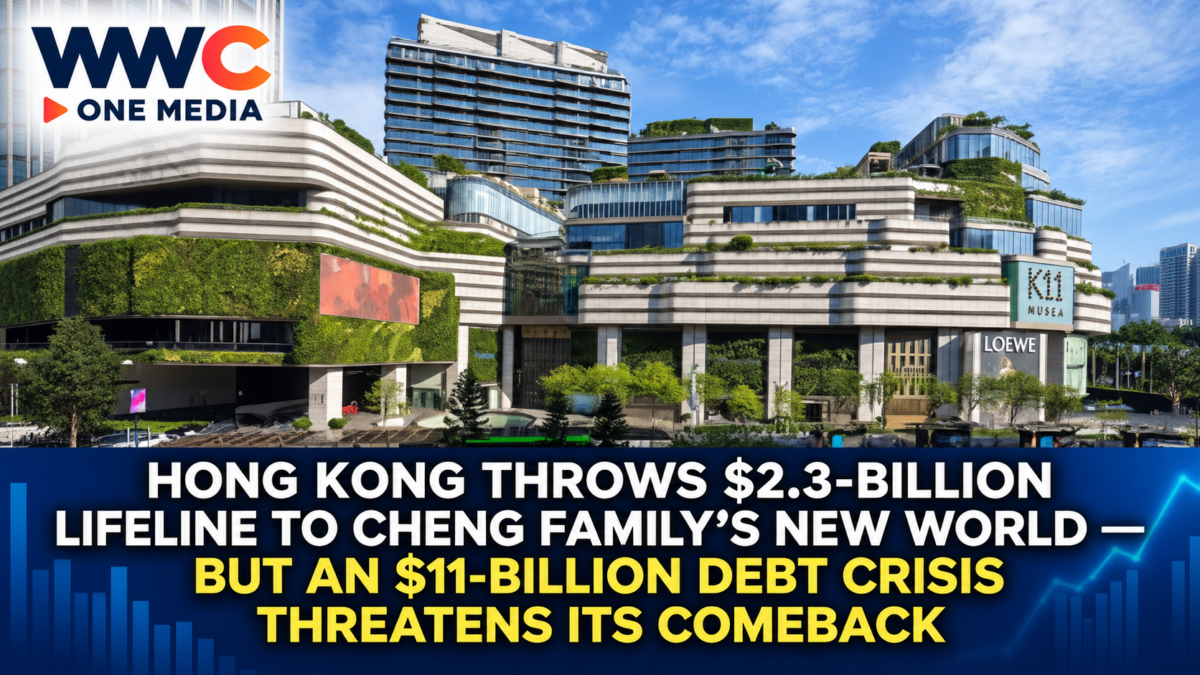
HONG KONG — October 14, 2026 — Hong Kong’s billionaire Cheng family has gained a critical opportunity to rescue property giant New World Development after the city’s Airport Authority agreed to take over a troubled HK$18-billion (US$2.3-billion) commercial complex and release the developer from decades of costly lease obligations.
The extraordinary agreement, reached on September 30, gives one of Hong Kong’s most indebted property companies valuable breathing room as it struggles to refinance billions of dollars in debt.
But the relief comes at a steep price.
New World must pay a HK$2.3-billion early termination fee and provide additional works and services valued at up to approximately HK$1.05 billion.
It has also recognized massive losses associated with the abandoned 11 SKIES project near Hong Kong International Airport.
The Airport Authority, meanwhile, has obtained an option to acquire approximately 29.8% of New World’s existing shares from the Cheng family’s investment company, Chow Tai Fook Enterprises, under specified conditions.
According to Bloomberg’s October 12 investigation, the unusual arrangement illustrates how far Hong Kong authorities are prepared to go to stabilize a developer whose financial problems have become intertwined with the city’s banking system and economic development ambitions.
New World faces enormous debt obligations, investor concerns and pressure to raise fresh capital.
Its founding family wants to preserve control of the company while seeking outside investors and reducing financial leverage.
Hong Kong’s Airport Authority has helped New World escape a costly property commitment. But the bigger question is whether this lifeline can restore the company’s financial health — or whether the Cheng family will ultimately have to surrender part of its ownership to save the business.
Hong Kong Airport Authority Takes Over the Troubled 11 SKIES Project
The centerpiece of the agreement is 11 SKIES, a massive retail, entertainment and office complex located near Hong Kong International Airport.
The project was originally intended to become an important commercial and tourism destination.
Developed at an estimated cost of HK$18 billion, the complex includes approximately 3.8 million square feet of gross floor area.
Its facilities comprise retail and dining areas, entertainment space and three Grade A office towers.
The project was designed to capitalize on international tourism, airport passenger traffic and Hong Kong’s connections with mainland China.
But changing economic conditions undermined those assumptions.
The pandemic disrupted travel and tourism, while the subsequent recovery in consumer spending and demand for commercial space proved weaker than anticipated.
New World faced the prospect of continuing to fund a large development that was not generating the expected returns.
Under the September 30 agreement, the developer will surrender the project to the Airport Authority on April 1, 2027.
In exchange, New World will be released from long-term lease obligations previously extending to September 2066.
The arrangement removes a significant source of future financial pressure.
The Deal Is a Lifeline — Not a Free Government Cash Bailout
The agreement has attracted attention because Hong Kong’s Airport Authority is a statutory body owned by the government.
Its decision to assume control of the project has therefore raised questions about public-sector support for a financially stressed private developer.
However, describing the arrangement as a direct HK$18-billion cash bailout would be misleading.
The HK$18-billion figure represents the approximate development cost of 11 SKIES.
It is not a new cash payment made to New World.
In fact, New World is required to compensate the Airport Authority.
The transaction includes a HK$2.3-billion termination fee, together with works and services valued at up to HK$1.05 billion.
The financial benefit comes primarily from ending future obligations associated with the unsuccessful project.
The Airport Authority gains control of the property and the opportunity to develop a new commercial strategy for the airport district.
The developer gains relief from a long-term commitment that had become increasingly difficult to justify.
How Much Will New World Pay to Exit 11 SKIES?
The company’s disclosed obligations include several components.
| Transaction component | Amount |
|---|---|
| Original 11 SKIES development cost | Approximately HK$18 billion |
| Early termination fee | HK$2.3 billion |
| Additional works and services | Up to HK$1.05 billion |
| Total potential termination-related obligations | Approximately HK$3.35 billion |
| Losses and provisions associated with 11 SKIES | Approximately HK$18.3 billion |
| Handover date | April 1, 2027 |
The HK$18.3-billion charge includes asset impairment and other provisions arising from the project.
It should not be interpreted as an additional HK$18.3-billion cash payment made immediately.
Accounting write-downs and cash payments have different effects on a company’s financial position.
New World has already reflected substantial project-related losses in its annual results.
The financial advantage of the exit is that the company no longer needs to carry the same future lease burden.
But those benefits do not automatically eliminate its existing debts.
Airport Authority Could Acquire Nearly 30% of New World
One of the most unusual features of the agreement concerns New World’s ownership.
Chow Tai Fook Enterprises, the Cheng family’s investment holding company, has granted the Airport Authority an option to acquire 750 million existing New World shares.
That represents approximately 29.8% of the developer’s currently issued shares.
The option can be exercised within three years for HK$2.25 billion, subject to contractual conditions.
According to Reuters Breakingviews, the agreed price represents a substantial discount to New World’s share price before the deal.
However, the Authority has not yet exercised the option.
It is therefore inaccurate to describe the Hong Kong government as already owning nearly 30% of New World.
The deal creates a potential future ownership position.
The option also contains conditions intended to ensure that Chow Tai Fook Enterprises remains New World’s largest shareholder and that relevant bank covenants are not breached.
This means the possibility of government-linked ownership is tied closely to the Cheng family’s plans for the company’s capital structure.
Why the Cheng Family Must Consider Raising Fresh Capital
The option creates a financial dilemma for the Cheng family.
If the Airport Authority acquires nearly 30% of existing shares, the family’s ownership position could be significantly reduced.
But the agreement requires the Cheng family’s holding company to remain the developer’s largest shareholder.
Meeting that condition may require changes to the ownership structure.
One possibility is a new equity investment in New World.
Another is a broader transaction involving existing and incoming shareholders.
Bloomberg reported that UBS analysts view the 11 SKIES arrangement as potentially accelerating an equity-raising exercise.
Fresh capital could help reduce debt and strengthen New World’s balance sheet.
However, issuing new shares could dilute existing shareholders.
The question is how to obtain enough funding without giving up control or creating unacceptable losses for current investors.
New World Faces Nearly $11 Billion in Debt Pressure
The company’s difficulties extend far beyond one property project.
According to Bloomberg, New World faces nearly US$11 billion in debt obligations approaching from as early as 2027.
Reuters Breakingviews identified approximately US$8.2 billion in loans and bonds coming due over the next two years.
The figures reflect different assessments of the company’s refinancing requirements and should not be added together.
The problem is that New World must manage large obligations while its property assets are under financial pressure.
Refinancing involves replacing maturing debts with new financing or negotiating extensions with existing creditors.
That can become difficult when interest rates are high and investors doubt a company’s ability to generate cash.
New World has already undertaken major refinancing exercises.
In 2025, the company secured approximately HK$88 billion, or US$11 billion, in refinancing support from banks.
The latest Airport Authority agreement gives it more time.
But it does not remove the need to address additional maturities.
New World Records Enormous Annual Loss
The property developer’s latest financial results demonstrate the seriousness of its problems.
For the year ended June 30, 2026, New World reported a loss for the year of approximately HK$26.8 billion.
Research by DBS and Bloomberg also identified an approximately HK$28.1-billion loss attributable to shareholders.
The figures differ because they refer to different accounting measures.
New World’s annual financial results showed that major impairment charges and provisions were responsible for much of the deterioration.
The 11 SKIES project alone accounted for approximately HK$18.3 billion of losses and provisions.
The company also recorded impairment charges on development properties and valuation declines affecting investment assets.
However, its recurring operations were not uniformly loss-making.
DBS Research reported approximately HK$2.2 billion in profit from recurring operations after excluding specified impairments, provisions and other losses.
That distinction matters for assessing the turnaround.
A company can report a very large accounting loss while some underlying operations continue producing earnings.
Nevertheless, large write-downs indicate that assets have lost substantial value relative to earlier expectations.
Bain Capital Emerges as a Potential Investor
New World has been exploring additional sources of funding.
Bloomberg reported in early October that Bain Capital was examining a potential investment in the developer.
The proposal could involve fresh capital from Bain alongside investment from the Cheng family.
The discussions remain preliminary.
No completed investment has been announced.
The parties have also been affected by uncertainty over Hong Kong’s property market and international financial conditions.
Bloomberg’s latest reporting indicates that negotiations are continuing cautiously.
A deal could improve New World’s balance sheet and support debt repayment.
But the size, valuation and ownership consequences of any Bain investment remain unresolved.
It would therefore be premature to describe Bain as an established new shareholder.
Blackstone Talks Earlier Failed Over Control
The Cheng family has also considered transactions involving other global investment firms.
Earlier discussions with Blackstone reportedly explored a potential arrangement worth approximately US$4 billion.
Those negotiations did not produce a completed agreement.
According to Bloomberg, the parties disagreed over the question of control.
The Cheng family was reluctant to accept terms that would significantly weaken its authority over New World.
The failed discussions demonstrate the central challenge facing the group.
It needs external capital.
But potential investors may demand substantial ownership rights or other protections in exchange for providing money to a highly indebted business.
A smaller investment may preserve family control but provide insufficient funding.
A larger investment may stabilize the balance sheet while substantially changing who controls the company.
The Cheng Family’s Influence Extends Across Hong Kong
New World was founded by the late billionaire Cheng Yu-tung and became one of Hong Kong’s major property developers.
The family’s businesses extend across property, retail, hospitality and other industries.
Chow Tai Fook Enterprises remains a central part of its investment structure.
New World has developed prominent Hong Kong commercial properties, hotels and residential projects.
Its portfolio also includes K11-branded shopping destinations and investments linked to major urban development initiatives.
These assets give the company significant economic influence.
But they also create financial complexity.
Commercial property investments often require large upfront expenditures and depend on long-term demand.
When borrowing costs increase or property valuations decline, highly leveraged developers can face pressure even while holding valuable assets.
New World’s difficulties reflect the risks of combining ambitious expansion with substantial debt.
Why Hong Kong’s Government Has an Interest in New World’s Survival
The Airport Authority agreement has prompted discussion about whether New World has become too important to fail.
The company is closely connected to Hong Kong’s commercial property market.
Its lenders include major financial institutions.
Its developments support employment, construction, retail and tourism activity.
A disorderly financial collapse could have consequences for creditors, contractors and other businesses.
Reuters Breakingviews noted that government involvement could reassure lenders as New World approaches another debt restructuring period.
However, the Airport Authority has not announced an unconditional guarantee of all New World’s financial obligations.
Nor has the government confirmed that it would rescue every private developer facing difficulties.
The existing transaction concerns a specific airport commercial development and a conditional share option.
Its wider significance lies in the willingness of a government-owned body to negotiate terms that ease the financial pressure on a prominent developer.
The Northern Metropolis Project Adds Strategic Importance
New World is involved in Hong Kong’s Northern Metropolis development.
The initiative aims to expand housing, infrastructure and economic activity closer to the border with Shenzhen.
It is one of the government’s long-term urban development priorities.
Private developers are expected to play important roles in delivering residential and commercial projects.
That makes the financial health of major developers relevant to the government’s broader plans.
Bloomberg cited Natixis economist Gary Ng, who highlighted New World’s economic and policy importance.
The concern is that severe financial pressure could reduce the company’s capacity to invest in strategically significant developments.
But involvement in public development priorities should not be confused with a guarantee of financial success.
Projects must still attract capital, meet demand and generate adequate returns.
Hong Kong’s Property Downturn Created the Crisis
The city’s real estate market has experienced several difficult years.
High interest rates, weaker demand and changing investment conditions placed pressure on both residential and commercial properties.
New World was especially vulnerable because of its heavy borrowing and ambitious development pipeline.
Some major projects were planned before the full effects of the pandemic and subsequent economic changes became clear.
The downturn reduced the value of properties and complicated asset sales.
It also discouraged investors from committing capital to projects requiring substantial additional spending.
Signs of recovery have emerged in parts of the market.
But the improvement remains uncertain.
New World must therefore manage its finances without relying entirely on a rapid rebound in property prices.
Deutsche Bank Facility Expansion Provides Additional Liquidity
The developer has also expanded financing arrangements with lenders.
On September 30, New World announced an increase in a facility involving Deutsche Bank.
The committed amount rose from HK$3.95 billion to approximately HK$4.9 billion.
That represents an increase of about HK$950 million.
The move provides additional financial flexibility.
However, a larger borrowing facility does not automatically mean debt has been repaid.
Depending on the terms, it may improve liquidity by providing access to more financing while adding to obligations that must eventually be serviced.
Investors therefore need to distinguish between liquidity support and permanent debt reduction.
Both can be valuable, but they serve different purposes.
New World Launches Bond Exchange Offer
New World has also pursued a restructuring of outstanding bonds.
In October, the company announced exchange offers involving approximately US$991 million of notes due in 2027 and 2028.
Such offers can allow companies to extend repayment schedules or modify debt terms.
For a heavily indebted developer, that may reduce immediate pressure from approaching maturities.
However, the outcome depends on creditor participation and the terms accepted.
A bond exchange does not necessarily eliminate the underlying economic cost of borrowing.
It may simply redistribute that cost over a longer period.
The company will need to demonstrate that its financial position can improve during the additional time obtained.
What Will Happen to 11 SKIES?
The Airport Authority is expected to take control of the complex on April 1, 2027.
It may pursue a revised commercial strategy better aligned with airport operations, tourism and visitor demand.
The project contains extensive retail, entertainment and office facilities.
Its future will depend on whether the Authority can attract businesses and customers at a sustainable cost.
However, no fully implemented new operating plan has been confirmed.
The takeover should not be described as a completed commercial turnaround.
The transfer of ownership and operational control is a first step.
The Authority must still determine how to make the complex economically viable.
What the Deal Means for Hong Kong Banks
New World’s financial condition matters to its lenders.
Major banks have substantial exposure to Hong Kong’s property industry.
Large refinancing negotiations can affect perceptions of credit quality and the availability of financing for other developers.
The Airport Authority agreement may help reduce uncertainty surrounding New World’s future liabilities.
But lenders will still examine the company’s ability to service debt and generate cash.
Successful refinancing could help stabilize confidence.
A failed capital-raising exercise or further asset deterioration could increase pressure.
For Hong Kong’s financial system, the most important issue is whether the developer’s obligations can be addressed in an orderly and sustainable manner.
What Asian Property Investors Should Watch
The transaction provides a lesson for property developers throughout Asia.
Real estate businesses often depend on long-term financing and assumptions about future demand.
Large projects can become vulnerable when borrowing costs increase or market conditions change.
The difficulties are especially serious for companies with concentrated portfolios and large debt maturities.
Governments may sometimes intervene through negotiations involving strategically important assets.
But such arrangements do not eliminate investment risk.
For Philippine and Southeast Asian investors, the case illustrates the importance of examining leverage, refinancing schedules, cash flow and asset valuations.
However, the Airport Authority agreement has not been shown to produce a specific direct impact on Philippine property companies.
Any such effect would require separate evidence.
What Happens Next?
Several developments could determine whether New World’s turnaround succeeds.
April 1, 2027: The planned handover of 11 SKIES to the Airport Authority.
Bond exchanges: The company will seek to manage maturities through negotiated debt arrangements.
Potential outside investment: Discussions involving Bain Capital or other investors may continue.
Cheng family financing: The family’s willingness to provide fresh capital could become increasingly important.
Airport Authority share option: The conditional right to acquire 750 million shares remains exercisable within the agreed period.
Hong Kong property conditions: A sustained recovery could improve asset values and sales.
Debt repayment capacity: Creditors will assess whether the company’s balance sheet is becoming genuinely stronger.
These developments will reveal whether the lifeline is the beginning of a successful restructuring or merely a delay before more difficult decisions.
The Bigger Question: Can the Cheng Family Save New World Without Losing Control?
Hong Kong’s Airport Authority has provided the Cheng family with a valuable opportunity.
By taking over the struggling 11 SKIES project and releasing the developer from future lease commitments, it has removed one of New World’s biggest financial burdens.
But the agreement does not erase the company’s debts.
New World still faces billions of dollars in upcoming maturities.
Its latest annual results include extraordinary impairment charges.
The Cheng family also faces a difficult decision over how much outside investment to accept.
Private equity firms may provide capital, but they are likely to demand adequate returns and protections.
Meanwhile, the Airport Authority’s conditional share option introduces the possibility of substantial government-linked ownership.
For investors, the critical issue is whether New World can achieve a durable financial recovery rather than simply obtain more time.
Hong Kong has thrown one of its most indebted property developers a major lifeline, allowing the Cheng family to escape decades of 11 SKIES obligations. But the real test is only beginning: Can New World refinance billions of dollars, attract fresh investment and restore profitability — or will the family’s determination to retain control become the biggest obstacle to saving its property empire?