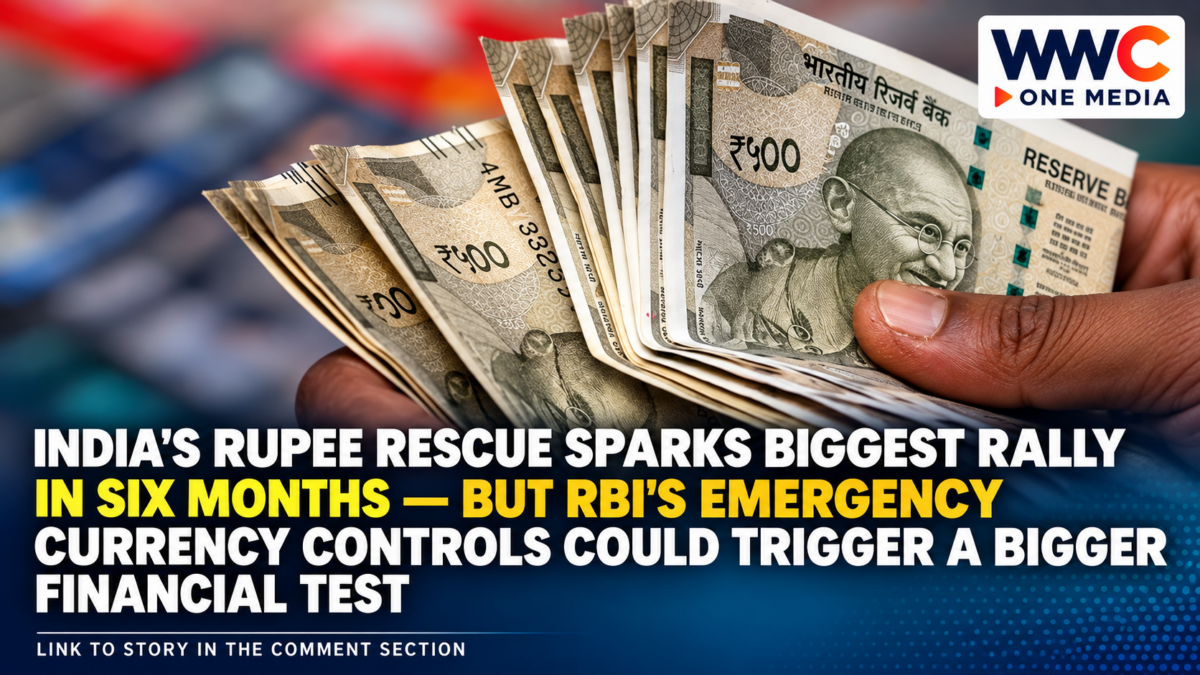
MUMBAI, INDIA — October 14, 2026 — India’s central bank is fighting one of its most difficult currency battles in more than a decade, deploying emergency-style foreign-exchange measures to defend the rupee as rising oil prices, foreign investment outflows and a stronger US dollar intensify pressure on Asia’s third-largest economy.
The Reserve Bank of India (RBI) has introduced a special dollar-supply facility for major state-owned oil companies, tightened foreign-exchange derivative rules and imposed new cash-reserve requirements on certain currency hedging transactions.
The unprecedented combination of measures has temporarily strengthened the rupee.
On October 12, India’s currency recorded its biggest daily gain in six months, rising approximately 1% against the dollar.
The recovery continued on October 13, when the rupee strengthened to ₹95.28 per dollar, its strongest closing level in approximately one month.
But the intervention has also created a new problem.
Banks are struggling to interpret some of the restrictions, trading volumes have declined in parts of the derivatives market, and businesses face potentially higher costs when protecting themselves against currency fluctuations.
The developments are central to a Bloomberg Opinion article published on October 13, titled The Indian Central Bank’s Rupee Rescue Is Getting Desperate.
The commentary questions whether increasingly restrictive market interventions can provide a lasting solution to India’s currency troubles.
Independent Reuters reporting confirms that the RBI’s actions have delivered short-term relief while creating significant uncertainty in foreign-exchange markets.
India’s central bank has succeeded in stopping the rupee’s immediate slide. But the real question is whether tighter currency controls can overcome the deeper economic pressures driving investors toward the dollar—or whether the RBI may eventually be forced to choose between defending the rupee and protecting economic growth.
RBI Launches Its Most Aggressive Rupee Defense in Years
The Reserve Bank of India unveiled a series of measures on October 10 to stabilize foreign-exchange markets.
The intervention followed the rupee’s fall toward historic lows.
On October 9, the currency closed at approximately ₹96.73 per dollar.
The weakening had been driven by rising oil-import costs, elevated US interest rates and substantial foreign capital outflows.
The RBI’s policy response includes three central measures.
First, it has created a special facility to meet the dollar requirements of state-owned oil companies.
Second, it has imposed additional cash-reserve requirements on certain foreign-exchange derivative transactions.
Third, it has restricted currency trading arrangements that do not have sufficiently documented underlying business exposure.
The objective is to reduce speculative demand for dollars and discourage transactions that could amplify pressure on the rupee.
However, these measures do not eliminate the need for dollars to pay for India’s imports.
They primarily change how dollar demand enters the market and how currency-related financial risks are managed.
India’s Rupee Rebounds From Near-Record Low
The immediate market response was dramatic.
Reuters reported that the rupee strengthened approximately 1% on October 12, moving from ₹96.73 to ₹95.77 per dollar.
It was the currency’s largest single-session gain in six months.
The following day, the rupee climbed as high as ₹95.0725 before closing at ₹95.28.
That represented an additional gain of approximately 0.5%.
The recovery made the rupee one of Asia’s strongest-performing currencies during that session.
However, the rebound needs to be placed in context.
India’s currency had already lost around 6% against the dollar during 2026.
A two-day recovery therefore does not necessarily establish a sustained reversal of the broader downtrend.
Analysts caution that the gains may prove temporary if oil prices remain elevated and foreign investment outflows continue.
India Rupee Crisis: Key Figures
| Indicator | Reported figure |
|---|---|
| Rupee closing rate, October 9 | ₹96.73 per US dollar |
| Rupee closing rate, October 12 | ₹95.77 per US dollar |
| Rupee closing rate, October 13 | ₹95.28 per US dollar |
| October 13 intraday high | ₹95.0725 per US dollar |
| Rupee depreciation in 2026 | Approximately 6% |
| New FX risk-reserve requirement | 20% |
| Derivative transactions triggering reserve rule | Above US$2 million, for specified eligible hedges |
| Threshold for certain transactions without established underlying exposure | Reduced from US$100 million to US$5 million |
Sources: Reuters, RBI foreign-exchange circulars, The Indian Express and Indian financial-market reporting. Exchange rates are historical market observations, not live quotations.
RBI Creates Special Dollar Facility for Oil Companies
One of the most important measures involves India’s oil imports.
India relies heavily on foreign crude oil.
International oil purchases are largely denominated in US dollars.
When oil prices rise, Indian refiners require more dollars to pay suppliers.
That can create significant demand for foreign currency and pressure the rupee.
The RBI has responded by opening a dedicated dollar-supply window for three major state-owned oil marketing companies:
- Indian Oil Corporation
- Bharat Petroleum Corporation
- Hindustan Petroleum Corporation
Instead of purchasing all their required dollars through the ordinary spot foreign-exchange market, the companies can obtain dollars through the special facility.
Reuters estimated that this arrangement could redirect approximately US$10 billion to US$12 billion of monthly dollar demand.
The estimate is based on oil-import requirements and is not a guaranteed monthly reduction in India’s overall demand for dollars.
India must still pay for imported energy.
The measure changes the source of dollar liquidity rather than reducing the country’s underlying oil-import bill.
Why Expensive Oil Is Hurting the Rupee
The Middle East conflict has significantly increased global energy costs.
Crude oil prices have remained elevated amid concerns about production disruptions and shipping routes.
For India, this creates a major economic challenge.
A higher oil-import bill can widen the trade deficit.
It can also increase domestic fuel costs and contribute to inflation.
Businesses may face higher transportation and production expenses.
Households can experience reduced purchasing power.
At the same time, importers require more dollars to settle transactions.
That places additional pressure on the exchange rate.
A weaker rupee can then make dollar-priced imports even more expensive in local-currency terms.
The result is a potentially damaging feedback loop between oil prices, inflation and currency depreciation.
This is one reason the RBI’s intervention has become increasingly aggressive.
India Introduces a 20% Foreign Exchange Risk Reserve
The central bank has also introduced a new Foreign Exchange Risk Reserve, or FERR.
Under the October 10 rules, authorized banks must maintain additional cash reserves with the RBI for specified rupee-related foreign-exchange derivative transactions.
The requirement applies to eligible contracts exceeding US$2 million in notional value when customers purchase foreign currency against the rupee to hedge current-account transactions.
The cash reserve is equal to 20% of the rupee-equivalent notional amount of the qualifying transaction.
The policy makes certain hedging activities more expensive for banks.
That additional expense may be passed on to businesses using the contracts.
The RBI intends the requirement to discourage excessive or speculative demand for foreign currency.
However, ordinary importers also use hedging to manage legitimate exchange-rate risks.
If hedging becomes more costly, some businesses may face greater financial uncertainty.
This is one of the most controversial aspects of the policy.
RBI Borrows a Strategy Associated With China’s Central Bank
Financial analysts have compared the new foreign-exchange reserve measure with policies used by China’s central bank.
The People’s Bank of China has previously employed administrative tools to influence foreign-exchange activity.
Such measures can increase the cost of taking positions that authorities believe are destabilizing a currency.
India’s latest approach follows a similar logic.
Instead of relying solely on interest-rate increases or direct market intervention, the RBI is seeking to influence the behavior of banks and traders through regulatory requirements.
The Indian Express described the measure as drawing from China’s foreign-exchange management playbook.
But the comparison has limits.
India and China operate under different financial systems, capital-account arrangements and policy frameworks.
The introduction of FERR does not mean India has adopted China’s entire exchange-rate regime.
Currency Derivatives Face Tighter Restrictions
The RBI has also reduced the threshold for certain foreign-exchange derivative transactions without established underlying exposure.
Previously, the relevant limit stood at US$100 million.
The new threshold is US$5 million.
The regulator has also restricted the cancellation and rebooking of certain derivative contracts.
These changes aim to reduce speculative positions that could amplify movements in the rupee.
The regulator is particularly concerned about transactions that create demand for dollars without corresponding genuine business requirements.
However, derivatives markets serve legitimate commercial purposes.
Exporters and importers use forward contracts to reduce uncertainty about future exchange rates.
Restrictions that reduce market liquidity can make those protections harder or more expensive to obtain.
This creates a policy trade-off.
Rules that discourage speculation may also affect the efficiency of transactions used by ordinary businesses.
Banks Report Confusion Over New Rules
The RBI’s policy changes have produced immediate operational difficulties.
Reuters reported on October 13 that at least eight major banks temporarily refrained from quoting certain dollar-rupee forward contracts.
The lenders were seeking clarification about how the new reserve requirements would apply.
Some initially interpreted the rules as potentially covering transactions between banks.
That created uncertainty about the amount of cash financial institutions would need to maintain.
The RBI subsequently provided clarifications to some institutions.
However, Reuters reported that certain banks were still seeking formal guidance.
Trading volumes declined in parts of the forward market.
Bid-ask spreads also widened.
That means the difference between the price at which market participants are willing to buy and sell currency contracts increased.
Wider spreads generally make trading more expensive.
The disruption illustrates how aggressively designed regulations can create unintended consequences.
Offshore Currency Trading Could Benefit From Restrictions
India’s foreign-exchange market includes both domestic and offshore trading activity.
The offshore non-deliverable forward market allows investors to take positions linked to the rupee without physically delivering the currency.
When domestic trading becomes more restricted, some participants may shift activity offshore.
Reuters reported that market participants were already observing increased interest in offshore alternatives.
This creates another potential challenge for regulators.
Restrictions can reduce activity in one market without necessarily eliminating the underlying demand.
Some trading may simply move to less directly controlled venues.
For the RBI, the objective will be to discourage destabilizing activity without undermining legitimate market liquidity.
The effectiveness of the measures will become clearer as banks and businesses adapt.
India’s Foreign Investment Outflows Add to Currency Pressure
The rupee’s problems extend beyond energy imports.
Foreign investors have reduced exposure to Indian financial assets.
Reuters reported that overseas investors had withdrawn more than US$30 billion from Indian equities during 2026.
Capital outflows can weaken a currency because investors converting proceeds into dollars create additional foreign-exchange demand.
The pressure can intensify when global investors favor US assets offering attractive yields.
India remains one of the world’s major economic growth markets.
But strong economic growth does not guarantee positive capital flows.
Investors also consider valuations, interest-rate differences, geopolitical risks and currency expectations.
A weaker currency can discourage foreign investment if investors fear additional exchange-rate losses.
That can create another reinforcing cycle.
India’s Foreign Exchange Reserves Face Pressure
The RBI has accumulated substantial foreign-exchange reserves over time.
Those reserves provide resources that can help manage currency-market volatility and meet external financial requirements.
However, supporting the rupee through dollar sales can reduce the reserve stock.
Reuters reported that India’s reserves had fallen to approximately US$734 billion from a recent peak near US$785 billion.
Business Standard reported a decline of around US$51.1 billion during the four weeks ending October 2.
These changes do not necessarily represent an identical amount of direct intervention.
Reserve valuations can also change because of fluctuations in currencies and asset prices.
But sustained reserve declines may limit policymakers’ willingness to continue selling dollars indefinitely.
India still has substantial reported reserves.
The issue is not that the country has already exhausted its defenses.
It is whether maintaining a particular exchange-rate outcome would become increasingly costly if the underlying pressures persist.
The RBI Has Already Raised Interest Rates
The currency measures followed a monetary-policy decision on October 7.
The RBI raised its policy rate by 25 basis points.
Higher interest rates can make domestic financial assets more attractive to investors.
They can also reduce inflation pressure by restraining borrowing and spending.
But rate increases carry economic costs.
Businesses may face higher financing expenses.
Consumers may pay more for loans.
Investment activity can slow if borrowing becomes too expensive.
For the RBI, this creates a difficult balancing act.
It must consider inflation, financial stability and economic growth while responding to external pressure on the rupee.
A central bank cannot rely on increasingly high interest rates indefinitely without considering the consequences for the wider economy.
RBI Governor Sanjay Malhotra Defends the Intervention
RBI Governor Sanjay Malhotra has defended the central bank’s measures.
Speaking to Moneycontrol, he said the restrictions were intended to curb speculative activity and maintain orderly market conditions.
The governor also emphasized that monetary policy and financial stability are interconnected.
His position reflects the RBI’s view that unusual market conditions may justify stronger intervention.
The central bank has not declared that India is experiencing a sovereign debt crisis or that it has lost control of the currency.
Instead, it argues that the measures are necessary to prevent destabilizing financial activity.
Critics believe the restrictions risk distorting the market.
Supporters argue that reducing speculative demand can give the economy time to adjust.
The dispute concerns the costs and effectiveness of the policy—not whether the RBI has any legitimate reason to address extreme currency volatility.
Could the Rupee Fall to 100 per Dollar?
The possibility of the rupee weakening to ₹100 per US dollar has become an important topic in Indian financial commentary.
The level is psychologically significant because it represents a round-number exchange-rate threshold.
Some analysts believe persistent oil costs and weak investment flows could eventually push the currency toward that mark.
Others argue that the latest RBI measures can maintain greater stability.
Reuters reported that some market participants believe the central bank may seek to defend the rupee around ₹97 per dollar.
However, the RBI has not formally committed to a fixed exchange-rate target at that level.
The currency’s future will depend on energy prices, capital flows, domestic policy and the US dollar.
A forecast of ₹100 per dollar is therefore a risk scenario, not an established outcome.
Why Currency Controls May Only Buy Time
The central issue is whether regulation can offset genuine economic demand for foreign currency.
India needs dollars to pay for imported goods and services.
Companies require foreign exchange for international business activities.
Investors may seek to transfer capital overseas.
Those underlying requirements cannot simply be eliminated through tighter derivatives rules.
The RBI can influence the timing, cost and channels through which transactions occur.
It can also supply dollars from reserves.
But long-term currency stability requires confidence in the country’s external finances and economic outlook.
If oil prices remain elevated and capital continues flowing out, pressure on the rupee may return.
That is the central concern raised by critics of the rescue effort.
India’s Growth Remains a Counterargument to Crisis Fears
Despite the pressure on the rupee, India continues to report strong economic growth.
Prime Minister Narendra Modi emphasized India’s economic resilience during the Bloomberg New Economy Forum in New Delhi.
He cited growth of 7.8% in the first quarter of the fiscal year and pointed to investment opportunities and economic reforms.
The IMF and RBI have also maintained relatively strong annual growth forecasts.
Those indicators distinguish India from an economy already experiencing a generalized collapse.
Growth, however, is only one part of currency stability.
A country can expand rapidly while facing a widening import bill, capital outflows or currency depreciation.
India’s challenge is to convert its growth potential into durable investment inflows and sustainable external financing.
That requires confidence in economic policy as well as strong domestic demand.
What This Means for Indian Businesses
The effects of the RBI’s measures differ across sectors.
Importers may benefit from a stronger rupee because dollar-priced purchases become less expensive in local-currency terms.
But higher hedging costs can reduce those savings.
Oil refiners may benefit from access to the dedicated dollar facility.
Exporters may face different pressures.
A stronger rupee can reduce the rupee value of dollar-denominated export earnings.
Businesses that previously planned around a weaker currency may need to revise their forecasts.
Financial institutions must also adapt their systems and risk management to the new restrictions.
The broader commercial challenge is uncertainty.
Companies need reliable access to foreign exchange so they can plan purchases, payments and investments.
Why the Rupee Crisis Matters to Asian Markets
India is a major destination for international investment and an important consumer of energy.
A prolonged period of currency volatility could influence investor sentiment across emerging Asian markets.
Foreign investors often assess regional assets together when adjusting their exposure to risk.
The RBI’s approach may also become a case study for other central banks facing a combination of imported inflation and capital outflows.
But financial-market conditions differ significantly among Asian economies.
The Philippines, Indonesia, Thailand and India have different reserve positions, trade structures and monetary-policy frameworks.
India’s measures do not automatically imply that other regional central banks will adopt comparable restrictions.
What the Philippines Should Watch
For Philippine investors and businesses, India’s currency experience offers several lessons.
A stronger US dollar can increase the local-currency cost of imported energy.
Higher global oil prices can add pressure to inflation.
Foreign portfolio flows can influence exchange rates even when domestic economies are growing.
Central banks may need to balance currency stability against economic activity.
However, the rupee’s performance does not determine the peso’s exchange rate.
There is no verified basis for claiming that the RBI’s October intervention will automatically cause a specific movement in USD/PHP.
The broader relevance is the importance of managing imported inflation, financial stability and external economic risks.
What Happens Next?
Investors will be watching whether the RBI’s currency measures continue to support the rupee after the initial rebound.
The central bank may issue additional guidance to clarify how the rules apply.
Banks will need to determine whether foreign-exchange trading conditions normalize.
Importers and exporters will assess the cost of currency hedging.
Global oil prices will remain an important driver.
Foreign portfolio flows could also influence whether dollar demand weakens or intensifies.
The RBI’s reserve position and future interest-rate decisions will provide further evidence about the sustainability of its strategy.
The decisive question is whether the measures produce lasting confidence or merely postpone another period of selling pressure.
The Bigger Question: Has the RBI Bought Enough Time to Save the Rupee?
India’s central bank has succeeded in generating a powerful short-term currency rebound.
The rupee’s gains on October 12 and 13 show that regulatory intervention can influence foreign-exchange markets.
But the strategy comes with financial and commercial costs.
Banks have experienced uncertainty.
Currency-market liquidity has been disrupted.
Businesses face more expensive hedging in some transactions.
And India’s underlying pressure from energy imports and capital outflows remains unresolved.
The RBI argues that its actions are necessary to protect financial stability.
Critics warn that increasingly restrictive measures may discourage investors and distort currency markets.
Both concerns deserve attention.
The immediate recovery is real.
The long-term success of the strategy has not yet been established.
India’s central bank has delivered the rupee’s strongest rebound in six months through one of its toughest currency-defense packages in years. But the bigger test is only beginning: Can the RBI restore lasting confidence without damaging financial-market liquidity—or will expensive oil, foreign capital outflows and a powerful US dollar force another round of increasingly costly interventions?