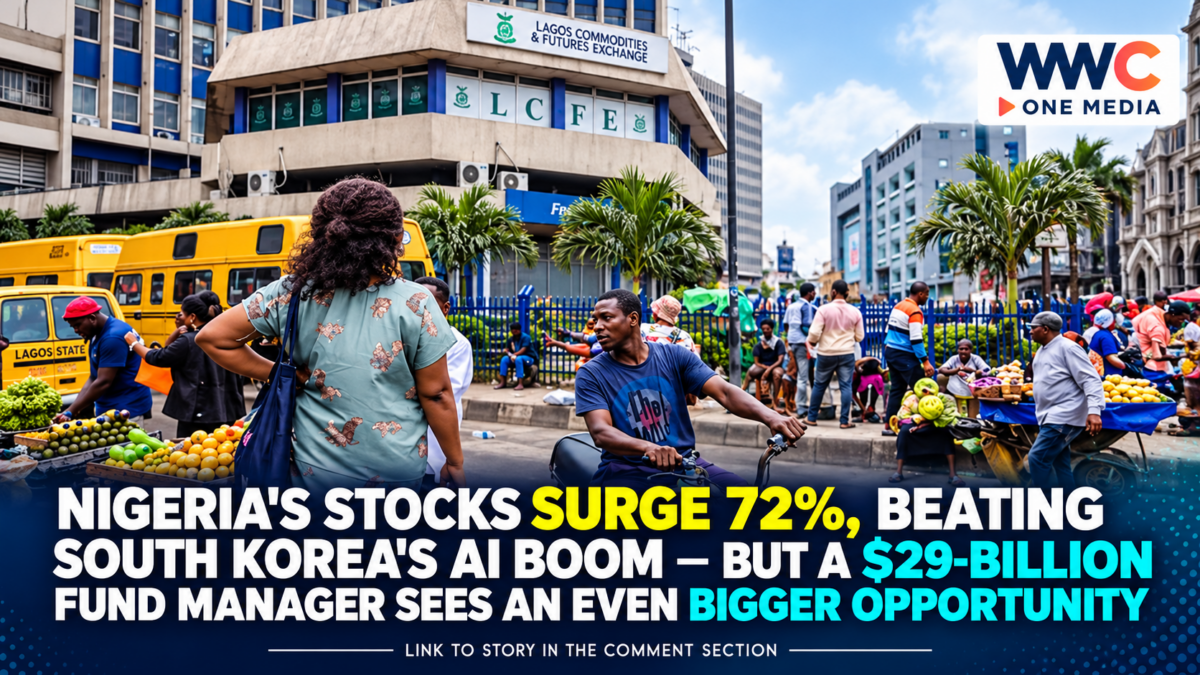
JOHANNESBURG / LAGOS / SEOUL — October 14, 2026 — Nigeria’s stock market is emerging as one of the world’s most surprising investment success stories, outperforming South Korea’s technology-driven rally and attracting attention from a major South African investment firm managing approximately $29 billion in assets.
Cape Town-based Allan Gray Ltd. is favoring Nigerian equities over South Korean stocks, arguing that Africa’s largest crude oil producer offers an alternative to the artificial intelligence investment frenzy dominating markets from Wall Street to Asia.
The investment preference comes after Nigeria’s benchmark stock index surged approximately 72% in US dollar terms in 2026, compared with a 54% advance in South Korea’s Kospi Index, according to Bloomberg data reported on October 14.
That performance has thrust Nigeria into the global investment spotlight, challenging the assumption that the biggest stock market opportunities must come from US technology companies or Asia’s semiconductor giants.
But behind the remarkable rally lies a more complicated question: Can Nigeria sustain its market momentum while foreign-exchange risks, limited liquidity and expensive valuations threaten emerging-market investors?
A $29-Billion Investment Manager Makes a Surprising Market Call
Allan Gray Ltd., one of South Africa’s prominent investment management companies, has identified Nigerian stocks as an attractive way to diversify away from the global AI trade.
The firm’s portfolio manager Kamal Govan, who oversees its approximately $604-million Africa ex SA Equity Fund, highlighted Nigeria’s increasingly competitive performance against South Korea.
The fund has gained around 28% this year, while Nigerian equities account for nearly one-third of its holdings.
That significant allocation reflects confidence in the Nigerian market’s underlying investment opportunities.
However, the preference should not be interpreted as Allan Gray shifting all $29 billion of its assets into Nigeria.
The $29-billion figure represents the firm’s broader assets under management, while the Nigerian positions described in Bloomberg’s report relate to its Africa-focused investment strategy.
Nigeria’s 72% Rally Challenges South Korea’s AI-Driven Market
South Korea has become one of the world’s most closely watched stock markets because of its exposure to artificial intelligence and advanced semiconductor manufacturing.
Its flagship technology companies, Samsung Electronics and SK Hynix, are major suppliers of memory chips used in AI-related computing infrastructure.
Demand for advanced semiconductors has helped support South Korea’s equity market.
But investors have also become increasingly concerned about the concentration of market gains among a relatively small number of technology companies.
According to Govan, the Kospi’s rally has been heavily influenced by Samsung Electronics and SK Hynix, which collectively represent nearly half of the index.
Nigeria’s advance, by contrast, has been supported by a wider range of businesses.
Its strongest sectors include banking, oil and gas, telecommunications and industrial goods.
This broader participation is a major reason Allan Gray sees Nigeria as an alternative to markets dominated by the AI investment theme.
However, broader sector participation does not automatically guarantee lower risk, particularly in a market exposed to currency volatility and commodity prices.
Nigerian Energy and Banking Stocks Deliver Extraordinary Gains
Some Nigerian companies have recorded particularly strong performances in 2026.
Seplat Energy, one of Allan Gray’s important oil and gas exposures, has risen approximately 197% in dollar terms this year, according to Bloomberg.
The company has benefited from investor interest in Nigeria’s petroleum sector and the wider search for energy-related investment opportunities.
Financial stocks have also produced exceptional returns.
Sterling Financial Holdings has recorded a gain of approximately 1,078% over the same period, making it one of the Nigerian market’s standout performers.
Such extraordinary gains have helped attract attention from institutional investors searching for opportunities beyond the world’s most heavily traded equity markets.
Nevertheless, rapid stock price appreciation can also increase the risk of sharp corrections.
Investors entering after substantial rallies may face much higher valuations than those who purchased shares before the market advanced.
Nigeria’s Stock Market Recovery Gains International Recognition
Nigeria’s investment outlook received another boost after FTSE Russell restored the country to frontier-market status in September.
The decision marked an important development for a market previously downgraded to unclassified status following concerns about foreign-exchange accessibility and investors’ ability to transfer capital out of the country.
Frontier-market classification can influence how some international investment funds assess and access a country’s equities.
The change could eventually support foreign investor participation and improve trading liquidity.
However, index classification alone does not guarantee an immediate influx of international capital.
Portfolio managers still need to evaluate trading conditions, currency convertibility, settlement procedures and company valuations.
Nigeria’s long-term success will depend partly on whether market reforms make it easier for foreign investors to enter and exit positions efficiently.
Reuters Warns That Africa Still Faces a Major Liquidity Problem
Nigeria’s spectacular market performance comes alongside a broader improvement in African financial markets.
Reuters reported on October 14 that the 2026 Africa Financial Markets Index, produced by Absa Bank and the Official Monetary and Financial Institutions Forum, showed progress across much of the continent.
Of the 29 African countries assessed, 21 recorded improved scores.
The study highlighted progress in inflation control, foreign-exchange reserves and regulatory reforms.
However, it also identified limited trading liquidity as a persistent obstacle to developing stronger capital markets.
South Africa retained its position as the continent’s highest-ranked financial market, followed by Mauritius and Namibia.
Nigeria, despite its exceptional stock rally, fell two positions to eighth place because of weaker scores for foreign-exchange access and transparency.
This highlights an important distinction.
A stock market can deliver outstanding investment returns while still facing structural weaknesses that discourage international investors.
For Nigeria, addressing those weaknesses could become essential if the country wants to transform its market rally into a sustainable increase in foreign investment.
Foreign Investors Have Not Fully Joined Nigeria’s Boom
An earlier Bloomberg report, published in July, found that international investors had largely missed Nigeria’s powerful equity rally.
Foreign investors accounted for approximately 12% of Nigerian stock market transactions during the first half of 2026, down from 27% over the same period in 2025.
Domestic investor participation increased to approximately 88%.
One reason was the attractiveness of Nigerian fixed-income investments, with some short-term debt instruments offering yields near 20%.
Foreign investors also remained cautious about settlement requirements and currency-related risks.
This creates an unusual situation in which a market generates exceptional returns while many overseas investors remain relatively underexposed.
If greater confidence in market infrastructure and currency stability encourages international investment, demand for Nigerian equities could increase.
But significant inflows are not assured.
South Korea’s AI Stocks Face Rising Volatility
South Korea remains a major beneficiary of the global semiconductor industry, but the sector has experienced increased volatility.
Reuters reported on October 13 that AI-related semiconductor stocks had suffered a sharp selloff as investors questioned whether enormous infrastructure spending would deliver sufficiently strong financial returns.
The Kospi declined more than 6% during that session, according to the report.
Yet South Korean stocks rebounded on October 14, demonstrating how quickly sentiment can change.
The recovery was supported by renewed buying in semiconductor companies and broader Asian equities.
These developments do not establish that South Korea’s technology boom has ended.
Rather, they demonstrate why investors are increasingly interested in countries and industries less directly exposed to the same AI-related risks.
Nigeria offers a different combination of banking, telecommunications, industrial and energy exposure.
Why Nigeria’s Rise Matters to Asian and Philippine Investors
The contrast between Nigeria and South Korea provides an important lesson for investors throughout Asia.
South Korea’s leading companies are central to global technology supply chains, while Nigeria offers exposure to different economic drivers.
Many international equity portfolios and emerging-market funds have significant positions in Asian technology businesses.
This can create concentration risk when the same semiconductor and AI-related stocks dominate multiple investment products.
Diversification into other regions may help reduce dependence on a single investment theme.
However, Nigerian equities bring their own challenges, including the naira’s exchange-rate movements, limited stock market liquidity and country-specific economic risks.
For Philippine investors, gaining exposure to frontier markets can also involve higher transaction costs, restricted product availability and foreign-currency considerations.
Investors should therefore distinguish between a market’s headline percentage gain and the actual return they could realize after currency movements, expenses and taxes.
Five Factors That Could Determine Nigeria’s Next Market Move
1. Foreign investor participation: Whether international fund managers begin increasing their allocations after years of limited involvement.
2. Currency stability: Whether the Nigerian naira remains sufficiently stable to protect foreign investors’ dollar-denominated returns.
3. Corporate earnings: Whether banking, telecommunications, industrial and energy companies can sustain the profit growth supporting their valuations.
4. Market liquidity: Whether continued reforms make Nigerian equities easier to trade and foreign capital easier to repatriate.
5. Global investment rotation: Whether investors move away from concentrated AI-linked equity exposure and toward less correlated markets.
These developments will help determine whether Nigeria’s exceptional 2026 performance represents a lasting shift in investor interest or a rally vulnerable to a sharp correction.
The Bigger Picture: Could Africa Challenge Asia’s Stock Market Dominance?
Nigeria’s rise is challenging a long-standing perception of where global investment opportunities are found.
For years, the strongest emerging-market narratives have centered on China’s manufacturing base, India’s economic expansion, Taiwan’s semiconductor industry and South Korea’s technology giants.
Nigeria’s 2026 rally illustrates how markets outside those established investment centers can occasionally produce extraordinary returns.
But its rise should not be mistaken for proof that Nigerian stocks will consistently outperform Asian equities.
The country’s long-term appeal will depend on reforms, corporate profitability, market access and confidence in its currency.
Allan Gray’s preference is ultimately a reminder that investment opportunities are not confined to the countries dominating today’s financial headlines.
Nigeria has already beaten South Korea’s AI-powered stock rally in 2026 — but the bigger question is whether Africa’s rising market can attract lasting global investment without surrendering its extraordinary gains to volatility, currency pressure and profit-taking.