WASHINGTON / ALASKA — U.S. President Donald Trump has announced presidential pardons for two Alaska mechanics involved in violations of federal vehicle emissions laws, reigniting a debate over environmental regulations, diesel engine modifications and the future of America’s Clean Air Act enforcement.
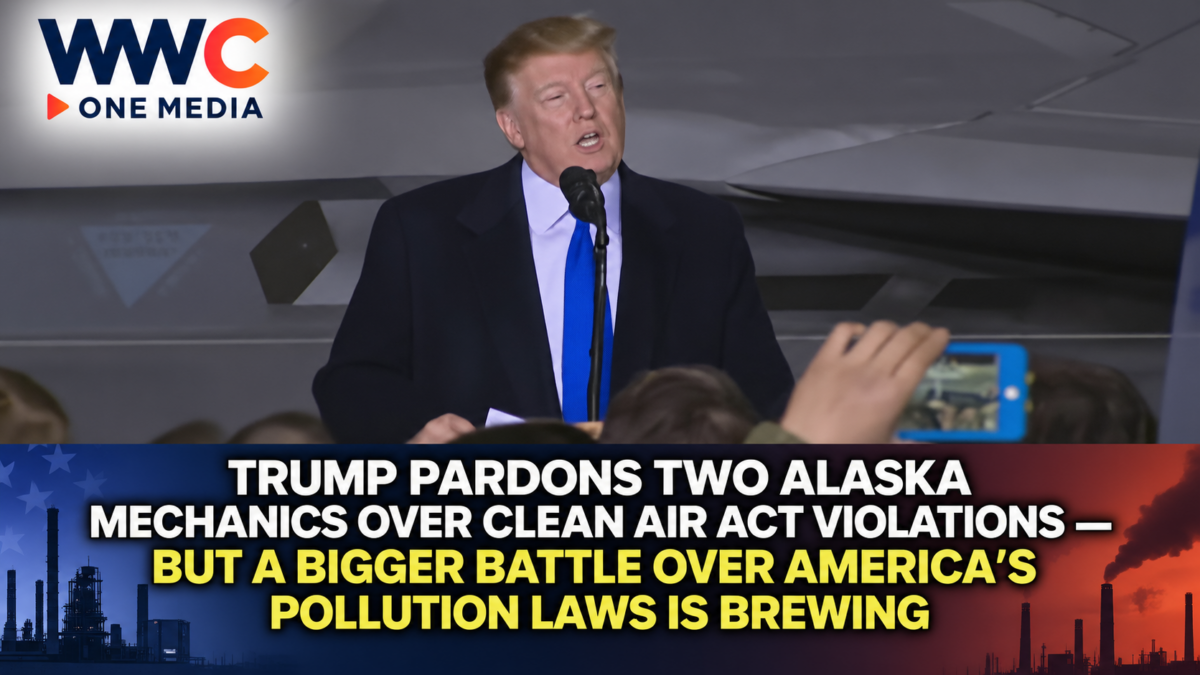
The pardons, announced during a Republican campaign rally in Wasilla, Alaska, on October 13, 2026, involved Zachary Czubac and Patrick Fleming, according to Just the News.
Trump portrayed the cases as examples of excessive federal intervention against people working to keep vehicles operating in difficult conditions.
But the decision raises a bigger question: Could presidential pardons for emissions violations weaken the federal government’s ability to enforce America’s pollution laws?
Trump Turns Alaska Rally Into Presidential Pardon Announcement
Trump announced the clemency decisions during his visit to Wasilla, where he campaigned for Republican Senator Dan Sullivan ahead of the November midterm elections.
The president criticized federal regulations affecting diesel engine modifications, arguing that enforcement actions had unfairly punished individuals trying to keep vehicles operational.
The issue carries particular significance in Alaska, where freezing temperatures, long transportation routes and limited access to specialized repair facilities can create substantial challenges for commercial vehicle operators.
Supporters of regulatory changes argue that complicated diesel emissions systems can be expensive to maintain and may contribute to vehicle downtime.
However, environmental regulators warn that disabling required pollution-control equipment can increase harmful emissions and threaten public health.
Why Diesel Emissions Rules Are at the Center of the Controversy
The Clean Air Act is one of America’s principal environmental laws, establishing requirements to reduce pollution from vehicles, factories and other sources.
Modern diesel engines use technologies including diesel particulate filters, exhaust gas recirculation systems and selective catalytic reduction equipment.
These systems are designed to reduce nitrogen oxides and particulate matter associated with respiratory and cardiovascular problems.
Some vehicle operators modify engines by removing or bypassing pollution-control systems, a practice commonly known as a “diesel delete.”
Although these modifications may reduce certain maintenance expenses, tampering with federally required emissions controls can violate US environmental law.
The debate now centers on how to balance operational reliability and business costs with air quality and public-health protections.
Trump Has Previously Pardoned Clean Air Act Violators
The latest announcement follows similar presidential clemency decisions earlier in 2026.
In July, Trump granted pardons to several individuals whose federal offenses involved vehicle emissions controls, including the sale or installation of equipment designed to bypass pollution systems.
CBS News and the Associated Press reported that some beneficiaries were diesel mechanics and business operators.
Trump presented the cases as examples of excessive regulatory enforcement, while environmental advocates argued that disabling pollution-control equipment can produce significant public-health consequences.
The Department of Justice’s presidential clemency records also document earlier pardons involving Clean Air Act offenses.
These actions have increased attention on how Trump’s administration intends to approach environmental enforcement.
EPA Warns Diesel Emissions Tampering Can Have Serious Consequences
Research by the US Environmental Protection Agency has highlighted the potential environmental damage caused by illegal emissions-control modifications.
An EPA assessment of known aftermarket defeat-device sales involving certain diesel trucks between 2009 and 2020 estimated that the modifications could produce more than 570,000 tons of excess nitrogen oxides and over 5,000 tons of excess particulate matter across the affected vehicles’ lifetimes.
Those estimates concern the broader defeat-device market, not the two Alaska mechanics specifically.
Nitrogen oxides and fine particulate pollution are linked to respiratory illnesses, cardiovascular problems and deteriorating air quality.
Environmental advocates argue that consistent enforcement is necessary to prevent businesses from gaining an unfair advantage by ignoring federal pollution standards.
Meanwhile, supporters of regulatory reform say policymakers should consider the financial and mechanical difficulties faced by vehicle owners, particularly in remote communities.
Alaska Senate Race Adds Political Significance
The timing of Trump’s pardon announcement is politically important.
Trump visited Alaska as Republicans worked to defend Senator Dan Sullivan’s seat against Democratic challenger Mary Peltola.
With the November midterm elections approaching, economic concerns, federal regulations and energy policy have become important campaign issues.
Alaska has traditionally favored Republican presidential candidates, although its voters have also supported politicians with independent political identities.
By announcing the pardons during a campaign rally, Trump connected his broader deregulatory agenda with local concerns about vehicle maintenance, transportation costs and federal government intervention.
However, presidential pardons do not eliminate the Clean Air Act or automatically authorize activities prohibited under existing federal regulations.
A Bigger Debate Over Presidential Clemency
Trump’s decision also comes amid broader scrutiny of presidential pardon powers.
An October 13 Reuters investigation examined his administration’s clemency decisions involving public officials, highlighting questions surrounding political influence, accountability and the traditional review process.
The investigation covered a wider set of cases and does not establish wrongdoing in the Alaska pardons.
Nevertheless, the latest decisions have renewed discussion about whether presidential clemency should be used to address regulatory enforcement disputes.
Supporters argue that presidents have constitutional authority to correct excessive punishments.
Critics warn that repeated pardons for regulatory offenses could weaken deterrence and create uncertainty about the consequences of violating federal laws.
What Happens Next?
The immediate beneficiaries of Trump’s announcement are the two Alaska mechanics, subject to the precise legal terms of their pardons.
But the longer-term implications could extend well beyond Alaska.
The administration could pursue additional changes to federal emissions enforcement, aftermarket vehicle modification rules and environmental regulatory policy.
The central challenge will be balancing the operational needs of vehicle owners and businesses against the government’s responsibility to protect public health.
For America’s diesel industry, the controversy concerns repair expenses, equipment reliability and regulatory compliance.
For environmental authorities, it raises questions about the continued effectiveness of pollution safeguards.
Trump’s pardons may have resolved two individual cases, but the larger battle over America’s diesel emissions rules and environmental enforcement is far from over.