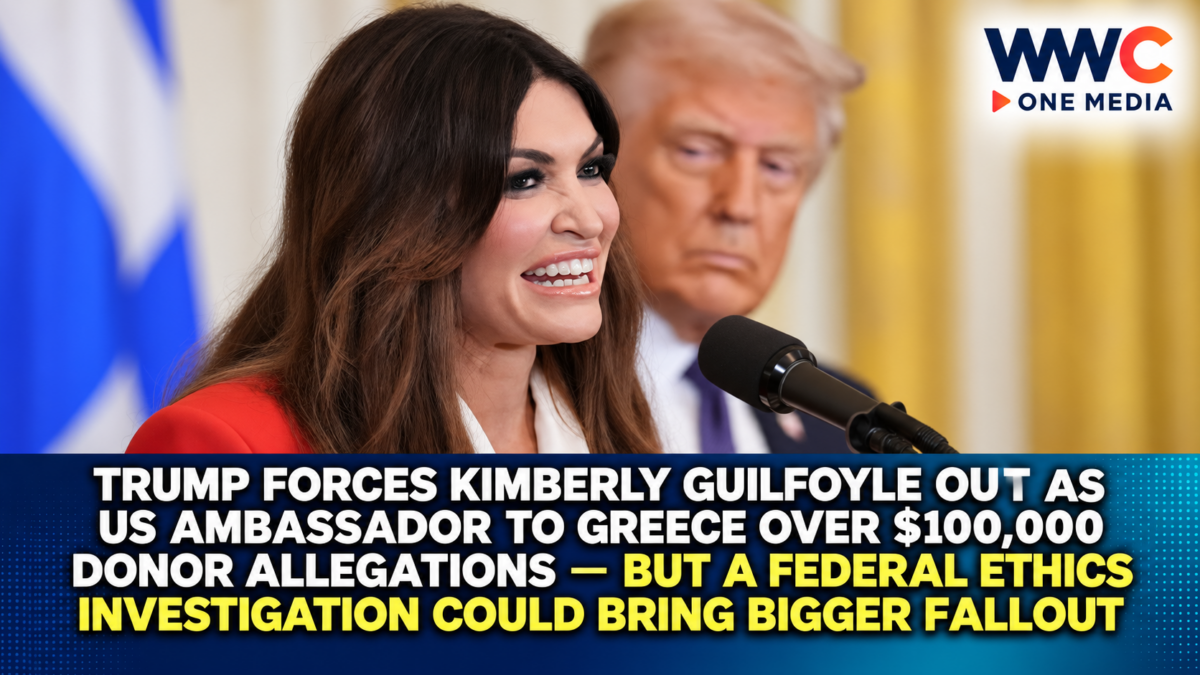
WASHINGTON / ATHENS — October 14, 2026 — President Donald Trump has forced Kimberly Guilfoyle out of her position as US ambassador to Greece following allegations that she sought personal financial benefits from political donors and business figures while offering access to powerful officials.
The development marks a dramatic reversal for Guilfoyle, a former Fox News personality, California prosecutor and prominent Trump political ally who was once engaged to the president’s eldest son, Donald Trump Jr.
On October 12, Bloomberg reported that Trump was considering dismissing Guilfoyle after a series of Wall Street Journal investigations raised questions about her conduct.
Asked whether he was contemplating her removal, Trump acknowledged that his administration was reviewing the situation.
By October 13, the White House had asked Guilfoyle to resign, and she publicly confirmed her departure.
The allegations include a reported request that longtime Trump supporter Eric Deters pay a $100,000 American Express bill shortly before Guilfoyle’s Senate confirmation hearing in 2025.
Other reports raised questions about luxury travel, gifts and whether she offered to use political connections to advance private interests.
Guilfoyle has strongly denied wrongdoing.
Her attorneys maintain that the disputed money related to unpaid speaking engagements and appearances, while her private travel complied with State Department guidance.
The controversy has also prompted scrutiny by the State Department’s inspector general and demands from congressional Democrats for an investigation.
Trump has already removed one of his most prominent political allies from a sensitive diplomatic post. But the bigger question is whether her resignation will end the controversy — or whether investigators will uncover wider problems involving money, influence and America’s diplomatic relationships.
Trump Says He Was Unhappy With Reports About Guilfoyle
The controversy escalated on Monday, October 12.
Speaking to journalists before departing for an Ohio campaign event, Trump was asked whether he would remove Guilfoyle from her position.
He confirmed that the matter was under consideration and expressed dissatisfaction.
His comments followed several reports in The Wall Street Journal alleging questionable dealings involving political donors and private businesses.
The remarks represented a notable change in the administration’s public approach.
Earlier, Secretary of State Marco Rubio had defended Guilfoyle’s performance and questioned whether the allegations were accurate.
But the growing volume of reporting increased the pressure on senior administration officials.
At that stage, Trump had not announced a dismissal.
That changed the following day.
White House Confirms Guilfoyle Was Asked to Resign
On Tuesday, October 13, White House press secretary Katie Zacharia confirmed that the administration had requested Guilfoyle’s resignation.
The White House thanked her for her service despite the circumstances of her departure.
Within approximately two hours, Guilfoyle announced that she was leaving the position.
Trump subsequently told reporters that he had not personally discussed the matter with her but had been dissatisfied with the allegations he had read.
The sequence is important.
Bloomberg’s original October 12 article concerned a potential dismissal.
By October 13, the requested resignation had become a confirmed development.
A report published on October 14 should therefore lead with Guilfoyle’s departure rather than suggest she remains in office awaiting a decision.
The $100,000 American Express Allegation
The central allegation involves Eric Deters, a Republican donor, lawyer and former congressional candidate.
According to The Wall Street Journal and subsequent reporting by CBS News and The New York Times, Deters alleged that Guilfoyle asked him to transfer $100,000 to help pay an American Express credit-card bill.
The alleged request came before her Senate confirmation hearing in July 2025.
Deters also alleged that Guilfoyle offered to assist him by using her connections within the Trump administration.
Messages reported by news organizations raised additional questions about whether she wanted the financial discussions kept private.
However, the existence of reported messages and a donor’s accusations does not by itself prove bribery or another criminal offense.
Guilfoyle’s lawyers dispute the allegations.
They maintain that money she sought from the donor represented compensation for previous speaking engagements and public appearances.
That explanation is materially different from an allegation that payment was requested in exchange for official influence.
Establishing what occurred would require examination of the underlying communications, financial records and relevant legal obligations.
Did Deters Actually Pay the $100,000?
This distinction is essential.
The reporting establishes that Deters alleged Guilfoyle requested the payment.
It does not establish that the entire $100,000 was actually transferred to her American Express account.
According to the Wall Street Journal’s account, Deters declined the request.
Therefore, the story should not claim that Guilfoyle received a proven $100,000 payoff.
A request for money, a completed payment and an exchange of official favors are different factual and legal questions.
Investigators would need evidence to establish whether any relevant transaction violated applicable laws or ethics rules.
Other Allegations Involve Gifts and Luxury Travel
The dispute goes beyond the credit-card allegation.
The Wall Street Journal also published reports concerning Guilfoyle’s relationships with business executives in Greece.
Those reports described allegations involving luxury travel, hospitality and the promotion of private business interests.
One account raised questions about her relationship with a Greek construction and energy company and whether a lobbyist associated with that business gained access to diplomatic activities.
Another alleged that Guilfoyle made statements concerning the influence of the United States over Greek political affairs.
Such allegations, if substantiated, could raise serious questions about diplomatic ethics and conflicts of interest.
But reporting about alleged conduct is not a judicial finding.
Guilfoyle’s attorneys have said she sought and followed State Department guidance concerning private travel.
The legal significance of any gifts, transportation or hospitality would depend on the circumstances, applicable regulations and evidence of any related official action.
Guilfoyle Denies Wrongdoing and Vows to Defend Her Reputation
Guilfoyle has rejected the allegations.
Following the White House request for her resignation, she published a statement describing them as false.
She said she intended to defend her name and reputation.
Her lawyers, David Schwartz and Jesse Binnall, have also disputed claims of misconduct.
They say the disputed financial request concerned legitimate unpaid compensation for work that predated her ambassadorship.
On private flights and travel, they maintain that she followed official guidance.
These denials are an essential part of the story.
The White House’s decision to seek her resignation is confirmed, but it is not equivalent to a criminal conviction or a final determination that the allegations are true.
State Department Watchdog Reviews Allegations
The controversy has attracted attention from the State Department’s Office of Inspector General.
According to the Associated Press, a US official said the watchdog was examining the allegations.
Other outlets reported that an investigation had been opened.
However, AP noted that its source could not confirm whether a formal inspector general investigation had begun, rather than an initial inquiry.
The distinction matters because government watchdogs can review complaints before deciding whether a full investigation is warranted.
An inquiry may result in further investigation, disciplinary recommendations or no action.
As of October 14, the reporting reviewed does not establish that Guilfoyle has been charged with a federal crime or found responsible for a specific ethics violation.
Democrats Demand Answers About Diplomatic Conduct
Congressional Democrats have called for further scrutiny.
Representative Gregory Meeks, the senior Democrat on the House Foreign Affairs Committee, and Senator Jeanne Shaheen, the senior Democrat on the Senate Foreign Relations Committee, have expressed concern.
Representative Robert Garcia, a leading Democrat on the House Oversight and Government Reform Committee, has also called for investigation.
Their concerns center on whether official diplomatic authority was used improperly and whether any private benefits influenced government conduct.
Congressional oversight could lead to requests for records, testimony or additional disclosures.
However, the scope and outcome of any future congressional proceedings remain uncertain.
The requests for investigation should not be reported as findings of guilt.
Why Guilfoyle’s Trump Family Connections Matter
Guilfoyle has been a prominent figure in Republican politics.
She previously worked as a prosecutor in California and later became a television commentator.
She was also engaged to Donald Trump Jr., placing her within the president’s extended political and personal circle.
Trump nominated her as ambassador to Greece in December 2024.
Her appointment drew attention because of her political profile and close relationships within the administration.
The scandal therefore carries an additional political dimension.
It raises questions about how senior diplomatic appointees are selected, vetted and supervised.
However, personal or political connections alone do not prove misconduct.
The issue is whether an ambassador fulfilled official responsibilities while complying with applicable ethical standards.
Marco Rubio Faces Questions Over His Earlier Support
Secretary of State Marco Rubio has also faced scrutiny over the administration’s handling of the controversy.
During a recent visit to Greece, Rubio defended Guilfoyle’s diplomatic work and challenged journalists who asked about the allegations.
He emphasized that reported accusations should not automatically be treated as proven facts.
That distinction remains valid.
However, further reporting increased pressure on the administration to assess the allegations and decide whether she should remain in office.
The eventual resignation demonstrated that the White House had lost confidence in her ability to continue in the role.
The reporting does not establish that Rubio personally made the final removal decision.
Why Greece Is a Strategically Important Diplomatic Post
Greece is an important US partner in southeastern Europe.
Its geographic position makes it significant for NATO security, regional trade and energy infrastructure.
The country has become particularly important as Washington seeks to expand American liquefied natural gas exports into European markets.
Greece’s ports, pipelines and energy facilities can support the movement of natural gas into the Balkans and neighboring countries.
Guilfoyle had emphasized energy cooperation during her tenure.
She participated in events involving US and Greek energy executives and officials.
That makes allegations concerning her relationships with industry figures especially sensitive.
However, the accusations do not establish that a particular energy agreement was improperly awarded or that all US-Greek energy cooperation is compromised.
Any such claim would require transaction-specific evidence.
Greek Politicians Demand Accountability
The controversy also generated criticism in Greece.
Opposition politicians questioned whether the allegations could undermine the country’s diplomatic dignity.
Some called for the Greek Foreign Ministry to seek an explanation.
Former deputy foreign minister Sia Anagnostopoulou described the matter as an issue of national dignity during parliamentary discussions.
Greek Foreign Minister Giorgos Gerapetritis responded that Guilfoyle had been treated according to the same diplomatic standards applied to other ambassadors.
The debate reflects the sensitivity of allegations involving foreign representatives.
An ambassador is expected to advance relations between governments, not create doubts about whether personal financial interests influence official decisions.
However, the Greek government’s response should not be portrayed as a formal finding that Guilfoyle broke the law.
Could the Resignation End the Controversy?
Removing an ambassador can resolve an immediate personnel problem.
It does not necessarily resolve questions about past conduct.
If watchdogs or lawmakers decide that further investigation is warranted, requests for documents or testimony could continue after Guilfoyle’s departure.
Possible areas of scrutiny include financial transactions, reported communications with donors and compliance with travel or gift regulations.
The available evidence does not establish whether additional government action will follow.
It would therefore be speculative to predict an indictment, a criminal trial or a particular legal penalty.
The confirmed outcome is her resignation.
Any further legal consequences remain uncertain.
What Happens Next?
The main developments to monitor are the status of the State Department watchdog’s inquiry, potential congressional oversight and any further release of documentary evidence.
The White House will also need to determine how to fill the ambassadorial vacancy and maintain diplomatic continuity with Greece.
A future nominee would ordinarily face the applicable appointment and confirmation process.
For Washington and Athens, the priority will be ensuring that bilateral cooperation continues despite the leadership controversy.
For Guilfoyle, the next stage may involve efforts to rebut the allegations and defend her professional reputation.
The Bigger Question: Will Trump’s Decision End the Scandal or Open a Wider Investigation?
Kimberly Guilfoyle’s departure represents a significant political setback for one of Trump’s most recognizable allies.
Just one day after the president said he was unhappy with reports about her conduct, the White House requested her resignation.
The allegations involve potentially serious questions about money, access, gifts and diplomatic responsibilities.
But their factual and legal significance has not yet been conclusively determined.
Guilfoyle denies wrongdoing and says she intends to defend herself.
Meanwhile, the State Department’s watchdog and members of Congress are examining whether additional scrutiny is necessary.
The case illustrates a broader challenge for any administration: maintaining public confidence that senior officials exercise authority in the public interest.
Trump has already acted to remove Guilfoyle from her diplomatic post. But the bigger test may come after her departure: Will the allegations end as a political embarrassment, or could further evidence trigger a deeper examination of influence, money and accountability inside America’s diplomatic system?